
Spain’s Madrid–Barajas Airport Goes Next-Level in 2026 with Iberia and Air Europa: Massive Terminal Upgrades, High-Speed Rail, and Carbon-Neutral Breakthrough

Published
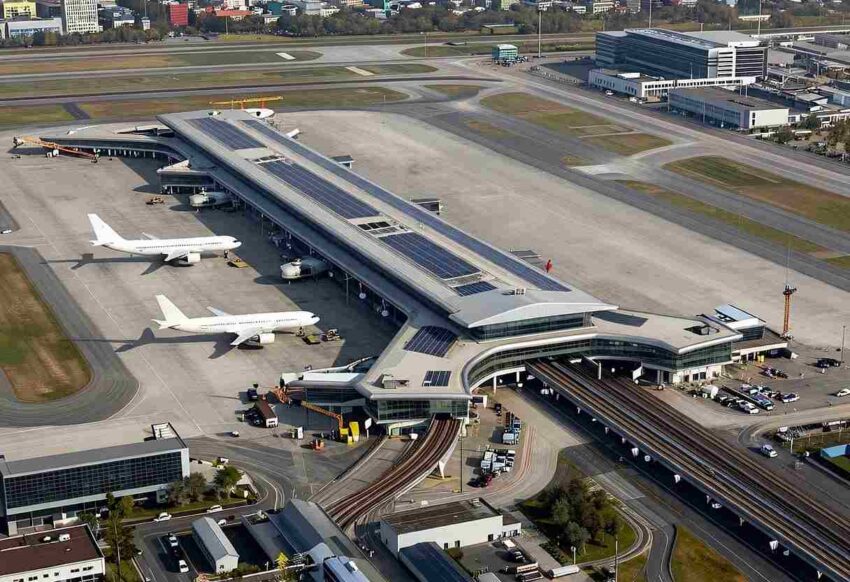
Image generated with Ai
In 2026, Adolfo Suárez Madrid–Barajas Airport (MAD) represents a focal point of Spain’s aviation development, combining infrastructure expansion, cutting-edge technology, and strategic regulatory alignment. As Spain’s primary gateway connecting Europe with Latin America, the airport operates under intense capital investment pressures outlined in the Aena Strategic Plan 2022–2026. Passenger throughput is projected at 310 to 326 million across the Aena network, reflecting both organic growth and the upcoming transition to the Third Airport Regulation Document (DORA III) covering 2027–2031.
The 2026 period marks a crucial juncture, balancing the completion of DORA II objectives with the procedural preparations required for DORA III approval. Capital expenditure is targeted at improving safety, operational efficiency, and passenger experience while supporting long-term growth objectives. This strategic alignment ensures Madrid–Barajas remains competitive as a major European hub.
Advertisement
Advertisement
DORA II to DORA III Regulatory Shift
The regulatory environment shapes both the operational and financial planning at Madrid–Barajas. DORA II, active since 2022, laid the foundation for post-pandemic recovery, prioritizing sustainability, innovation, and restoration of traffic volumes. By 2026, the airport has exceeded network-wide targets, achieving the 300 million passenger milestone ahead of schedule.
The upcoming DORA III framework is poised to scale regulated investment dramatically. In early 2026, Aena’s Board approved a €9.991 billion investment plan across the Spanish airport network. These funds are earmarked for capacity upgrades, safety, quality enhancements, and maintenance projects over the next five years. For Madrid–Barajas, the procedural completion of DORA III requires presentation to the Airport Coordination Committees and submission to the Directorate General of Civil Aviation (DGAC) for Council approval by September 30, 2026.
Advertisement
Advertisement
Financial Structure and Revenue Models in 2026
Financial planning for 2026 centres on the Maximum Annual Revenue per Passenger (IMAP). The IMAP for the fiscal year is set at €10.52 per passenger, with an Adjusted Maximum Annual Revenue per Passenger (IMAAJ) of €11.02. These figures reflect careful calibration to maintain competitive airport charges while ensuring adequate revenue to service debt and fund DORA III initiatives.
Financial and Traffic Metrics for 2026
| Metric | 2026 Value | Source |
|---|---|---|
| Maximum Annual Revenue per Passenger (IMAP) | €10.52 | 3 |
| Adjusted Maximum Annual Revenue per Passenger (IMAAJ) | €11.02–€11.03 | 3 |
| Projected Network Passenger Volume | ~310 Million | 1 |
| Estimated Network Passenger Growth | +1.3% vs 2025 | 3 |
| Consolidated EBITDA Margin Goal | ~59% | 1 |
| International Contribution to Group EBITDA | 15% | 1 |
| Shareholder Pay-out Ratio | 80% | 1 |
Aena’s financial resilience is strengthened by international operations contributing 15% of total Group EBITDA, while deleveraging trends anticipate a reduced net debt-to-EBITDA ratio. These factors, combined with NextGenerationEU funding, ensure sufficient capital for infrastructure expansion.
Advertisement
Advertisement
Terminal Expansion and Physical Infrastructure Upgrades
To achieve the long-term capacity target of 90 million passengers per annum, Madrid–Barajas is undertaking extensive physical expansion. The focus in 2026 is twofold: modernizing T1, T2, and T3 terminals through the new processor building and continuing the phased expansion of Terminal 4 and its satellite T4S.
New Processor Building for Terminals 1–3
A central feature of 2026 is the new processor building located opposite T1–T3. This facility consolidates check-in, security, and baggage handling into a unified hub, addressing operational inefficiencies inherent in the fragmented older terminals. The consolidation ensures a smoother passenger flow and aligns T1–T3 service levels with the high standards of T4. Renovation of existing departure areas complements the processor building, integrating modern design and operational efficiency.

Image generated with Ai
Terminal 4 and T4S Expansion – Barajas Plan 2.0
T4, Madrid–Barajas’ flagship terminal, continues its expansion in 2026. Initial phases focus on extending security checkpoints to accommodate increased passenger volumes without interrupting daily operations. Remote aprons and platforms for T4S and T1–T3 are undergoing pavement renovation and the installation of energy-efficient lighting. These upgrades reinforce Madrid’s position as Europe’s primary hub for Latin American traffic and future-proof the airport for wide-body aircraft operations.
Integration of High-Speed Rail at Terminal 4
The 2026 opening of the high-speed rail (AVE) link at T4 represents a transformative milestone. Managed by Adif, the €63 million project includes a 3.5 km standard-gauge rail access integrating conventional commuter and high-speed services via a triple-track tunnel under the A-1 motorway.
Technical Highlights of the AVE Integration
- Mixed-gauge tunneling for simultaneous AVE and Cercanías operations
- Reinforced tunnel structure beneath A-1 motorway
- Standard-gauge track connection from Madrid Chamartín to airport
- Advanced signaling systems with ASFA train control for safe mixed-mode operations
The AVE extension allows long-distance passengers from Seville, Barcelona, and Valencia to access the airport directly, reducing reliance on domestic short-haul flights and freeing slots for high-value international services.
Advertisement
Advertisement
Strategic Route Expansion and Fleet Modernization
Madrid–Barajas has implemented aggressive route growth strategies in 2026, leveraging the Airbus A321XLR for long-haul “thin” routes. Iberia and Air Europa lead the expansion.
Iberia Key 2026 Routes
| Route | Start Date | Frequency | Aircraft |
|---|---|---|---|
| Madrid–Newark (EWR) | Mar 29 | Daily | A321XLR |
| Madrid–Monterrey (MTY) | Jun 2 | 3x weekly | A330-200 |
| Madrid–Fortaleza (FOR) | Jan 19 | 3–4x weekly | A321XLR |
| Madrid–Tokyo (NRT) | Ongoing | 3–4x weekly | A350-900 |
| Madrid–Recife (REC) | Jan 2026 | 3x weekly | A321XLR |
Air Europa Key 2026 Routes
| Route | Start Date | Frequency | Aircraft |
|---|---|---|---|
| Madrid–Johannesburg (JNB) | Jun 24 | 3x weekly | B787 |
| Madrid–Geneva (GVA) | Jun 19 | 2x daily | B737 |
| Madrid–Tangier (TNG) | Jun 2026 | 3x weekly | B737 |
| Madrid–Marrakech & Tunis | Jun 2026 | Resumption | Various |
These routes include North American, Latin American, African, and European expansions. The 2026 FIFA World Cup further amplifies demand, particularly for Mexican host cities such as Monterrey, requiring coordinated schedules and surge planning.
Operational Adjustments During Málaga Rail Outage
An extended AVE outage between Málaga and Madrid in spring 2026, due to weather-related damage near Álora, prompted emergency air services. Iberia and Air Europa increased daily flights to Málaga, underscoring Madrid–Barajas’ role as a resilient national transport hub. Elastic planning strategies, including surge-informed circulation modeling, prevented terminal congestion while security personnel deployment was intensified.
Digital Transformation and ENAIRE Innovations
Madrid–Barajas leads in technological innovation. Biometric boarding, remote driving of 129 boarding bridges, and automated security systems enhance operational efficiency. ENAIRE projects include:
- RAXUS: Automated drone integration and U-space operations
- SPARK: Performance assessment for European Digital Sky
- AEQUILIBRIUM: Optimizing latent airport capacity using algorithmic analysis
Predictive ATC memory systems provide non-binding recommendations based on real-time weather and traffic conditions, enhancing safety and efficiency.
Environmental and Sustainability Milestones
2026 marks Madrid–Barajas’ target year for significant carbon neutrality achievements. The Climate Action Plan invests €550 million by 2030, with immediate 2026 priorities:
Advertisement
Advertisement
- 82% reduction of Scope 1 and 2 emissions vs 2019
- Photovoltaic systems meeting 52% of electricity needs
- BREEAM Excellent certification for all new infrastructure
Remote boarding bridge operation and SAF adoption contribute to reduced fuel consumption, aligning with Europe’s low-carbon aviation goals.

Image generated with Ai
Environmental Metrics 2026
| Metric | Target / Status | Source |
|---|---|---|
| Carbon Neutrality | Target Year | 6 |
| Scope 1 & 2 Reduction | 82% vs 2019 | 37 |
| Net Zero Target | 2030 | 1 |
| ACA Certification | Level 4+ | 1 |
| Photovoltaic Power | 52% of connection needs | 6 |
Airport City Development and Revenue Diversification
Madrid–Barajas’ Airport City initiative diversifies Aena revenue streams through logistics and commercial real estate. By 2026, 25% of project areas have been awarded or developed.
Logistics Park Highlights
- First area awarded to P3 Group Sarl (€170 million investment)
- 28-hectare site in Corredor del Henares
- Joint venture structure: Aena 35% land contribution, 75-year lease, €52.5 million upfront
- 152,914 m² buildable area with state-of-the-art warehouses, offices, and support services
- Sustainability: green spaces, bicycle lanes, and photovoltaic roof power
Real estate revenue increased by over 34% vs 2019, reflecting effective asset commercialisation.
Enhancing Service Quality and Passenger Experience
Maintaining service levels amid construction and expansion is a core focus. Twenty-six DORA performance indicators monitor security wait times, terminal flow, and passenger satisfaction. Major tenders in duty-free, food & beverage, and specialty retail revitalized terminal experiences. Minimum Annual Guaranteed rents increased by 46% over 2019, with projected commercial revenue per passenger growth of 32% in 2026.
Advertisement
Advertisement
Conclusion: Madrid–Barajas as a Model Global Hub
By 2026, Adolfo Suárez Madrid–Barajas Airport has emerged as a model for sustainable, multimodal, and technologically advanced airport operations. High-speed rail integration at T4 extends its catchment to the entire Iberian Peninsula. DORA III investment planning secures funding for a decade of growth. Strategic route expansion, particularly using the Airbus A321XLR, strengthens Madrid’s role in Latin American, North American, African, and Asian markets. Carbon neutrality and Airport City diversification set global benchmarks in environmental responsibility and revenue strategy. Terminal expansions, technological modernization, and integrated multimodal planning ensure that Madrid–Barajas continues to be a pivotal driver of Spain’s economic and territorial development.
Advertisement
