Published on March 3, 2026

Image generated with Ai
A significant new initiative in Southern Thailand aims to address the delicate balance between high-volume global tourism and environmental integrity. The “Save Maya, Save Pakarang” project was recently launched at the Hat Noppharat Thara-Mu Ko Phi Phi National Park, signalling a watershed moment in the region’s environmental strategy. This ambitious project was launched through a collaborative effort between the public and private sectors led by the Andaman Natural Resources Conservation Foundation and a large network of environmental partners. Krabi Governor Angkoon Silathewakul presided over the official opening ceremony, which was attended by distinguished officials from the Protected Areas Regional Office 5 as well as Senate Extraordinary Commission representatives.
The preservation of natural heritage is often viewed as a singular task, but within this project, it is treated as a multi-dimensional responsibility. A comprehensive framework has been established to ensure that the long-term sustainability of the Andaman Sea is prioritized over short-term commercial gains. By involving government agencies, educational institutions, and civil society, a collective commitment to Krabi’s natural assets is being demonstrated. This synergy is intended to create a protective barrier around the region’s biodiversity while allowing for controlled, eco-conscious exploration by international travellers.
A core pillar of this initiative is the dissemination of knowledge regarding marine ecosystems. Educational and environmental activities were integrated into the launch to ensure that the message of conservation reaches beyond administrative circles. A specialized conservation forum was conducted, where panel discussions were led by national park directors and veteran environmental experts. During these sessions, the intricate needs of natural resource preservation were examined in detail. Furthermore, various learning stations were strategically positioned to engage local residents and the younger generation, ensuring that the principles of marine stewardship are instilled in those who will inherit these coastal landscapes.
The “Save Maya, Save Pakarang” project is deeply rooted in the fulfilment of Royal initiatives, which have long advocated for the restoration and conservation of Thailand’s marine resources. These high-level directives serve as the ethical compass for the project, aligning local actions with national priorities. By framing the restoration of the Andaman Sea as a matter of national heritage, a deeper sense of duty is fostered among all stakeholders involved. This alignment ensures that the work carried out in Krabi contributes to a broader vision of a resilient and ecologically thriving Thailand.
Advertisement
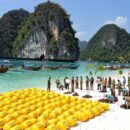
Following the formal proceedings, the focus was shifted to Maya Bay, a site globally recognized for its breathtaking limestone cliffs and turquoise waters. Here, direct action was taken to rehabilitate the shoreline and protect the underwater world. Coastal trees were planted along the beach to stabilize the shoreline ecosystem and prevent erosion, which is a significant threat to the bay’s aesthetic and biological health. These physical interventions are designed to restore the natural buffer zones that have been impacted by years of heavy foot traffic and climatic shifts.
One of the most critical technical aspects of the project involves the installation of mooring buoys within the protected waters. These buoys are utilized to organize maritime tourism and, more importantly, to prevent the devastating damage caused by boat anchors. In the past, sensitive coral reefs were frequently compromised by anchors being dropped directly onto living coral structures. Through the implementation of a structured mooring system, vessels are now provided with secure points of attachment that do not interfere with the seabed. This infrastructure is essential for the regeneration of “Pakarang” (coral), allowing the reef systems to recover in a controlled environment.
Advertisement
Advertisement
It is widely recognized that the economy of Krabi is inextricably linked to the health of its marine environment. Therefore, the “Save Maya, Save Pakarang” initiative is not merely an environmental project but also an economic safeguard. By promoting sustainable tourism practices, the longevity of the region’s appeal is secured. When coral reefs are protected and water quality is maintained, the value of the destination is heightened for eco-conscious travellers. This shift toward quality-based tourism over quantity-based tourism is viewed as the only viable path forward for the Andaman region.
The success of this initiative is heavily dependent on the continued cooperation between the public and private sectors. The participation of private businesses signifies a growing awareness that the exploitation of natural resources without reinvestment is a failing business model. Instead, a model of “circular responsibility” is being adopted, where the profits generated from tourism are funnelled back into the maintenance of the very environment that attracts visitors. This collaborative effort serves as a blueprint for other coastal destinations worldwide that are struggling with the pressures of over-tourism and climate change.
The “Save Maya, Save Pakarang” project will continue to prioritise monitoring and adaptation as it progresses through its next phases. Park authorities and environmental scientists will closely monitor the impact of the mooring buoys as well as the growth of newly planted coastal trees. The commitment demonstrated by Hat Noppharat Thara-Mu Ko Phi Phi National Park and its partners suggests that Krabi has entered a new era of environmental consciousness. Through these sustained efforts, future generations will be able to enjoy the natural beauty of Maya Bay and its surrounding waters, ensuring Thailand’s position as a global marine conservation leader.
Advertisement
Tags: Andaman Sea preservation, marine conservation Krabi, Maya Bay restoration, sustainable tourism Thailand


















Tuesday, March 3, 2026
Tuesday, March 3, 2026

Tuesday, March 3, 2026

Tuesday, March 3, 2026

Tuesday, March 3, 2026

Tuesday, March 3, 2026