
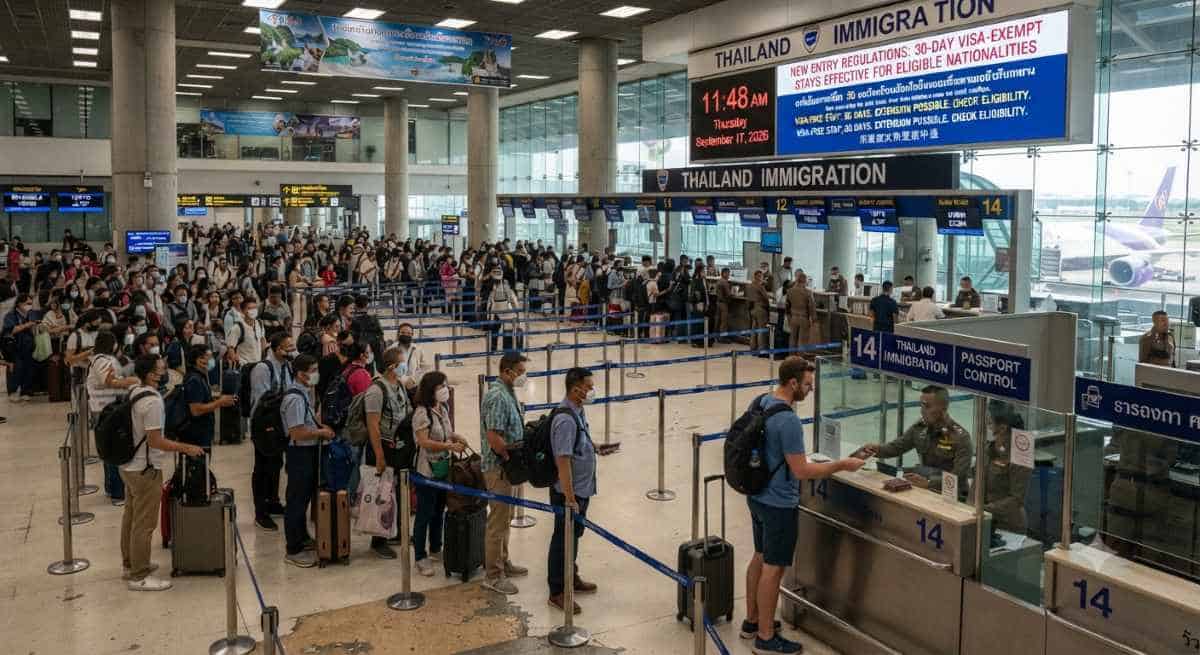
Image generated with Ai
The official announcement regarding the modification of entry regulations was published in the Royal Gazette, signaling a major structural pivot in the national immigration framework of the Southeast Asian nation. For an extended period, foreign visitors from a broad roster of global jurisdictions enjoyed a more expansive entry policy. However, regulatory authorities decided to overhaul these protocols to address administrative concerns and streamline border management.
The legal notices, endorsed through the Ministry of Interior, outline a structured transition period before full implementation. Administrative documents specify that the formal framework takes effect precisely fifteen days after publication, establishing September 15, 2026, as the definitive enforcement date. Consequently, any journeys initiated prior to this milestone remain governed by prior allowances, whereas subsequent arrivals must adhere strictly to the revised limitations.
International visitors accustomed to extended holiday itineraries will experience direct logistical adjustments as a consequence of this policy transition. Nationals originating from sixty designated countries and territories—including the United States, the United Kingdom, Canada, and Australia—will see their permitted duration of stay without prior consular authorization reduced from sixty days down to thirty days.
This adjustment effectively halves the initial allocation granted at immigration checkpoints for tourism purposes. Furthermore, specific stipulations have been enacted regarding land-border entries, where crossings are typically restricted to a maximum of twice per calendar year for select categories.
Advertisement
Advertisement
Tourists who crossed international borders prior to the mid-September deadline retain their originally sanctioned duration, ensuring that current holidaymakers are not abruptly penalized by retroactive enforcement. Additionally, alternative groups face distinct designations, such as a fifteen-day allocation for specific nationalities and narrowed Visa on Arrival provisions.
Economic stakeholders within the hospitality, travel, and aviation sectors have closely monitored these regulatory shifts. Tourism remains a foundational pillar of the national economy, prompting continuous balancing acts between encouraging high visitor volumes and safeguarding national security. Industry analysts suggest that shortening the permitted timeframe aims to mitigate potential abuses of standard tourist pathways by individuals engaging in unauthorized employment or unlawful operations.
While shorter durations might alter travel patterns for long-haul vacationers, tourism boards emphasize that the destination retains its core appeal. Travel agencies are actively adapting their itinerary planning offerings to align with the compressed thirty-day window, ensuring that clients are adequately informed about pre-travel preparation and potential procedural changes at ports of entry.
Navigating the updated immigration landscape requires careful planning by prospective visitors. Passport holders from the sixty eligible countries intending to remain in the country beyond the initial thirty-day period are not automatically required to obtain an advance visa from a diplomatic mission.
Instead, a formal mechanism permits travelers to request a single extension of up to an additional thirty days directly through authorized local immigration offices, subject to official evaluation and approval. Visitors are strongly advised to verify their exact nationality status under the updated schedules, monitor entry stamp dates closely, and ensure compliance with land-border crossing limitations. Keeping abreast of official updates published by consular departments helps prevent inadvertent overstays and ensures a seamless transit experience.
A clear divergence exists between the current regulatory environment and the preceding framework introduced in 2024, which permitted an extensive sixty-day stay for a broader array of over ninety countries and territories. Under the former system, travelers enjoyed greater flexibility for extended holiday planning without immediate administrative touchpoints. The newly instituted regime curtails this leniency by scaling back the general exemption list to sixty specific participants and capping the default stay at thirty days.
Moreover, historical provisions concerning Visa on Arrival mechanisms and separate bilateral agreements have been rigorously streamlined. Certain nations previously handled under alternative categories have been integrated into the thirty-day framework, while others have been shifted to distinct fifteen-day allowances or dedicated bilateral terms, marking a more centralized and tightly controlled border control strategy.
Advertisement
Tags: bangkok, immigration rules, policy, Restrictions, stay thailand
Advertisement
Advertisement













Saturday, September 5, 2026

Friday, September 4, 2026

Saturday, September 5, 2026

Saturday, September 5, 2026

Thursday, September 3, 2026

Wednesday, September 2, 2026

Saturday, September 5, 2026

Saturday, September 5, 2026


