
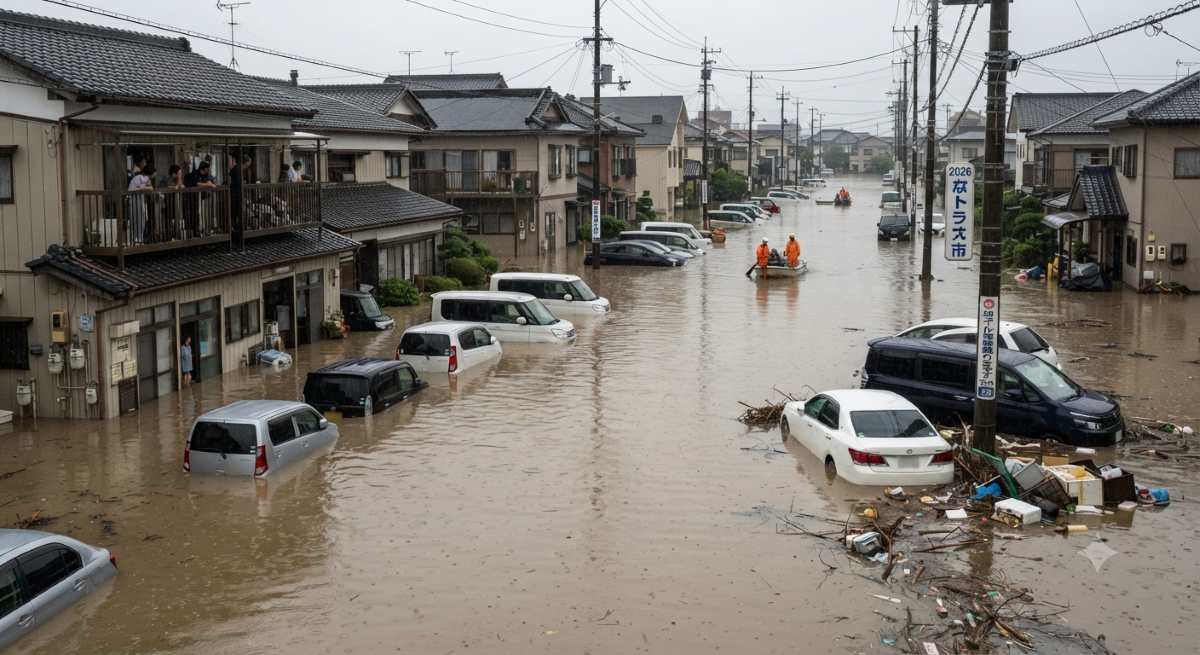
Image generated with Ai
The weather patterns across the archipelago of Japan have recently turned severe, prompting immense concern from regional disaster management authorities. During the early hours of Thursday, August 27, 2026, the Japan Meteorological Agency implemented its most critical emergency protocols across central sectors of the nation.
Continuous, violent downpours began pummelling the vulnerable Noto Peninsula area, driven by stationary linear precipitation zones that persistently formed over the region facing the Sea of Japan. Warm, humid air flowing northward from a Pacific high-pressure system collided with an active seasonal front, creating towering rain clouds that far exceeded standard seasonal forecasting models.
Advertisement
Municipalities including Himi City located within Toyama Prefecture, alongside Hakui City, Shika Town, Hodatsushimizu Town, and Nakanoto Town situated in Ishikawa Prefecture, experienced historic volumes of water accumulation. Within a brief six-hour window ending early Thursday morning, meteorological stations recorded an astonishing 211 millimeters of rainfall in Himi and 210 millimeters in Hakui. Over a twenty-four-hour duration, these figures escalated to record-breaking highs exceeding 320 millimeters, forcing local governments to establish emergency response headquarters to coordinate immediate rescue and relief operations.
The sudden escalation of weather extremes has severely disrupted transportation networks, tourist itineraries, and daily transit across the Hokuriku region. Major roadways connecting tourist hubs have become impassable due to rapid surface water accumulation, overflowing riverbanks, and localized mudslides.
Advertisement
Advertisement
Several rivers within Toyama breached their banks, while municipal areas in Ishikawa reported widespread inundation of residential zones and community isolation. Essential infrastructure suffered immediate strain, with power transmission networks experiencing localized blackouts affecting thousands of households.
Travellers utilizing regional road networks find themselves at substantial risk, particularly motorists navigating low-lying valleys and coastal thoroughfares where vehicles can easily be trapped or swept away by fast-moving currents. Public transit schedules face cascading delays, suspension of local bus routes, and potential rail disruptions as engineering teams monitor track stability and bridge safety across the affected prefectures.
Tourism and regional logistics operators are increasingly forced to re-evaluate operational resilience in the wake of intensifying climate anomalies. Industry analysts note that recurrent heavy precipitation events during the late summer season highlight deep vulnerabilities in regional infrastructure, demanding accelerated investments in modern drainage systems and advanced early-warning telemetry.
Hospitality providers across Ishikawa and Toyama are adapting by implementing comprehensive emergency management drills, robust shelter-in-place frameworks, and real-time multilingual communication channels tailored for international visitors.
Furthermore, transit authorities are collaborating closely with meteorological bureaus to deploy automated barrier systems and proactive route closures, minimizing the economic and physical fallout associated with sudden climatic shocks. These evolving corporate and municipal strategies reflect a broader paradigm shift within Japan’s tourism sector, where disaster preparedness is now treated as a foundational component of long-term destination management.
Disaster management protocols in Japan have undergone significant evolution when contrasted with previous regional responses to extreme meteorological events. Historically, disaster warnings relied heavily on generalized advisories that often left individual municipalities struggling to interpret localized risk levels in real time.
The implementation of the modernized five-tier alert system, which features the definitive Level 5 emergency designation, represents a major administrative upgrade designed to prompt immediate, mandatory civilian action rather than passive observation.
This proactive methodology was heavily reinforced following tragic structural and vehicular entrapment incidents during prior torrential storms in regions like Chiba Prefecture. Current institutional policies now mandate a zero-tolerance stance on entering flooded zones, backed by synchronized cross-jurisdictional data sharing between meteorological forecasters, river management bureaus, and local police forces to safeguard residents and transient populations alike.
Advertisement
Tags: climate, disaster management, Emergency Alerts, floods, Hokuriku
Advertisement
Advertisement













Saturday, September 5, 2026

Friday, September 4, 2026

Saturday, September 5, 2026

Saturday, September 5, 2026

Thursday, September 3, 2026

Wednesday, September 2, 2026

Saturday, September 5, 2026

Saturday, September 5, 2026


