
BRICS Summit 2026 Delhi: Traffic Advisory, Commuter Routes, and Bharat Mandapam MICE Guide

Published
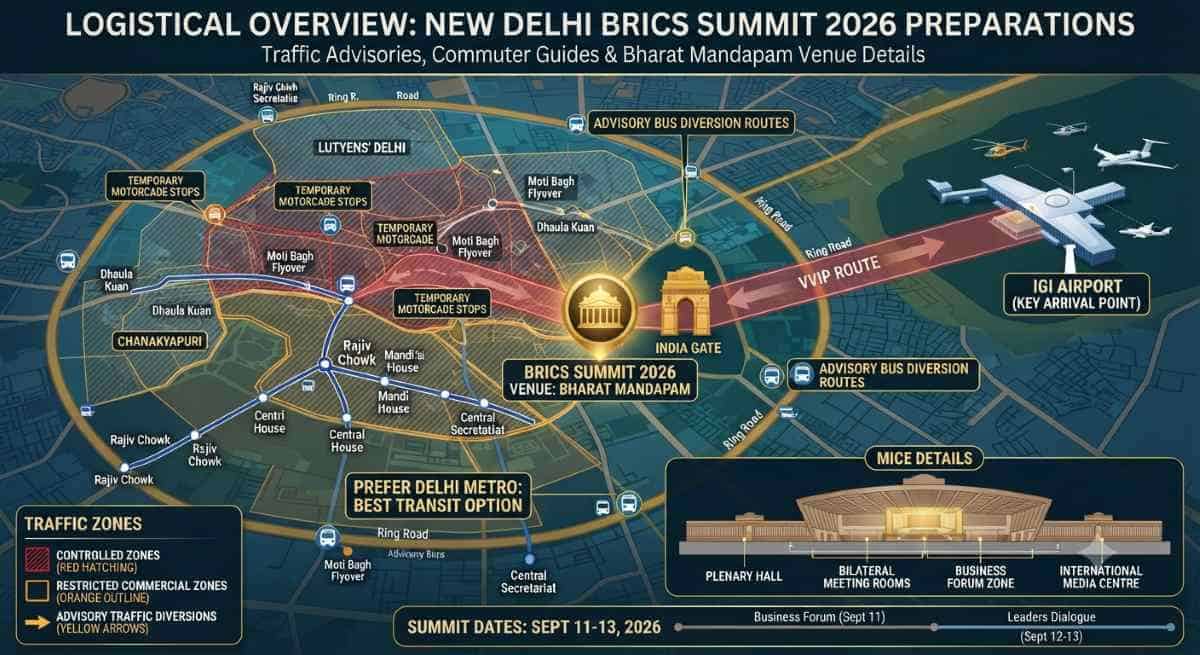
The capital city of India is currently immersed in intensive security and administrative preparations as preparations are finalized for the upcoming BRICS 2026. The 18th BRICS Leaders Summit is scheduled to take place in New Delhi, bringing together heads of state, high-ranking diplomats, and international delegations.
Ahead of this high-profile global gathering, extensive motorcade rehearsals have been conducted across central and southern districts to ensure flawless transit execution. The primary venue designated for these high-level deliberations is the state-of-the-art Bharat Mandapam situated within Pragati Maidan. This multifaceted international convention center serves as the focal point for all formal sessions, business forums, and associated diplomatic engagements.
Advertisement
Advertisement
Impact on Travellers
Regular commuters, local residents, and international visitors must anticipate notable disruptions in daily transit routines throughout the duration of the event. Security protocols dictate that more than thirty-five major roadways will be subjected to strict traffic regulations, alongside the activation of twenty-two specific diversion points.
Key arteries such as Sardar Patel Marg, Shanti Path, Janpath, Akbar Road, and Mathura Road will experience temporary closures whenever official motorcades are mobilized. Furthermore, travelers heading toward the Indira Gandhi International Airport or major railway terminals—including New Delhi, Old Delhi, and Hazrat Nizamuddin—are formally advised to factor in substantial buffer times to bypass unexpected route holds. To facilitate smoother crowd management, educational institutions across the capital will remain completely shut on Friday, September 11, 2026.
Advertisement
Advertisement
Industry Insights
From an institutional and economic perspective, the summit underscores the expanding strategic footprint of the bloc while testing urban management capacities. The integration of premier MICE infrastructure allows the host nation to showcase organizational efficiency on a global scale. Ancillary events, including the BRICS Business Forum and deliberations by the BRICS Women’s Business Alliance, run parallel to the main political agenda. These sessions draw hundreds of corporate leaders, financial experts, and trade delegates, thereby stimulating high-value economic exchanges and reinforcing multilateral commercial ties across emerging markets.
Practical Information for BRICS Summit in Delhi
Commuters navigating the metropolitan area during the summit window are strongly encouraged to adopt proactive travel strategies. The Delhi Metro network remains the most dependable mode of public transportation, offering uninterrupted underground connectivity that successfully circumvents surface-level restrictions.
Advertisement
Advertisement
Private vehicle users are advised to monitor real-time traffic updates issued by the Delhi Traffic Police and to utilize outer ring corridors for longitudinal transit across the city. Commercial and heavy vehicles face total prohibitions within the core security zones, ensuring that congestion is minimized around high-security perimeters.
Comparison with Previous Policies or Developments
In contrast to earlier diplomatic gatherings like BRICS Summit where restrictions were often applied uniformly and persistently throughout entire days, contemporary traffic management frameworks prioritize dynamic, short-duration closures. Roads are no longer sealed indefinitely; instead, traffic is regulated momentarily to facilitate the swift and secure passage of specific motorcades before normal flow is promptly restored. This refined approach reflects an evolutionary shift toward minimizing public inconvenience while simultaneously upholding the rigorous security mandates required for international heads of state.
Advertisement
