
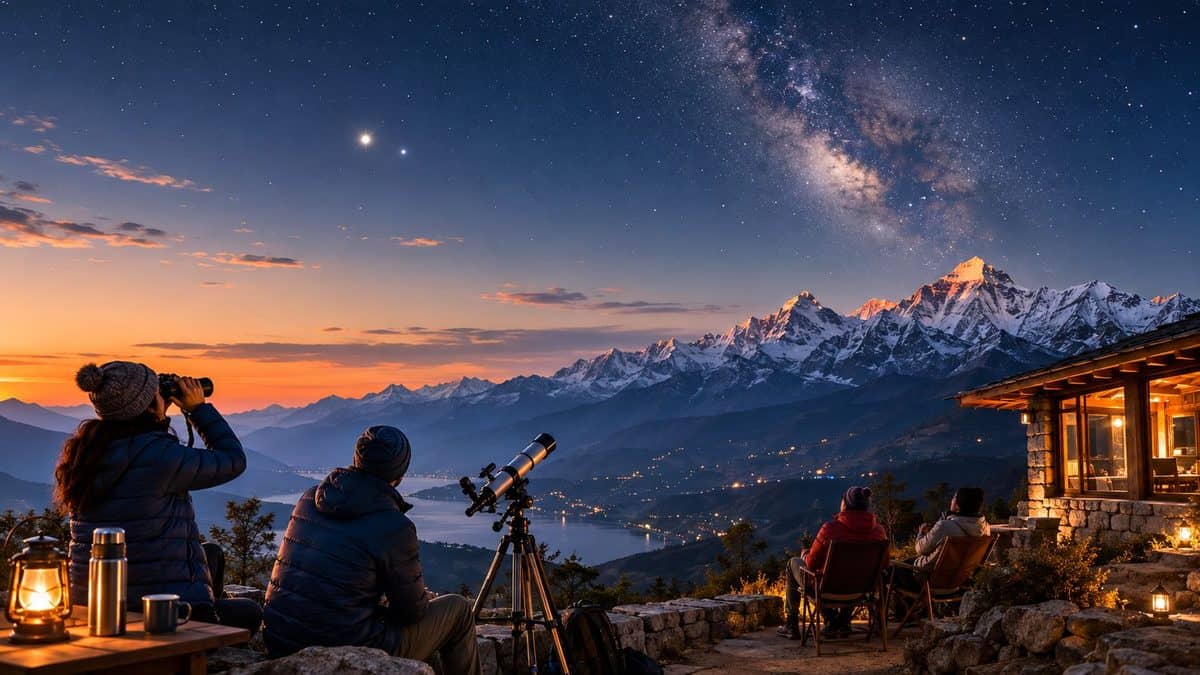
Image generated with Ai
September begins with a remarkable celestial event. Venus soon aligns with Spica in the west, just above the horizon. You can see the conjunction in the direction of the setting sun roughly one hour after sunset on September 1 and for around 90 minutes. For travelers, the conjunction is the perfect excuse to reimagine your evening commute by taking the opportunity to do some astronomy along the route.
Packing up some good binoculars and tripod would make a boring commute into a new and exciting evening destination. The week of the event offers other reasons to travel. There will be several lunar meetings with Mars and the Moon close to the Pleiades. The Moon will also be at last quarter. This will provide significantly less light during the evenings and finally give you some opportunity for dark sky observing. Travellers can view dark sky excursion as a reason to visit places that are further away.
Advertisement
For travellers, the appeal of astronomy lies partly in its simplicity. Unlike many attractions, the sky requires no admission ticket, elaborate infrastructure or fixed opening hours. However, location makes an enormous difference.
On Tuesday, September 1, Venus appears low in the west-south-west. It shines close to Spica, the brightest star in Virgo. The pair should be sought around 30 minutes after sunset. Their relatively low position makes an unobstructed western horizon particularly valuable.
Advertisement
The opportunity is brief. Venus and Spica remain visible for only about 90 minutes after sunset. Consequently, travellers staying in cities should avoid tall buildings and strong artificial lighting.
Wednesday offers another chance to see the pair. Venus begins moving away from Spica, but the two remain an attractive twilight sight. Therefore, visitors who miss the closest pairing still have a second evening for observation.
The timing also matters from a tourism perspective. Twilight experiences can extend the value of a travel itinerary beyond conventional sightseeing hours. A visitor can finish dinner, leave a hotel and watch the western sky change within minutes.
That makes astronomy particularly attractive for resorts, rural tourism operators and destinations seeking meaningful evening activities.
The Venus-Spica pairing is only the opening act. The Moon creates several additional observing opportunities throughout the week.
On September 3, a 61%-lit waning gibbous Moon approaches the Pleiades. The famous cluster sits in Taurus and is also known as the Seven Sisters. Binoculars can help reveal its stars despite the Moon’s brightness.
The Moon then reaches last quarter on September 4. This phase rises around midnight, leaving the early evening comparatively dark. That change is significant for travellers interested in galaxies, nebulae and star clusters.
By September 5, the Moon has become a 38%-lit waning crescent. It moves through Taurus before approaching its thinner crescent phase.
On September 6, the 27%-lit Moon pairs with Mars before sunrise. Travellers willing to wake early can therefore finish the week with another planetary-lunar encounter.Date Celestial highlight Approximate viewing window Traveller value September 1 Venus near Spica About 30 minutes after sunset Best evening spectacle September 2 Venus and Spica remain nearby Evening twilight Second opportunity September 3 Moon near the Pleiades Before dawn Binocular-friendly sight September 4 Last quarter Moon After midnight Darker early evening September 5 Waning crescent Moon in Taurus Before sunrise Quiet early-morning viewing September 6 Moon near Mars Before sunrise Strong finale for skywatchers
The exact altitude and timing will vary with destination. Travellers should therefore check local astronomical data before planning a dedicated observation session.
The broader story extends beyond this week’s planetary alignments. Dark skies are increasingly becoming part of the destination proposition.
Artificial light can overwhelm faint astronomical objects. Urban skylines can make even prominent stars difficult to distinguish. Remote destinations therefore offer something cities increasingly struggle to provide.
DarkSky International says its International Dark Sky Places programme now covers more than 270 places across 22 countries and six continents. Collectively, the programme protects more than 160,000 square kilometres of land and night skies.
That development illustrates a growing shift in destination management. Darkness is no longer simply the absence of development. It can become a resource worth protecting.
For tourism boards, this creates a compelling proposition. A destination can combine astronomy with hiking, wildlife, local food, cultural experiences and accommodation.
For travellers, the result is a more immersive itinerary. The attraction becomes the landscape by day and the sky by night.
India offers a particularly strong example through Ladakh. The Union Territory has increasingly positioned astronomy alongside adventure, culture and nature tourism.
The official Ladakh tourism platform specifically promotes astro-tourism at Hanle and Pangong, citing the region’s exceptionally clear skies. It identifies April to October as a favourable period and highlights new-moon nights for optimum visibility.
Hanle has also developed beyond conventional sightseeing. The Indian Astronomical Observatory and the surrounding dark-sky landscape provide a scientific dimension to the visitor experience.
In 2025, Ladakh officials reported that approximately 28,000 tourists visited Hanle during the previous year. The administration also discussed training residents as astro-tourism guides and strengthening astronomy education.
That is an important tourism signal. Astro-tourism can create roles for communities rather than simply attracting visitors to a remote landscape.
Local guides can explain constellations, operate telescopes and interpret regional astronomical traditions. Accommodation providers can create overnight packages around observation sessions.
The model also gives travellers a reason to stay longer.
Ladakh’s approach demonstrates that successful astro-tourism needs more than clear skies. Infrastructure, interpretation and community participation all matter.
The administration’s 2026 Astro Week included astronomy talks, astrophotography displays and telescope-guided observations. Cultural exhibitions featured local handicrafts, cuisine and heritage alongside astronomy.
That combination is particularly valuable for travel businesses. Visitors rarely travel thousands of kilometres for a single five-minute observation.
Instead, astronomy can become the anchor for a broader destination experience.Destination element Why it matters to travellers Dark skies Improves visibility of stars and faint celestial objects Local astronomy guides Adds interpretation and educational value Telescopes Enables deeper observation beyond naked-eye sights Astrophotography Creates a strong memory and visual travel product Local cuisine Extends the experience beyond astronomy Cultural interpretation Connects the night sky with local heritage Overnight accommodation Encourages longer stays Responsible lighting Protects the resource that attracts visitors
Ladakh has also moved towards dedicated infrastructure. In 2025, the Union Territory announced a ₹276.65 lakh Mini Planetarium and Astro Globe project at Hanle Dark Sky Reserve. The initiative aims to support scientific education, night-sky programmes, astro-tourism and local employment.
This is significant for travel planners. It shows how astronomy can evolve from a niche interest into structured destination infrastructure.
Moonlight deserves more attention when planning an astronomical holiday. A bright Moon can enhance landscapes but reduce visibility of faint celestial objects.
This week’s transition towards last quarter therefore benefits deep-sky observers. The Moon rises later, leaving more darkness during the first part of the night.
That distinction matters for different types of travellers.
Casual visitors may prefer a bright Moon because it makes landscapes easier to navigate. Photographers may want moonlight for foreground illumination. Experienced observers, meanwhile, often seek darker periods.
Consequently, the best astronomy destination is not necessarily the destination with the brightest skies alone. The lunar calendar, weather, altitude, horizon and local light pollution all influence the experience.Traveller type Best approach this week First-time stargazer Watch Venus and Spica after sunset Families Choose an organised evening observation session Photographers Seek a clear western horizon for Venus and Spica Deep-sky observers Use the darker period around last quarter Early risers Target the Pleiades and later Mars Astro-photographers Prioritise remote locations with minimal light pollution
One of the strongest lessons from this week’s sky is that travellers should not automatically wait for complete darkness.
Venus and Spica are most attractive during twilight. The western sky retains colour while the first stars emerge. This creates a more dramatic visual experience than a completely dark sky.
Travellers should arrive at their viewing location before the event begins. That allows time to identify the horizon and adjust to changing light conditions.
A clear western horizon is especially important on September 1 and 2. Hills, buildings and trees can easily block low celestial objects.
For destinations promoting evening astronomy, this also creates an opportunity. Hotels can organise short twilight sessions before dinner. Guides can explain the transition from sunset to night.
The experience can feel natural rather than heavily programmed.
The rapid growth of dark-sky tourism creates a paradox. More visitors can threaten the very darkness they travel to experience.
Artificial lighting remains one of the most obvious risks. Poorly designed lights can diminish night-sky quality while disturbing nocturnal wildlife.
DarkSky International’s responsible astrotourism principles call for purposeful, targeted and controlled lighting. They also stress environmental protection, respect for local communities and sustainable economic benefits.
These principles have direct implications for accommodation providers.
Hotels and camps can shield unnecessary lights. They can reduce excessive illumination around observation areas. They can also explain darkness policies to guests.
The aim should not be to eliminate lighting. Instead, destinations should use it intelligently.
This is becoming increasingly relevant to hospitality. DarkSky International’s accommodation programme recognises properties that protect night skies through responsible lighting and visitor-focused experiences.
For travellers, a dark-sky credential can therefore become another factor when choosing where to stay.
This week’s celestial events provide a useful reason to consider dedicated astronomy destinations. However, travellers do not need to cross continents for every astronomical event.
The first step is finding a location away from major artificial-light sources. National parks, rural landscapes, deserts, mountain regions and protected areas can offer better conditions.
The second is checking the weather forecast. A destination with excellent darkness is useless under heavy cloud.
The third is checking the lunar phase. Bright moonlight can change the quality of an observing session dramatically.
Finally, travellers should consider safety. Remote astronomy sites can involve rough terrain, low temperatures, limited mobile coverage and high-altitude conditions.
Ladakh provides a useful example. Its astronomical appeal is considerable, but high-altitude travel requires sensible preparation. Travellers should follow local guidance and avoid treating an astronomy excursion as an ordinary evening outing.
The Venus-Spica encounter also reveals how tourism businesses can package astronomy more effectively.
A simple product could combine sunset viewing, a guided constellation walk and local dinner. More sophisticated packages could add telescopes, astrophotography instruction and overnight accommodation.
The strongest products would remain flexible. Clouds can disrupt astronomical observations, so operators should build alternative experiences into itineraries.
A cloudy night could become an astronomy lecture, cultural storytelling session or planetarium experience. This protects customer value without making unrealistic promises.
Ladakh’s recent programming illustrates this broader model. Its Astro Week combined science, cultural astronomy, local products and guided observations.
That approach offers a useful blueprint for destinations worldwide.
The importance of Venus next to Spica is largely aesthetic. But Venus next to Spica adds distinct value to tourism in both commercial and experiential ways.
Travelers are seeking novel experiences, rather than the same ordinary experiences. A special night sky can provide the authenticity of place that travelers are searching for.
With this week’s lineup, there are many viewing opportunities. Venus and Spica are easily observable. For binocular users, the Pleiades are visible. The Last Quarter Moon is visible and helps to provide less light to the night sky. Finally, for early risers, Mars provides an observable object.
The significance of this for vacation destinations is obvious. As we see, by not using a lot of resources, dark areas can become resources for vacation travel.
For responsible vacation travel, the position of the stars becomes a good reason to travel. It is often the case that after sunset, travelers are most interested in what is happening in the sky and the stars, rather than what happens during the day on the ground.
Advertisement
Advertisement
Advertisement













Saturday, September 5, 2026

Friday, September 4, 2026
Saturday, September 5, 2026

Saturday, September 5, 2026

Thursday, September 3, 2026

Wednesday, September 2, 2026

Saturday, September 5, 2026

Saturday, September 5, 2026


