
Image generated with Ai
Kuwait joins Iran, Israel, UAE, and Qatar in the global maritime spotlight as the impending Strait of Hormuz reopening triggers a sudden resurgence in luxury Gulf cruise bookings and port operations across the region. Moreover, renewed optimism surrounding maritime connectivity is encouraging cruise operators, port authorities, and tourism stakeholders to prepare for increased passenger demand. As regional gateways strengthen infrastructure and operational readiness, travelers are expected to benefit from expanded itineraries and improved port services. In addition, the reopening is anticipated to stimulate economic activity by supporting tourism, shipping, and hospitality sectors throughout the Gulf. Consequently, Kuwait joins Iran, Israel, UAE, and Qatar in responding to the growing momentum generated by the impending Strait of Hormuz reopening and its impact on luxury Gulf cruise bookings and port operations. Furthermore, stronger regional collaboration and enhanced maritime access are expected to revitalize international travel while reinforcing the Gulf’s position as a leading cruise destination.
The geopolitical crossfire was drawn directly around Kuwait due to its critical strategic geography at the northern tip of the Persian Gulf and its status as a host nation for major United States military installations. Critical maritime infrastructure within Kuwait was subjected to direct physical threats during the active phase of the hostilities. Coordinated attacks utilizing hostile drones and cruise missiles were reported on March 27, 2026, by the Ministry of Public Works of Kuwait and the Kuwait Ports Authority. Material damage was suffered by Shuwaikh Port, which functions as the primary commercial trade hub of Kuwait near Kuwait City, and the under-construction Mubarak Al Kabeer Port project situated on Bubiyan Island. Although casualties were avoided during these initial strikes, the vulnerability of the logistics network of Kuwait to regional spillover was starkly highlighted.
Advertisement
The operational friction was escalated dramatically on June 6, 2026, when ballistic missiles were launched by the Aerospace Force of the Islamic Revolutionary Guard Corps directly at the Ali Al Salem Air Base in Kuwait. This military action was justified by the Iranian command as direct retaliation for airstrikes conducted by the United States against radar sites located in Goruk and Qeshm Island. The incident followed an unauthorized attempt by four tankers to exit the Strait of Hormuz under the guidance of the United States military without receiving clearance from the Islamic Revolutionary Guard Corps. The rulers of Kuwait were explicitly blamed by the Iranian Foreign Ministry for allowing their sovereign territories and military bases to be utilized for hostile operations against Iran. Local civil aviation and domestic infrastructure were disrupted by this targeting, which included minor damage caused to the airport of Kuwait by a United States Patriot missile interceptor operational error.
Despite this profound operational friction, a high degree of resilience was maintained by Kuwaiti port operations at Shuaiba and Shuwaikh. Terminal and bunkering services continue to be operated without the enforcement of formal restrictive advisories, even as a transition out of a wartime footing is executed by the broader region. Multi-billion dollar maritime projects are currently being accelerated by Kuwait in anticipation of the formal reopening of the waterway. This includes the expansion of the USD 4 billion Mubarak Al Kabeer Port development, which is recognized as a massive commercial opportunity for marine engineering and construction corporations.
Advertisement
Advertisement
Furthermore, the revival of the luxury tourism sector is being prioritized by the government of Kuwait. Prior to the outbreak of the war, additions to regional itineraries had been made by premier cruise lines, including Star Cruises, Silversea Cruises, and Crystal Cruises, to satisfy the growing demand from Kuwaiti and international travelers. These luxury cruise partnerships are intended to be restored by the Kuwaiti government through the leveraging of the planned introduction of a single GCC-wide cruise passenger visa and the integrated Visit Kuwait electronic platform, thereby positioning the northern Gulf ports of the nation as key transit terminals.
The regulatory measures enforced within the Strait of Hormuz were defended by Iran under historic sovereignty and established treaty frameworks, including the 1958 Geneva Convention and the 1982 United Nations Convention on the Law of the Sea. Cooperative merchant vessels were guided through northern routes near Larak Island by the Iranian Ports and Maritime Organization, whereby its right to police the waterway against hostile state assets was continuously asserted. Following the February 28, 2026 attacks, the de facto closure of the Strait of Hormuz by Iranian forces was characterized by external observers as the descent of an Oil Curtain across the Middle East.
A comprehensive framework designed to restore the pre-war status quo is outlined within the leaked terms of the diplomatic accord brokered by Pakistan. An immediate reopening of the Strait of Hormuz to unrestricted commercial shipping has been committed to by Iran. In exchange, the termination of the United States naval blockade and the phased lifting of American and United Nations sanctions will be granted. Furthermore, a USD 300 billion post-war reconstruction fund is envisioned for Iran, which remains conditional upon the resumption of negotiations addressing the nuclear program of Tehran and its specific uranium enrichment levels.
A permanent administrative framework is intended to be negotiated by Tehran with Oman and other littoral states following an initial 60-day window of free transit. This proposed framework includes the introduction of security and maritime service fees of up to USD 2 million per transit. Furthermore, a detailed vetting procedure continues to be enforced by the Islamic Revolutionary Guard Corps. Shipowners are required to disclose cargo values, ownership structures, and crew nationalities to the Persian Gulf Strait Authority, a process that is coordinated by the Ports and Maritime Organization of Iran alongside national security councils. Because the Islamic Revolutionary Guard Corps and its collection agencies remain sanctioned by United States and European authorities, a severe legal dilemma is created for global maritime operators, as any direct or indirect payment of transit fees risks violating international sanctions.
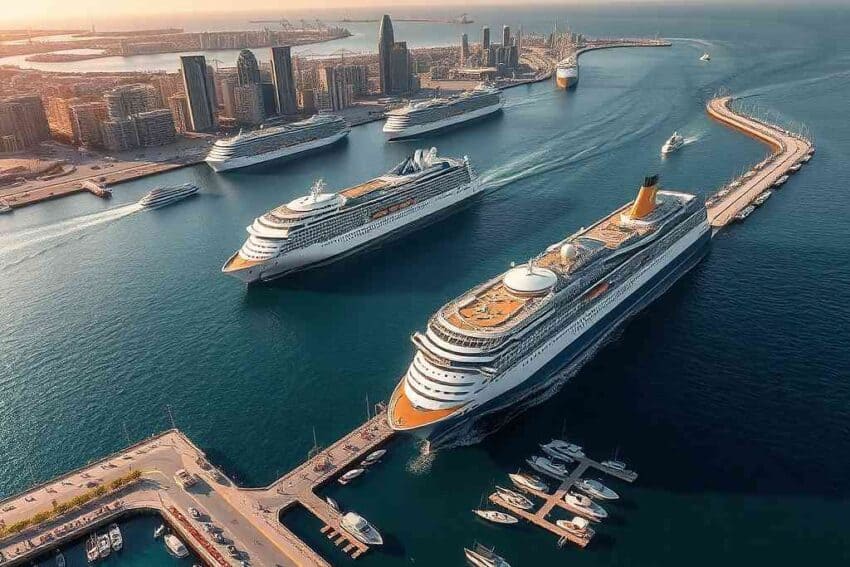
Image generated with Ai
A hardline diplomatic stance was strictly maintained by Israel throughout the duration of the crisis. Concerns regarding Iran’s actions were emphasized by Israeli Foreign Minister Gideon Sa’ar during a meeting with German Foreign Minister Johann Wadephul in Berlin, where the blockade was described as an assassination of freedom of navigation and an existential threat to the international rules-based order.
To mitigate the severe European energy deficit generated by the blockade, the export of surplus jet fuel and natural gas to Germany was authorized by the Israeli Ministry of Energy and Infrastructure, under the leadership of Eli Cohen. The strategic positioning of Israel remained aligned with the complete degradation of hostile regional networks, and its participation in the initial air conflict on February 28, 2026, fundamentally shifted the geopolitical calculations of the entire MENA economic zone.
The regional cruise recovery is poised to be led by the United Arab Emirates, utilizing modern infrastructure and comprehensive joint marketing initiatives. Strategic partnerships have been reinforced by the Department of Culture and Tourism Abu Dhabi, which is highlighted by the homeporting of the Celestyal Discovery to operate its Iconic Arabia itineraries.
Rigorous commercial and regulatory licensing frameworks continue to be maintained by the Department of Economy and Tourism in Dubai under DTCM and DET guidelines. Destination management companies, inbound tour operators, and cruise stopover programs are governed by these strict standards, ensuring the preservation of destination reputation and regional financial stability. Furthermore, networks are being expanded by regional maritime developers such as AD Ports Group, which has launched coordinated Red Sea cruise operations across various Egyptian terminals, thereby directly linking the cruise economy of the Gulf with broader Mediterranean and African maritime routes. During the crisis, transit cargo destined for the United Arab Emirates and neighboring states was rerouted overland via Khor Fakkan to bypass the maritime bottleneck.
The regional cruise recovery is similarly being spearheaded by Qatar alongside the United Arab Emirates. Doha Port’s Grand Cruise Terminal, which is managed cooperatively by Mwani Qatar and Qatar Tourism, has established the state as a major premium destination. The terminal features a striking architectural facade consisting of 1,174 stacked arches alongside an integrated arrival aquarium, allowing for the processing of up to 12,000 passengers per day.
Prior to the military escalation, the 2025/2026 winter season was scheduled to host 72 to 73 vessel calls, including premium deployments of the MSC Euribia, the Celestyal Journey, and the new Aroya Cruises of Saudi Arabia. The regional leadership of Qatar was underlined by its designation as the GCC Tourism Capital for 2026 and its selection as the Favourite Cruise Destination at the United Kingdom’s Wave Awards 2025. Extensive waterfront programs have been introduced at Old Doha Port to maintain commercial momentum during the seasonal summer pause, including water sports at Container Yard and accessibility enhancements within the Mina District.
The maritime tourism economy of Egypt has become intrinsically linked with the Persian Gulf recovery through strategic infrastructure expansions managed by Gulf-based entities. Upgraded docking berths at the Sharm El Sheikh Cruise Port are currently managed under a 15-year concession by the United Arab Emirates-based AD Ports Group, serving as a strategic gateway connecting Gulf itineraries to Jordan and wider Red Sea tourism routes.
Furthermore, the Noatum Ports Safaga Terminal in Egypt has been developed via a USD 200 million investment. This multipurpose terminal features a 1,000-meter quay and a capacity of 450,000 TEUs, establishing it as the first internationally operated port in Upper Egypt. Cargo logistics are integrated with passenger ferry terminals at this facility, allowing the effects of the Persian Gulf de-escalation to be leveraged to revitalize maritime commerce across the Red Sea and into the African continent.
The announcement of the tentative peace agreement has been welcomed by the international shipping community, yet it is emphasized by maritime security organizations that the physical reopening of the Strait of Hormuz must be viewed as distinct from the immediate restoration of normal trade flows. Commercial recovery remains constrained by several technical, financial, and regulatory security thresholds that must be resolved before global carrier confidence is fully restored.
The threat of sea mines is recognized as the single greatest physical barrier to safe navigation. Throughout the period of active hostilities, the deployment of naval mines within the established Traffic Separation Scheme was threatened by the Islamic Revolutionary Guard Corps. Although limited mine-clearance operations have been engaged in by the United States military and Omani authorities—including the detection of floating mine hazards near the Omani coastline—complete verification of the shipping lanes is demanded by international shippers. It is estimated by five Western maritime security sources that clearing the Traffic Separation Scheme with conventional minesweepers and autonomous underwater drones will require 40 to 50 days of continuous operation before the waterway is deemed safe by maritime insurers. Up to six months may be required for comprehensive clearance and a return to pre-crisis navigation baselines. An international minesweeping coalition, led by the United Kingdom and France, is being coordinated to assist in this effort once the peace deal is formally signed.
The financial impact of the conflict is illustrated by the collapse of shipping volumes and the drastic escalation of insurance costs. On May 31, 2026, just 10 commercial transits were recorded within the Strait of Hormuz, representing a mere 11 percent of the pre-crisis baseline of approximately 95 daily transits. Over 500 commercial vessels, including approximately 155 to 215 crude oil and chemical tankers, remained trapped inside the Persian Gulf during the peak of the crisis. War-risk premiums were driven to prohibitive levels by this maritime bottleneck.

Image generated with Ai
The impending signing of the Switzerland peace agreement and the subsequent reopening of the Strait of Hormuz present a critical window of opportunity for regional governments, port authorities, and maritime operators. To convert this diplomatic breakthrough into a sustainable economic and commercial recovery, several strategic areas must be addressed by stakeholders.
Clear legal guidance regarding Iranian transit vetting and the proposed navigation fees must be established by commercial shipping lines. Industry bodies, including Intertanko and the International Chamber of Shipping, should coordinate with the United States Treasury’s Office of Foreign Assets Control to secure formal sanctions waivers. This coordination is essential to ensure that international carriers and P&I clubs are not exposed to secondary sanctions penalties by required administrative payments made to Iranian port entities.
To accelerate the return of international luxury cruise brands, bilateral cooperation agreements should be leveraged by GCC maritime and tourism authorities, specifically Mwani Qatar, the Saudi Ports Authority, the Dubai DET, and the Abu Dhabi DCT. The following measures should be prioritized by these entities:
Through proactive coordination, targeted infrastructure investment, and rigorous compliance planning, the post-war challenges can be effectively navigated by the maritime economies of the Persian Gulf, thereby restoring the position of the region as a premier global hub for international trade, logistics, and luxury maritime tourism.
Advertisement
Tags: energy logistics, GCC unified cruise visa, geopolitics, global shipping crisis 2026, Luxury tourism
Advertisement
Advertisement












Tuesday, September 1, 2026

Tuesday, September 1, 2026

Tuesday, September 1, 2026

Tuesday, September 1, 2026

Tuesday, September 1, 2026

Tuesday, September 1, 2026

Tuesday, September 1, 2026

Tuesday, September 1, 2026



