
Why Italy’s Dop Wine Tourism Boom in 2025–2026 Has Every Other Destination on Edge

Published
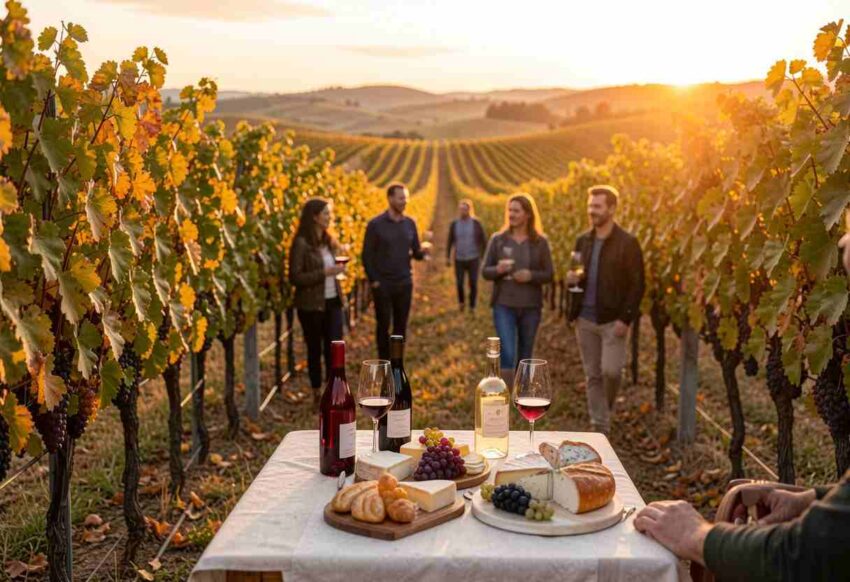
Image generated with Ai
Italy’s wine and broader enogastronomic tourism has been portrayed as being in a transition from simple growth in numbers to a more mature phase characterised by stronger governance and higher value experiences. In this evolution, 2025 has been framed as the reference year due to the availability of detailed quantitative evidence, while 2026 has been described through forecasts and qualitative analyses provided by sector observatories and specialised reports.
This transformation has been rooted in the way Dop and Igp products have been repositioned from mere ingredients to cultural and economic pillars, increasingly integrated into territorial development strategies and travel behaviour patterns. As a result, wine tourism has been progressively recognised as a strategic lever for the Italian vitivinicultural system, especially in a context marked by declining global wine consumption.
2025 as a consolidation year for Dop food and wine tourism
In 2025, Italy’s Dop and Igp‑linked tourism has been documented in detail by the 2nd “Rapporto Turismo Dop 2026” produced by Fondazione Qualivita with Origin Italia and institutional support. A total of 667 enogastronomic tourism activities connected to Dop and Igp systems has been recorded, representing an increase of 73 initiatives compared to 2024 and corresponding to a 12 percent rise year on year.
Within this overall figure, 292 events have been counted, including festivals, tastings, cultural appointments and sports‑related gatherings, marking a 26 percent increase compared to the previous year and signalling a lively calendar distributed across territories. Among these events, 60 first‑time initiatives have been registered, indicating that experimentation and innovation have been encouraged within the protected designation landscape.
Advertisement
Advertisement
The territorial spread of this growth has been significant. Sixteen out of twenty Italian regions have reported more Dop‑related tourism activities than in the previous year, confirming that the movement has not been confined to a few flagship destinations. Veneto, Tuscany, Emilia‑Romagna, Lombardy and Piedmont have been placed at the top of the regional rankings, supported by strong production chains, consolidated tourist appeal and consortia that have been able to engage actively in local governance.
A dense governance network has been highlighted by the involvement of around 367–376 consortia together with nearly 500 local bodies and associations in Dop tourism initiatives. Through this network, public and private actors have been connected, and local institutions, associations and producer organisations have been induced to work together in planning and managing tourism experiences.
Advertisement
Advertisement
Visitor perceptions and symbolic changes
The perspective of visitors has been captured through the introduction of the “Turisti Dop” survey, which has added a demand‑side dimension to the 2025 picture. Approximately three out of four visitors have recognised consortia as guarantors of product authenticity at Dop events, indicating high trust in these organisations as certifiers of quality and origin. Tastings have been identified as the main motivation for attending such initiatives by a majority of participants, confirming the central role of sensory experience in wine and food‑related travel.
The educational dimension has been strongly emphasised. Most respondents have stated that participation in Dop tourism activities has improved their understanding of product characteristics, production methods and local history and culture, showing that these experiences have been perceived as learning opportunities and vehicles for narrative connection with territories.
Advertisement
Advertisement
Symbolic recognition has accompanied this consolidation. More than 700 mentions of “Turismo Dop” in print and online media have been reported in 2025, signalling a strong presence in public discourse. In the same period, the expression “Turismo Dop” has been officially added to the Treccani dictionary as a new term representative of ongoing social and economic transformations, further legitimising the phenomenon in the cultural sphere.
Regulatory context and the role of consortia
The evolution of wine and Dop tourism has not been driven solely by market forces and visitor behaviour; it has also been shaped by changes in the regulatory framework. EU Regulation 2024/1143 has explicitly included tourism management among the responsibilities assigned to Dop and Igp consortia. Through this decision, consortia have been formally called upon to plan and coordinate tourism activities, reinforcing their central role as territorial managers and not only as product protectors.
In 2025, this regulatory shift has started to be translated into practice. Hundreds of consortia have taken on new functions related to the design of experiences, the coordination of local actors and the communication of values attached to protected products. This evolution has been highlighted by figures such as Mauro Rosati and Cesare Baldrighi, who have described a system in which networks based on collaboration and shared governance have been emerging, with consortia acting as reference points for credibility and quality assurance.
The recognition of Italian cuisine as UNESCO heritage has further reinforced this dynamic, by framing traditional dishes and ingredients as part of an intangible cultural legacy. Dop and Igp products have therefore been perceived not only as market items but also as carriers of identity and heritage, which has increased their attractiveness for travellers seeking authentic and meaningful experiences.
Advertisement
Advertisement
Economic weight and the enotourism context
The consolidation of Dop tourism in 2025 has been accompanied by broader evidence on the economic value of wine tourism in Italy and Europe. According to the Osservatorio Nazionale del Turismo del Vino, the value of Italian enotourism in 2024 has been estimated at around 2.9 billion euro, representing a 16 percent increase compared to 2023. This expansion has been associated with high per‑capita spending levels, which have reached up to around 400 euro per wine tourist when accommodation, services and direct purchases have been taken into account.
At the European scale, wine tourism has been assessed as being worth approximately 39 billion euro within a global market estimated at roughly 46.5 billion dollars. In this scenario, Italy has been positioned as a key player, with its regions competing through differentiated offerings and strong brand recognition linked to well‑known denominations and landscapes.
The macro‑economic environment has been favourable. Bank of Italy tourism data cited in the Qualivita framework have reported a tourism surplus of 19.6 billion euro in the first nine months of 2025, indicating that incoming flows and travel receipts have exceeded expenditures abroad and have provided a supportive background for enogastronomic and wine‑related tourism.
At the same time, global wine consumption has reached its lowest level since 1961, creating pressure on wineries to diversify revenue sources beyond traditional bottling and distribution. In this context, wine tourism has been viewed as an asset capable of generating direct sales in the cellar, creating loyalty relationships with visitors and strengthening the resilience of production districts.
2026: from volume growth to value and governance
For 2026, detailed official counts comparable to the 667 activities and 292 events reported for 2025 have not yet been published, as the latest “Rapporto Turismo Dop” has been based on 2025 data. Nevertheless, enotourism‑specific analyses released in early 2026 have allowed trends, strategic shifts and market expectations to be described.
The report “Quando il vino incontra il turismo”, dedicated to Italian enotourism, has portrayed wine tourism as a strategic lever growing in controtendenza with the decline in wine consumption. Projections have indicated an expected average annual growth rate of about 12.9 percent for wine tourism worldwide and in markets connected to Italy, signalling strong demand for experiences centred on territory, culture and sustainability.
Advertisement
Advertisement
In this evolving scenario, the emphasis has been placed less on simply increasing the number of events and more on upgrading their quality and economic yield. While 2025 has been marked by the proliferation of initiatives, including many first‑time formats, early 2026 narratives have focused on immersive experiences, harvest participation, small‑group tastings, thematic itineraries and sustainability‑oriented offers, all designed to raise perceived value and visitor spending.
Governance has been another key dimension. The dense web of consortia and local entities activated in 2025 has been recognised as an asset that, in 2026, has been called to evolve toward more integrated and coordinated territorial models. The need to avoid fragmentation, to manage flows across seasons and to present coherent wine tourism brands to international markets has been stressed by analysts and stakeholders, who have advocated for shared strategies and public‑private alliances.
Demand profiles and internationalisation
From the demand side, Italian wine tourism has continued to be driven predominantly by domestic visitors. Data from sector observatories have indicated that around 55 percent of wine tourists have been Italian nationals, rising to about 62 percent when residents and proximity visitors have been included. This strong home‑market base has provided stability and repeat visitation potential, especially for weekend trips and short stays focused on cellar visits and local cuisine.
At the same time, the growth potential for the coming years has been associated with the ability to attract more international guests and to reduce seasonality. Even though precise 2026 numbers have not yet been consolidated, strategies aimed at foreign markets have been reinforced, often in connection with events such as Vinitaly and with targeted campaigns promoting wine routes, Dop districts and themed itineraries.
Desaisonalisation has been considered a central objective. Wine experiences have been promoted beyond classic summer and harvest periods, with proposals such as winter tastings, cultural festivals, sport‑linked events and wellness‑oriented stays in rural settings. These initiatives have been intended to distribute arrivals more evenly across the year, to support local economies and to improve the use of infrastructures and services.
Media, policy and the narrative of change
The media system and legislative attention have continued to play an important role in shaping the narrative of wine and Dop tourism during this transition phase. The more than 700 mentions recorded in 2025 and the inclusion of “Turismo Dop” in the Treccani dictionary have signalled that this form of tourism has become part of the public conversation and national imagination.
Advertisement
Advertisement
In parallel, a growing number of legislative acts at European, national and regional levels has been monitored, with more than a hundred measures related in some way to the sector. These acts have ranged from regulations on denominations and hospitality practices to incentives for rural tourism, cultural heritage projects and infrastructure improvements, all of which have indirectly supported wine‑related travel.
Academic research has mirrored this increasing attention. In 2025, 24 scientific studies on Dop and Igp food tourism have been mapped, up from 17 in 2024, addressing topics such as marketing strategies, territorial development, sustainability and cultural heritage valorisation. This expanding body of work has contributed analytical tools and case studies that have helped stakeholders to understand the shift from quantity to quality in wine tourism.
An evolving model of wine‑driven travel
Taken together, these developments have indicated that Italy’s wine tourism and Dop‑linked enogastronomic travel have been moving from a phase dominated by growth in numbers to a more mature model based on value creation, governance and international positioning. In 2025, expansion in activities and events, the mobilisation of hundreds of consortia and local entities, strong media coverage and symbolic recognition have confirmed that the foundations of this model have been laid.
In early 2026, the focus has been increasingly placed on how these assets can be transformed into integrated itineraries, higher‑spending experiences and long‑term territorial projects. The shift in travel trends has therefore been characterised by a stronger search for authenticity, education and connection with local culture, combined with expectations of professional management and quality standards.
In this context, Italian wine landscapes and Dop districts have been positioned as laboratories where new forms of tourism, rooted in identity and sustainability, have been tested and refined. As full 2026 data become available in the next edition of the Dop tourism report, the trajectories described by current analyses are expected to be confirmed or further specified, but the direction of change – from volume growth to structured, value‑driven wine tourism – has already been clearly signalled.
Advertisement
