
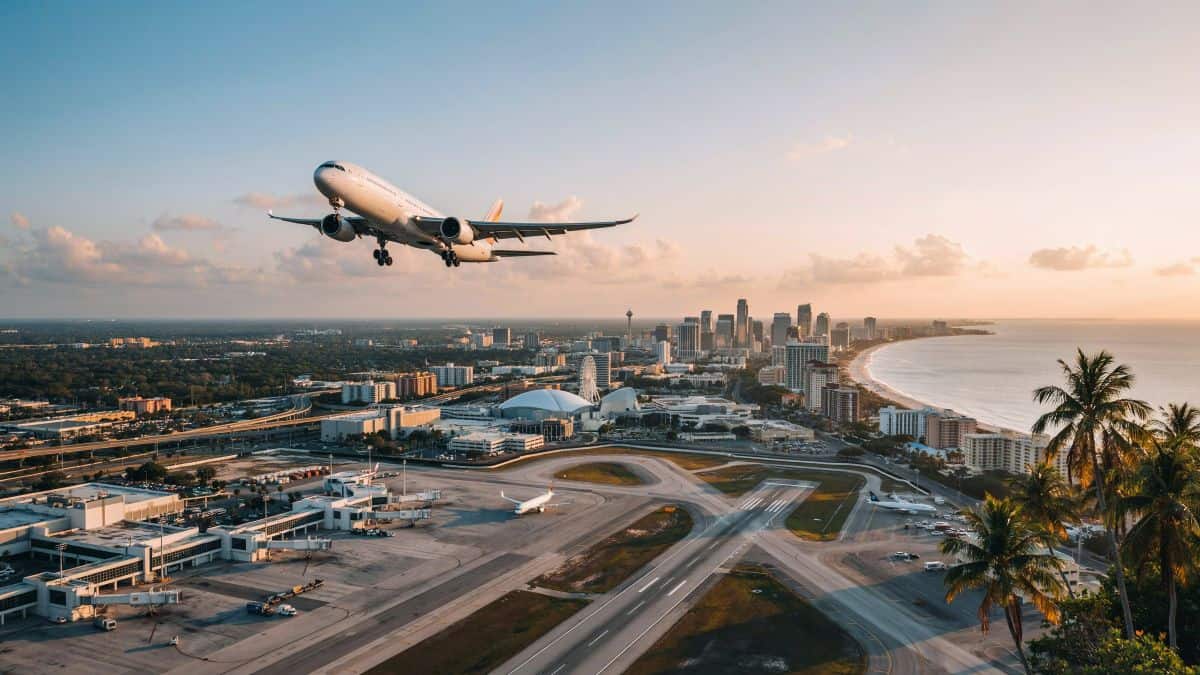
Image generated with Ai
Allegiant Airlines planned service expansions provides access to cheaper air travel between major markets in the east US and Florida’s most popular spots. New routes already announced connect the cities of Cincinnati, Boston, Providence, and Portsmouth to Orlando, Punta Gorda, Sanford, St. Petersburg, and Fort Lauderdale. Most of these pairs of airports currently have no or little direct competition. This adds even more value to these routes, focusing on leisure travel. The numbers support this expansion, with over 143 million people visiting Florida in 2025, a new record. With over 29 million passengers using Florida’s commercial airports in the first three months of 2026, it’s clearly the best location to support new air travel.
Allegiant Airlines is reportedly preparing seven nonstop connections focused entirely on Florida. The routes would connect communities in Massachusetts, Rhode Island, New Hampshire and the Cincinnati metropolitan region with some of the state’s most important leisure gateways.
The proposed network includes:Origin Florida destination Reported distance Cincinnati Orlando International 756 miles Boston Punta Gorda 1,232 miles Boston Orlando Sanford 1,097 miles Boston St Pete-Clearwater 1,193 miles Providence Fort Lauderdale 1,188 miles Portsmouth Fort Lauderdale 1,285 miles Providence Orlando Sanford 1,049 miles
These services would strengthen point-to-point connectivity without requiring passengers to transfer through large airline hubs. Boston would gain three additional links to secondary Florida airports, while Providence would secure connections to Central and South Florida.
Advertisement
Advertisement
Portsmouth International Airport at Pease would also gain an important South Florida link. That route could offer travellers from New Hampshire, southern Maine and northern Massachusetts another departure option outside Boston Logan International Airport.
However, the seven services should be described as reported or planned routes until Allegiant publishes their launch dates, frequencies and seasonal operating periods. They differ from the eight Florida routes formally announced by the carrier in May 2026.
Five of the seven reported airport pairs would have no competing nonstop airline, according to the supplied route information. This gives Allegiant an opportunity to stimulate demand rather than merely redistribute passengers already using an established service.
The Cincinnati–Orlando market would be the most competitive. Allegiant would operate alongside Delta Air Lines, Frontier Airlines and Southwest Airlines. Travellers could benefit from broader fare choice, although ticket prices would continue to depend on travel dates, capacity and demand.
Providence–Fort Lauderdale would also face direct competition. JetBlue serves the market throughout the year, while Southwest provides seasonal flights.
The remaining airport pairs could give passengers access to nonstop journeys that would otherwise require a connection, a lengthy road transfer or departure from a more distant airport. This represents one of the most important potential benefits of the Allegiant Florida routes.
The US Department of Transportation explains that domestic airlines generally determine their fares, routes and market entry commercially following airline deregulation. Consequently, the appearance of a route in a carrier’s network does not mean the federal government has guaranteed its continuation.
Three of the targeted destinations are Punta Gorda, Orlando Sanford and St Pete-Clearwater—are secondary airports serving large tourism regions. These facilities can provide alternatives to busier primary gateways while distributing visitor spending across additional communities.
Orlando Sanford offers access to Central Florida and its extensive attraction, accommodation and transport network. St Pete-Clearwater connects travellers with the Tampa Bay region and Florida’s Gulf Coast. Punta Gorda supports access to southwest Florida, including communities near Charlotte Harbor and the wider Fort Myers tourism market.
Fort Lauderdale-Hollywood International Airport has a different role. It is one of Florida’s largest aviation gateways and serves South Florida’s beaches, hotels, cruise industry and urban destinations.
Official state figures show that Florida’s 19 commercial airports recorded 29.9 million enplanements during the first quarter of 2026, representing annual growth of 1.8%. Orlando registered 7.6 million enplanements, while Fort Lauderdale handled 4.7 million.
Domestic enplanements increased by 2.5% to 24.5 million and accounted for 81.8% of the statewide total. These results indicate that domestic aviation remains fundamental to Florida’s visitor economy.
Florida welcomed a revised record of 143.33 million visitors in 2025, according to VISIT FLORIDA’s official tourism figures. That represented an increase of 0.2% over 2024.
The state received an estimated 39.88 million visitors during the first quarter of 2026. Domestic travellers contributed approximately 36.54 million visits and represented 91.6% of the quarterly total.
Domestic air visitation performed particularly strongly. It increased by 2.5% year on year to 13.85 million visitors. By comparison, preliminary non-air visitation declined by 3.4% to 22.69 million.
This contrast is significant for the proposed Allegiant Florida routes. It indicates that air travel remained resilient even as Florida recorded a 1% decline in total first-quarter visitation.
International demand also strengthened. Overseas arrivals increased by 8.5% to approximately 2.29 million during the quarter. Canadian visitation reached an estimated 1.05 million.
Florida hotels sold 0.6% more rooms during the same period. Additional nonstop services could support accommodation demand by opening Florida destinations to travellers who previously lacked convenient direct flights.
Florida tourism produced an estimated US$133.6 billion in economic impact during 2024, according to the state’s official destination marketing organisation. The sector supported approximately 1.8 million jobs.
Florida also held a 15.5% share of the United States domestic tourism market in 2024. Its established attractions, coastal destinations, warm climate, cruise gateways and large accommodation inventory continue to support year-round travel demand.
New flights can extend that economic activity beyond airports. Visitor spending reaches hotels, transport operators, attractions, retail businesses and local tourism services. Secondary gateways may also encourage travellers to stay in communities outside the state’s largest metropolitan centres.
Nevertheless, new airline capacity does not automatically guarantee higher tourism revenue. The final impact will depend on flight frequency, seat capacity, operating seasons, load factors and the proportion of passengers who represent genuinely additional visitors.
Allegiant uses an unbundled fare structure. Its advertised base prices generally cover transportation and a limited personal item, while optional products may cost extra.
Passengers should therefore compare the complete journey price rather than relying exclusively on the initial fare. Checked baggage, larger cabin baggage, seat selection, priority services and itinerary changes may increase the final cost.
Travellers should also examine ground transport arrangements. A secondary airport may offer a less congested arrival experience, but it may be farther from a passenger’s hotel or principal attraction.
The US Department of Transportation’s aviation consumer resources explain passenger protections and provide guidance concerning refunds, cancellations, baggage and airline service complaints. Customers should review confirmed schedules and applicable fare conditions directly before booking.
Establishing Allegiant Florida routes would connect underserved areas of the East Coast to 5 major Florida gateways, including Boston, Providence, Portsmouth and Cincinnati, to offer new non-stop flight options. This would also benefit Punta Gorda and St. Pete Clearwater, as the new routes would also include Orland and Ft. Lauderdale. According to given statistics, Florida’s tourism economy is powerful with record breaking annual visits and an increase in both domestic air arrivals and airport activity. While Allegiant Florida is still finalizing when these routes will start and how frequently and when these routes will operate, it is clear that these routes have the potential to be valuable in terms of tourism. This will be especially true if Allegiant Florida can sustain and strengthen this capacity over time and charge lower fares in combination with reliable flights in order to draw more visitors.
Advertisement
Advertisement
Advertisement













Saturday, September 5, 2026

Friday, September 4, 2026

Saturday, September 5, 2026

Saturday, September 5, 2026

Thursday, September 3, 2026

Wednesday, September 2, 2026

Saturday, September 5, 2026

Saturday, September 5, 2026


