
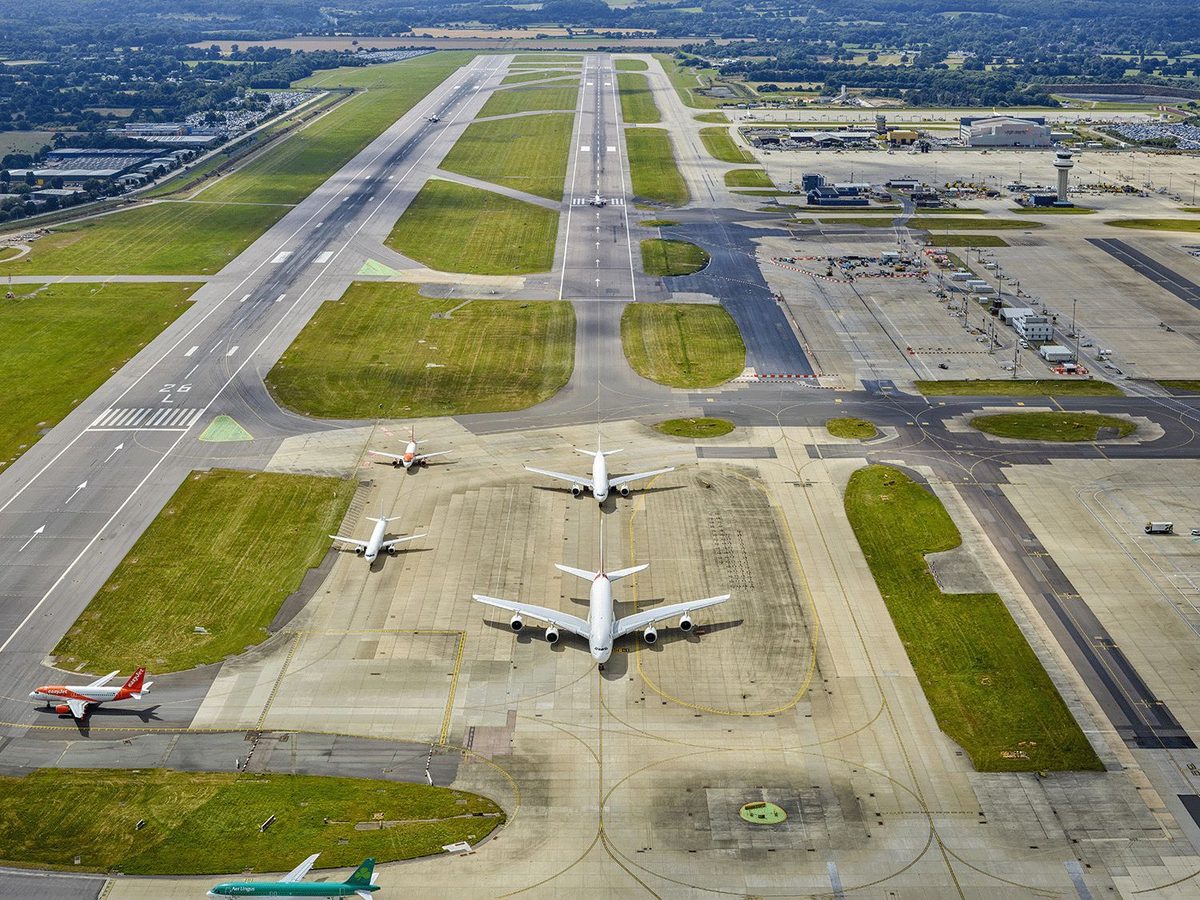
Flights at London Gatwick Airport were disrupted for almost an hour on Friday after an aircraft became stuck on the runway. The airport closed its runway for 50 minutes because of a technical problem involving a departing aircraft. Airport teams subsequently towed the aircraft away and completed a full safety inspection before reopening the runway.
However, the short closure produced a much larger operational impact. By Friday evening, flight-tracking data showed 90% of Gatwick flights delayed, with 8% cancelled and average delays reaching 71 minutes. Some arriving aircraft also diverted to airports including Stansted and Birmingham.
The episode highlights the operational sensitivity of Gatwick’s high-throughput runway system. For travellers, the disruption also demonstrates how a relatively short infrastructure closure can trigger delays that continue for several hours.
The disruption began on Friday afternoon when an aircraft encountered a technical problem while preparing to depart Gatwick. The airport subsequently closed the runway as a safety precaution, bringing both arriving and departing traffic to a temporary standstill.
Advertisement
Advertisement
Gatwick described the problem as a “technical issue with a departing vehicle”. The airport did not provide further technical details about the nature of the fault, and the available information does not establish precisely what caused the aircraft to become stuck.
Airport teams eventually towed the aircraft clear of the runway. Gatwick then completed a full safety inspection before reopening the runway, allowing aircraft operations to resume.
The closure itself lasted approximately 50 minutes. Nevertheless, the operational consequences continued well after aircraft could again use the runway because the disruption had already affected aircraft movements and schedules.
That distinction matters for travellers. Airport disruptions rarely end when infrastructure reopens, because aircraft, crews and passengers may already have moved out of position.
As a result, one blocked runway can create delays across multiple subsequent rotations. The effect can become particularly pronounced during busy afternoon and evening operating periods when aircraft movements remain tightly scheduled.
The scale of the disruption became clearer later in the evening. Flight-tracking data showed that 90% of flights were delayed shortly after 21:30 BST, while 8% had been cancelled.
Average delays reached approximately 71 minutes. Those figures show why a 50-minute runway closure can produce several hours of passenger disruption.
An aircraft scheduled to depart late may subsequently miss its destination airport slot. Its next sector can then depart late, creating another delay and potentially affecting passengers who were not travelling through Gatwick during the original closure.
Crew availability can further complicate recovery. Airlines may need to reorganise aircraft rotations, crews, airport slots and passenger connections before schedules can return to normal.
Arrivals also faced difficulties during the disruption. Some aircraft could not land at Gatwick and instead diverted to alternative airports, including London Stansted and Birmingham.
For passengers, a diversion can create a second logistical challenge. The aircraft may have completed its flight, but passengers can still face a significant onward journey to their booked destination.Disruption Indicator Reported Position Runway closure 50 minutes Airport impact Arrivals and departures Flights delayed later Friday 90% Flights cancelled later Friday 8% Average reported delay 71 minutes Alternative airports Stansted, Birmingham and others Reported cause Technical issue involving departing aircraft
These figures represent a snapshot of the disruption rather than a final assessment of the airport’s daily performance. Airport operations can recover progressively as aircraft and crews return to their planned rotations.
The incident also exposes an important structural feature of Gatwick’s operation. The airport has two runways, but it does not currently operate them as two independent runways for routine simultaneous operations.
The northern runway primarily serves as a standby facility when the main runway becomes unavailable. The Civil Aviation Authority has previously described Gatwick as operating in a single-runway configuration.
That arrangement makes runway availability particularly important. Arrivals and departures therefore depend heavily on the operational availability of the main runway.
At an airport with independently usable parallel runways, operators can sometimes shift traffic when one runway becomes unavailable. Gatwick has less flexibility under its current operating configuration, particularly during periods of heavy demand.
The difference becomes especially significant during peak periods. Gatwick’s summer 2026 congestion arrangements cover substantial parts of the operating day, highlighting the pressure placed on available runway capacity.
Consequently, even a temporary runway restriction can affect a much larger number of flights. The Friday incident provides a practical example of that network effect.
This is one reason Gatwick has pursued plans to increase runway capacity. The airport’s northern runway development aims to bring that runway into more regular operational use.
CAA documentation indicates that the proposal would introduce dual-runway operations. Under the proposed arrangement, approximately 50% to 70% of departures could routinely use the northern runway.
The proposed development could therefore provide additional resilience as well as capacity. However, the project remains subject to regulatory processes, infrastructure requirements and detailed operational considerations.
The airport’s scale puts Friday’s disruption into perspective. Gatwick handled 42.8 million passengers in 2025, according to the airport’s published figures.
It also recorded approximately 259,000 aircraft movements during the year. Its average passenger load factor stood at 84.5%, demonstrating the intensity of activity across its network.
The airport’s airline mix further increases its importance to the travel sector. Gatwick reported that easyJet carried around 18.9 million passengers through the airport during 2025.
Long-haul traffic represented approximately 16% of Gatwick’s passenger volume. The airport therefore serves not only European leisure travellers but also long-distance business, visiting-friends-and-relatives and international holiday traffic.
Several international markets recorded strong growth during 2025. Passenger numbers to Sub-Saharan Africa increased by 22%, while traffic to the Far East and South Asia rose by 24%.
The Middle East and Central Asia also recorded growth of approximately 17%. For international travellers, these figures demonstrate why operational disruption at Gatwick can have consequences far beyond short European routes.
The airport has also sought to increase the efficiency of its existing infrastructure. Gatwick said maximum scheduled aircraft movements would rise from 55 per hour in 2025 to 57 per hour in 2026.
Higher utilisation, however, makes operational resilience increasingly important. When schedules operate close to available capacity, airlines have fewer opportunities to absorb unexpected interruptions.
Runway capacity does not work like a simple queue. When an airport closes a runway, aircraft cannot necessarily resume their original sequence immediately after operations restart.
Some aircraft may already be holding in the air. Others may have diverted, while departing aircraft may occupy stands or taxiways and prevent normal traffic flow.
Air traffic controllers must subsequently rebuild the movement sequence safely. Airlines must also reorganise aircraft rotations, crews and passenger connections.
A delayed inbound aircraft can affect its next departure. That delayed departure can then affect another destination, allowing the disruption to spread through several sectors.
Crew working-time limitations can add further pressure. If crews reach their operational limits, airlines may need replacement crews before aircraft can continue.
This explains why passengers can continue experiencing delays long after an airport announces that its runway has reopened. The physical obstruction may disappear quickly, but the schedule imbalance can take much longer to unwind.
Gatwick’s own operational performance provides useful context. The airport reported its strongest on-time departure performance in a decade during 2025, excluding the pandemic period.
It also reported an 11-percentage-point improvement compared with 2024. Friday’s incident should therefore be viewed as a specific operational disruption rather than evidence of a persistent airport-wide performance problem.
For passengers, diversion can be considerably more complicated than an ordinary flight delay. An aircraft landing at another airport does not necessarily mean the passenger journey has ended.
Travellers may still need to reach the destination shown on their original ticket. That becomes particularly challenging when the alternative airport lies a significant distance from the intended destination.
Passengers may also face uncertainty over luggage, onward connections and ground transportation. They should therefore wait for clear instructions from their airline before arranging expensive alternative transport themselves.
Which? highlighted this issue following the disruption. The consumer organisation said airlines remain responsible for ensuring diverted passengers reach the final destination on their ticket.
That responsibility can be particularly important for passengers arriving at another London airport. Travellers should ask whether their airline will provide buses, rail arrangements or another form of onward transport.
The same principle applies to meals and accommodation when disruption becomes prolonged. Passengers should ask the airline what assistance is available before paying for essential expenses themselves.
Travellers should also retain receipts where they have incurred reasonable costs. Those records may become important if they later seek reimbursement under applicable passenger-rights rules.
British and international passengers should understand the distinction between care and compensation. These are separate passenger protections and do not operate under identical conditions.
UK261 provides rights for passengers on qualifying flights. The Civil Aviation Authority says airlines must provide care during qualifying significant delays.
That care can include food and drink, communication facilities and accommodation where an overnight stay becomes necessary. However, the precise rights depend on the circumstances and route involved.
Compensation operates differently. Passengers may qualify where they reach their final destination more than three hours late and the relevant legal conditions are satisfied.
Extraordinary circumstances can affect compensation eligibility. However, passengers can still retain rights to care even where compensation does not apply.
The circumstances surrounding Friday’s technical incident will therefore matter when airlines assess individual claims. Travellers should not automatically assume that every delay creates an entitlement to financial compensation.Passenger Situation What Travellers Should Check Significant delay Ask the airline about meals and refreshments Overnight disruption Request accommodation and transport where applicable More than five hours’ delay Check eligibility to abandon the journey and seek a refund Diversion to another airport Ask how onward transport will be arranged Arrival more than three hours late Check potential UK261 compensation eligibility Cancelled flight Review refund or comparable rerouting options Self-funded expenses Keep receipts and evidence of disruption
Passengers delayed by more than five hours may have the option to abandon their journey and seek a refund where UK261 applies. Travellers should check the rules covering their specific flight before making a decision.
Passengers travelling from Gatwick should check their flight status before leaving for the airport. They should also continue checking airline notifications because departure times can change after an initial disruption.
The airport’s official website provides live flight information and passenger guidance. Travellers should use the airport and airline channels rather than relying solely on social-media reports.
Passengers whose flights divert should wait for clear instructions. They should ask whether the airline will provide buses, rail arrangements or other onward transport before paying for their own journey.
Those facing lengthy delays should document the time they received disruption notifications. They should also retain boarding passes, booking references and receipts connected with the disruption.
This documentation can become valuable if passengers later seek reimbursement or compensation. It also helps establish a clear record of the disruption when dealing with an airline.
Business travellers face an additional consideration. A relatively short runway closure can become a much longer schedule disruption when it affects an important connection or same-day meeting.
Travellers with time-critical commitments should therefore allow additional contingency when flying through a heavily utilised airport. That approach becomes particularly important during peak travel periods.
Friday’s disruption gives fresh relevance to Gatwick’s wider capacity strategy. The airport has been pursuing routine use of its northern runway to expand operational capacity.
The proposal seeks to establish dual-runway operations while modifying the northern runway’s existing operating arrangements. The development could allow a significant proportion of departures to use the additional runway.
Under the proposed configuration, approximately 50% to 70% of departures could routinely use the northern runway. Arrivals would continue to use the main southern runway under the proposed operating model.
The strategic argument extends beyond passenger growth. Additional runway capability could provide greater operational resilience when one runway becomes unavailable.
However, dual-runway operations would require regulatory approval, infrastructure changes and carefully managed airspace procedures. Safety considerations remain central to any expansion of airport capacity.
Friday’s event should therefore not be interpreted as an immediate justification for a particular infrastructure decision. Instead, it demonstrates why capacity, resilience and safety remain closely connected at major airports.
The timing of Friday’s disruption also matters. Gatwick’s summer operating period extends into September, when leisure and business travel continue to generate significant demand.
CAA congestion rules for summer 2026 identify multiple peak periods during weekdays and weekends. That creates additional pressure on airports operating close to their available capacity.
September also remains important for European leisure travel. Families return from holidays, while business travel begins strengthening after the summer slowdown.
Gatwick’s route mix adds another layer. Its substantial long-haul operation means disruption can affect passengers travelling considerably farther than destinations around Europe.
A delay at the origin airport can also disrupt onward plans. Missed connections may lead to additional accommodation, rebooking and ground-transport requirements.
For travel companies, the incident reinforces the value of proactive disruption management. Airlines, tour operators and corporate travel managers should monitor airport operating conditions when schedules run near capacity.
Friday’s disruption also comes as the UK reviews its wider aviation passenger protection framework. The government announced a Civil Aviation Bill in June 2026 that includes measures intended to strengthen passenger protection.
The proposed legislation would also give the Civil Aviation Authority greater enforcement powers. The government says the measures would strengthen action where airlines fail to meet passenger obligations involving disruption and assistance.
Separately, the CAA launched a UK261 compliance programme in October 2025. The programme examines whether airlines comply with their passenger-rights obligations.
The regulator said its initial programme covers the UK’s largest 25 airlines. Together, those carriers account for approximately 90% of commercially flown UK passengers.
That regulatory scrutiny makes accurate disruption handling increasingly important for airlines. For travellers, it also reinforces the importance of knowing the assistance available during significant delays.
The practical message remains straightforward. A runway closure does not automatically remove passenger rights, although compensation depends on the circumstances surrounding each disruption.
Friday’s Gatwick disruption demonstrates how quickly a technical problem can ripple through a high-capacity airport. The runway closed for only 50 minutes, yet delays persisted for hours and some aircraft diverted to alternative airports.
Gatwick subsequently reopened the runway after towing away the affected aircraft and completing a safety inspection. That sequence underlines the airport’s priority of maintaining safe operations rather than reopening before checks were complete.
For passengers, the immediate priority is accurate information. Travellers should monitor their airline and Gatwick’s official flight information before travelling and throughout any disruption.
Those affected by significant delays should ask about food, accommodation and onward transport. Passengers facing diversions should seek clear instructions before paying for alternative arrangements.
The wider lesson is equally important for the travel industry. Gatwick’s capacity strategy is becoming increasingly relevant as passenger demand and runway utilisation rise. Friday’s disruption showed why resilience must develop alongside growth.
Advertisement
Tags: Gatwick Airport, Gatwick flight delays, London Gatwick Airport, runway closure, UK airport disruption
Advertisement
Advertisement













Saturday, September 5, 2026

Friday, September 4, 2026

Saturday, September 5, 2026

Saturday, September 5, 2026

Thursday, September 3, 2026

Wednesday, September 2, 2026

Saturday, September 5, 2026

Saturday, September 5, 2026


