
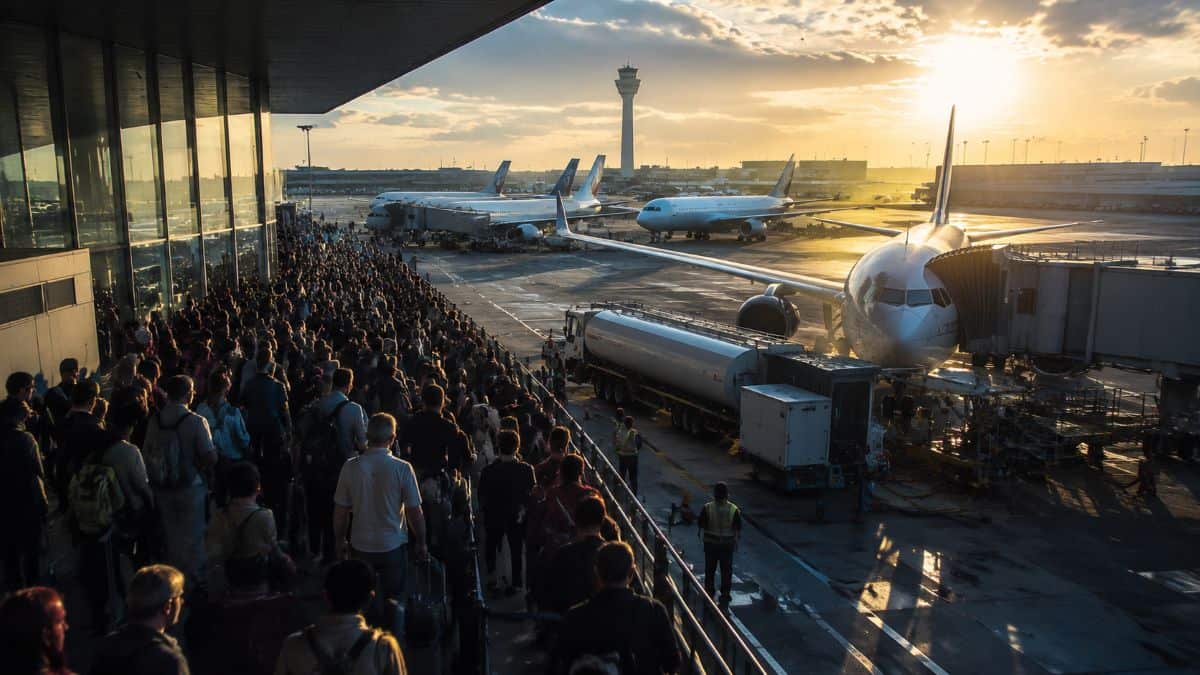
Image generated with Ai
Europe averted a jet fuel crisis in 2026 despite extreme pressure from a summer travel surge that pushed the aviation system to the edge. Germany, the UK, Spain, France and other major economies faced supply strain due to tight global oil markets and Middle East transit disruptions. The International Energy Agency (IEA) had warned of a possible six-week jet fuel supply window and falling inventory levels near a critical 23-day threshold.
The crisis was avoided through rapid refinery output increases, diversified fuel imports from the US, Africa and intra-European sources, and coordinated airline responses including capacity cuts and fuel efficiency measures. These combined actions prevented airport fuel shortages, mass cancellations and system breakdown across Europe’s busiest aviation hubs during peak demand in 2026.
The crisis began when global oil supply routes were disrupted due to geopolitical instability affecting key Middle Eastern transit corridors. This included reduced fuel flows through the Strait of Hormuz, one of the world’s most critical energy chokepoints.
At the peak of concern, the International Energy Agency warned that Europe could have only “around six weeks of jet fuel supply” under prolonged disruption scenarios. Aviation analysts also flagged that inventories could fall below the critical 23-day threshold, a level often associated with operational stress for airline networks.
Advertisement
Advertisement
Jet fuel prices surged sharply during this period, driven by:
Despite this, no systemic collapse occurred due to rapid market adaptation.
A key stabilising factor was Europe’s refinery response. Instead of relying heavily on imports, European refiners increased jet fuel production by shifting output priorities and maximising throughput.
Industry data from energy market reports shows:
In several cases, refinery operators reconfigured processing units to optimise kerosene yields, a technically complex adjustment requiring real-time coordination between traders and engineers.
This refinery surge played a decisive role in preventing shortages at major aviation hubs including Frankfurt, Paris, Amsterdam, and Madrid.
With Middle Eastern supply routes disrupted, Europe rapidly diversified its fuel imports.
Alternative supply sources included:
This diversification reduced dependency on any single corridor and allowed fuel to continue flowing into major hubs despite global uncertainty.
According to energy trade monitoring bodies, this shift marked one of the fastest aviation fuel rerouting responses in recent European history.
The European Commission confirmed that while risks were elevated, no formal fuel shortage emergency was declared across the EU aviation system.
Airlines did not wait for shortages to materialise. Instead, they implemented pre-emptive operational adjustments across European networks.
Key actions included:
These steps allowed airlines to preserve core operations while managing cost volatility.Country Airline / Carrier Type Capacity Cuts (Route Strategy) Fuel Efficiency Measures Operational Focus UK British Airways, easyJet Reduced low-margin European short-haul routes; trimmed seasonal leisure frequencies Aggressive tankering on select EU routes; improved long-haul load factors Protect long-haul profitability + Heathrow hub stability Germany Lufthansa Group Reduced short-haul feeder routes; seasonal route recalibration in leisure markets Optimised routing via Frankfurt/Munich hubs; fleet fuel burn optimisation Hub efficiency + network balancing France Air France-KLM (France ops) Limited capacity on secondary European routes; seasonal schedule smoothing Increased fuel planning efficiency; selective tankering on high-cost corridors Protect Paris hub + transatlantic connectivity Spain Iberia, Vueling Reduced low-yield intra-Europe flights; adjusted summer tourist frequency Mediterranean route optimisation; improved aircraft utilisation rates Tourism demand alignment + cost control Italy ITA Airways, regional carriers Reduced domestic and island route frequencies (Sicily/Sardinia focus) Fuel-efficient routing across Mediterranean corridors Island connectivity + seasonal demand balancing Netherlands KLM Selective European route reductions; maintained core intercontinental network Schiphol-based fuel optimisation; high load-factor scheduling Transit hub protection Belgium Brussels Airlines Minor European frequency reductions on low-demand routes Optimised EU hub connections; improved fuel planning coordination EU transfer hub efficiency Greece Aegean Airlines, Olympic Air Reduced ultra-seasonal island flight frequencies Short-haul fuel optimisation; island-to-mainland efficiency planning Tourism season management Portugal TAP Air Portugal Adjusted European feeder routes; limited low-yield summer expansion Atlantic routing optimisation; improved long-haul fuel efficiency Transatlantic corridor stability Poland LOT Polish Airlines Reduced selected European feeder services Improved Warsaw hub efficiency; better fuel burn optimisation on medium-haul routes Central/Eastern Europe connectivity Sweden SAS Minor frequency reductions on regional routes Nordic routing efficiency improvements; fleet optimisation Stability-focused restructuring Norway Norwegian Air Shuttle Selective leisure route trimming Fuel-efficient point-to-point network optimisation Cost-sensitive leisure market control
Even without physical shortages, fuel cost volatility created upward pressure on ticket pricing.
Observed market effects included:
Budget carriers, which rely heavily on tight cost structures, were particularly exposed, leading to selective route trimming and schedule optimisation.
Despite this, demand remained strong, with summer travel bookings across Mediterranean destinations still near record levels.
The aviation system came under pressure due to a rare combination of structural vulnerabilities:
At the height of uncertainty, analysts warned that continued disruption could have triggered:
However, these scenarios were avoided through rapid coordination between governments and industry.
Not all countries faced equal risk during the pressure phase.
This uneven exposure required targeted logistical coordination to prevent bottlenecks at critical hubs.Country Exposure Level Key Risk Drivers Supply Strength Factors Overall Situation 🇬🇧 United Kingdom High Heavy import dependence, limited domestic refining buffer, exposure to global price shocks Strong airport infrastructure but reliant on imports via European and global supply chains Most vulnerable among major aviation hubs 🇩🇪 Germany Moderate High demand hub pressure, refinery constraints during maintenance cycles Strong industrial refining base, diversified inland logistics Balanced but sensitive to disruptions 🇫🇷 France Moderate Peak summer tourism demand, refinery outages during maintenance windows Significant domestic refining capacity and strategic reserves Stable but periodically strained 🇪🇸 Spain Moderate High seasonal tourism load, island-region supply logistics complexity Strong refining sector and Mediterranean import access Generally resilient with localized pressure 🇮🇹 Italy Moderate–High Island geography constraints (Sicily, Sardinia), import reliance Moderate refining capacity, multiple port entry points Vulnerable during peak travel surges 🇳🇱 Netherlands Low–Moderate Transit-heavy aviation hub (Schiphol), high throughput pressure Strong refining and logistics integration (Rotterdam hub advantage) Efficient but congestion-sensitive 🇧🇪 Belgium Low–Moderate High transit aviation exposure via Brussels hub Strong EU logistics integration Stable supply with external dependency 🇬🇷 Greece High Island geography, tourism-driven seasonal spikes, fragmented logistics Limited refining base, heavy import reliance Structurally vulnerable in peak season 🇵🇹 Portugal Moderate–High Atlantic positioning, import dependency, tourism season spikes Limited refining scale, but stable port access Sensitive during high demand months 🇵🇱 Poland Moderate Rising aviation demand, regional logistics constraints Growing refining capacity, improving infrastructure Improving resilience but still developing 🇸🇪 Sweden Low Lower demand volume, strong import diversification Stable logistics and Nordic energy coordination Low systemic risk 🇳🇴 Norway Low Strong energy exporter status offsets aviation fuel constraints Robust energy sector integration Highly stable supply environment
Even though the immediate crisis was avoided, structural challenges remain deeply embedded:
Energy analysts consistently warn that these structural issues mean Europe remains vulnerable to future shocks, especially during high-demand travel seasons.
Key institutions maintain a cautious tone:
The consensus is clear: Europe is stable for now, but operating close to capacity limits.
The 2026 summer travel season represents one of the most demanding periods for aviation since pre-pandemic recovery cycles stabilised.
Key demand indicators include:
This surge coincided directly with fuel market stress, creating a near-perfect pressure test for Europe’s aviation system.
While Europe successfully avoided jet fuel chaos, analysts caution that the underlying risk remains.
Future triggers could include:
Any of these factors could quickly reintroduce volatility into the system.
In conclusion, Germany joins UK, Spain, France and others as Europe averts a jet fuel crisis amid a severe summer travel surge that pushed the aviation system to the edge in 2026. The headline risk emerged from tight global oil markets, disrupted Middle Eastern supply routes, and soaring seasonal demand, which together threatened widespread aviation instability across Europe’s busiest hubs.
However, Europe avoided the jet fuel crisis because coordinated refinery output increases, rapid import diversification, and strategic fuel allocation across major economies ensured continuous supply flow. Airlines also played a critical role by cutting low-margin routes, optimising fuel usage, and adjusting capacity during peak pressure periods. These combined actions stabilized the system and prevented airport fuel shortages, mass cancellations, and operational breakdowns. Ultimately, Europe averted the jet fuel crisis through synchronized industrial, governmental, and airline responses, keeping the aviation network functional despite extreme summer travel pressure in 2026.
Advertisement
Advertisement
Advertisement













Saturday, September 5, 2026

Friday, September 4, 2026

Saturday, September 5, 2026

Saturday, September 5, 2026

Thursday, September 3, 2026

Wednesday, September 2, 2026

Saturday, September 5, 2026

Saturday, September 5, 2026


