

Sri Lanka Takes on Thailand and Other Asian Tourism Hotspots With Free 30-Day Visas: The Full List of Countries Revealed Here!

Published
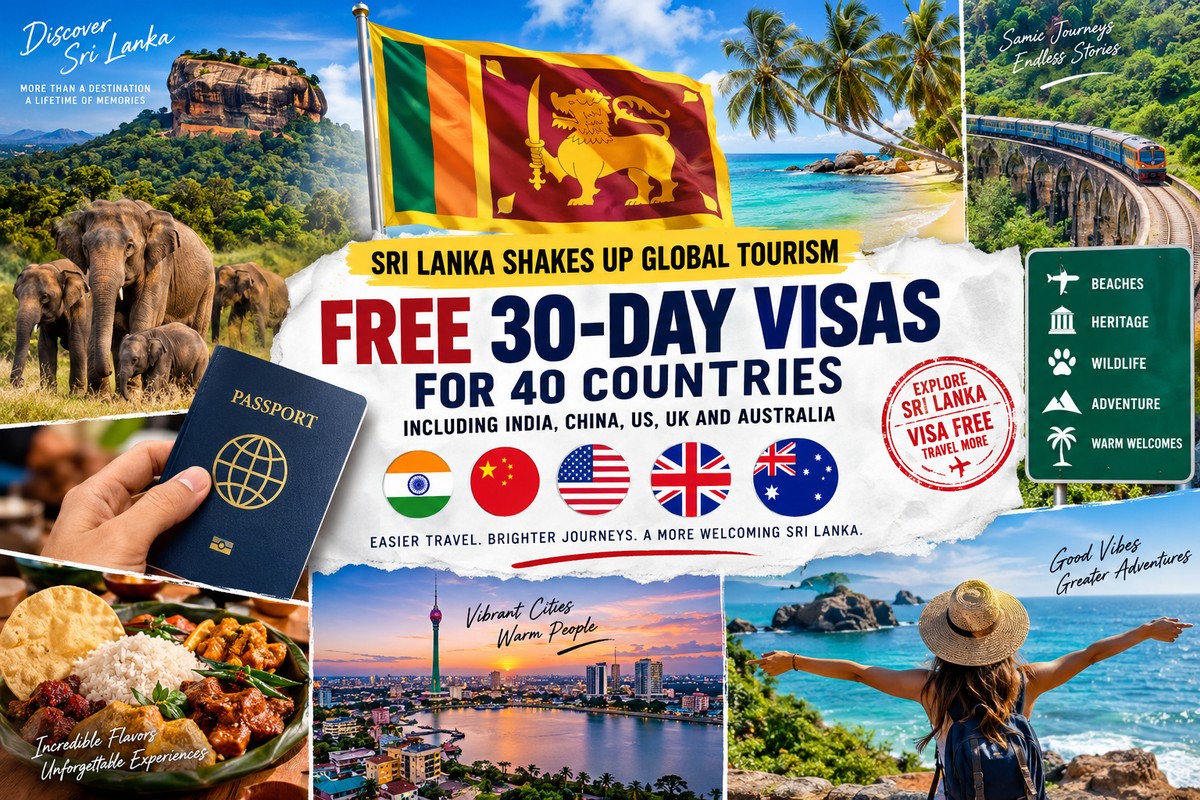
Sri Lanka is expanding international travel opportunities through a free tourist visa initiative designed to make the island nation more accessible to visitors from major global markets. The policy covers countries across Asia, Europe, North America, the Middle East and Oceania, creating opportunities for leisure travelers seeking beach vacations, cultural experiences and nature-based tourism. Introduced on May 25, 2026, the policy targets major international visitor markets. Travelers can explore pristine beaches, ancient heritage sites and spectacular wildlife destinations without paying tourist ETA fees. However, advance electronic travel authorization remains mandatory for most visitors. As regional competition intensifies, this ambitious strategy could strengthen hospitality businesses, attract holidaymakers and accelerate economic recovery through sustained visitor spending.
However, the initiative comes during a period of uneven tourism performance. Official figures show that Sri Lanka welcomed more than 1.53 million international visitors during the first eight months of 2026, although monthly growth varied considerably.
Advertisement
Advertisement
Sri Lanka Expands Free 30-Day Tourist Visas to 40 Countries in 2026
| No. | Country | Region | Free Visa Duration |
|---|---|---|---|
| 1 | Australia | Oceania | 30 days |
| 2 | Austria | Europe | 30 days |
| 3 | Bahrain | Middle East | 30 days |
| 4 | Belarus | Europe | 30 days |
| 5 | Belgium | Europe | 30 days |
| 6 | Canada | North America | 30 days |
| 7 | China | East Asia | 30 days |
| 8 | Czech Republic | Europe | 30 days |
| 9 | Denmark | Europe | 30 days |
| 10 | Finland | Europe | 30 days |
| 11 | France | Europe | 30 days |
| 12 | Germany | Europe | 30 days |
| 13 | India | South Asia | 30 days |
| 14 | Indonesia | Southeast Asia | 30 days |
| 15 | Iran | Middle East | 30 days |
| 16 | Israel | Middle East | 30 days |
| 17 | Italy | Europe | 30 days |
| 18 | Japan | East Asia | 30 days |
| 19 | Kazakhstan | Central Asia | 30 days |
| 20 | Kuwait | Middle East | 30 days |
| 21 | Malaysia | Southeast Asia | 30 days |
| 22 | Nepal | South Asia | 30 days |
| 23 | Netherlands | Europe | 30 days |
| 24 | New Zealand | Oceania | 30 days |
| 25 | Norway | Europe | 30 days |
| 26 | Oman | Middle East | 30 days |
| 27 | Pakistan | South Asia | 30 days |
| 28 | Poland | Europe | 30 days |
| 29 | Qatar | Middle East | 30 days |
| 30 | Russia | Europe / Asia | 30 days |
| 31 | Saudi Arabia | Middle East | 30 days |
| 32 | South Korea | East Asia | 30 days |
| 33 | Spain | Europe | 30 days |
| 34 | Sweden | Europe | 30 days |
| 35 | Switzerland | Europe | 30 days |
| 36 | Thailand | Southeast Asia | 30 days |
| 37 | Türkiye (Turkey) | Europe / Asia | 30 days |
| 38 | United Arab Emirates | Middle East | 30 days |
| 39 | United Kingdom | Europe | 30 days |
| 40 | United States | North America | 30 days |
Why Has Sri Lanka Introduced Free 30-Day Tourist Visas for 40 Countries?
Sri Lanka‘s decision to provide free tourist visas reflects a broader effort to strengthen international tourism, encourage visitor spending and make travel planning more convenient.
Visa fees represent one of several expenses international travelers consider when choosing destinations. Removing this charge can make a country more attractive, particularly to families, budget-conscious visitors and travelers comparing several Asian destinations.
Advertisement
Advertisement
The initiative also supports Sri Lanka’s efforts to position itself as a competitive vacation destination. Its tourism industry depends on international demand for coastal resorts, heritage attractions, wildlife experiences and cultural tours.
By extending free visas to 40 countries, the government is targeting both established and developing visitor markets.
Advertisement
Advertisement
The Department of Immigration and Emigration announced the policy on May 24, 2026, with implementation beginning the following day.
Although the processing fee has been removed, tourists must still comply with entry requirements. The government has therefore simplified the cost of access without eliminating immigration screening.
Which 40 Countries Can Now Travel to Sri Lanka With Free Tourist Visas?
The 2026 policy covers several of Sri Lanka’s important international tourism markets, including India, China, Germany, France, Russia, the United States, Canada and Australia.
It also extends free tourist visa eligibility to countries in the Middle East, Southeast Asia and Central Asia.
The complete official list includes:
| Region | Countries eligible for free 30-day tourist visas |
|---|---|
| South Asia | India, Nepal, Pakistan |
| East Asia | China, Japan, South Korea |
| Southeast Asia | Indonesia, Malaysia, Thailand |
| Europe | Austria, Belarus, Belgium, Czech Republic, Denmark, Finland, France, Germany, Italy, Netherlands, Norway, Poland, Spain, Sweden, Switzerland, United Kingdom |
| North America | Canada, United States |
| Oceania | Australia, New Zealand |
| Middle East | Bahrain, Iran, Israel, Kuwait, Oman, Qatar, Saudi Arabia, United Arab Emirates |
| Central Asia | Kazakhstan |
| Transcontinental markets | Russia, Turkey |
The policy applies to eligible nationals holding ordinary, diplomatic, official or service passports.
Advertisement
Advertisement
All 40 countries receive the same basic tourist entitlement: a free 30-day visa obtained through the Electronic Travel Authorization system.
This approach allows Sri Lanka to reach numerous markets without introducing different tourist visa fees for each participating nationality.
How Do Singapore, Seychelles and the Maldives Benefit From Separate Visa Arrangements?
Sri Lanka’s free tourist visa framework extends beyond the 40 countries covered by the May 2026 expansion.
Singapore, Seychelles and the Maldives qualify under separate reciprocal arrangements. These arrangements provide free tourist authorization but include different permitted stay periods.
Citizens of Singapore and Seychelles can obtain free tourist ETAs for 30 days. Maldivian nationals receive a longer 90-day tourist visa through the same authorization system.
| Country | Free tourist visa duration | Arrangement |
|---|---|---|
| Singapore | 30 days | Reciprocal agreement |
| Seychelles | 30 days | Reciprocal agreement |
| Maldives | 90 days | Reciprocal agreement |
These agreements bring the total number of eligible nationalities to 43.
Advertisement
Advertisement
The arrangements are particularly relevant to regional tourism connectivity, as shorter international journeys can support weekend vacations, family visits and multi-destination itineraries.
However, travelers from these three countries must still obtain ETA approval before arrival unless they qualify for a specific exemption.
The longer allowance for Maldivian citizens is an important exception to the standard 30-day policy.
How Will Free Tourist Visas Improve Travel Opportunities for India, China and Other Asian Countries?
Asian countries are among the most strategically important markets included in Sri Lanka’s free tourist visa initiative.
India benefits from geographical proximity, existing aviation connections and strong cultural relationships with Sri Lanka. Removing tourist visa fees makes short international vacations more economical for Indian families, couples and independent travelers.
China represents another significant opportunity. Chinese travelers interested in cultural attractions, beach resorts and organized vacation packages can now obtain their tourist ETAs without paying the processing fee.
Advertisement
Advertisement
Japan and South Korea also qualify, creating additional opportunities for high-value leisure tourism.
Meanwhile, Indonesia, Malaysia and Thailand could benefit from stronger regional vacation demand. These countries have established international travel markets and connections with the broader Asian tourism network.
Nepal and Pakistan are also included, expanding access for South Asian travelers.
However, the effectiveness of the policy will depend on air connectivity, travel affordability and destination marketing. Free visas can encourage travel interest, but they do not guarantee additional bookings.
Why Are the United States, United Kingdom and European Countries Important to Sri Lanka’s Tourism Strategy?
Sri Lanka’s inclusion of the United States, United Kingdom, Canada and several European countries reflects the importance of long-distance international tourism.
Travelers from these markets frequently consider destinations offering combinations of coastal relaxation, cultural experiences, wildlife encounters and distinctive accommodations.
Advertisement
Advertisement
Sri Lanka offers these experiences across a relatively compact island, allowing visitors to combine several destinations during one vacation.
The United Kingdom has established historical, cultural and travel connections with Sri Lanka. Germany, France, Italy and the Netherlands are also relevant markets for European leisure tourism.
The visa initiative extends to Nordic countries, including Sweden, Norway, Denmark and Finland, where international winter vacations can create opportunities for tropical destinations.
American and Canadian travelers may also find the waiver useful when planning longer Asian itineraries.
However, the actual financial saving from a free visa is only one consideration for long-haul visitors. Airfares, travel time, accommodation costs and flight availability often have a greater influence on destination choices.
What Do Sri Lanka’s Latest 2026 Tourist Arrival Figures Reveal About the Market?
Sri Lanka’s official tourism statistics reveal a destination experiencing both growth and periods of declining international demand.
Advertisement
Advertisement
According to the Sri Lanka Tourism Development Authority, the country recorded 1,535,122 international tourist arrivals between January and August 2026.
January welcomed 277,327 visitors, representing a 9.7% increase compared with the corresponding month in 2025. February recorded 279,328 arrivals, an increase of 16.2%.
However, March experienced a 19.8% decline, followed by a 22.3% decrease in April.
May registered positive annual growth of 9.6%, while June, July and August recorded further year-over-year declines.
| Month | 2026 arrivals | Annual change |
|---|---|---|
| January | 277,327 | +9.7% |
| February | 279,328 | +16.2% |
| March | 183,979 | -19.8% |
| April | 135,643 | -22.3% |
| May | 145,745 | +9.6% |
| June | 124,551 | -9.9% |
| July | 196,845 | -1.7% |
| August | 191,704 | -3.3% |
| Total | 1,535,122 | — |
These fluctuations demonstrate why visa liberalization cannot be evaluated through a single month’s performance. Broader economic conditions, aviation schedules and seasonal travel patterns must also be considered.
How Can Travelers Apply for Sri Lanka’s Free 30-Day Tourist Visa?
Eligible travelers can apply for their free tourist Electronic Travel Authorization through Sri Lanka’s official immigration website.
Advertisement
Advertisement
The application process begins at eta.gov.lk, where applicants provide personal identification, passport information and other required travel details.
For eligible nationalities, the tourist ETA processing fee is waived.
However, free authorization does not mean unconditional entry.
Travelers must comply with immigration requirements, including holding appropriate travel documents and demonstrating that they meet the conditions for a temporary visit.
Air passengers should be able to present a return or round-trip ticket. Visitors must also have sufficient financial resources to cover their expenses.
The tourist authorization permits two entries within the original 30-day period. A second entry does not establish a new 30-day stay.
Advertisement
Advertisement
Travelers requiring additional time can apply for a visa extension, subject to applicable charges.
The official rules also prohibit employment outside the activities permitted under the tourist authorization.
Which Sri Lankan Destinations Could Benefit Most From Easier International Access?
Sri Lanka’s tourism attractions extend well beyond its main international gateway in Colombo.
The island offers historical cities, coastal resorts, mountain landscapes, religious landmarks and protected natural areas.
Among its most internationally recognizable attractions is Sigiriya Rock Fortress, where visitors can explore an ancient royal complex surrounded by distinctive landscapes.
The cultural city of Kandy attracts visitors interested in traditional architecture, religious heritage and cultural experiences.
Advertisement
Advertisement
Southern coastal destinations such as Galle and Mirissa support beach tourism, boutique hospitality and marine-related excursions.
Hill-country destinations, including Ella and Nuwara Eliya, provide opportunities for hiking, scenic railway journeys and tea-estate tourism.
Wildlife tourism is another important component, with national parks attracting visitors interested in elephants, birds and other native species.
Easier entry could help spread international demand across these destinations. However, infrastructure, environmental protection and responsible visitor management remain essential to sustainable tourism development.
How Could the Visa Expansion Strengthen Hotels, Airlines and Local Tourism Businesses?
The economic significance of Sri Lanka’s free tourist visa initiative extends beyond its immigration system.
Hotels, airlines, travel agencies, transportation providers and local businesses could benefit if reduced entry costs encourage additional international visitors.
Advertisement
Advertisement
For accommodation providers, stronger tourism demand could improve room occupancy and support investment in hospitality services.
Airlines may benefit from increased interest in Sri Lanka, particularly where competitive flight connections already exist.
Tour operators could introduce vacation packages emphasizing easier entry for eligible nationalities. Such products may appeal to families, first-time visitors and travelers comparing multiple destinations.
Local businesses could also gain opportunities through increased spending on food, transportation, guided tours, handicrafts and cultural activities.
However, these outcomes remain potential benefits rather than established results of the policy.
A visa waiver does not automatically create new flights, lower accommodation prices or increase visitor spending.
Advertisement
Advertisement
For sustainable economic gains, Sri Lanka must combine accessible entry arrangements with reliable transport, quality services, effective destination promotion and responsible tourism investment.
Can Sri Lanka’s Free Visa Policy Make It More Competitive Against Other Asian Tourism Destinations?
Sri Lanka’s latest visa initiative may strengthen its appeal in an increasingly competitive Asian tourism market.
Travelers comparing regional destinations often examine total vacation costs, entry requirements, available flights, accommodation options and the range of experiences offered.
By removing tourist ETA charges for nationals of 40 countries, Sri Lanka eliminates one administrative expense from the planning process.
This can be particularly relevant for group travelers and families, where individual processing fees would otherwise accumulate.
Nevertheless, the country faces competition from destinations offering extensive international flight networks, established resorts and varied visitor experiences.
Advertisement
Advertisement
Sri Lanka’s strongest advantage may therefore be the combination of convenient entry and its distinctive tourism offering.
A traveler can explore ancient heritage sites, tropical beaches, wildlife reserves and mountainous landscapes within one country.
The long-term competitiveness of this approach will depend on service quality, accessibility and Sri Lanka’s ability to translate greater travel interest into confirmed bookings and higher tourism expenditure.
What Does Sri Lanka’s Free 30-Day Visa Expansion Mean for International Tourism in 2026?
Sri Lanka’s decision to provide free 30-day tourist visas to 40 countries marks an important step toward reducing travel costs and improving international accessibility.
The initiative includes major tourism markets such as India, China, the United States, the United Kingdom, Australia, Germany, France and Japan. Separate reciprocal arrangements further extend free authorization to Singapore, Seychelles and the Maldives.
For eligible travelers, the immediate advantage is the removal of tourist ETA processing fees. However, obtaining advance authorization and meeting immigration requirements remain necessary.
Advertisement
Advertisement
For Sri Lanka’s tourism industry, the policy offers opportunities to attract additional visitors and support hospitality, aviation and local businesses.
The country’s mixed tourism performance during the first eight months of 2026 also highlights the challenge ahead.
Ultimately, the success of the visa expansion will depend not simply on making entry cheaper, but on turning easier access into sustained visitor demand, stronger tourism revenue and lasting economic benefits.
Anup Kumar Keshan, Founder, CEO, and Editor-in-Chief of Travel And Tour World (TTW), notes, “Sri Lanka’s decision to offer free 30-day tourist visas to travelers from 40 countries marks a significant step toward strengthening its position in the global tourism market. By including major visitor markets such as India, China, the United States, the United Kingdom and Australia, the island nation is making international travel more affordable and accessible.
This initiative could create new opportunities for airlines, hotels, tour operators and local businesses while encouraging visitors to explore Sri Lanka’s pristine beaches, ancient heritage sites, wildlife reserves and breathtaking landscapes. However, the elimination of tourist visa processing fees alone cannot guarantee sustained tourism growth. Improved air connectivity, competitive travel packages, reliable infrastructure and quality hospitality services will remain essential.
With growing competition among Asian destinations, Sri Lanka’s strategy demonstrates how simplified entry policies can support tourism recovery and encourage international visitor spending. Eligible travelers must still obtain electronic travel authorization and comply with immigration requirements.
Advertisement
Advertisement
The real challenge now is transforming easier access into higher tourist arrivals, stronger economic returns and sustainable development. If supported by effective tourism promotion and responsible destination management, this policy could help Sri Lanka emerge as an increasingly attractive destination for international travelers in 2026 and beyond.”
Sri Lanka’s expanded tourist visa policy signals an ambitious effort to strengthen its position in the competitive international travel market. Rising competition, changing traveler preferences and the need for stronger tourism revenue have encouraged authorities to reduce entry costs. The solution offers eligible visitors free tourist authorization while maintaining standard immigration requirements. With 40 nationalities covered, the initiative could stimulate demand for hotels, airlines, restaurants and local attractions. However, success will depend on affordable flights, improved infrastructure and consistent visitor experiences. Ultimately, easier access creates opportunities, but sustained tourism growth requires stronger connectivity, effective promotion and responsible destination management.
Advertisement
