
Europe’s October Transport Turmoil Hits Netherlands, Belgium and France With New Staggered Strikes and Route Cuts

Published
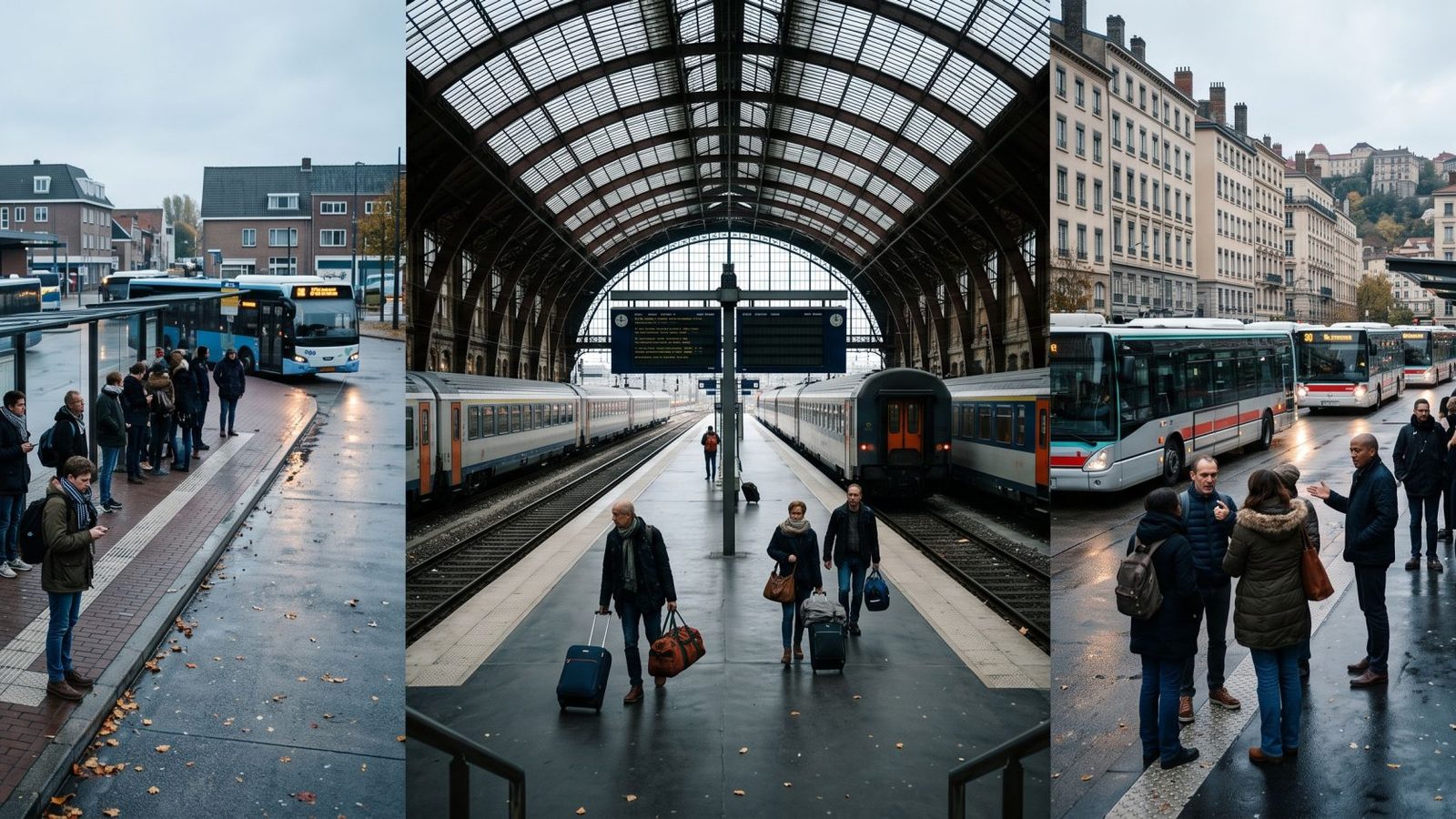
Europe transport strikes have created a difficult October for passengers in the Netherlands, Belgium and France, but the disruption is not one coordinated shutdown. Dutch regional transport workers are striking on 14 October 2026 after collective agreement talks failed. Belgium experienced separate bus, rail and public-sector actions between 8 and 12 October.
France is preparing for serious disruption to Lyon buses on 15 October, following smaller local incidents elsewhere. The result is missing services, reduced timetables and uncertain connections. Official unions, operators and government notices explain both the scale of the problem and why the three disputes must be distinguished.
Advertisement
Advertisement
Why Europe’s Transport Trouble Has Arrived in Separate Waves
The dates tell the story. A spontaneous bus walkout emerged in Belgium’s Wallonia region on 8 October. Brussels faced national union mobilisation on 9 October, followed by a wider Belgian public-sector strike on 12 October. Two days later, the Netherlands nationwide bus strike put regional services under severe pressure. Lyon’s TCL operator then warned that its buses would be heavily disrupted on 15 October. These staggered events have different organisers and demands. They also affect different parts of the transport system. A closed regional bus route, a reduced national train timetable and a demonstration-related metro closure require different passenger responses.
Dutch Drivers Walk Out for 24 Hours After Talks Collapse
Unions FNV and CNV called regional public transport employees out from midnight on Wednesday, 14 October, until midnight on Thursday, 15 October. The action follows eight negotiating rounds without a replacement for the collective agreement that expired on 30 June. The unions say employers failed to address their longstanding objections before an October ultimatum expired. The national journey planner 9292 warned that buses would not operate across much of the country, although exceptions remained. The strike covers a range of regional operators. It does not mean that every bus, tram, metro service or train in the Netherlands has stopped running.
Advertisement
Advertisement
Roster Changes and Retirement Protections Drive the Dutch Dispute
Pay matters, but the Dutch dispute reaches deeper into working life. FNV says employers want greater flexibility over duty announcements, potentially reducing notice to just 24 hours under certain arrangements. It also objects to proposals affecting unpaid breaks and schemes protecting older staff. The union is seeking a 6% pay rise to protect purchasing power. CNV has pursued its own wage and employment demands. Operators, represented through the employers’ association VWOV, argue that high costs and financial pressure make agreement difficult. These are competing negotiating positions, not changes already imposed through a completed contract. Their disagreement explains the industrial action.
Arriva, EBS, Keolis and Qbuzz Face Uneven Route Cuts
The Dutch network has not shut uniformly. According to 9292, Arriva buses in Noord-Brabant were not scheduled to run, while Achterhoek buses were expected to continue. Other Arriva territories faced possible cancellations. In Haaglanden, EBS planned to operate only routes 30, 31, 43, 45, 455, 456, 826 and 827 on an amended timetable. Keolis warned of fewer services in Almere and Utrecht, while Qbuzz anticipated possible reductions across several northern and western regions. Transdev brands Connexxion and Hermes were also affected. The lesson for passengers is simple: a national strike label cannot reliably describe individual local routes and actual departures.
Advertisement
Advertisement
Amsterdam and The Hague Differ From Rotterdam’s Bus Situation
City boundaries provide another crucial distinction. Amsterdam’s GVB and The Hague’s HTM operate under separate municipal employment arrangements, so their city networks were not part of the same regional walkout. Rotterdam requires more precise wording. Although its municipal transport also follows a different collective agreement, 9292 reported that RET buses and neighbourhood buses would not operate on 14 October. RET trams and metro services were expected to continue. Passengers reaching a major station could therefore still face difficulties completing a journey by bus. Describing all three cities as fully unaffected would hide the most useful practical information for affected travellers.
Regional Rail and Utrecht Trams Add to Dutch Uncertainty
The Netherlands’ national railway operator NS said its own trains would follow the normal timetable. Regional rail was a different matter. Arriva trains in Limburg were suspended, while some services in Achterhoek-Rivierenland faced possible cancellations. Keolis also warned of a thinner Blauwnet and RRReis timetable. In Utrecht, U-OV suspended tram lines 20 and 22, while line 21 depended on the availability of drivers. Several buses remained conditional, with many routes cancelled outright. This makes the last connection especially vulnerable. A passenger may reach Utrecht or another busy regional hub by train and still struggle to travel onwards without a bus.
Advertisement
Advertisement
Dutch Holiday Travel Exposes a Wider Accessibility Problem
The strike coincides with the northern Netherlands’ autumn school break, scheduled for 10–18 October. That creates potential problems for families taking day trips and visitors relying on buses from railway stations to accommodation or attractions. The pressure also exposes a longer-running policy concern. In its 5 October assessment of public transport, the Dutch government identified staffing shortages, declining service availability and funding pressures. It outlined structural investment of €300 million in regional accessibility. This is not money earmarked for settling drivers’ pay claims. It instead shows why reliable regional mobility has become an urgent national policy priority for officials.
Belgium Experienced Three Different Actions Within Five Days
Belgium public transport disruptions followed a separate sequence. Workers at several Walloon LETEC depots began spontaneous action on 8 October. Trade unions then organised a national mobilisation centred on Brussels on 9 October. A further nationwide public-sector strike followed on Monday, 12 October, affecting trains, buses, trams and metros. These dates matter. The Belgian nationwide actions were not newly beginning on 14 October, when the Dutch strike took place. Nor did every Belgian operator face identical cancellations. SNCB, De Lijn, STIB-MIVB and LETEC each issued their own travel information, reflecting different levels of workforce participation and route availability across regions.
Walloon Bus Staff Challenged Changes to Collective Agreements
The Walloon LETEC dispute offers the closest Belgian parallel to the Dutch negotiations. Public-services union CGSP said talks had continued since February over four collective arrangements, including end-of-career provisions and funds benefiting employees. According to its 8 October statement, management’s position on ending an existing retirement-related agreement after December heightened tensions. Some depot staff responded with spontaneous industrial action. The dispute concerns the conditions attached to employment, rather than a general decision to close regional transport. It also remained distinct from the broader Belgian demonstrations against federal policy. That separation is essential when explaining the actual reasons behind the walkouts.
Government Reforms Fuelled Belgium’s Wider Union Mobilisation
Belgium’s 9 and 12 October actions reflected wider opposition to proposed government measures. FGTB criticised potential changes to automatic wage indexation, VAT and working-time arrangements. Public-sector unions also raised concerns about pensions, sick-leave protections and spending cuts. An official Belgian strike advisory issued by Poland’s government confirmed those issues and warned travellers about disruption to SNCB rail services, Brussels public transport, De Lijn and TEC. The advisory supports the reasons for the planned action; it does not establish that every service was cancelled. These were contested policy proposals, not a single new law already implemented across the national transport industry.
Advertisement
Advertisement
Wallonia’s Reform Plans Show Why Reliability Is Now Political
Wallonia’s government has considered how to keep essential transport available during future walkouts. Its April 2026 proposed LETEC service contract called for a guaranteed reduced network during strikes, with advance information about operating routes. The plan envisaged at least 48 hours’ notice and an updated framework with representative trade unions by the end of 2027. It also targeted better bus connections at railway stations and dedicated links to tourism and employment centres. These are proposed reforms, not evidence that guaranteed service existed during October’s walkouts. Their importance lies in the continuing debate over passenger reliability, public funding and workers’ rights.
Belgian Rail Passengers Faced a Drastically Reduced Timetable
SNCB’s figures show how severely the 12 October strike challenged travel planning. The national operator prepared an alternative timetable providing approximately seven in ten InterCity trains, one in two local and suburban trains, and only one in five peak-hour services. The railway action began at 22:00 on Sunday, 11 October. SNCB and infrastructure manager Infrabel prepared the plan using declarations from staff available to work. These were published service expectations, not independently audited final cancellation totals. For passengers, fewer local and rush-hour trains meant greater uncertainty over connections even when many major city-to-city journeys remained possible for some travellers.
Brussels Metro and Tram Restrictions Shifted Between Strike Days
Brussels saw different operating patterns on 9 and 12 October. STIB-MIVB initially expected only metro lines 1 and 5 to operate on 9 October, alongside a small selection of tram and bus routes. Night bus services were suspended. On 12 October, the operator reported that all metro lines were running, albeit less frequently. Tram lines 18, 35, 39, 44, 51 and 93 were suspended under its later update, while buses generally operated at sharply reduced frequency. A journey that worked on one strike day might have failed on the other. Checking the date and route was therefore essential for passengers.
Flanders’ Buses and Belgium’s International Links Also Suffered
De Lijn, which runs buses and trams across Flanders, announced serious timetable disruption for both 9 and 12 October. It prepared alternative services using available staff and warned that last-minute cancellations remained possible. The effects went beyond domestic journeys. Eurostar confirmed that some trains to and from Brussels were cancelled on 12 October because of the Belgian strike.
Brussels Airport separately reported some flight cancellations on 9 October linked to participation by employees of ground handler Alyzia. The airport did not expect comparable direct flight disruption on 12 October, although access by public transport could still be difficult for travellers.
Lyon’s 15 October Bus Strike Brings France Into Focus
France’s clearest new transport strike warning concerns Lyon. TCL confirmed that buses in zones 1 and 2 would face serious disruption on Thursday, 15 October, during an industrial action period running from 04:30 until 01:30 the following day. Its notices listed C26 and 116 among services suspended, while routes including 126 faced reduced frequencies.
Advertisement
Advertisement
Metropolitan mobility authorities also flagged the disruption. Importantly, the notices do not spell out a verified list of wage or roster demands. The strike is therefore confirmed, but its precise bargaining cause should not be guessed or presented as identical to the Dutch dispute.
Paris, Grenoble and the Paris Suburbs Tell a Different Story
Elsewhere in France, the picture was more localised. The municipality of Houilles reported a Keolis bus strike affecting parts of the Argenteuil Boucles de Seine network on 9 October, with roughly one third of journeys expected to be cancelled on specified routes. RATP reported Paris metro station closures and bus diversions linked to demonstrations on 13 October.
Grenoble’s M réso network also changed tram and bus services during demonstrations, while Angers operator Irigo warned of diversions. These were real passenger difficulties for people needing reliable connections. Yet a protest-related closure cannot automatically be described as a strike by transport employees.
French Aviation Warnings Must Not Be Confused With Rail Strikes
French transport headlines can become misleading when separate events are combined. Air Corsica said a pilots’ strike had ended after an agreement, with regular flying expected to resume on 13 October. Separately, aviation union SNPNC-FO suspended a previously announced strike notice for 17–21 October after discussions about retirement arrangements. Neither event proves an ongoing nationwide French airline stoppage on 14 October. The same caution applies to rail.
Eurostar reported engineering-related changes on parts of the French network during October. Those works may disrupt passengers, but they are not evidence of a national railway strike caused by French transport workers.
European Train and Bus Cancellations Reveal a Cross-Border Risk
European train and bus cancellations become especially disruptive when passengers depend on several networks for one journey. A Brussels-bound Eurostar service can be cancelled by industrial action in Belgium while French rail operators continue running. A Dutch NS train can operate normally even if the regional bus needed for the final miles does not.
Advertisement
Advertisement
Searches for France bus and rail disruptions should likewise distinguish a verified Lyon bus strike from separate maintenance works and city demonstrations. These differences matter to tourists, commuters and international travellers. The headline may concern three countries, but the practical risk lies in every uncertain connection.
What Travellers Should Do as More Strike Threats Emerge
Passengers should check individual operator applications immediately before leaving, not rely solely on a normal timetable saved earlier. In the Netherlands, 9292 and the relevant bus company publish route exceptions. In Belgium, SNCB, STIB-MIVB, De Lijn and LETEC provide revised services. For Lyon, TCL’s line notices are essential for 15 October.
FNV and CNV have warned that further Dutch action could follow; Belgian unions have also raised the possibility of a November general strike. Neither warning makes future dates automatically certain. Europe transport strikes are serious, but accurate dates, verified causes and real route information matter more than alarming generalisations.
Advertisement
