
Jamaica’s Hotels Face a New US Tourism Test as Google AI Mode Hotel Booking Goes Live

Published
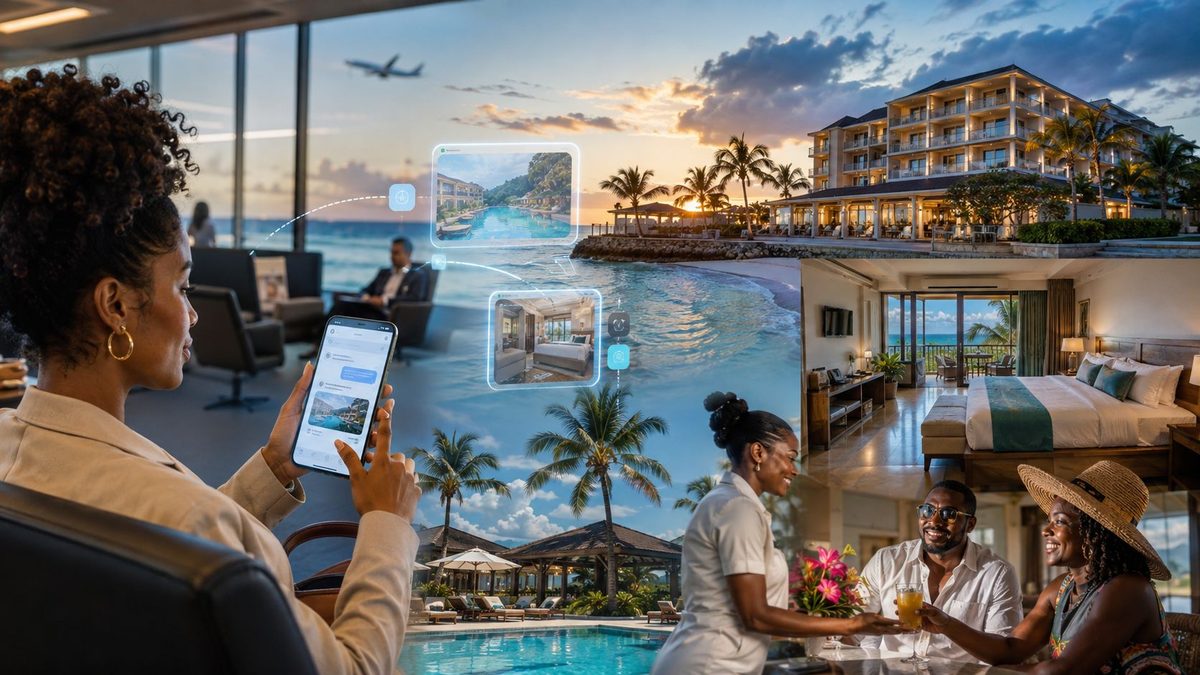
Image generated with Ai
Google AI Mode hotel booking is moving travel search closer to the transaction, potentially changing how Americans choose Jamaican accommodation. Google began rolling out hotel reservations within AI Mode in the United States on August 27, 2026. Travellers can describe their preferences conversationally, compare properties and review room details before booking. Supported reservations can then continue through Google with Google Pay. The initial ecosystem includes major hotel groups and online travel agencies.
The development matters disproportionately to Jamaica. The United States remains the island’s dominant tourism source market, accounting for about 74% of arrivals in recent official reporting. Jamaica recorded 2.6 million stopover visitors in 2025, despite disruption from Hurricane Melissa. Tourism earnings reached an estimated US$4.09 billion.
Advertisement
Advertisement
For Jamaican hotels, the issue is therefore larger than another Google feature. The interface where travellers make decisions is changing.
Google Is Bringing Booking Into Conversation
Until recently, hotel discovery followed a familiar digital sequence. Travellers searched destinations, opened hotel websites, checked reviews and compared rates. They then moved between booking platforms before completing a reservation.
Advertisement
Advertisement
AI Mode compresses much of that journey.
Advertisement
Advertisement
A traveller can describe a holiday in ordinary language. They might request an adults-only, beachfront, all-inclusive property near Montego Bay. They could also specify a nightly budget, food ratings and airport transport.
Google can interpret those preferences and produce a curated selection. Travellers can then refine their request through follow-up questions. The system can surface reviews, amenities and other comparison factors before booking.
For supported properties, the process moves further. Travellers can choose room types, examine cancellation conditions and review pricing. They can then continue through Google and pay using Google Pay.
The transaction does not make Google the hotel operator. Google states that the hotel or booking platform remains the merchant of record and handles customer service.
That distinction matters. Google increasingly controls discovery and decision-making, while its partners continue handling fulfilment.
Advertisement
Advertisement
Jamaica’s US Market Makes This Significant
Jamaica has a particularly strong reason to watch this development closely.
The US has consistently supplied the overwhelming majority of Jamaica’s visitors. Official Jamaican tourism figures placed the US share at 74% of total arrivals in 2024. Canada followed with 12.9%.
Earlier Ministry of Tourism figures also showed the US accounting for roughly 73% of stopover visitors. Approximately 2.1 million Americans visited Jamaica as stopover tourists in 2023.
The commercial exposure is substantial.
| Jamaican Tourism Indicator | Latest Official Figure | Why It Matters |
|---|---|---|
| 2025 total visitors | 3.7 million | Shows the scale of the tourism economy |
| 2025 stopover visitors | 2.6 million | Core accommodation market |
| 2025 cruise visitors | 1.1 million | Significant but less directly hotel-dependent |
| 2025 tourism earnings | US$4.09 billion | Demonstrates economic importance |
| US share of arrivals | About 74% | Highlights exposure to US travel behaviour |
| 2024 stopover visitors | About 2.9 million | Demonstrates pre-2025 accommodation demand |
| 2024 cruise passengers | About 1.25 million | Illustrates broader visitor scale |
| International gateways | More than 55 projected in 2025 | Expands destination accessibility |
Figures compiled from Jamaica’s Ministry of Tourism.
Advertisement
Advertisement
Consequently, Jamaican hotels do not need Google to launch the feature locally before feeling its effects.
A traveller in New York can use AI Mode to research Montego Bay. A traveller in Miami can compare Negril properties. Someone in Atlanta can search for a Kingston hotel and complete a supported reservation.
The market can change before the technology reaches the destination itself.
Discovery Is Becoming The New Distribution Battle
The traditional hotel competition centred heavily on visibility.
Properties competed for Google rankings, direct traffic, OTA placement and social-media attention. However, AI introduces another layer between the traveller and the underlying inventory.
Advertisement
Advertisement
The question becomes more complicated.
Can an AI system accurately understand the hotel?
Can it identify the property’s strongest attributes?
Can it distinguish an adults-only resort from a family resort?
Can it recognise genuine beachfront access?
Advertisement
Advertisement
Can it understand whether airport transfers are included or merely available?
These details increasingly influence machine-generated recommendations.
Google already provides hotel information through its broader travel ecosystem. Its hotel booking links have historically combined pricing and availability with routes into booking channels.
AI Mode takes that model further by placing conversation around the inventory.
That means hotels must make their digital information precise, current and consistent.
Advertisement
Advertisement
What Hotels Must Get Right
A hotel cannot rely solely on a visually impressive website.
Its room descriptions need to be clear. Its amenities need to be accurate. Its policies must remain current. Its location information should match across important digital platforms.
Reviews also become strategically important.
An AI system can use reviews and other available information to help travellers compare properties. Therefore, hotels need to manage guest experience as carefully as their digital presentation.
For Jamaican operators, several areas deserve particular attention.
Advertisement
Advertisement
| Digital Factor | Traveller Question | Hotel Priority |
|---|---|---|
| Room inventory | What room can I book? | Accurate availability |
| Pricing | What will I actually pay? | Consistent rates |
| Cancellation | Can I cancel without penalty? | Clear policies |
| Location | How close is the beach or airport? | Precise descriptions |
| Amenities | Does the property meet my needs? | Updated listings |
| Accessibility | Can travellers with disabilities use facilities? | Detailed accessibility information |
| Transport | Is airport transfer available? | Clear service details |
| Dining | What food options exist? | Accurate restaurant information |
| Reviews | What do recent guests say? | Strong service delivery |
| Booking channel | Where can I complete payment? | Reliable distribution connectivity |
This is not simply a marketing exercise.
It is becoming a data quality challenge.
Smaller Jamaican Hotels Face A Test
Large hotel groups may initially have an advantage.
Google’s launch partners include Booking.com, Choice Hotels International, Expedia, Hilton, Hotels.com, IHG Hotels & Resorts, Marriott International, Priceline, Trip.com and Wyndham Hotels & Resorts.
That list includes several global distribution networks.
Advertisement
Advertisement
Independent Jamaican properties therefore face an important question. Can their inventory, pricing and property information surface with comparable clarity?
The answer may depend partly on their distribution partners.
However, smaller hotels also possess an opportunity.
AI recommendations do not necessarily require a property to be globally famous. A well-defined hotel with strong reviews and accurate attributes can potentially match a highly specific traveller request.
That creates room for differentiation.
Advertisement
Advertisement
A boutique hotel in Negril might appeal to a traveller seeking a quiet property with direct beach access. A Kingston hotel could suit someone prioritising business facilities and airport connectivity. A family resort could compete on children’s amenities rather than brand recognition.
Specificity could become a competitive advantage.
Travellers Could Gain More Control
From a consumer perspective, the change could simplify planning considerably.
Instead of opening ten tabs, travellers can explain what they want. AI Mode can then narrow the field around those preferences.
That could be particularly useful for complex hotel searches.
Advertisement
Advertisement
A traveller might request a refundable room near Montego Bay Airport. They could add a swimming pool, family-friendly facilities and a specific budget. They might then ask which options have the strongest recent reviews.
Previously, each condition could require separate searches.
Now the traveller can progressively refine the same conversation.
That creates a more natural planning process.
Nevertheless, travellers should not treat AI recommendations as an automatic guarantee of the best available deal. They should still inspect the final price, taxes, cancellation terms, room category and inclusions before paying.
Advertisement
Advertisement
Google itself says the booking process displays details such as room type and cancellation policy.
For international travel, travellers should also confirm entry requirements separately. Jamaica’s official tourism guidance says all visitors need a return or onward ticket, while requirements vary according to citizenship and residency.
The Human Travel Advisor Still Matters
The rise of conversational booking does not eliminate professional travel advice.
Instead, it could change where advisors create value.
A machine can compare hotel attributes rapidly. An experienced advisor can interpret nuances that structured data may miss.
Advertisement
Advertisement
That includes destination suitability, neighbourhood atmosphere, transfer reliability and the practical differences between resorts.
Jamaica’s tourism leadership has previously stressed the importance of travel advisors in supporting the US market. Ministry figures showed the US share of Jamaica’s visitor market rising from about 63% after the pandemic to approximately 74%.
The new technology may therefore create a hybrid model.
AI can handle discovery and comparison. Travel professionals can add judgement, reassurance and personalised expertise.
That could prove particularly valuable for luxury, multi-generational and complex Caribbean holidays.
Advertisement
Advertisement
Jamaica’s Tourism Growth Raises The Stakes
The timing is notable because Jamaica is simultaneously expanding its tourism capacity and connectivity.
In September 2025, the Ministry of Tourism projected 4.5 million visitors for the year. That included 3.1 million stopover visitors and 1.4 million cruise passengers. Jamaica also reported direct connections to more than 55 international gateways.
The island has also been diversifying its source markets.
In February 2026, Jamaica reported its strongest-ever performance from Latin American markets. Arrivals from the region increased by more than 62,000 passengers compared with the previous year.
However, the US remains pivotal.
Advertisement
Advertisement
That makes digital changes inside the American travel market especially important for Jamaican tourism businesses.
The issue is not whether Jamaica remains attractive.
The issue is how travellers encounter that attractiveness.
How Booking Has Changed Over Time
Hotel distribution has already passed through several major phases.
| Era | Main Discovery Method | Main Booking Behaviour |
|---|---|---|
| Pre-internet | Travel agents and brochures | Adviser-led booking |
| Early internet | Hotel websites | Direct research |
| OTA expansion | Expedia, Booking.com and others | Rate comparison |
| Mobile era | Apps and mobile search | Faster self-service |
| Metasearch era | Google and comparison tools | Price-led comparison |
| AI era | Conversational search | Preference-led recommendation |
| Emerging agentic era | AI interfaces | Recommendation through transaction |
The latest stage does not necessarily replace earlier channels.
Advertisement
Advertisement
Instead, it places an intelligent interface above them.
Google’s own travel strategy shows this progression. In 2025, the company said AI Mode could search across reservation platforms and websites, while future development aimed to connect travellers with flights and hotels through conversational planning.
By August 2026, hotel booking had moved into the live product.
That is a significant acceleration.
What This Means For Jamaican Hotels
For hotel executives, the strategic lesson is straightforward.
Advertisement
Advertisement
Digital visibility must evolve into digital comprehensibility.
A property needs more than a high search ranking. Its information must be structured well enough for AI systems to understand what makes the hotel relevant.
That requires cooperation across revenue management, marketing, distribution and operations.
Rate parity matters. Inventory accuracy matters. Reviews matter. Property descriptions matter. Cancellation policies matter.
Most importantly, the actual guest experience matters.
Advertisement
Advertisement
An AI recommendation can create the booking. It cannot permanently compensate for a poor stay.
The long-term winners are therefore likely to combine strong digital data with strong hospitality.
Practical Checks For Travellers Booking Jamaica
Travellers using AI-assisted hotel search should still apply conventional booking discipline.
They should compare the final payable amount rather than the headline nightly rate. They should check whether breakfast, resort fees, transfers or taxes are included.
They should verify the exact room category. A partial ocean view is not necessarily an oceanfront room.
Advertisement
Advertisement
Cancellation terms deserve equal attention. A cheaper non-refundable rate may not suit a traveller whose plans remain uncertain.
Location also deserves scrutiny. “Near Montego Bay” can describe very different travel experiences.
Finally, travellers should confirm the booking confirmation directly after payment. They should retain the reservation details and understand which company will provide customer service.
That last point matters because Google says the hotel or booking platform remains responsible for the transaction and customer support.
Jamaica Must Prepare Before The Shift
Jamaica does not need to wait for AI Mode to become available locally.
Advertisement
Advertisement
The priority should be preparation.
Hotels should audit their Google profiles and major distribution listings. They should review descriptions, amenities, room categories and policies.
They should also examine how consistently their information appears across platforms.
Tourism authorities can play a broader role by encouraging digital standards across accommodation providers. Destination-level information also needs to remain accurate.
This matters because AI recommendation systems depend on reliable information.
Advertisement
Advertisement
Jamaica has already recognised the importance of digital and physical accessibility. The Ministry has described inclusive tourism as a strategic opportunity for destination growth and diversification.
The same principle applies to AI-era distribution.
The destination must be understandable before it can be intelligently recommended.
The Booking Interface Is Changing Fast
Google’s latest move signals a wider shift in travel commerce.
The old model sent travellers from search to websites, from websites to OTAs and eventually to booking engines. The emerging model increasingly asks the interface to coordinate those steps.
Advertisement
Advertisement
For Jamaica, the implications are unusually direct.
The island depends heavily on American visitors. Its accommodation sector is expanding. Its connectivity is strengthening. Meanwhile, American travellers are gaining new tools that can compress hotel discovery and booking.
Google AI Mode hotel booking therefore represents more than a technology story.
It is a distribution story.
It is also a competitiveness story.
Advertisement
Advertisement
For travellers, the immediate promise is convenience and more personalised hotel searches. For Jamaican tourism businesses, the challenge is ensuring their properties remain visible, understandable and bookable inside increasingly intelligent digital ecosystems.
The hotels that adapt early could gain an advantage.
Those that rely only on traditional search visibility may find the rules have quietly changed.
Advertisement
