
Germany Expands Green Air-Rail Connections as Frankfurt and Munich Strengthen Hub Capacity

Published
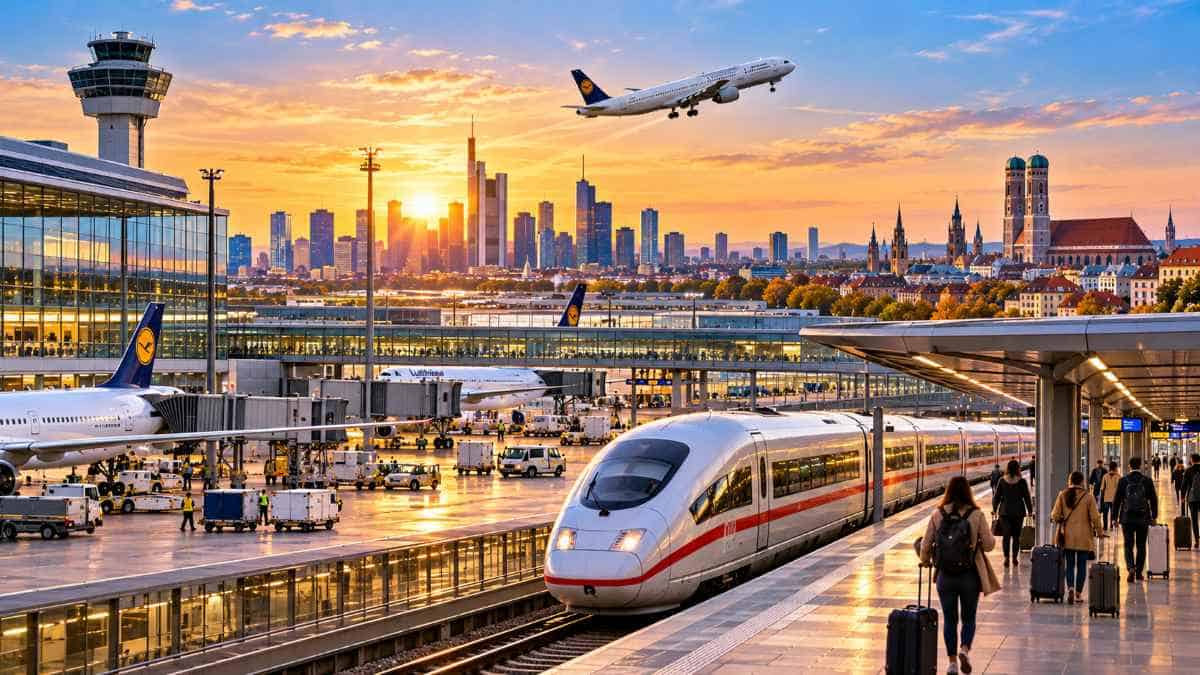
The cities of Frankfurt and Munich remain complementary centres in terms of the country’s transport infrastructure on an international level. Their airports operate as major entry points for flights to Europe and even long-haul destinations. Frankfurt International Airport is one of the leading hubs of the Lufthansa Group and one of the busiest international aviation centres in Europe. The airport has a wide-ranging network of flights that connect Germany with countries from Asia, North America, Africa and the Middle East. Access to Germany’s railway network is provided by the long-distance train station at Frankfurt International Airport, which is connected to the terminal. Munich Airport operates as another gateway airport, especially for people travelling to the southern part of Germany, Austria and other neighbouring European destinations. The connection to the Deutsche Bahn makes it possible for passengers to have combined travel options, including a railway trip to various parts of Bavaria. The connection between airports and the railway network can be used by Lufthansa to better distribute passengers.
Lufthansa Express Rail Expands the Role of Deutsche Bahn
Lufthansa Express Rail is an established partnership between Lufthansa and Deutsche Bahn that allows passengers to combine selected railway journeys with international flights through a single booking.
Advertisement
Advertisement
The service connects Frankfurt Airport with several German cities, allowing passengers to travel by ICE train before continuing their journey by air. Participating railway stations include Cologne, Düsseldorf, Stuttgart, Aachen, Hamburg, Berlin and other destinations, depending on the available timetable and service arrangements.
Passengers benefit from coordinated booking procedures and specific connection protections. These arrangements are designed to make rail-to-air transfers more convenient and provide assistance when a qualifying connection is disrupted.
Advertisement
Advertisement
The proposed expansion across Frankfurt and Munich would build on this intermodal model, with greater emphasis on replacing selected domestic feeder flights through railway connections. However, the precise routes, additional frequencies and operational arrangements described in the supplied development require confirmation.
For international visitors, the wider concept could make it easier to reach German cities without relying exclusively on domestic aviation.
Advertisement
Advertisement
ICE Rail Services Offer an Alternative to Short-Haul Flights
Deutsche Bahn’s Intercity Express (ICE) network forms the backbone of long-distance passenger rail travel in Germany. High-speed services connect major cities, including Frankfurt, Munich, Berlin, Cologne, Hamburg and Stuttgart.
For journeys between destinations with established direct railway connections, ICE services can provide an alternative to short-haul flights, particularly when airport check-in, security procedures and transfers are considered.
Advertisement
Advertisement
Frankfurt’s position within the German railway network is especially important. Frankfurt Airport’s long-distance station allows passengers to access ICE services without travelling into the city centre first.
Munich also benefits from extensive railway connections, with services linking the Bavarian capital to destinations across Germany and neighbouring countries.
For tourists, this creates opportunities to combine international arrivals with onward journeys to historic cities, cultural attractions and Alpine destinations.
Synchronized Baggage Handling Could Simplify Passenger Transfers
One of the most relevant features of the proposed air-rail expansion concerns baggage management.
Advertisement
Advertisement
Passengers travelling between airports and railway stations often need to manage their luggage independently, particularly when separate transport bookings are involved. Coordinated baggage arrangements could reduce this inconvenience by improving the handling of suitcases across different stages of a journey.
Lufthansa Express Rail already provides integrated booking and connection arrangements on eligible routes, although passengers should check the specific baggage conditions applicable to their itinerary.
The proposed expansion’s reference to synchronised luggage handling would require further coordination between airline ground-handling teams, railway operators and airport service providers.
For international visitors arriving in Frankfurt or Munich, more convenient transfers could improve access to regional destinations, particularly for families, business travellers and tourists carrying luggage for extended holidays.
Sustainable Aviation Fuel Changes the Economics of Air Travel
Germany’s shift towards more sustainable transport also coincides with tighter European requirements governing sustainable aviation fuel.
Under the European Union’s ReFuelEU Aviation regulation, fuel suppliers must ensure that sustainable aviation fuel accounts for at least 2 per cent of aviation fuel supplied at covered EU airports from 2025. The required share rises to 6 per cent in 2030, with further increases scheduled for subsequent years.
Advertisement
Advertisement
These requirements apply to aviation fuel rather than railway operations. Nevertheless, they form part of the wider policy environment encouraging airlines to reduce the environmental impact of flying.
Sustainable aviation fuel can be produced from eligible renewable and waste-based feedstocks, subject to regulatory sustainability criteria. Its wider adoption remains dependent on production capacity, availability and cost.
For Lufthansa Group, expanding suitable railway alternatives could complement its broader efforts to manage emissions across its European network.
Frankfurt and Munich Offer Access to Major German Tourism Destinations
The stronger integration of air and rail services could also benefit Germany’s tourism industry by improving access to destinations beyond its principal aviation hubs.
Frankfurt offers visitors a combination of financial-district architecture, museums, historic squares and cultural attractions. The Römerberg, Städel Museum and Frankfurt’s riverside museum district remain important stops for international visitors.
The city also provides convenient railway access to destinations such as Heidelberg, Mainz and the Rhine Valley, where historic towns, vineyards and river landscapes attract visitors throughout the year.
Advertisement
Advertisement
Munich offers a different tourism experience through Bavarian heritage, traditional architecture, museums and access to the Alps. Marienplatz, Nymphenburg Palace, the English Garden and the city’s numerous museums are among its principal attractions.
Railway connections from Munich also provide access to destinations such as Garmisch-Partenkirchen, Nuremberg and Salzburg in neighbouring Austria.
For international travellers, integrated flight and railway bookings could make it easier to organise itineraries that combine urban tourism with regional excursions.
Germany Advances Its Green Mobility Strategy
The increased integration of the airline network of Lufthansa with that of Deutsche Bahn’s rail network is part of an emerging trend of modal transport of passengers in Europe. Airline companies can find solutions to airport capacity management and maintain connectivity to relevant markets by replacing selected short-haul feeder routes with rail transport services. On the other hand, railway companies will benefit through partnerships with international airlines in terms of increased opportunities for attracting passengers from abroad. The success of the strategy will rely on how often railway services operate, efficient transfer arrangements, cost competitiveness, and coordination between airlines, airports, and railway companies. With increasing demands for sustainable aviation fuel and lower-emission mobility in European transport policies, Frankfurt and Munich will continue playing critical roles in Germany.
Advertisement
