


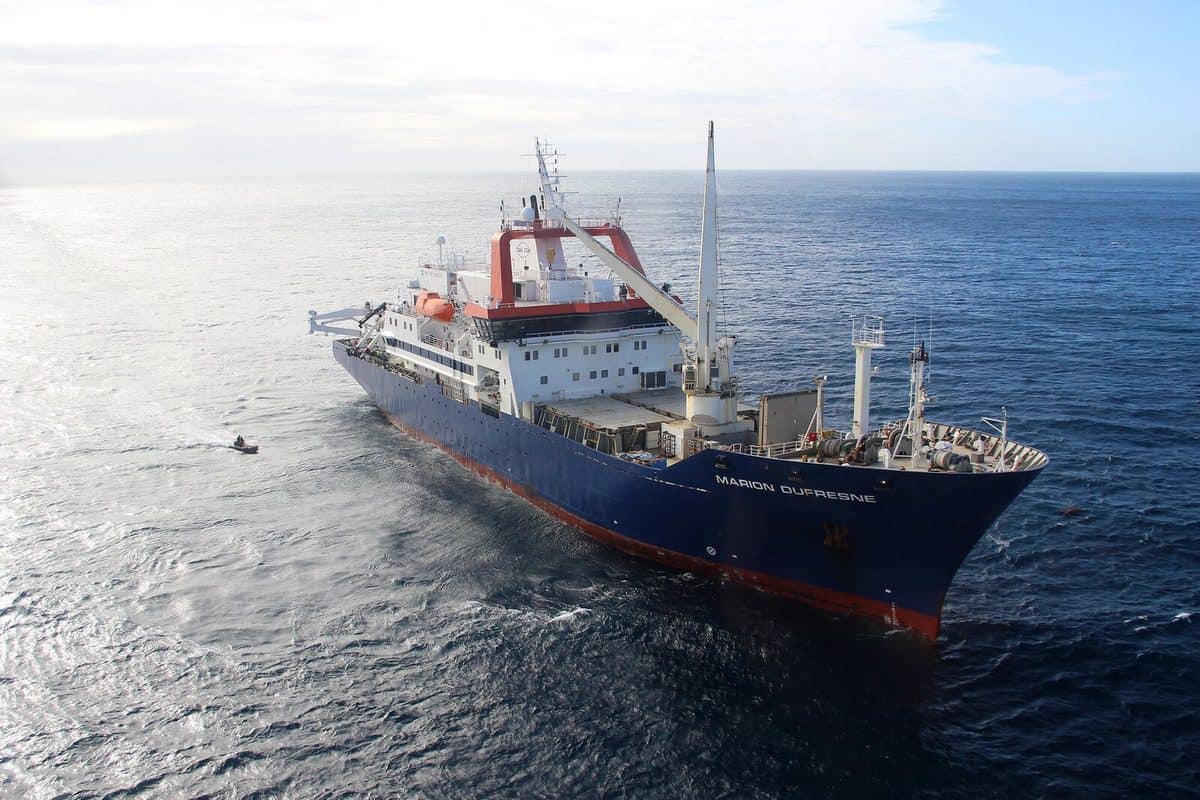
France’s next scheduled Marion Dufresne mission is due to leave Le Port on 15 October 2026 and return on 27 November, operating a combined OP3–OP4 programme that calls at Kerguelen twice. But this is not a newly bookable expedition cruise. TAAF no longer offers tourist stays aboard the vessel. Kerguelen access instead depends on administrative permission, protected-area controls and, for foreign participants where required, a separate visa process outside the Schengen framework. The operational gateway is Le Port, while oversight is centred in Saint-Pierre.
The most important detail for travel readers is not simply that the Marion Dufresne will sail south again in October. It is what the voyage reveals about the structure of travel to one of the planet’s most inaccessible territories.
Advertisement
According to the current Terres australes et antarctiques françaises, or TAAF, 2026 operational calendar, the combined OP3–OP4 mission is scheduled to depart La Réunion on 15 October and return on 27 November 2026. The published route runs from Crozet to Kerguelen and Amsterdam before returning through Crozet, Kerguelen and Amsterdam again, followed by Tromelin. The itinerary therefore includes two separate Kerguelen calls within the same combined operation.
TAAF links this rotation with the arrival of new environment and French Polar Institute personnel, the beginning of the austral summer scientific campaign, changes involving district medical personnel and other summer research movements. The authority also identifies this period as one of stronger wildlife presence.
Advertisement
Advertisement
| Official 2026 operation | Published dates | Principal routing | Operational significance |
|---|---|---|---|
| OP1 | 11 March–10 April | Tromelin, Crozet, Kerguelen, Amsterdam | End of summer scientific missions and transition towards winter operations |
| OP2 | 14 August–14 September | Crozet, Kerguelen, Amsterdam, Tromelin | District leadership and personnel rotation |
| OP3–OP4 | 15 October–27 November | Crozet, Kerguelen, Amsterdam, Crozet, Kerguelen, Amsterdam, Tromelin | Combined operation supporting summer science, personnel movements and two Kerguelen calls |
The distinction matters. TAAF generally describes the Marion Dufresne as undertaking around four southern-island operations annually, but its current 2026 calendar publishes OP1, OP2 and a combined OP3–OP4 programme. Travel businesses should therefore work from the specific official annual schedule rather than assume a conventional four-departure passenger timetable.
The journey begins in Le Port, on La Réunion. TAAF’s published operating pattern identifies Le Port as the location where logistics begin, crew and TAAF personnel embark, final loading takes place and passengers authorised for the mission board before departure.
Saint-Pierre, farther south on La Réunion, performs a different but equally important role. TAAF has maintained its headquarters there since 2000. The headquarters accommodates around 90 personnel and contains the central administrative services that support the district authorities managing Kerguelen, Crozet and Amsterdam.
This creates a two-part gateway rarely explained in conventional destination coverage: Le Port is the physical logistics gateway, while Saint-Pierre is the institutional gateway.
Advertisement
Advertisement
Kerguelen itself lies about 3,490 kilometres from La Réunion, according to the French Polar Institute. Reaching Port-aux-Français normally takes roughly ten days when the voyage includes the Crozet call. The islands are served by sea rather than through a conventional passenger aviation network.Kerguelen access infrastructure Officially verified position Travel implication Distance from La Réunion About 3,490 km Requires long-range maritime planning Typical journey towards Kerguelen About ten days including Crozet Not comparable with an ordinary island transfer Main station Port-aux-Français Administrative, scientific and logistics base Station buildings About 9,000 m² Infrastructure exists primarily for missions rather than tourism Winter base population Usually around 60 Extremely limited permanent service environment Summer population Can reach around 120 Activity rises with the scientific season Average summer temperature About 7°C Cold-weather preparation remains necessary
These figures come from the French Polar Institute’s Kerguelen station information.
This is the central traveller-facing point.
According to the current TAAF tourism page, the administration no longer offers tourist stays aboard the Marion Dufresne. That means the October OP3–OP4 sailing should not be marketed or interpreted as a newly released expedition-cruise departure.
The ship certainly possesses passenger capability. TAAF states that the Marion Dufresne can carry up to 114 passengers, while approximately 650 square metres aboard are allocated to laboratories. It also carries personnel, ordinary freight, hazardous materials and fuel and performs scientific work when deployed in its research role. Those capabilities do not convert the current TAAF rotation into a commercial tourist sailing.
The distinction is especially important for agents handling extreme-destination enquiries. Historical material about passenger voyages aboard the vessel can remain visible online, but the operative official position in September 2026 is that tourist stays are no longer offered.
The absence of conventional tourism does not mean every non-operational traveller is automatically excluded.
TAAF’s official project framework permits selected project holders to request embarkation aboard the Marion Dufresne. The authority’s 2026–2027 media-project programme specifically provides for applications linked to the southern districts and says approved media project holders receive a preferential embarkation rate.
However, the published deadline for that programme was 31 March 2026, with applications assessed during April and May and decisions scheduled for June. Consequently, the October voyage is not a last-minute commercial alternative for someone who simply wants to visit Kerguelen.
A second institutional pathway illustrates how selective access is continuing. France’s Ministry of Culture currently has a creative-residency programme linked to the Marion Dufresne. Applications remain open until 30 September 2026, with the selected artist scheduled to embark from La Réunion during March–April 2027 for Crozet, Kerguelen, Amsterdam and Tromelin. The programme requires medical fitness and subjects off-base movement to district-authority approval.Traveller or participant type Position on 7 September 2026 Practical meaning Ordinary leisure tourist seeking Marion Dufresne holiday Tourist stays not offered No standard cruise inventory to sell Approved institutional personnel Operates through official mission system Access linked to operational purpose Selected media project holder Possible through TAAF project framework Requires prior selection; 2026 published deadline has passed Selected artistic resident 2027 programme currently accepting applications Institutional selection, medical and regulatory conditions apply Private yacht seeking landing Very restricted Exceptional authorisation required Foreign authorised participant Subject to TAAF entry documentation rules Schengen assumptions should not be used
Kerguelen presents another easily missed travel-planning issue: the French Southern and Antarctic Lands sit outside both the European Union territory and the Schengen Area under the framework described by TAAF. A Schengen itinerary should therefore never be treated as automatically establishing entry rights into Kerguelen.
According to TAAF’s current visa guidance, when a visa is required, approval from the senior administrator of the TAAF must precede visa issuance. The administration currently instructs applicants to request this agreement at least two months before arrival. The subsequent visa application goes through the appropriate diplomatic, consular or other competent French authority.
There is a noteworthy operational detail for travel professionals. Article L367-2 of France’s current immigration code states a statutory minimum of one month for seeking the administrator’s agreement, while TAAF’s own traveller-facing procedure currently instructs applicants to allow at least two months. The safer operational standard for itinerary planning is therefore the longer TAAF administrative lead time.
French law also allows a district chief to refuse admission where a foreign arrival lacks the required documents or visas. This turns documentation into an operational access condition rather than a routine formality.
Independent maritime access is also tightly constrained.
According to TAAF, pleasure-vessel anchoring in territorial waters around Kerguelen, Crozet and Saint-Paul and Amsterdam, together with access ashore, is highly limited and strictly regulated. Exceptional applications may be submitted to the senior administrator where particular justified circumstances exist.
Even after reaching Kerguelen, movement on land remains subject to permission from the district chief. A number of areas are completely closed or require additional written authorisation because of ecological protection or scientific status. Restricted Kerguelen locations include Île Foch, several islands within the Gulf of Morbihan, the Leygues and Nuageuses island groups and other sensitive sectors.
This is not therefore a destination where an expedition operator can simply substitute a yacht programme after discovering that Marion Dufresne tourism is unavailable.
The regulatory system reflects the extraordinary environmental status of the region.
The French Austral Lands and Seas have been a UNESCO World Heritage property since 2019. UNESCO records the entire property at 166,267,100 hectares, equivalent to approximately 1.663 million square kilometres, with the Kerguelen component alone covering 57,500,200 hectares.
UNESCO states that human activities are strictly prohibited across almost one-third of the property, while activities elsewhere remain regulated through environmental assessment and management controls. The wider reserve protects globally important concentrations of seabirds and marine mammals and serves as an exceptional long-term scientific research environment.
Kerguelen’s tourism constraints therefore cannot be separated from conservation policy. Restricted demand is not simply the consequence of remoteness. It is built into the territory’s management architecture.
The French Polar Institute maintains 38 refuges or isolated sites at Kerguelen, substantially more than at Crozet or Amsterdam. Its teams use Marion Dufresne rotations to resupply, repair and prepare these sites for research projects.
Across the sub-Antarctic islands, the institute deploys roughly 30 scientific projects each year. Work encompasses fields including seismology, geomagnetism, sea-level monitoring, ecology and long-term observation of marine birds and mammals.
That explains why OP3–OP4 is more significant than an exotic voyage on a map. It is effectively a moving logistics corridor supporting the transition into the most active scientific period of the year.
The Marion Dufresne cannot simply berth alongside Port-aux-Français like a conventional cruise ship at a developed terminal. TAAF explains that the southern bases do not have ports capable of receiving the supply vessel directly. At Kerguelen the vessel remains offshore in the Gulf of Morbihan, with helicopters used for people and lighter loads and nautical equipment used for heavier cargo.
The information gain for the travel sector lies in reclassifying Kerguelen correctly.
It may look like an expedition-tourism destination because it combines remote geography, extraordinary wildlife, a specialist vessel and a UNESCO-protected environment. Yet its current operating model is much closer to controlled mission mobility than commercial expedition cruising.
That distinction affects product development. There is no normal allocation of cabins for leisure sellers. There is no conventional airport gateway. A yacht cannot assume landing rights. Foreign-entry requirements cannot safely be inferred from an ordinary Schengen visa. Environmental zoning can restrict movement after arrival. Even available non-tourist opportunities are generally tied to an approved scientific, administrative, cultural or media purpose.
For Réunion, however, the system creates strategic gateway value. Le Port concentrates the maritime and freight function, while Saint-Pierre concentrates TAAF administration. Those roles give the island a specialist position within France’s southern Indian Ocean network even though they do not generate mass Kerguelen tourism.
For destination marketers, Kerguelen therefore represents a different form of value: scientific prestige, conservation visibility, expedition storytelling and France’s remote-territory presence rather than visitor-volume growth.
The strategic message from the October operation is therefore not that Kerguelen is opening. It is almost the reverse.
France continues to support substantial human movement into the archipelago, but that movement is overwhelmingly tied to science, environmental management, logistics, sovereignty and carefully selected projects. The combined October rotation demonstrates how substantial that controlled mobility can become during the austral summer while remaining structurally separate from conventional tourism.
That distinction is likely to become increasingly relevant as travellers seek less-visited destinations and expedition operators search for new Southern Ocean experiences. Kerguelen has enormous destination appeal, but its value is protected precisely because access is not scaled like a normal tourism product.
For the international travel trade, the practical opportunity is therefore not immediate volume. It lies in understanding the Réunion-to-Kerguelen gateway, monitoring future TAAF policy, separating authorised project travel from ordinary tourism and ensuring that rare access is communicated accurately.
As of 7 September 2026, the most important fact remains clear: France’s 15 October Marion Dufresne departure is a major Kerguelen mobility event, but it is a controlled institutional mission rather than a newly available holiday sailing.
Advertisement
Advertisement
Advertisement













Monday, September 7, 2026
Monday, September 7, 2026

Monday, September 7, 2026

Monday, September 7, 2026
Monday, September 7, 2026

Monday, September 7, 2026

Monday, September 7, 2026

Monday, September 7, 2026

