
China’s Laoling Lets Tourists Enter the Movie and Become Stars in Shandong’s Immersive Travel Boom

Published
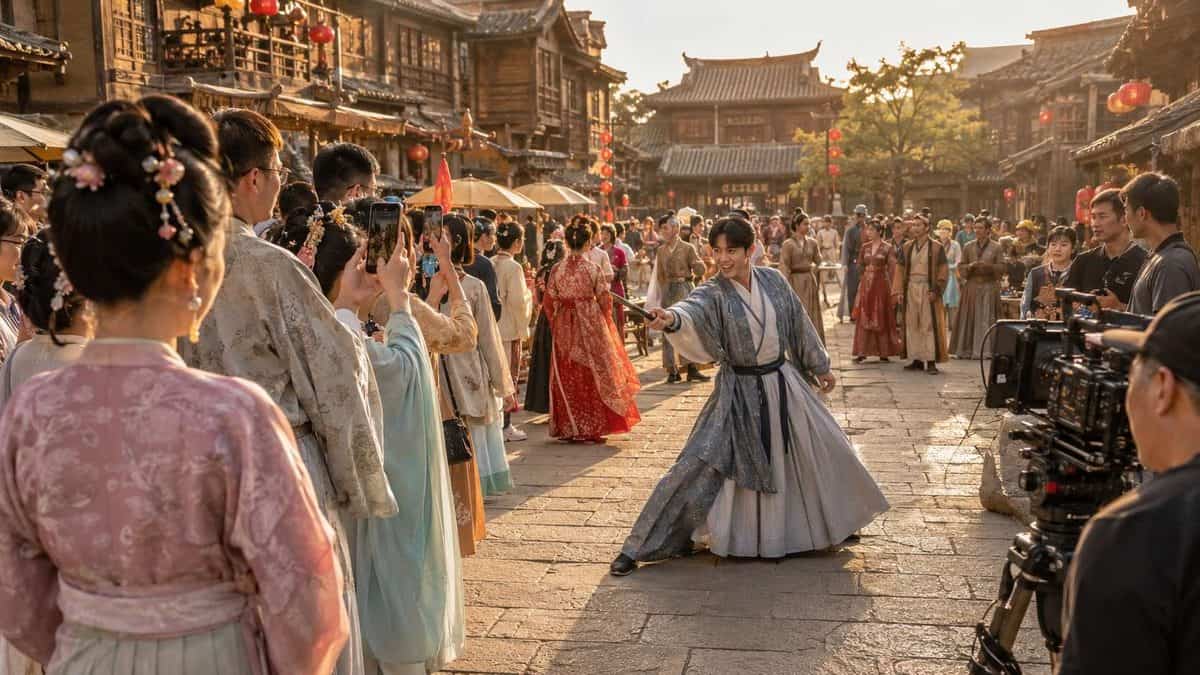
Image generated with Ai
Laoling’s development of immersive film tourism allows participants to enter working screen worlds and perform in sets. Shandong, China, invites visitors to experience the Detective Chinatown 1900 and Flourished Peony sets with live actors and characters, immersive experiences, moving performances, and on-site shooting. Laoling’s development of film tourism presents a unique opportunity to utilize production infrastructure to develop a visitor economy with accommodations, food services, retail, and village businesses. Through provincial and municipal programs, Laoling offers travelers an interactive tourism experience and an opportunity to focus on a smaller city in China and increase activity and spending. This experience also provides opportunities to travel to studios to watch performances as opposed to the typical studio tour.
Laoling Is Turning Film Sets into Places Tourists Can Enter
Laoling is changing the basic idea of a studio tour. Visitors do not simply look at scenery from behind a barrier. They can move through streets built for major productions, meet performers, wear costumes and create their own screen moments.
Advertisement
Advertisement
This visitor-led model sits at the centre of Laoling film tourism. It turns production spaces into playable environments once filming schedules permit public access.
The city’s best-known screen locations include the Tang Dynasty-inspired setting used for the television drama Flourished Peony, known in Chinese as Guo Se Fang Hua. Its success drew public attention to the detailed period streets built inside Laoling Film Studio.
Advertisement
Advertisement
The production of Detective Chinatown 1900 gave the destination another recognisable setting. The studio constructed a full-scale interpretation of San Francisco’s Chinatown in the early twentieth century.
The set contains 199 buildings and took 218 days to complete. It provided the principal environment for the film and later became a valuable tourism asset.
Advertisement
Advertisement
These locations give visitors access to two contrasting screen worlds. One recreates imperial-era China, while the other presents a stylised Chinese-American neighbourhood from a different historical period.
That visual variety matters. It allows the studio to offer costume photography, live entertainment, family activities and social-media content without depending on a single production.
Advertisement
Advertisement
Film Production Came Before the Tourism Boom
Laoling did not begin as an established film-tourism city. Its development grew from a local effort to attract production companies and build a new service economy.
The film studio was listed as a significant Shandong project. Its original development direction combined film and television production with cultural tourism, rather than treating those businesses as separate activities.
Production teams needed outdoor sets, indoor facilities, technical services, accommodation, transport and local workers. Those requirements created a foundation that could later support leisure visitors.
The studio gained greater national visibility in 2024 when Flourished Peony used its Tang-themed complex. Public curiosity increased as the television drama reached audiences.
Advertisement
Advertisement
The release of Detective Chinatown 1900 created another wave of interest. Its distinctive streets gave potential visitors a physical place connected with a widely recognised screen story.
Laoling subsequently converted selected production spaces for tourism use. This involved more than opening gates and selling admission.
Officials and operators added performances, visitor routes, interactive characters and recreational activities. The result was a working production base with an expanding public-facing identity.
What Makes the Experience More Than a Studio Tour
The strongest feature of Laoling’s approach is visitor participation. The destination wants travellers to feel that they have entered a story rather than arrived at an exhibition.
The experience includes streets based on different periods, live role-playing characters and opportunities to recreate screen scenes. Costumes and themed photography make it easier for guests to become part of the visual setting.
The studio has also developed activities that explain how films are produced. Visitors may encounter staged filming environments, production demonstrations or guided content-creation experiences.
Advertisement
Advertisement
According to the Shandong Department of Culture and Tourism, the studio developed “enter the set” activities that reproduce aspects of a working production. Professional teams can guide visitors through filming and recording experiences.
The official programme also promotes:
- NPC interaction with costumed performers
- Moving shows staged across different streets
- Period clothing and photography
- Special-effects performances
- Light and water-based entertainment
- Behind-the-scenes production experiences
- Visitor-created short films and videos
- Family and youth activities
These features encourage people to spend more time inside the attraction. They also create additional sales opportunities beyond basic admission.
Costume rental, photography, food, souvenirs and premium activities can all become part of one visit. This helps convert audience recognition into direct local consumption.
Key Official Tourism Indicators
Public statistics show that film-related travel was already producing measurable results before the latest 2026 promotion.
| Indicator | Period | Officially reported result | Tourism significance |
|---|---|---|---|
| Laoling visitor growth | 2024 | 42.32% increase | Shows rapid destination expansion |
| Laoling tourism revenue growth | 2024 | 51% increase | Spending grew faster than visitor volume |
| Laoling Film Studio visitors | 2025 Spring Festival | More than 150,000 | Strong demand linked to screen locations |
| Wider nearby attraction and commercial visits | 2025 Spring Festival | Nearly 700,000 | Indicates spending beyond the studio |
| Comprehensive tourism income | 2025 Spring Festival | More than RMB90 million | Demonstrates wider local economic value |
| Productions attracted | By November 2025 | More than 30 | Builds a continuing supply of screen content |
| Newly registered screen businesses | Official municipal reporting | 178 | Supports a local production cluster |
| Initial public opening | Seven-day period | More than 60,000 visitors | Shows strong early curiosity |
| Neighbouring village homestays | Reported in 2025 | 72 units across six villages | Connects studio demand with rural income |
These figures require careful interpretation. Nearly 700,000 visits refer to surrounding attractions and commercial areas, not admissions to the film studio alone.
Advertisement
Advertisement
The revenue figure also represents broader tourism activity during the holiday period. It should not be described as ticket income generated only by Laoling Film Studio.
Tourism Revenue Is Growing Faster Than Visitor Numbers
Laoling reported a 42.32 per cent rise in tourist numbers during 2024. Tourism income increased by 51 per cent over the same period.
The faster rise in revenue suggests that the destination attracted more visitors while also increasing average commercial activity. Film experiences, accommodation, dining, performances and shopping can all contribute to that difference.
During the 2025 Spring Festival holiday, the studio welcomed more than 150,000 visitors. Nearby attractions and commercial districts recorded nearly 700,000 visits, while comprehensive tourism income passed RMB90 million.
The figures show why local authorities are treating film production as more than a cultural project. A successful set can generate expenditure during filming and continue attracting money after a production reaches viewers.
Cast members and production crews require rooms, meals, vehicles and technical support. Leisure travellers later generate demand for many of the same services.
Advertisement
Advertisement
This creates two connected markets. The first is production-related business travel. The second is screen-inspired leisure travel.
Government Policy Is Building a Complete Screen-to-Spending Chain
The official strategy extends from attracting production teams to converting completed sets into tourism experiences.
Shandong authorities describe the model as a chain involving film production, scene development, visitor participation and consumer spending. Each stage supports the next.
The city has established services to help production crews secure locations, permits and local support. This reduces operational barriers for companies considering Laoling.
Local agencies have also encouraged screen-related enterprises to register in the city. Official municipal information records 178 newly registered film and television businesses.
The studio had signed agreements with 30 major production companies by the end of 2024. By November 2025, more than 30 film and television productions had entered the facility.
Advertisement
Advertisement
Laoling Film Studio also became a national 3A-rated tourist attraction and gained provincial recognition as an official filming location. Its first and second development phases had entered operation by late 2025.
In June 2026, Shandong tourism authorities highlighted Laoling as a model for developing smaller destinations. The provincial report on “treasure towns” placed the studio at the centre of an economy linking filming, cinema viewing and visitor consumption.
The 2025 Provincial Tourism Conference Raised Laoling’s Profile
Laoling Film Studio served as the principal venue for the 2025 Shandong High-Quality Tourism Industry Development Conference.
The event gave the emerging destination a provincial platform. It also pushed the studio to upgrade its visitor programme and public spaces.
Officials planned an immersive format instead of limiting the conference to a fixed stage. Guests could walk through recreated streets while encountering characters, live music, acrobatics and dramatic performances.
The public opening during the May Day period allowed ordinary travellers to enter major sets. These included the Chinatown location from Detective Chinatown 1900 and the Tang-themed area associated with Flourished Peony.
Advertisement
Advertisement
Shandong’s official conference material said approximately 100 interactive performers were planned across the site. The programme combined period streets with music, stunts and mobile entertainment.
That format demonstrated how the studio could operate as both an industry venue and a public attraction. It also provided a testing ground for experiences that could be offered during later tourism seasons.
Local Hotels and Villages Are Sharing the Demand
A film attraction cannot create a lasting destination economy if tourists arrive and leave without using local services.
Laoling has therefore linked the studio with accommodation, restaurants, retail areas and nearby rural communities. The objective is to turn a short visit into broader spending.
Communities near the studio have converted vacant homes and unused residential property into visitor accommodation. Provincial reporting documented 72 homestay units across six villages.
That development gives local households a route into the tourism economy. It also creates accommodation with a different character from conventional city hotels.
Advertisement
Advertisement
Additional businesses have emerged around costumes, props, photography and local food. These services respond directly to the behaviour of immersive-film visitors.
A traveller who hires historical clothing is more likely to purchase professional photographs or video. A visitor attending an evening performance may also need dinner and overnight accommodation.
Hotels in Laoling can benefit from weekend visits, family trips and production crews. However, no official source reviewed for this article provides a verified citywide hotel occupancy rate linked solely to the film studio.
The available evidence supports increased accommodation demand. It does not support claims that every hotel or village business has benefited equally.
Tour Operators Gain a New Shandong Itinerary
The studio gives tour operators a product that can be combined with Laoling’s existing cultural and natural attractions.
Laoling is widely associated with its ancient jujube landscape. Official material records a cultivation history stretching back around 3,000 years.
Advertisement
Advertisement
The city has approximately 300,000 mu of jujube forest and more than 20 million trees. Thousands are described as ancient specimens.
A combined itinerary could connect the film studio, village accommodation, local food and the jujube landscape. Such packaging would distribute visitors across a wider area.
The studio also creates opportunities for:
- Family day trips
- School and educational visits
- Costume photography groups
- Film-production study tours
- Festival packages
- Weekend self-drive holidays
- Small corporate and incentive groups
- Domestic screen-fan itineraries
Tour operators must still confirm operating times and public access. Active filming can affect which areas are available on a particular day.
Youth Travel Could Become an Important Market
Laoling’s screen environment has clear educational value. Students can observe how scenery, costumes, acting, lighting and recording combine to create a production.
The city has worked with Shandong broadcasting organisations to develop youth-focused screen activities. Government project material has also identified study-tour and educational facilities connected with the wider development.
Advertisement
Advertisement
This creates a product that sits between entertainment and practical learning. Children can explore historical streets while learning how fictional environments are constructed.
Older students may gain exposure to acting, photography, editing, set design and production management. Those subjects broaden the attraction beyond fans of particular dramas.
Study travel can also support weekday demand. Family tourism often concentrates on weekends and public holidays, while organised educational groups can travel during the school term.
No official annual target for student arrivals has been published in the sources reviewed. The youth-travel opportunity should therefore be presented as a developing programme, not a confirmed volume forecast.
Airlines and Airports Face Limited Direct Impact
Laoling’s film-tourism growth does not currently represent a major aviation development. The city does not have its own commercial airport, and no new air route has been officially announced specifically for the studio.
Visitors travelling by air would normally connect through larger transport centres in Shandong or neighbouring regions before completing the journey by road or rail.
Advertisement
Advertisement
The destination’s immediate market is therefore more likely to be domestic travellers from accessible parts of Shandong, Hebei, Beijing and Tianjin. Self-drive and organised coach travel remain important.
Airlines could benefit indirectly if Laoling becomes part of a longer Shandong itinerary. Current official information does not isolate passenger demand generated by the film studio.
Claims about a direct increase in airport traffic would therefore be premature. The clearest current impact falls on local transport, accommodation, food services and experience providers.
International Travellers Should Treat Laoling as an Emerging Destination
Laoling remains far less established internationally than Beijing, Shanghai, Xi’an or Shandong’s coastal cities.
That gives experienced visitors a chance to see a newer form of Chinese screen tourism. It also means overseas travellers should plan more carefully.
The attraction is built strongly around Chinese-language films, television dramas and live interaction. English-language interpretation may not be available across every performance or activity.
Advertisement
Advertisement
International visitors should confirm:
- Current opening dates
- Areas accessible during active filming
- Performance schedules
- Ticket and activity charges
- Costume-rental conditions
- Photography restrictions
- Transport from the nearest rail connection
- Availability of foreign-language support
- Hotel policies for international guests
China’s national entry rules depend on passport, journey and date of travel. Laoling has not introduced a separate visa scheme or local entry reform.
Travellers should consult official Chinese diplomatic or immigration information before departure. They should not assume that a national transit or visa-exemption arrangement applies to every itinerary.
Sustainability Depends on Reusing Rather Than Rebuilding
Film production can consume significant materials when sets are constructed for temporary use. Laoling’s tourism model offers one practical response by keeping selected locations commercially active after filming.
A reusable set can host later productions, performances, educational groups and tourists. That may extend the economic life of the original construction.
The model can also reduce pressure to create an entirely new attraction for every tourism season. Existing streets can be refreshed through characters, stories and scheduled activities.
Advertisement
Advertisement
However, no detailed public environmental assessment reviewed for this article quantifies energy savings, waste reduction or carbon benefits from the studio’s tourism conversion.
It is accurate to describe reuse as part of the operating model. It would not be accurate to label the entire attraction sustainable without published environmental measurements.
What Visitors Can Expect at Laoling Film Studio
The main appeal is visual participation. Visitors enter streets designed to look convincing on camera and then shape their own experience around them.
Some guests may focus on recognised productions. Others may come for clothing, photography, live shows or family entertainment.
| Visitor interest | Relevant experience |
|---|---|
| Film and television fans | Locations connected with popular productions |
| Families | Live characters, performances and interactive activities |
| Content creators | Distinctive streets, costumes and short-video opportunities |
| Students | Production demonstrations and screen-industry learning |
| Cultural travellers | Tang-inspired architecture and period storytelling |
| Group travellers | Structured routes, shows and themed activities |
| Overnight visitors | Village homestays, local dining and wider Laoling attractions |
Schedules can change when spaces are required for filming. Travellers should check current notices rather than relying on old social-media posts.
Future Development Follows Published Government Plans
Official plans place film production and cultural tourism within the same development framework.
Advertisement
Advertisement
The studio’s first two phases are already in operation. Public policy also identifies digital improvement, new consumption settings and enhanced visitor activities as continuing priorities.
Dezhou wants to develop a film-industry cluster and a recognised northern Chinese screen-tourism destination. Laoling forms a central part of that ambition.
An earlier municipal project description placed total planned investment at RMB1.179 billion, covering about 790 mu and approximately 199,800 square metres of construction.
That planning document projected capacity for between 10 and 30 screen productions and more than 500,000 annual visitors after full development. These are project expectations, not confirmed annual results.
Future reporting should compare those targets with verified operating data. It should also distinguish studio admissions from wider city visitor figures.
Frequently Asked Questions
Can tourists enter the sets used for active film productions?
Selected areas are opened to visitors, including recognised locations connected with major productions. Access can change when crews require a space, so travellers should check the studio’s latest official operating notice before travelling.
Advertisement
Advertisement
Is Laoling Film Studio suitable for families and children?
Yes. The attraction has offered costumed characters, travelling performances, themed streets, photography and interactive activities. Some programmes also explain filming processes, giving the visit an educational element for children and students.
Does Laoling have a special visa or direct international flight connection?
No separate Laoling visa programme or studio-specific international air service has been announced. Overseas visitors must follow China’s national entry requirements and continue to Laoling through the regional rail and road network.
Laoling’s Screen Tourism Story Is Only Beginning
Laoling uniquely offers film environment tours so travelers can experience the set first hand and encounter film characters. They can even create their own film experiences. Laoling’s film tourism now connects substantial sets with performances, accommodations, and eateries, as well as small businesses, throughout this portion of Shandong. Although recorded statistics show increased visitor numbers and tourism dollars, Laoling still considers themselves an underrated and new destination with international vacation potential. To build their tourism, they have to ensure continued access, improvements of offered tourism experiences, and reporting online about their tourism statistics. Travelers recognize their film tourism. Unlike traditional film tourism structures, they can enter and experience films spaces, rather than see them on the other side of the globe.
Advertisement
