

Spain and Egypt Set the Pace With Other European Destinations as 2027 Solar Eclipse Travel Triggers a Fierce Booking Race

Published
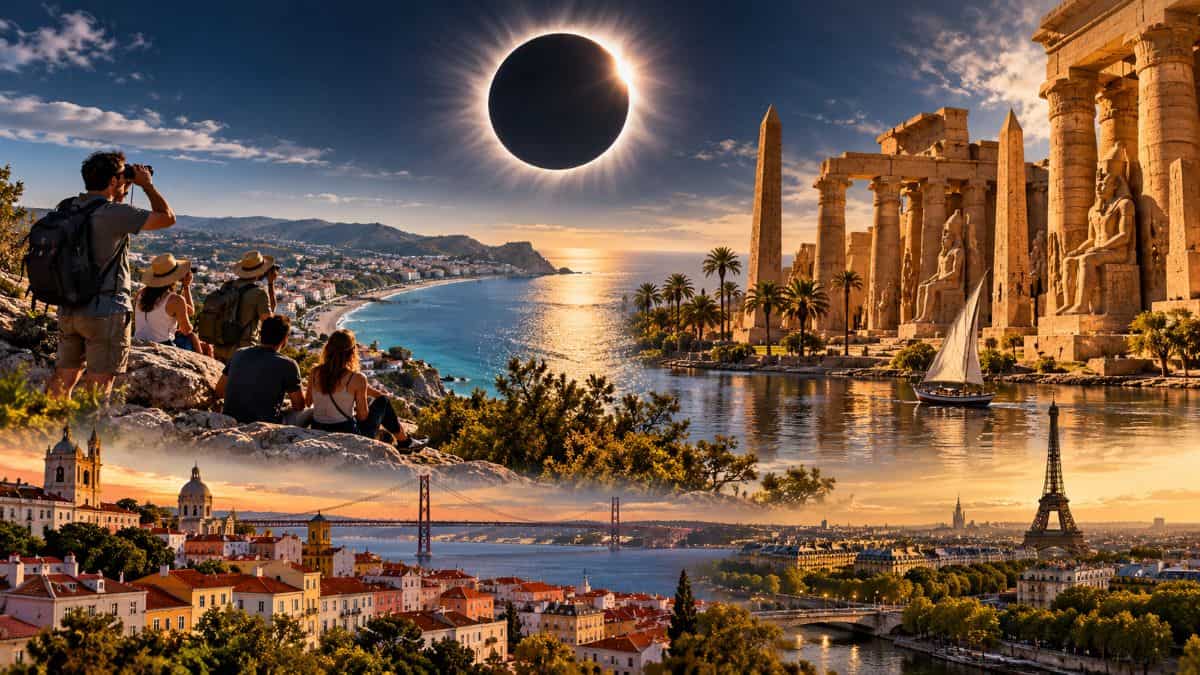
The 2027 solar eclipse travel market is showing early signs of a booking surge, with Spain emerging as a key European destination ahead of the total solar eclipse on 2 August 2027. easyJet reported a 70% increase in bookings by British travellers to destinations along the path of totality, while bookings to selected Spanish destinations rose by 69%. Accommodation searches also revealed limited availability in Seville and Gibraltar, alongside exceptionally high advertised prices in parts of southern Spain. Egypt offers a compelling alternative, with totality lasting approximately six minutes and 23 seconds near the point of greatest duration. Portugal and France will experience partial eclipses, creating a different proposition for summer travellers.
The figures point to a growing commercial opportunity for airlines, accommodation providers and specialist tour operators. However, comparable booking-growth data for all four countries remains unavailable, making it too early to declare a definitive destination winner. The next phase of the 2027 solar eclipse travel market will depend on flight capacity, confirmed hotel reservations, organised viewing experiences and travellers’ willingness to plan months ahead.
Advertisement
Advertisement
Spain’s Southern Corridor Draws Early Booking Interest
Spain has the strongest published European booking signals so far, particularly around destinations connected with Andalusia and the Strait of Gibraltar. easyJet reported that bookings to Seville, Almería and Málaga had increased by 69% following the August 2026 eclipse. Across destinations along the path of totality, bookings by British travellers rose by 70%, according to the airline’s figures reported in August 2026.
The distinction between these figures matters. The 70% increase covers destinations along the totality corridor, while the 69% increase relates to selected Spanish destinations. Neither figure represents Spain’s entire tourism market, and neither establishes how many travellers booked exclusively to watch the eclipse.
Advertisement
Advertisement
The geographical advantage is nevertheless clear. Spain’s National Geographic Institute identifies Ceuta and Melilla, almost the entire province of Cádiz, much of Málaga province and the southernmost areas of Granada and Almería within the path of totality. The eclipse will occur during the morning, with maximum coverage around 10.50am Spanish peninsular time in parts of the country.
The duration varies substantially between locations. Ceuta will experience approximately four minutes and 48 seconds of totality, compared with two minutes and 54 seconds in Cádiz and one minute and 48 seconds in Málaga. These differences make precise location selection essential for visitors seeking the longest possible viewing window in Spain.
Advertisement
Advertisement
Seville illustrates the difference between a convenient travel base and a location within the totality corridor. The city offers established accommodation, cultural attractions and transport links, but travellers must check the eclipse path carefully before choosing where to watch. A hotel in a major city does not guarantee a view of totality.
Hotel Availability Signals Pressure on Peak Dates
Accommodation data offers a second indication of early interest. In an August 2026 search for a three-night stay in Seville beginning on 1 August 2027, Booking.com results indicated that 87% of places to stay were unavailable. A similar search for Gibraltar showed approximately 98% unavailability, according to Euronews Travel’s report.
Advertisement
Advertisement
These figures are snapshots rather than definitive occupancy statistics. A property may be unavailable because it has sold out, temporarily withheld rooms, imposed restrictions or not yet released its inventory. The figures therefore indicate limited visible choice, not necessarily that the same proportion of every room in each destination has been sold.
Advertised prices have also reached extraordinary levels in some locations. Euronews reported a one-night villa listing in El Palmar, near the Cádiz coast, priced at €33,129 for six people. Three properties in Tarifa were advertised at €13,260, €12,500 and €11,090 per night for a stay from 1 to 2 August 2027.
These are individual asking prices, not market averages or verified transaction values. Nevertheless, they highlight the importance of comparing equivalent properties, cancellation terms and neighbouring dates before drawing conclusions about the eclipse’s effect on accommodation costs.
For hotels and holiday-rental operators, the event presents an opportunity to package rooms with transport, breakfast, guided viewing and flexible departure arrangements. However, businesses should avoid treating a short-lived price spike as evidence of sustainable year-round demand. The more useful commercial measure will be the proportion of inventory sold at confirmed rates against comparable August periods.
Advertisement
Advertisement
Egypt Offers the Longest Viewing Window
Egypt’s strongest advantage is astronomical rather than purely commercial. NASA’s eclipse calculations place the point of greatest duration near 26°49′ north and 31°08′ east, where totality will last approximately six minutes and 23 seconds. The event will cross parts of North Africa and the Middle East after passing southern Spain, making Egypt a significant destination for specialist eclipse itineraries.
The duration difference is substantial. Ceuta’s maximum totality lasts four minutes and 48 seconds, leaving Egypt with approximately 95 seconds more darkness at the respective maximum-duration points. Travellers considering Egypt should still distinguish the point of greatest duration from any particular city or hotel, as the exact experience depends on the observer’s location.
| Destination | Eclipse Type | Approximate Totality | Travel Consideration |
|---|---|---|---|
| Egypt, near greatest duration | Total | 6 minutes 23 seconds | Confirm the precise viewing location and transfer arrangements |
| Ceuta, Spain | Total | 4 minutes 48 seconds | Strong duration within Spain’s accessible European corridor |
| Cádiz, Spain | Total | 2 minutes 54 seconds | Coastal viewing options, subject to local conditions |
| Málaga, Spain | Total | 1 minute 48 seconds | Established urban accommodation and transport |
| Lisbon, Portugal | Partial | No totality | Suitable for travellers accepting a partial eclipse |
| Paris, France | Partial | No totality | City-break option rather than a totality destination |
Durations are location-specific astronomical predictions, not guaranteed viewing conditions.
Egypt’s longer spectacle could support multi-day packages combining eclipse viewing with Luxor’s archaeological attractions and Nile itineraries. Yet this remains a commercial proposition to investigate, rather than a demonstrated booking trend. The published easyJet figures identify Egypt among the destinations attracting interest, but do not provide a separate percentage increase for Egyptian bookings.
Tour operators targeting Egypt should therefore be assessed through confirmed package sales, available departures, room allocations and disclosed booking lead times. These metrics would show whether the longer eclipse is translating into paid travel rather than merely attracting online attention.
Portugal and France Offer Different Eclipse Experiences
Portugal and France provide important comparisons because neither will experience totality on 2 August 2027. Both countries will see a partial solar eclipse, in which the Moon covers only part of the Sun. Their appeal therefore rests on the combination of astronomical interest, established tourism infrastructure and the possibility of incorporating the event into a wider summer holiday.
Advertisement
Advertisement
In Portugal, the partial eclipse will begin at approximately 8.33am Western European Summer Time and end at 10.58am. In Porto, the event is predicted to begin around 8.41am, reach its maximum at approximately 9.45am and end around 10.55am. These are local predicted timings, and the proportion of the Sun covered differs by location.
France will experience a partial eclipse from approximately 9.49am to 12.22pm Central European Summer Time. Paris and other French cities offer opportunities for travellers who want to combine the event with museums, gastronomy and established urban attractions. However, a partial eclipse cannot reproduce the experience of totality, including the brief appearance of the solar corona to observers within the correct path.
The commercial comparison requires caution. No equivalent country-level booking-growth figures for Portugal and France appear in the evidence reviewed here. Their inclusion in the investigation should therefore test whether partial-eclipse visibility can influence travel choices, rather than presume that either country is experiencing a comparable booking surge.
The 2026 Eclipse Provides a Useful Benchmark
The 2027 event follows a total solar eclipse on 12 August 2026, which crossed parts of Greenland, Iceland and Spain. Spain’s National Geographic Institute describes the 2026 eclipse as the first total solar eclipse visible from mainland Spain in more than a century. Its path crossed the country from west to east, with totality occurring close to sunset in Spain.
The two events create a useful comparison for tourism researchers. The 2026 eclipse offered an evening viewing opportunity in Spain, whereas the 2027 event will occur during the morning and concentrate totality in the country’s far south. Egypt’s maximum totality in 2027 will also be considerably longer than the 2026 eclipse’s reported maximum of two minutes and 18 seconds.
However, the reported 69% increase in bookings to selected Spanish destinations followed the August 2026 eclipse; it should not be mistaken for a year-on-year comparison of equivalent travel periods. To establish the event’s incremental effect, researchers would need booking data from comparable dates, routes and destinations, alongside normal summer demand.
Advertisement
Advertisement
The wider astronomical calendar also gives travellers a longer planning horizon. An annular solar eclipse will occur on 26 January 2028, followed by a total solar eclipse on 22 July 2028. These events may sustain interest in astronomy-led travel, although their commercial effects will depend on visibility, access and the availability of organised experiences.
Airlines and Tour Operators Face a Capacity Test
The early booking figures offer airlines a commercial signal, but booking growth alone cannot reveal whether additional flights will be needed. A carrier can record more reservations on an existing route without adding a single seat. Conversely, a new service can increase capacity while keeping the load factor stable, making bookings and available seats essential complementary measures.
A robust industry assessment should compare scheduled seats, flight frequencies and fares for travel around 30 July–4 August 2027. Airlines should also disclose the relevant booking window and comparison period wherever possible. Without these details, a 70% increase cannot be translated into an equivalent increase in passenger numbers or tourism revenue.
The same distinction applies to specialist tour operators. Advertised packages, expressions of interest and waiting lists demonstrate market activity, but confirmed sales provide stronger evidence of demand. Tour companies should be asked how many departures they have scheduled, how many places remain available and whether their prices include transfers to a verified viewing site.
| Commercial Indicator | What It Reveals | What It Cannot Prove Alone |
|---|---|---|
| Airline booking growth | Direction and pace of reservations | Total visitor numbers or additional capacity |
| Scheduled seat capacity | Available air transport supply | Actual passenger demand |
| Hotel availability | Visible accommodation choice | Confirmed occupancy across the destination |
| Advertised room prices | Market asking prices | Completed sales or average rates |
| Confirmed tour sales | Paid demand for organised experiences | Total independent traveller demand |
| Event registrations | Interest in organised viewing | Hotel stays or wider tourism expenditure |
This distinction matters for destination management organisations. Their strongest opportunity may lie in coordinating transport, viewing locations and accommodation rather than simply promoting the eclipse. Well-designed itineraries can distribute visitors across surrounding towns, extend stays and reduce pressure on a small number of coastal hotspots.
Where Travellers Should Stay and Watch
For visitors seeking totality in Spain, the first decision should be the precise viewing location, not the hotel brand or nearest major airport. Ceuta, Cádiz, Málaga and parts of Granada and Almería lie within the totality corridor, but each offers a different duration. Travellers should consult the official municipal eclipse tables before paying for an accommodation package that promises a total eclipse experience.
Advertisement
Advertisement
Seville may work as a cultural base, but it should not be treated as interchangeable with a location inside the totality path. Visitors staying outside the corridor would need to travel to an appropriate site, allowing for road congestion, parking restrictions and potential local access controls. Accommodation providers should clearly distinguish overnight location from the place where their guests will view the eclipse.
Egypt requires the same precision. Travellers should establish the exact viewing coordinates, transfer time and planned arrival before selecting a package based on the maximum duration. A destination marketed as being near Luxor may not offer the same duration or circumstances as a site closer to the centre line.
Portugal and France remain viable for visitors content with a partial eclipse. Their larger cities may simplify transport and offer more choice for a wider holiday, but the expected level of solar coverage should be checked for the exact location. In every country, weather conditions can affect visibility, so travellers should consider flexible arrangements where possible.
Safe Viewing Must Shape Every Itinerary
Eye protection is a critical part of eclipse planning. Looking directly at the partially eclipsed Sun without suitable protection can cause serious eye injury, and ordinary sunglasses do not provide adequate protection. Travellers should use eclipse viewers that meet the relevant international safety standard, such as ISO 12312-2, and follow recognised astronomical safety guidance.
There is one important exception to the rule against direct viewing. During the brief period of complete totality, observers within the path can view the eclipsed Sun without a solar filter. However, they must replace their protection before the bright solar surface reappears. Anyone outside the totality corridor must keep suitable eye protection in place throughout direct observation.
Event organisers should build these precautions into ticket information, guided tours and visitor briefings. They should also explain whether a viewing site has adequate road access, toilets, shade and crowd-management arrangements. For destination authorities, these details are not peripheral services; they form part of the visitor experience and help reduce avoidable disruption.
Advertisement
Advertisement
Booking Early Without Paying Blindly
The accommodation signals suggest that travellers should investigate availability early, but they should not interpret every unavailable listing as a completed sale. Flexible cancellation policies, clear transfer arrangements and a verified viewing location may offer greater value than an expensive room advertised as being close to the eclipse corridor.
Travellers should compare the complete trip cost, including flights, accommodation, local transport, viewing access and any specialist tour fees. They should also confirm whether a package guarantees a place within the path of totality or merely offers an excursion to a nearby destination. These distinctions become especially important when prices rise sharply around a single event date.
| Planning Priority | What Travellers Should Verify |
|---|---|
| Eclipse visibility | Exact viewing coordinates and local timings |
| Accommodation | Cancellation terms, total price and location |
| Flights | Arrival buffer, route availability and return options |
| Guided tours | Confirmed departure, transport and viewing access |
| Safety | Approved solar viewers and organiser guidance |
| Weather contingency | Flexible arrangements and realistic expectations |
The event also creates an opportunity for tourism businesses to offer more than a one-morning excursion. Multi-night stays, regional itineraries and astronomy-led experiences can distribute spending across accommodation, transport, restaurants and attractions. However, operators should base capacity decisions on confirmed demand rather than isolated price listings or search interest.
The Next Booking Data Will Decide the Race
The 2027 solar eclipse travel market is already producing measurable signals, with Spain leading the available European booking evidence and Egypt offering the longest predicted totality. The 70% rise in bookings to destinations along the eclipse path and the 69% increase for selected Spanish destinations indicate growing interest, while accommodation searches reveal pressure on some peak dates. Nevertheless, comparable booking data for Portugal, France and Egypt remains essential before ranking the four markets commercially. The strongest investigation will track confirmed reservations, flight capacity, room rates and tour sales against consistent baselines. For travellers, the priority is to secure a practical itinerary around a verified viewing location, rather than chase the highest advertised price.
Advertisement
