
Vietnam and Thailand Follow An Expanding ASEAN QR Ecosystem As Southeast Asia Travel Payments Transform Tourism

Published
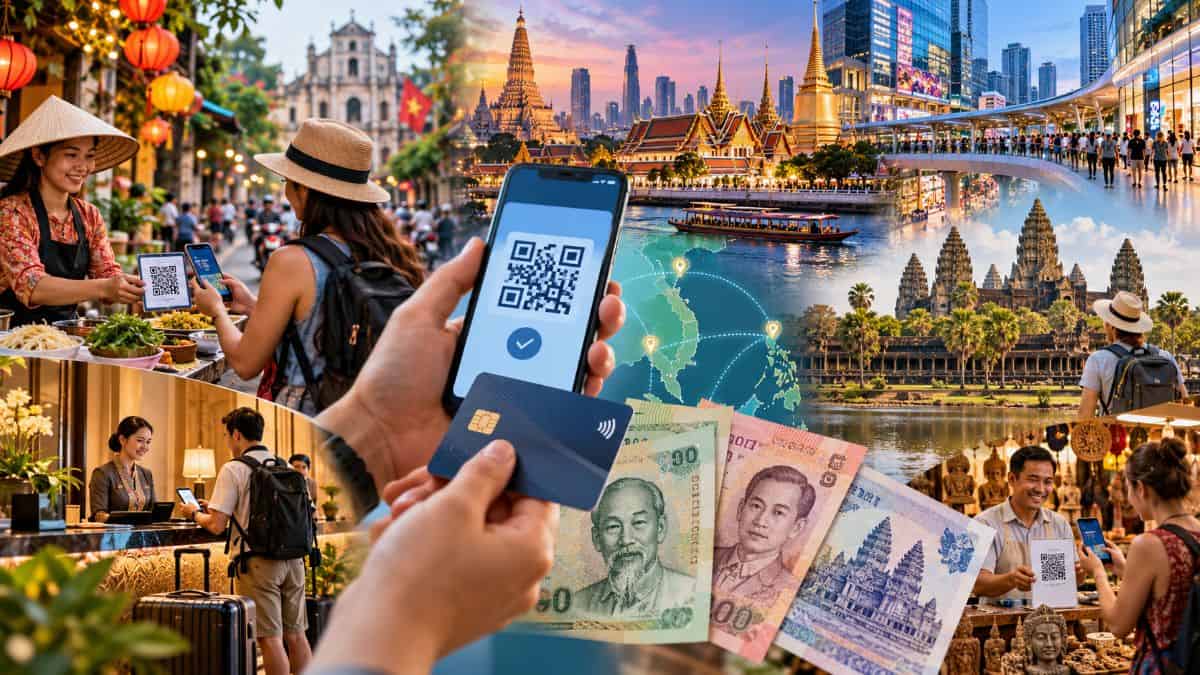
Image generated with Ai
Vietnam, Thailand and Cambodia are accelerating a new era of digital travel payments, but international visitors still need more than a smartphone. Vietnam recorded more than 15 billion non-cash transactions in the first half of 2026, while Thailand processed 7.3 million cross-border QR payments during 2025. Cambodia, meanwhile, now connects international visitors to around 4.5 million KHQR merchant locations, creating a rapidly expanding digital corridor across mainland Southeast Asia. Yet the transformation remains uneven. Foreign travellers can encounter domestic-only QR codes, card restrictions, currency conversion costs and connectivity gaps. The emerging lesson is therefore clear: cash, cards and mobile payments now work together, rather than replacing one another completely. For travellers crossing the three countries, payment resilience matters as much as payment convenience.
Southeast Asia’s Payment Landscape Is Splitting Open
A journey through Vietnam, Thailand and Cambodia increasingly begins with a phone rather than a currency exchange counter. QR codes are appearing across restaurants, retailers, transport businesses and smaller tourism operators, while banks and central banks are linking domestic payment systems across borders.
Advertisement
Advertisement
However, the apparent simplicity hides an important distinction. A QR code being visible does not mean every foreign visitor can use it. Compatibility depends on the originating bank, payment application, participating network, merchant infrastructure and cross-border agreement.
That distinction gives travellers a new financial consideration. The question is no longer simply whether a destination accepts digital payments, but whether a visitor’s particular payment ecosystem can enter that network.
Advertisement
Advertisement
Vietnam illustrates this divide particularly well. The country recorded more than 15 billion non-cash payment transactions during the first six months of 2026, up 34.28% year on year. Their value exceeded VND190 quadrillion, while more than 89% of people aged 15 and above held payment accounts.
| Vietnam Payment Indicator | First Half 2026 |
|---|---|
| Non-cash transactions | More than 15 billion |
| Year-on-year volume growth | 34.28% |
| Year-on-year value growth | 12.24% |
| Population aged 15+ with payment accounts | More than 89% |
| Digital transaction share at many institutions | More than 95% |
The figures demonstrate how deeply digital payments have entered domestic economic life. They do not, however, mean that every international visitor can reproduce the same experience.
Advertisement
Advertisement
Vietnam’s QR Surge Meets A Tourist Reality
Vietnam’s digital acceleration is creating one of the most compelling payment stories in the region. Domestic QR usage is expanding rapidly, while banks and payment operators are pursuing connections with overseas systems.
Yet international usability remains narrower than domestic adoption. Recent figures presented by Vietnam’s payment authorities show that only about 154,000 of more than 2.5 million domestic payment points, roughly 6%, currently offer VietQR Global for international visitors.
Advertisement
Advertisement
That gap matters for travellers. A visitor may see a familiar QR symbol at a café but still discover that the displayed code works only through participating Vietnamese applications.
Vietnam is consequently moving towards a two-speed payment environment. Domestic consumers can access an increasingly mature digital ecosystem, while international visitors remain dependent on compatible cross-border arrangements.
The country is nevertheless building those bridges. Thailand-linked QR payments already allow participating Thai bank users to scan selected VietQR codes in Vietnam, showing how regional interoperability is moving beyond policy discussions and into actual tourism transactions.
Thailand Turns QR Into Tourism Infrastructure
Thailand has taken a more extensive regional approach to payment interoperability. The Bank of Thailand says its cross-border payment network now covers users across more than 10 countries or jurisdictions, with QR payments designed for tourists and other travellers.
Advertisement
Advertisement
The scale is significant. Thailand recorded 7.3 million cross-border QR payment transactions worth THB5.935 billion in 2025. Malaysia accounted for 3.8 million transactions worth THB2.671 billion, representing a 2.4-fold increase in transaction volume from the previous year.
| Thailand Cross-Border QR Data | 2025 |
|---|---|
| Total transactions | 7.3 million |
| Total value | THB5.935 billion |
| Malaysia transactions | 3.8 million |
| Malaysia transaction value | THB2.671 billion |
| Coverage | More than 10 countries or jurisdictions |
Thailand has also widened inbound payment options for major visitor markets. Chinese visitors, for example, can use participating Alipay, UnionPay and WeChat Pay channels to pay at participating Thai merchants.
The country’s Scan Thailand – Pay Like A Local initiative adds another tourism dimension. Thailand’s central bank, tourism authorities and participating banks have been encouraging businesses in major destinations to adopt merchant QR systems for foreign visitors.
This is particularly important for smaller operators. Digital acceptance can reduce dependence on cash while giving businesses another route to capture spending from international visitors.
Cambodia Builds A Tourist-Facing Digital Bridge
Cambodia presents a different but equally important model. Its KHQR framework is designed as an interoperable national QR standard, allowing different payment schemes and financial institutions to operate through a common merchant-facing code.
The National Bank of Cambodia reported approximately 4.5 million merchants connected to KHQR when it launched the Bakong Tourists App with Visa in January 2025. International visitors can connect eligible Visa cards issued in their home countries to the tourist application and use KHQR for transactions.
Advertisement
Advertisement
The development is significant because it addresses a problem that ordinary domestic QR systems cannot solve alone. A tourist does not necessarily possess a Cambodian bank account or local wallet, yet the merchant should still be able to receive a digital payment.
Cambodia then expanded the regional proposition further in June 2026. The National Bank of Cambodia launched Phase I of cross-border QR connectivity with India, allowing Indian users to scan KHQR codes through participating mobile banking applications.
The central bank said the arrangement could reach 4.5 million merchant locations nationwide. For Indian visitors, that creates a particularly relevant new payment route, although travellers still need to confirm whether their own banking application participates.
The Three-Country Payment Comparison
The three destinations are therefore converging towards digital travel payments, but their structures remain distinct.
| Payment Dimension | Vietnam | Thailand | Cambodia |
|---|---|---|---|
| Domestic QR maturity | Rapidly expanding | Highly developed | Rapidly expanding |
| Cross-border QR | Expanding | Broad regional network | Expanding |
| Tourist-specific infrastructure | Developing | Growing | Bakong Tourists |
| International card role | High | High | High |
| Cash requirement | Still relevant | Still relevant | Still relevant |
| Main traveller issue | Foreign compatibility | Network eligibility | App and network compatibility |
| Major QR system | VietQR | Thai QR/PromptPay | KHQR/Bakong |
The practical implication is straightforward. Travellers should not confuse digital maturity with universal accessibility. Each country may appear highly cashless while presenting a different set of requirements to overseas visitors.
Cash Is Shrinking But Has Not Disappeared
The rise of QR payments does not eliminate cash’s usefulness. Small markets, independent food stalls, local transport operators and rural businesses can still operate outside the most sophisticated payment networks.
Advertisement
Advertisement
Cash also provides a fallback when a traveller encounters a dead phone battery, unstable mobile connection or payment application failure. That makes a modest physical reserve a form of travel resilience rather than an outdated habit.
Cambodia adds another layer because travellers can encounter both Cambodian riel and US-dollar pricing. Vietnam relies heavily on the Vietnamese dong, while Thailand uses the baht. Consequently, a three-country itinerary can create three different currency-management challenges.
| Country | Local Currency | Cash Use | Digital Consideration |
|---|---|---|---|
| Vietnam | Vietnamese dong | Small purchases remain relevant | Check foreign QR compatibility |
| Thailand | Thai baht | Useful for small merchants | Cross-border QR is expanding |
| Cambodia | Cambodian riel | Useful alongside wider dollar use | KHQR offers growing interoperability |
The sensible approach is not to carry large amounts of cash. Instead, travellers can maintain a controlled local-currency reserve while keeping their primary spending digital.
Cards Still Anchor Larger Travel Spending
International cards remain particularly relevant for hotels, airlines, major restaurants, shopping centres and higher-value purchases. They also provide an important fallback when QR payments fail or a traveller cannot access a participating local network.
Cards, however, introduce another cost question. Foreign transaction fees, ATM charges, exchange-rate spreads and dynamic currency conversion can materially alter the final price.
Dynamic currency conversion deserves particular attention. When a payment terminal offers to charge the traveller directly in their home currency, the displayed amount may include a merchant or payment-provider conversion rate.
Advertisement
Advertisement
Travellers should therefore examine the transaction currency before approving it. The convenience of seeing a familiar currency does not automatically mean the conversion represents the lowest available cost.
The Hidden Price Behind “Cashless”
A digitally convenient payment can still be financially inefficient. The final cost may depend on the traveller’s card issuer, exchange-rate provider, ATM operator, payment application and merchant arrangements.
Consider a traveller making a US$100-equivalent purchase. The headline price may look identical across cash, card and QR payment, but the underlying conversion route can differ.
| Cost Factor | Cash | Card | Mobile/QR |
|---|---|---|---|
| Currency conversion | Exchange counter/ATM | Card network or issuer | Wallet/bank/network |
| ATM fee | Possible | Possible | Usually not applicable |
| Foreign transaction fee | Not applicable | Possible | Depends on provider |
| Merchant surcharge | Possible | Possible | Depends on network |
| DCC exposure | No | Yes | Usually different mechanism |
| Internet dependence | No | Usually low | Often relevant |
This is why Southeast Asia travel payments should be assessed through the total transaction cost, rather than the apparent convenience of a payment button.
The Failure Test Every Traveller Should Consider
The strongest payment strategy is the one that survives failure.
A phone can run out of battery. A card can be declined. An ATM can reject a foreign card. A QR application can require authentication that the traveller cannot complete overseas.
Advertisement
Advertisement
Connectivity creates another vulnerability. A traveller may have mobile data in Bangkok but encounter weaker service during a rural excursion or island transfer.
That makes redundancy valuable. The most resilient arrangement is a three-layer wallet: a primary digital payment method, a separate physical card and a controlled amount of local cash.
Travellers should also keep the backup card physically separate from the primary card. Copies of important travel information should remain accessible without relying entirely on the phone.
Cross-Border QR Is Changing Tourism
The wider significance extends beyond traveller convenience. Payment interoperability can influence where tourists spend, particularly when smaller businesses gain access to international customers.
Thailand’s experience demonstrates this clearly. Its central bank has linked PromptPay with payment systems across ASEAN and other major visitor markets, while also promoting QR acceptance among tourism businesses.
Vietnam is following the same regional trajectory. Cambodia is pursuing its own network of bilateral and multilateral connections, including recent links with India and Singapore.
Advertisement
Advertisement
These initiatives fit a broader ASEAN ambition to make regional payments faster, cheaper and more interoperable. For tourism, that can reduce friction at the exact point where visitors decide whether to make a purchase.
A New Wallet Logic For Regional Travel
The old travel-money formula was simple: exchange cash, carry a card and find an ATM when necessary. The emerging model is more layered because digital payment infrastructure now varies by country and visitor nationality.
For Vietnam, travellers should check whether their home payment provider can access participating VietQR Global merchants. In Thailand, they should verify whether their banking or wallet application belongs to a supported cross-border network.
In Cambodia, travellers should investigate KHQR compatibility and, where relevant, tourist-payment options before departure. Indian visitors should particularly check whether their participating banking application supports the Cambodia connection launched in June 2026.
The wider lesson for Southeast Asia travel payments is that preparation now means checking networks, not simply checking currencies.
What Travellers Should Carry Across Borders
A traveller moving through all three countries should avoid designing the trip around a single payment channel. The ideal mix depends on nationality, bank, itinerary and spending pattern.
Advertisement
Advertisement
| Payment Layer | Purpose | Why It Matters |
|---|---|---|
| Primary card | Hotels, flights, major spending | Broad acceptance |
| Backup card | Emergency spending | Protects against declines |
| Mobile payment | QR and smaller merchants | Fast and increasingly widespread |
| Local cash | Markets, transport, emergencies | Works without connectivity |
| Secure travel wallet | Currency and card storage | Limits exposure during loss |
The practical principle is redundancy without excess. Travellers do not need a wallet stuffed with multiple cards and currencies, but they should avoid depending entirely on one app.
The Cashless Journey Still Needs A Backup
Vietnam, Thailand and Cambodia are collectively demonstrating that Southeast Asia’s payment landscape is becoming more interconnected. Yet the transition is not producing one seamless regional wallet.
Instead, the region is creating a patchwork of interoperable systems. Thailand has established an extensive cross-border network, Cambodia is rapidly expanding KHQR connectivity, and Vietnam is scaling QR infrastructure while still working through the international acceptance gap.
For travellers, that means the future is neither cash-only nor completely cashless. The most dependable travel wallet combines digital speed, card reach and physical cash resilience.
As payment networks expand, the balance will continue shifting towards smartphones. For now, however, travellers crossing Southeast Asia should prepare for a landscape where the QR code may be everywhere, but access to it is not yet universal.
Advertisement
