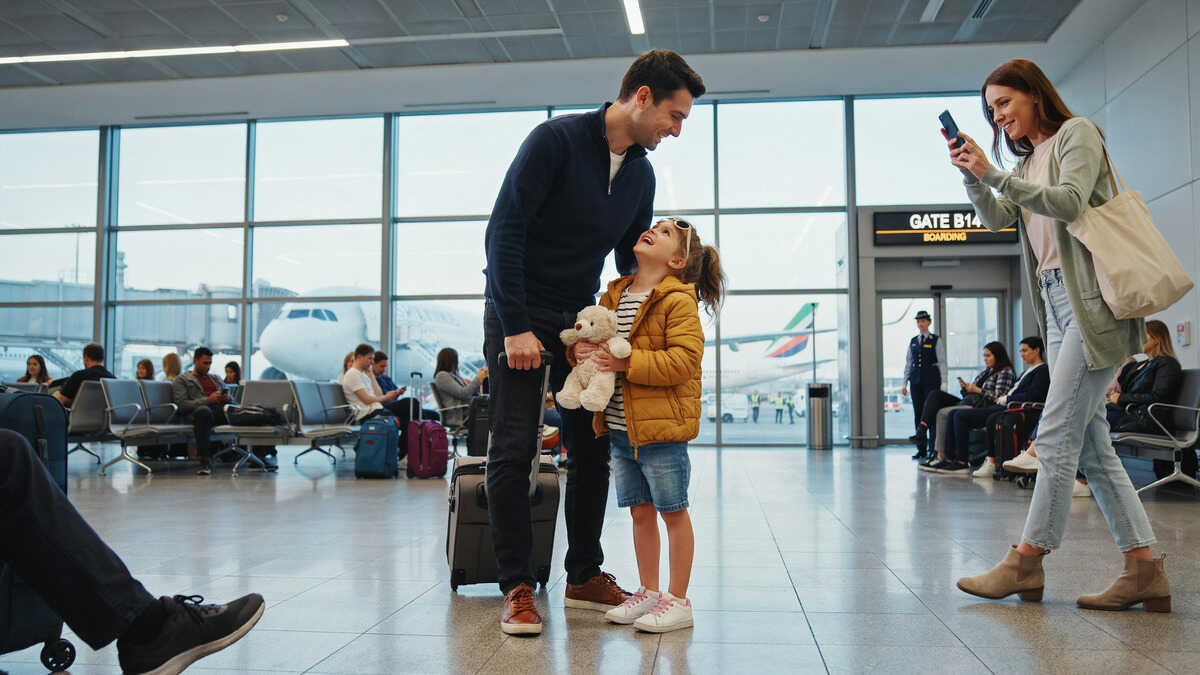
Image generated with Ai
US Parents are transforming the school holidays as they opt for more flexible trips that help them acquire better deals and provide a better travel experience. American families have a new travel focus that is cheaper, less crowded and educational trips, as opposed to fixed holiday periods. Things have changed, with flexible work and the new desire to make family memories instead of saving school holidays, families don’t have to wait before they travel.
The findings highlight a major shift in family travel behaviour, showing that the traditional school calendar is becoming less dominant as families look for cheaper flights, better accommodation availability, fewer crowds and more flexible travel options.
The survey, conducted among 1,000 US parents with children aged five to 18 by Atomik Research on behalf of Omio, shows that families are increasingly treating travel as a valuable life experience that can happen throughout the year rather than only during peak holiday periods.
For decades, American families have planned holidays around summer vacations, winter breaks and school holidays. However, rising travel costs, changing work patterns and the demand for more affordable experiences are pushing parents to rethink when they travel.
Advertisement
The Omio research shows that school calendars are no longer the only factor influencing family holiday decisions. Parents are increasingly considering travel dates based on practical issues such as ticket prices, hotel availability, weather conditions and work flexibility.
Among parents surveyed, 22% said better flight and hotel availability was a key reason for travelling outside traditional school holidays. Meanwhile, 19% said saving money influenced their decision, while another 19% wanted to avoid extreme weather conditions.
Other important factors included modern workplace flexibility. Around 16% of parents said remote-work opportunities allowed them to travel outside standard school holiday periods, while another 16% said avoiding crowds was a major motivation.
The trend reflects a wider transformation in family tourism, where travellers are increasingly prioritising value, comfort and personalised experiences over fixed seasonal travel patterns.
Advertisement
Advertisement
Financial pressure has become one of the strongest drivers behind this changing travel behaviour.
According to the survey, 92% of parents said they would consider taking their children out of school for a holiday if it resulted in any level of financial savings. This shows that even small reductions in travel costs can influence family decisions.
Almost half of respondents said they would consider travelling during school term time if they saved less than $1,000. The results suggest that families are actively searching for ways to reduce holiday expenses by avoiding peak travel periods when flights, hotels and attractions often become more expensive.
The ability to travel during quieter periods can provide families with more choices, including better accommodation options, shorter queues at attractions and potentially lower transportation costs.
For many parents, the decision is no longer only about missing classroom time. Instead, it is about balancing education, financial responsibility and creating meaningful family memories.
The survey also identified differences between mothers and fathers when it comes to taking children away during school terms.
Around 74% of fathers said they had taken their children out of school for a family trip, compared with 62% of mothers.
The difference suggests that parents may have varying perspectives on the balance between education schedules and family travel opportunities.
However, across both groups, the overall trend remains clear: a significant number of American parents are becoming more comfortable with flexible travel planning.
Rather than seeing holidays only as leisure breaks, many families are viewing travel as an opportunity for children to learn through real-world experiences.
The changing attitude towards school-term holidays is also connected to how parents view the educational value of travel.
The Omio survey found that 44% of parents believe missing several days of school can be worthwhile if the trip creates meaningful family experiences.
Another 28% said travel can be as educational as time spent inside the classroom.
Parents are increasingly recognising that visiting new destinations can expose children to different cultures, languages, history, geography and real-life situations that cannot always be replicated in a traditional classroom.
Generational differences were also recorded. Around 30% of Millennial parents said travel could provide the same educational value as classroom learning, compared with 23% of Generation X parents.
This indicates that younger generations of parents may be more likely to view travel as an important part of childhood development rather than simply a break from education.
Parents considering school-term travel are not choosing only one specific season. The survey found that families are spreading their trips across different periods of the year.
Around 52% of parents identified winter, between December and February, and spring, from March to June, as periods when they had travelled or would consider travelling outside official school holidays.
Meanwhile, 47% identified autumn as another suitable period for family travel.
This pattern suggests that families are looking beyond traditional peak travel seasons and exploring opportunities throughout the year.
For destinations, airlines, hotels and travel companies, this creates new opportunities to attract visitors during quieter months.
The growth of flexible family travel could help reduce seasonal pressure on popular destinations while allowing businesses to maintain stronger demand throughout the year.
The survey also examined how families communicate school absences when travelling during term time.
Around 45% of parents said they directly inform schools that the absence is for a holiday.
However, some parents choose different explanations. About 18% said they describe the absence as a family or personal reason, while 7% said they report that the child is sick. Another 7% provide no specific explanation.
The findings highlight the ongoing debate between schools and families about attendance, affordability and the value of travel experiences.
While schools continue to focus on consistent attendance, many parents argue that occasional travel can provide children with valuable experiences outside the classroom.
The changing behaviour of American families reflects a larger transformation across the travel industry.
Parents are increasingly searching for flexible booking options that allow them to compare different transport methods, find lower prices and create trips that match their personal schedules.
Omio said the survey reflects growing demand for travel planning that is not restricted by school calendars. The company highlighted the increasing importance of helping families compare transport choices, including trains, buses, ferries and flights, in one platform.
As families continue to balance budgets, work commitments and educational priorities, flexible travel is expected to become an increasingly important part of the tourism market.
The survey demonstrates a clear change in family holiday culture. For millions of American parents, the question is no longer whether travel should happen during school time, but when the timing creates the best combination of affordability, convenience and memorable experiences.
Survey methodology: Omio commissioned Atomik Research, part of 4media group, to survey 1,000 US adults who are parents of at least one child aged between five and 18. The research was conducted from July 30 to August 3, 2026, with a margin of error of plus or minus three percentage points at a 95% confidence level.
Advertisement
Tags: Budget Family Vacations, family travel, flexible travel trends, School Holiday Travel, US Tourism
Advertisement
Advertisement












Thursday, September 3, 2026

Thursday, September 3, 2026

Thursday, September 3, 2026

Thursday, September 3, 2026

Wednesday, September 2, 2026

Wednesday, September 2, 2026

Thursday, September 3, 2026

Thursday, September 3, 2026