
Namibia Cruise Tourism Enters New Phase as Port of Walvis Bay Berth 9 Modification Advances

Published
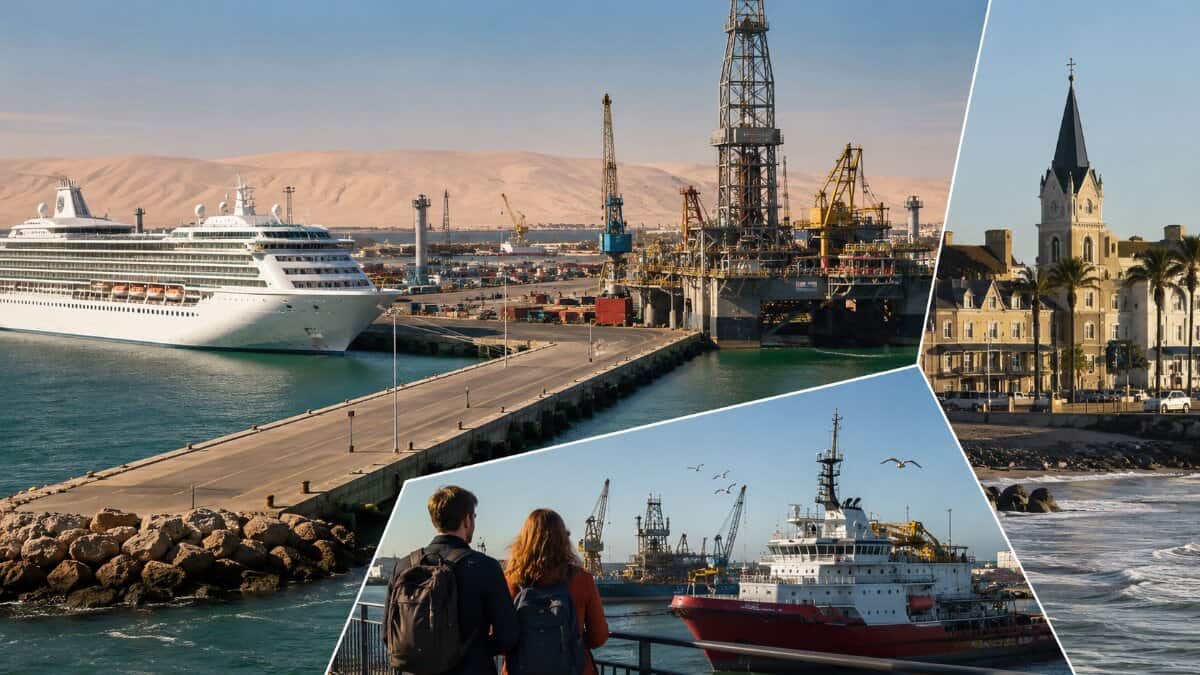
Namibia’s approaching Maritime Week has acquired a much more consequential cruise-tourism dimension. Namport is formally planning to transform Berth 9, Walvis Bay’s dedicated passenger-liner facility, into a 340-metre multipurpose quay incorporating oil-and-gas supply-base functions, tug operations and future passenger-ship handling. An initial procurement document uses 2027 as the planning start for a three-to-five-year Venus oil-field construction-support period. No cruise suspension has been announced. The critical issue for cruise lines and tour operators is therefore future berth allocation, passenger handling and shore-excursion continuity between Walvis Bay and Swakopmund.
Namibia Maritime Week Arrives as Walvis Bay’s Dedicated Cruise Berth Faces a Fundamental Change in Role
The timing makes the infrastructure story particularly important. According to the Namibia Tourism Board, Maritime Week will take place in Walvis Bay from 28 September to 3 October 2026, bringing together maritime stakeholders around shipping, marine fuel and ocean safety. Those subjects may appear technical to leisure travellers, but they sit directly alongside the operating conditions that determine whether passenger vessels can berth efficiently and whether thousands of cruise visitors can move quickly from ship to shore.
The under-reported development is Berth 9. Namibia’s own environmental documentation describes it as the first dedicated passenger-liner berth at the Port of Walvis Bay, created so cruise operations could be separated from the main cargo activities concentrated around Berths 1 to 8. The existing facility can accommodate large cruise vessels of up to 350 metres overall length.
Namport is now progressing a procurement process to modify that infrastructure. Its official project notice, reference ISD/EPC/NAMPORT-3694/2025, covers modification of the existing jetty, quay-wall works, dredging, land reclamation, ground improvement and road construction. The initial-selection applications closed on 29 January 2026.
Advertisement
Advertisement
What Exactly Is Being Planned at Berth 9?
According to Namport’s initial EPC procurement documentation, Berth 9 was originally designed for passenger vessels on one side and harbour tugboats on the other. The proposed modification would turn the dolphin-type jetty into a complete multipurpose terminal with reclaimed land behind the quay.
That change matters because the infrastructure would no longer have a cruise-only strategic identity.
Advertisement
Advertisement
| Official Berth 9 provision | Verified project detail | Cruise-sector significance |
|---|---|---|
| Existing function | Dedicated passenger facility, with cruise activity separated from the principal cargo hub | Gives cruise calls a distinct operating area today |
| Proposed quay | Existing passenger jetty converted into a 340-metre continuous quay wall | Creates a substantially different landside and waterside operating environment |
| Land development | About 4.2 hectares of new reclaimed land, with approximately 6.6 hectares of heavy-duty paved laydown area in total | Indicates substantially greater logistics and equipment activity behind the berth |
| Initial strategic function | Onshore supply base associated in the procurement scope with development and construction planning for the Venus field | Introduces oil-and-gas logistics into infrastructure historically associated with cruise passengers |
| Other berth function | Part of the facility is intended for Namport’s tug fleet | Adds another operational requirement to berth planning |
| Later multipurpose use | Passenger ships, dry-bulk vessels, mixed cargo and further offshore-support activity are included | Cruise remains contemplated, but within a shared terminal rather than an exclusively passenger-focused concept |
| Passenger design reference | Section A uses a 294-metre passenger vessel, 92,700 GT and 32.3-metre beam, for specified quay-wall lateral design forces | Confirms that cruise-vessel loading remains incorporated into the engineering concept |
| Water depth | Initial completion depth of 11 metres below chart datum, with an ultimate design depth of 16 metres for Section A | Relevant to future vessel compatibility, although these figures alone do not determine which ships will ultimately be accepted |
| Environmental status | Namibia’s environmental portal currently displays review in progress | The modification should not yet be treated as a completed or fully operational change |
An important technical distinction is necessary. The procurement document’s 294-metre design vessel should not be interpreted as a newly announced maximum cruise-ship length. Namport states that this vessel model is being used for lateral-force design. Separately, the environmental assessment describes the existing berth as capable of accommodating cruise vessels up to 350 metres. Official material reviewed for this report does not establish a future 294-metre operational cap.
Why 2027 Has Become the Date Cruise Planners Need to Watch
The initial-selection document introduces the most consequential timing detail.
Advertisement
Advertisement
Namport’s preliminary scope anticipates the modified facility serving as the principal supply base for construction associated with the Venus oil-field development, using 2027 as the starting planning assumption and estimating a three-to-five-year construction period. After that phase, the document envisages broader multipurpose operations including passenger ships, general cargo and further offshore-energy support.
That does not mean cruise operations have been cancelled for 2027. It also does not establish that the oil development or every element of the berth project has received all final approvals.
Namport explicitly states that the scope in the initial-selection document is indicative and may be amended when the final request for proposals is issued. The Ministry of Environment, Forestry and Tourism environmental portal also continues to display the project at the review stage.
The appropriate travel-industry interpretation is therefore planning exposure rather than confirmed disruption.
Advertisement
Advertisement
Cruise itinerary planners work years ahead. Berth availability, terminal security, coach staging, gangway movements, immigration processing and excursion departure windows can influence whether a destination remains operationally attractive even when the destination itself continues welcoming ships.
Walvis Bay and Swakopmund Make This More Than a Port Infrastructure Story
The second city in this story is Swakopmund, but it should not be misrepresented as the cruise port.
Cruise vessels call at Walvis Bay. Swakopmund matters because it forms part of the same coastal visitor economy.
According to the Namibia Tourism Board, Swakopmund and Walvis Bay are approximately 30 kilometres apart. NTB markets them together as major destinations on Namibia’s central coast, combining the main seaport with resort, desert and adventure experiences.
Historical Namport data demonstrates how rapidly a passenger call can spill beyond the harbour boundary. Its February 2020 institutional newsletter recorded more than 3,000 passengers and crew disembarking from one MSC Orchestra visit and travelling into both Walvis Bay and Swakopmund.
That relationship explains why berth efficiency matters to the wider coastal tourism economy. Delayed clearance or shortened usable port time can potentially compress excursion windows. Conversely, predictable passenger handling gives operators more opportunity to sell longer desert, marine, cultural and coastal itineraries.
Advertisement
Advertisement
Namibia Is Already Working on Passenger Facilitation Before Maritime Week
Cruise infrastructure is not the only official policy stream moving in 2026.
In July, the Namibia Tourism Board and the Ministry of Home Affairs, Immigration, Safety and Security convened a dedicated Cruise Tourism Stakeholder Engagement in Walvis Bay involving government agencies, tourism businesses, law enforcement, port stakeholders and private-sector participants.
According to NTB, the work covered passenger facilitation, institutional coordination, visitor experience and Namibia’s competitiveness as a cruise destination.
Taken alongside the Berth 9 plans, that meeting becomes more significant. Namibia is simultaneously examining how cruise passengers move through the destination while its principal passenger berth is being considered for a wider maritime-logistics mission.
That intersection is the real travel story entering Maritime Week.
Walvis Bay’s Expanding Cargo Economy Raises the Value of Berth Certainty
The pressure to diversify Berth 9 can be understood through Namport’s wider operating numbers.
Advertisement
Advertisement
For the financial year ended March 2025, Namport reported 253,996 TEUs of container traffic, up 48 per cent, while general cargo reached 6.34 million tonnes, an increase of 13 per cent. Total vessel calls fell 13 per cent to 1,850, yet gross tonnage rose to 23.5 million, which Namport associates with a shift towards larger vessels.
| Latest official indicator | Figure | Strategic relevance |
|---|---|---|
| Namport revenue FY2024/25 | N$2.88 billion | Demonstrates the commercial scale of Namibia’s port economy |
| Container throughput | 253,996 TEUs | Up 48%, increasing the importance of efficient port capacity |
| General cargo | 6.34 million tonnes | Up 13%, reinforcing pressure for versatile infrastructure |
| Cross-border cargo | About 2.45 million tonnes | Highlights Walvis Bay’s regional logistics role |
| Vessel calls | 1,850 | Down 13% |
| Gross vessel tonnage | 23.5 million | Higher tonnage despite fewer calls indicates larger-vessel activity |
| Namibia international tourist arrivals, 2024 | 1,257,093 | Tourism had recovered to about 78.8% of its 2019 level |
Port figures are from Namport’s Integrated Annual Report statistics, while tourism figures come from the latest full-year Tourist Statistical Report currently listed by Namibia’s environment and tourism ministry.
The comparison does not imply that cargo and tourism compete directly on every call. It shows why Namibia needs infrastructure capable of supporting several fast-growing maritime priorities without weakening the visitor experience.
The Real Strategic Question Is Coexistence Rather Than Cruise Versus Oil
The information gain for the travel trade lies in what the official documents collectively reveal.
Berth 9 is not being designed out of cruise tourism. Passenger vessels remain explicitly included in Namport’s future multipurpose concept, and a cruise ship forms part of the structural design basis. That is the reassuring part.
The harder issue is operational coexistence.
Advertisement
Advertisement
A dedicated passenger berth simplifies the interface between ship operations and tourism. A multipurpose terminal potentially introduces different requirements: heavy equipment, supply-base movements, tug operations, cargo handling, controlled areas, additional vehicle activity and more complicated berth scheduling. Namport’s project documentation also provides for roads, access controls, utilities, future marine-diesel infrastructure and heavy-duty operating areas.
None of those elements automatically damages cruise tourism. Well-designed multipurpose ports handle passenger and commercial traffic worldwide.
The differentiator will be whether Namibia retains the attributes that made a dedicated berth useful in the first place: predictable berthing, clean passenger segregation, rapid coach access, secure processing and sufficient time ashore.
That is why Maritime Week’s official focus on shipping, marine fuel and ocean safety now carries a direct tourism relevance. The key question is no longer simply whether Walvis Bay can receive cruise vessels. It is whether its next generation of port infrastructure can accommodate a larger blue-economy agenda without diluting passenger efficiency.
What Travel Agents and Cruise Tour Operators Should Monitor Now
- Do not treat Berth 9 as closed. No official source reviewed as of 30 August 2026 announces suspension of cruise calls or cancellation of the dedicated passenger facility.
- Watch the final EPC scope. Namport states that the initial design scope can still change during the later procurement process.
- Track environmental clearance. The official project page remains at review in progress, making regulatory status an important construction-timing indicator.
- Seek berth confirmation early for 2027 onward itineraries. The preliminary project timetable makes future berth allocation commercially relevant even before physical works begin.
- Protect shore-excursion margins. Operators serving Swakopmund should build contracts around realistic clearance, coach-staging and port-exit times because the city lies outside the cruise port itself.
- Monitor passenger-facilitation reforms. Namibia’s July 2026 stakeholder process shows immigration, security, tourism and port coordination are already receiving official attention.
- Separate planning assumptions from confirmed disruption. The Venus-related dates in the procurement scope are infrastructure-planning parameters and should not be promoted to travellers as an announced cruise restriction.
Namibia’s Maritime Expansion Could Strengthen Cruise Tourism If Passenger Certainty Is Preserved
Walvis Bay Maritime Week from 28 September to 3 October 2026 is therefore more important to cruise tourism than its event description initially suggests. The discussions on shipping, fuel and maritime safety will take place while Namibia is considering one of the most consequential physical changes to the infrastructure used by passenger ships at its principal seaport.
For Namibia, the opportunity is considerable. A deeper, more capable multipurpose Berth 9 could strengthen Walvis Bay’s broader maritime economy while retaining cruise functionality. Expanding offshore-energy activity can also stimulate transport, accommodation and business-travel demand across the coastal region.
Advertisement
Advertisement
The challenge is equally clear. Walvis Bay’s value to cruise itineraries depends not only on whether a ship physically fits alongside a quay, but on whether passengers can move efficiently into Walvis Bay, Swakopmund and surrounding coastal attractions.
As of 30 August 2026, there is no verified cruise cancellation story here. There is something more strategic: Namibia is approaching a point where a berth built specifically to separate tourism from cargo is being redesigned to serve several sectors at once.
For cruise lines, destination managers and tour operators, that transition — and how passenger priority is preserved within it — is the development to watch.
Advertisement
