
Paris and Barcelona Converge with Silverstone and Monaco as Sporting Events Tourism Fuels International Travel and Regional Spending

Published
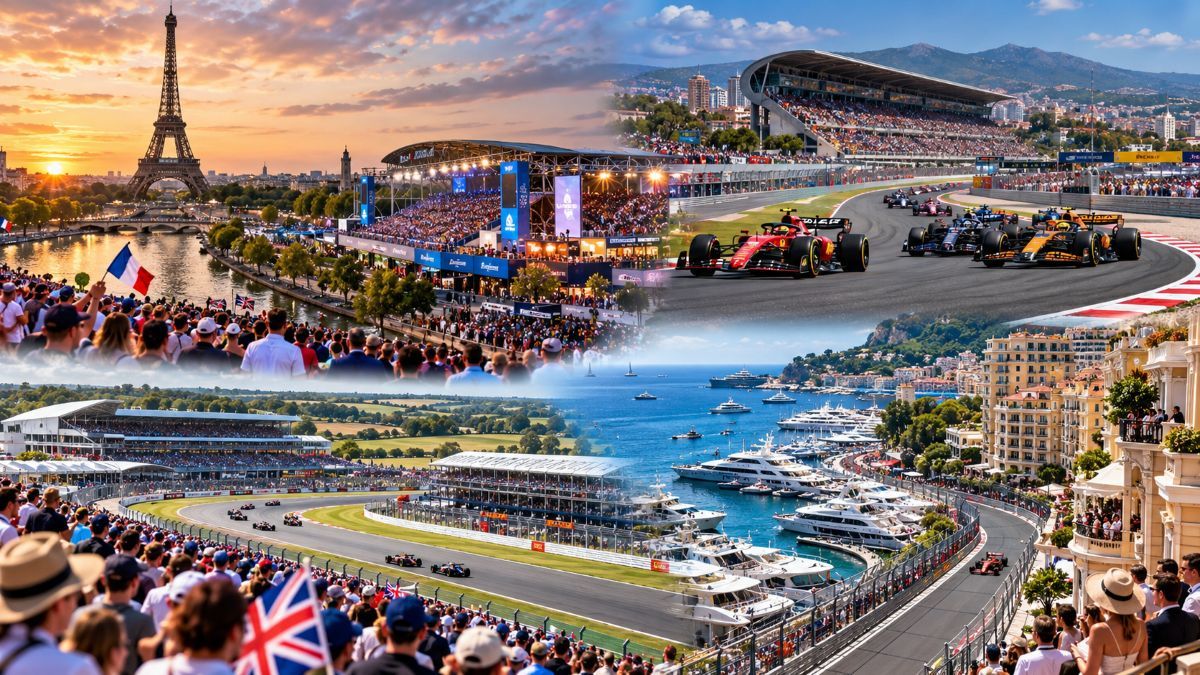
Europe’s biggest sporting events are creating tourism opportunities that extend far beyond stadium gates, with hotel demand, international visitor spending and regional travel emerging as crucial measures of their wider economic value. Paris welcomed an estimated 11.2 million visitors to Greater Paris during the 2024 Olympic and Paralympic Games, while Silverstone recorded 500,000 admissions across the 2025 British Grand Prix weekend. Barcelona’s Formula One race offers another model, combining motorsport with an established international city-break market. Monaco, meanwhile, demonstrates how a compact destination can concentrate premium hospitality demand and visitor expenditure. Comparing these four destinations reveals why attendance alone cannot establish which sporting event delivers the strongest tourism returns.
Sporting Crowds Reveal Four Different Tourism Economies
Sporting-event tourism has become an important consideration for destination planners, accommodation providers, transport operators and regional tourism businesses. However, headline attendance figures rarely reveal how much additional travel an event generates, how long visitors stay or where their spending ultimately goes. A packed circuit can generate substantial business for nearby hotels, yet a major city may capture wider benefits through restaurants, museums, retail and extended holidays.
Advertisement
Advertisement
Paris, Barcelona, Silverstone and Monaco illustrate four distinct approaches to this market. Paris provides a benchmark for a multi-venue mega-event, Barcelona combines Formula One with established urban tourism, Silverstone draws visitors into the English countryside, and Monaco capitalises on luxury hospitality within limited geographical space. Their differences make them valuable case studies for understanding the relationship between sporting demand and the wider visitor economy.
The central question is not simply which event attracts the largest crowd. It is which event generates additional overnight stays, encourages visitors to explore beyond the venue and distributes spending across local businesses. Answering that question requires accommodation statistics, visitor profiles, transport data and carefully interpreted economic-impact estimates.
Advertisement
Advertisement
Paris Sets the Benchmark for Extended Visitor Spending
Paris demonstrates how a major sporting occasion can influence accommodation choices, leisure spending and the duration of a city break. According to Paris je t’aime, Greater Paris recorded an estimated 11.2 million visitors during the 2024 Olympic Games period, including residents, day-trippers and tourists. Of these, approximately 3.1 million were tourists, comprising 1.7 million international visitors and 1.4 million domestic tourists. The distinction matters because the headline figure does not represent 11.2 million incoming tourists.
The accommodation figures reveal a more useful measure of travel demand. Paris hotels recorded 84% occupancy between 23 July and 6 August 2024, a rise of 10 percentage points compared with the corresponding period in 2023. Average stays also lengthened, reaching 3.1 nights for French visitors and 2.9 nights for international visitors. Both figures exceeded their respective 2023 levels, suggesting that the Games influenced more than simple visitor numbers.
Advertisement
Advertisement
France’s national statistics institute, INSEE, provides further evidence of the spending effect. Tourists staying in paid accommodation and primarily motivated by the Games spent an average of €194 per night in 2024, excluding expenditure directly related to the event. That compared with €159 during the third quarter of 2023, although the comparison does not isolate every effect of the Games from wider economic changes.
The composition of that spending is particularly revealing. Average accommodation expenditure reached €110 per night during the Games, against €78 in 2023, while leisure spending increased from €16 to €27. Spending on goods, however, fell from €23 to €17 per night. This suggests that event-motivated visitors prioritised accommodation and experiences over shopping, creating opportunities for hotels, restaurants and attractions.
For travellers, the lesson is straightforward. Major events can transform the cost and character of a destination, even when visitors do not attend every competition. For tourism businesses, Paris illustrates why length of stay and expenditure by category provide stronger commercial insights than arrival totals alone.
Barcelona Converts Motorsport Into Regional Demand
Barcelona presents a different tourism model because its Formula One weekend operates within an established international leisure destination. The city already attracts visitors for architecture, beaches, gastronomy, cultural attractions and cruise connections. Consequently, the research challenge is to identify how much additional demand the Grand Prix creates beyond the city’s normal tourism activity.
The Barcelona Tourism Observatory reported 26.1 million tourists across Destination Barcelona in 2025, including 16 million in the city and 10.1 million in the surrounding region. Direct tourism expenditure reached an estimated €14.041 billion, divided between €10.376 billion in the city and €3.665 billion in the region. These figures describe the overall destination economy, not the Formula One event alone.
Destination Barcelona tourism indicators for 2025
Advertisement
Advertisement
| Indicator | Reported result |
|---|---|
| Tourists across the destination | 26.1 million |
| Tourists in Barcelona city | 16.0 million |
| Tourists in the surrounding region | 10.1 million |
| Direct tourism expenditure | €14.041 billion |
| Overnight stays in tourist accommodation | More than 56 million |
| Barcelona Airport passenger movements | More than 57.4 million |
The wider tourism infrastructure gives Barcelona a significant advantage when accommodating international event visitors. The region recorded more than 56 million overnight stays in tourist accommodation during 2025, while Barcelona Airport handled over 57.4 million passenger movements. Nevertheless, strong annual figures cannot establish whether the Grand Prix caused additional hotel bookings or simply coincided with existing summer demand.
The circuit’s own reporting offers a separate measure of the event’s economic footprint. The 2024 Spanish Grand Prix generated a reported economic impact exceeding €300 million and supported 2,500 full-time-equivalent jobs. The latest edition cited by the circuit attracted more than 300,000 attendees, although the published announcement does not make those attendance figures a measure of unique overnight visitors.
The race’s regional location also creates an important travel question. Visitors may stay in Barcelona, choose accommodation closer to the circuit or combine the race with a wider Catalonian holiday. A detailed analysis should therefore compare accommodation performance in the city and surrounding municipalities, alongside rail, road and shuttle movements during the event weekend.
For travellers, this creates a practical choice between city-based sightseeing and accommodation closer to the circuit. For destination planners, the priority is ensuring that event visitors contribute to the wider regional economy rather than concentrating their expenditure in a limited number of venues.
Silverstone Tests the Power of Rural Event Tourism
Silverstone offers one of Europe’s clearest examples of concentrated sporting demand outside a major metropolitan centre. Its rural setting makes accommodation, transport coordination and regional distribution central to the visitor experience. The event’s tourism value therefore depends not only on the number of people entering the circuit, but also on where they sleep, eat and spend money.
The 2025 British Grand Prix welcomed 500,000 people through Silverstone’s gates across the race weekend, surpassing the 480,000 attendance reported for each of the 2023 and 2024 editions. The circuit also reported that 600 buses transported more than 125,000 people to and from the venue. Of those buses, 100 were electric vehicles.
Advertisement
Advertisement
These figures demonstrate the logistical scale of the event. They also reveal why transport provision should be treated as part of the tourism product rather than simply a means of reaching the circuit. Large crowds require coordinated services, suitable arrival windows, traffic management and clear information about alternative accommodation and onward connections.
Silverstone’s wider programme also helps explain why attendance alone cannot measure its economic value. The 2025 weekend included 25 on-track sessions and historic demonstrations, alongside concerts and entertainment. Such activities can encourage visitors to arrive earlier, remain later or treat the event as a multi-day leisure break rather than a single race.
However, the available figures do not establish how many attendees stayed overnight, how many were international visitors or how much additional expenditure reached surrounding businesses. Those questions require accommodation occupancy data, campsite bookings, visitor surveys and expenditure estimates from relevant local tourism authorities.
For travellers, Silverstone requires a different planning strategy from a city-centre event. Accommodation may be distributed across rural locations and nearby towns, while transfers can become a major component of the journey. Booking early, checking official transport arrangements and considering accommodation beyond the immediate circuit can improve flexibility, although availability and journey times vary by event year.
The regional opportunity is equally significant. If visitors stay in neighbouring towns and spend money with independent restaurants, accommodation providers and attractions, the benefits can spread beyond the circuit. Establishing the scale of that spillover would help determine whether Silverstone produces a broader regional tourism dividend.
Monaco Turns Limited Space Into Premium Demand
Monaco illustrates how sporting tourism can generate substantial economic activity within a remarkably small territory. Unlike Paris, which accommodates visitors across a large metropolitan area, the principality concentrates its Grand Prix around a compact street circuit, waterfront, hotels, restaurants and hospitality venues. This creates an unusual commercial environment in which limited space, premium experiences and international visibility reinforce one another.
Advertisement
Advertisement
An official assessment by Monaco’s Institute of Statistics and Economic Studies, IMSEE, valued the 2017 Monaco Grand Prix’s economic benefits at €90 million over four days. The estimate comprised €21.7 million in direct benefits and €68.3 million in indirect benefits. Hotels approached full occupancy, while terraces, rooftops and boats generated additional viewing opportunities beyond conventional grandstand tickets.
The same assessment estimated more than 200,000 cumulative participants across the four-day event, with daily numbers varying between 50,000 and 65,000. It also found that 40% of people present did not have a direct view of the race. That finding demonstrates the reach of the event atmosphere, although it does not establish that everyone without a direct view was a non-ticket-holder or an additional tourist.
Monaco’s economic model extends beyond hotel bookings. Corporate hospitality, restaurant reservations, temporary terrace rentals, boat experiences and transport services can all benefit from the Grand Prix. Moreover, neighbouring French Riviera destinations may capture accommodation demand when visitors cannot secure suitable rooms within the principality itself.
The €90 million estimate remains a historical benchmark, not a current assessment of the event’s value. A modern comparison would require updated expenditure data, current hotel performance and a clear distinction between spending generated by the Grand Prix and spending that would have occurred anyway.
For travellers, Monaco highlights the importance of planning beyond the immediate destination. Staying in a neighbouring town may offer an alternative when accommodation is scarce, although visitors should compare transfer costs, journey times and event-day transport arrangements before booking.
Four Events Compared on Tourism Value
The available evidence establishes distinct strengths, but it does not yet support a definitive ranking of the four events by additional tourism spending. Their figures cover different years, geographic areas and measurement methods. The following comparison separates demonstrated results from the information still needed.
Advertisement
Advertisement
| Destination | Strongest verified evidence | Wider tourism opportunity | Main evidence gap |
|---|---|---|---|
| Paris | 11.2 million visitors during the 2024 Games; hotel occupancy of 84% | Longer stays, leisure spending and metropolitan visitor dispersal | Additional spending attributable solely to the Games |
| Barcelona | €300 million-plus reported Grand Prix impact in 2024 | Regional accommodation, city breaks and extended Catalonian holidays | Event-specific overnight stays and incremental expenditure |
| Silverstone | 500,000 admissions and 125,000-plus bus passengers in 2025 | Rural accommodation, campsites and nearby towns | Visitor origins, overnight stays and regional spending |
| Monaco | €90 million estimated economic benefits in 2017 | Premium hospitality, luxury accommodation and French Riviera spillover | Comparable current expenditure and visitor-night data |
The comparison reveals four different ways sporting occasions can support tourism. Paris demonstrates the potential for extended stays and spending across a major city, Barcelona combines an established visitor economy with motorsport demand, Silverstone tests the regional reach of a rural event, and Monaco shows how premium experiences can generate expenditure beyond ticket sales.
However, the most commercially valuable event may not be the one with the highest attendance or the largest reported economic impact. A destination with fewer visitors could deliver stronger returns per overnight stay, while another might spread benefits across a larger number of local businesses. Tourism value depends on additional expenditure, visitor behaviour and the proportion of benefits retained locally.
Transport Capacity Shapes the Visitor Experience
Transport infrastructure is a decisive part of sporting-event tourism because concentrated arrivals can place pressure on airports, railways, roads and local public transport. The four destinations face different challenges, ranging from metropolitan crowd management to rural transfers and restricted street access.
Barcelona’s airport scale provides extensive international connectivity, while Paris benefits from a large metropolitan transport network. Silverstone’s bus operations demonstrate the importance of organised transfers to a rural venue. Monaco’s compact geography makes regional rail and road connections particularly important when local capacity comes under pressure.
Yet capacity figures alone do not establish how effectively a destination handles demand. A rigorous investigation should compare passenger volumes, additional services, journey times, disruption and the proportion of visitors using public transport. These measures would help identify whether transport infrastructure supports tourism growth or becomes a constraint on the visitor experience.
Travellers should check official event transport guidance before choosing accommodation. They should also compare the total journey, including transfers and late-night returns, rather than selecting a hotel solely by its distance from the venue. Where event organisers provide shuttle services, advance booking and clearly defined departure points can be particularly useful.
Advertisement
Advertisement
Accommodation Prices Need Seasonal Context
Sporting events can tighten accommodation availability and influence room prices, but the scale of that effect varies between destinations. Monaco’s restricted supply makes premium accommodation a particularly important research subject, while Silverstone’s regional geography creates a wider network of hotels, campsites and rural stays. Barcelona and Paris have larger accommodation markets, although their capacity also serves substantial year-round demand.
The most informative comparison would examine hotel occupancy, average daily rates and revenue per available room during event dates. These measures should be compared with equivalent weekdays, the same season in previous years and nearby areas outside the event’s immediate footprint.
A price increase does not automatically indicate additional tourism value. Higher rates can improve hotel revenue, but they can also displace ordinary visitors, encourage residents to alter their travel dates or shift demand towards surrounding towns. The final analysis should therefore examine both commercial performance and the wider destination effect.
For travellers, flexible dates and alternative accommodation areas may offer useful options. Nevertheless, visitors should assess transport costs and availability alongside room prices, particularly when staying outside the main destination.
What the Industry Should Measure Next
A more comprehensive assessment requires comparable data from tourism authorities, accommodation providers, transport operators and event organisers. The most valuable missing information concerns overnight stays, visitor origins, length of stay, non-ticket-holder spending and the geographical distribution of expenditure.
Researchers should also distinguish gross economic activity from genuinely additional spending. An event may attract visitors who would otherwise have travelled to the destination, while some regular tourists may avoid the area during busy periods. Both effects influence the final economic outcome.
Advertisement
Advertisement
Industry analysis should account for public expenditure, event operating costs, imported supplies and profits leaving the local economy. It should also assess whether sporting events encourage repeat visits after the competition ends. These factors offer a more balanced assessment than promotional estimates alone.
Official tourism observatories and statistical agencies provide a sound starting point for this work. However, event-specific surveys and consistent reporting periods remain essential if destinations want to compare results reliably.
Why Sporting Tourism Matters to Travellers
Europe’s major sporting occasions offer different opportunities for visitors, accommodation providers and destination planners. Paris shows how a mega-event can influence spending and length of stay, Barcelona highlights the relationship between motorsport and an established tourism economy, Silverstone demonstrates the importance of regional transport and accommodation, and Monaco illustrates the commercial potential of premium hospitality.
The strongest event cannot yet be identified from the available figures alone. A credible ranking requires comparable evidence on additional overnight stays, visitor spending and the distribution of benefits beyond the competition venue. Until that evidence exists, the most useful conclusion is that attendance measures scale, while incremental spending and overnight stays reveal more about tourism value. For travellers, understanding these differences can help with accommodation choices, transport planning and decisions about extending a sporting trip into a wider holiday.
Advertisement
