

UK Joins Belgium and Other Leading Countries in Netherlands Tourism as Amsterdam Tightens Visitor Rules in 2026

Published
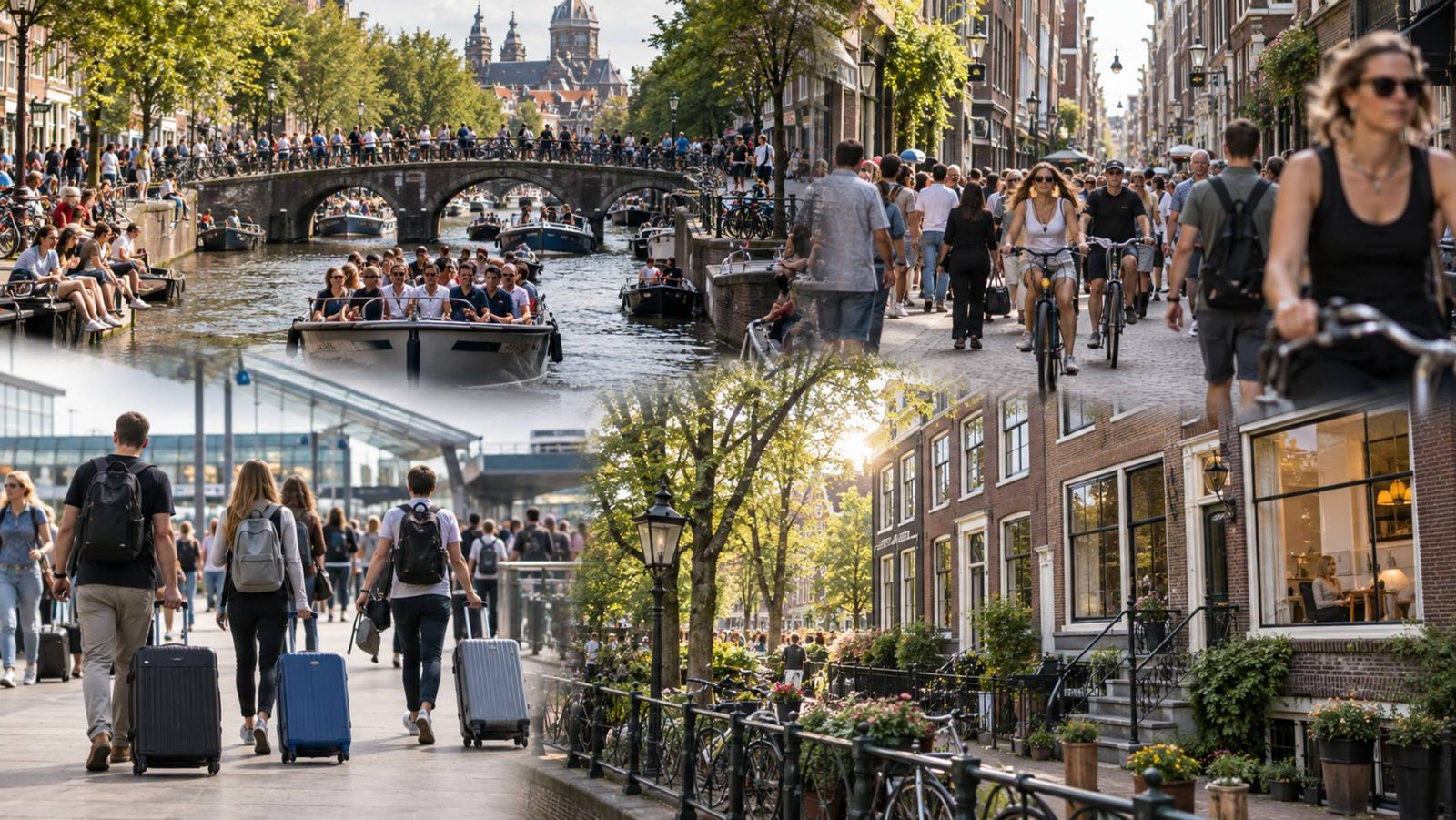
The UK, Belgium, Germany and the US are important international tourism markets for the Netherlands as Amsterdam pushes for fewer tourists amid growing concerns about overcrowding and pressure on residential neighbourhoods. The Dutch capital’s tighter accommodation rules are reshaping the travel environment while international visitor demand continues to increase nationally. Amsterdam’s approach has implications for hotels, holiday rentals, travel agencies and visitors planning European city breaks. The wider tourism impact extends beyond Amsterdam because the Netherlands continues to attract travellers from neighbouring European countries and long-haul markets, creating a challenge between tourism growth and sustainable destination management.
Amsterdam Tourism Restrictions 2026: Why the Netherlands Capital Is Controlling Visitor Growth
Amsterdam’s approach to tourism is changing as the city seeks to reduce pressure on heavily visited neighbourhoods without preventing international travel. The latest municipal statistics show that the city recorded 23.7 million tourist overnight stays in 2025, above its annual policy threshold of 20 million. In May 2026, Amsterdam’s Research and Statistics Department projected that overnight stays could reach between 25 million and 29.4 million by 2028. These figures demonstrate why local authorities continue to restrict accommodation expansion and strengthen neighbourhood-level regulations. The measures focus on visitor concentration and residential liveability rather than closing the destination to tourists.
Advertisement
Advertisement
- Tourism volume: The city recorded 23.7 million tourist overnight stays in 2025.
- Policy threshold: Amsterdam’s annual ceiling remains 20 million overnight stays.
- Excess demand: Recorded stays exceeded that threshold by 3.7 million.
- Future outlook: The municipal forecast indicates further growth towards 2028.
- Travel impact: Accommodation regulation is becoming an increasingly important consideration for international visitors.
| Tourism indicator | Verified information |
|---|---|
| Recorded overnight stays | 23.7 million in 2025 |
| Annual policy threshold | 20 million |
| Excess above threshold | 18.5% |
| Forecast period | 2026–2028 |
| Overnight stays forecast for 2028 | 25–29.4 million |
Netherlands Tourism Market 2026: National Growth Continues Despite Amsterdam’s Restrictions
The Netherlands continues to welcome international tourism growth even as Amsterdam introduces tighter controls. The Netherlands Board of Tourism & Conventions published its Forecast 2026 on 22 January, projecting approximately 53 million domestic and international overnight guests nationwide. International arrivals were expected to increase by 2.4%, reaching around 23 million guests, while domestic guests were forecast to decline by 1% to approximately 30 million. This difference highlights the contrasting priorities within Dutch tourism. At the national level, international travel demand remains an economic opportunity. In Amsterdam, the focus is increasingly on managing accommodation capacity and limiting localised visitor pressure.
- Total tourism demand: Approximately 53 million overnight guests are forecast for 2026.
- International market: Foreign guest arrivals are expected to grow by 2.4%.
- Domestic market: Dutch overnight guests are projected to decline by 1%.
- European demand: Europe is expected to account for around 80% of international overnight guests.
- Growth outlook: Overall overnight guest growth is forecast at just 0.5%.
| Netherlands tourism market | 2026 forecast |
|---|---|
| Total overnight guests | Approximately 53 million |
| International overnight guests | Approximately 23 million |
| Domestic overnight guests | Approximately 30 million |
| International guest growth | +2.4% |
| Domestic guest growth | −1% |
| Overall overnight guest growth | +0.5% |
UK Tourism to the Netherlands in 2026: British Travellers Face a Changing Amsterdam City Break Market
The United Kingdom remains an important European source market for Dutch tourism. According to NBTC’s January 2026 forecast, overnight guests travelling from the UK are expected to increase by approximately 1%, although British arrivals remain below their 2019 levels. NBTC identifies British visitors as particularly sensitive to accommodation prices, making cost an important consideration for Dutch city-break tourism. Amsterdam’s tighter holiday-rental rules do not prevent British travellers from visiting, but they affect the regulatory environment in which accommodation providers operate. The distinction is significant for UK tour operators, online booking platforms and independent travellers comparing short-stay properties across the Netherlands.
Advertisement
Advertisement
- Market forecast: UK overnight arrivals are projected to rise by 1% in 2026.
- Historic comparison: Arrivals remain below pre-pandemic levels according to NBTC.
- Accommodation pricing: British demand is sensitive to rising travel costs.
- Holiday rentals: Visitors should verify that accommodation providers meet municipal requirements.
- Destination choice: Other Dutch destinations remain available to travellers exploring beyond Amsterdam.
| UK travel market indicator | Verified position |
|---|---|
| Netherlands inbound growth forecast | +1% |
| Reference year | 2026 |
| Comparison with 2019 | Still below 2019 levels |
| Main demand consideration | Accommodation affordability |
| Amsterdam entry restrictions on UK tourists | No general entry ban introduced by the city’s tourism measures |
Belgium Tourism to the Netherlands: Cross-Border Travel Demand Maintains Steady Growth
Belgium is another important neighbouring market for tourism in the Netherlands. NBTC forecasts a 1% increase in overnight guests from Belgium in 2026, reflecting modest growth rather than a substantial acceleration. Belgium’s geographic proximity makes it relevant to shorter Dutch leisure trips and multi-destination European itineraries. However, Amsterdam’s accommodation restrictions apply according to property location and rental type, not a visitor’s nationality. Belgian tourists therefore face the same locally applicable accommodation rules as other international travellers. The broader Netherlands market remains open, while municipal policy increasingly distinguishes between tourism that contributes to destinations and activity that creates concentrated neighbourhood pressure.
- Demand forecast: Belgian overnight guest numbers are projected to grow by 1%.
- Market importance: Belgium remains a key neighbouring source country.
- Short-break travel: Proximity supports access to Dutch destinations.
- Regulatory application: Amsterdam’s holiday-rental limits apply equally to Belgian and other foreign guests.
- Travel planning: Accommodation location and compliance remain important booking considerations.
| Belgium–Netherlands tourism indicator | Position in 2026 |
|---|---|
| International source market | Belgium |
| Forecast arrival growth | +1% |
| Market category | Neighbouring European country |
| Amsterdam accommodation regulation | Applies by property and neighbourhood |
| Broader tourism impact | Moderate projected demand growth |
Germany Leads Netherlands Tourism Demand as Amsterdam Balances Growth With Local Capacity
Germany remains the Netherlands’ largest international source market. NBTC expects almost eight million German overnight guests in 2026, with growth slowing to approximately 0.5%. The organisation identifies increasing price sensitivity among German visitors, including greater interest in less expensive regions and camping accommodation. These market conditions are particularly relevant to Amsterdam, where limitations on hotel development and short-term residential rentals influence accommodation supply. German travellers have access to destinations across the Netherlands, making tourism distribution an important consideration. The national forecast suggests that continued German demand will coexist with slower growth and more selective accommodation spending.
Advertisement
Advertisement
- Largest source market: Germany leads international overnight arrivals in the Netherlands.
- Expected visitor volume: Almost eight million German overnight guests in 2026.
- Growth rate: Arrivals are forecast to increase by approximately 0.5%.
- Accommodation preference: NBTC identifies increasing price sensitivity and interest in camping.
- Amsterdam implications: The city’s accommodation restrictions operate alongside continued demand from its largest national source market.
| Germany tourism indicator | Verified 2026 forecast |
|---|---|
| Expected German overnight guests | Almost 8 million |
| Annual growth forecast | +0.5% |
| Position in Netherlands inbound tourism | Largest international source market |
| Noted market trend | Greater price sensitivity |
| Alternative accommodation identified by NBTC | Camping and lower-cost regions |
US Tourism to the Netherlands in 2026: American Arrivals Expected to Outpace European Growth
The United States represents a faster-growing long-haul source market for Dutch inbound tourism. NBTC forecasts a 5% increase in overnight guests from the US during 2026, exceeding the growth rates projected for the UK, Belgium and Germany. This contrast is important for understanding the Netherlands’ changing visitor mix. American travellers are not subject to a nationality-specific restriction under Amsterdam’s local tourism-management measures. However, their accommodation options are governed by the same municipal rules affecting residential holiday rentals and hotel development. The combination of stronger long-haul demand and constrained new accommodation capacity makes Amsterdam’s regulatory framework relevant to international travel suppliers.
- Visitor growth: US overnight arrivals are projected to increase by 5%.
- Market comparison: The forecast exceeds the rates for the three named European markets.
- International importance: US demand contributes to the Netherlands’ long-haul visitor segment.
- Accommodation compliance: Amsterdam’s restrictions are based on accommodation type and location.
- Travel trade implications: US-focused booking intermediaries must consider local rental conditions when selling Amsterdam accommodation.
| Country | NBTC 2026 forecast growth |
|---|---|
| United States | +5% |
| United Kingdom | +1% |
| Belgium | +1% |
| Germany | +0.5% |
Amsterdam Holiday Rental Rules 2026: Eight Neighbourhoods Face a Strict 15-Night Limit
Amsterdam’s most direct tourism restrictions involve residential holiday accommodation. From 1 April 2026, the city reduced the annual holiday-rental allowance from 30 nights to 15 nights in eight neighbourhoods, including Jordaan, Nieuwmarkt/Lastage and Oude Pijp. Elsewhere, the normal limit generally remains 30 nights. Property owners must also comply with permit, registration and rental-notification requirements. These restrictions affect the permitted operation of short-stay accommodation rather than introducing a maximum stay of 15 nights for hotel guests. For international visitors, the relevant issue is whether the accommodation they book is legally offered under the municipality’s rules.
- Annual limit: Eight neighbourhoods now have a maximum of 15 holiday-rental nights.
- Other areas: The normal annual maximum elsewhere is generally 30 nights.
- Registration: Tourist rental listings must display a registration number.
- Permit requirement: Owners generally need a valid holiday-rental permit.
- Guest capacity: A holiday rental may accommodate no more than four guests at a time.
| Amsterdam neighbourhood | Annual holiday-rental limit |
|---|---|
| Haarlemmerbuurt | 15 nights |
| Jordaan | 15 nights |
| Grachtengordel-West | 15 nights |
| Grachtengordel-Zuid | 15 nights |
| Weteringschans | 15 nights |
| Burgwallen-Nieuwe Zijde | 15 nights |
| Nieuwmarkt/Lastage | 15 nights |
| Oude Pijp | 15 nights |
Amsterdam’s Latest Tourism Policy Update: Helmersbuurt Faces Proposed Restrictions for 2027
The latest verified municipal development concerns Helmersbuurt, where Amsterdam has proposed reducing the annual holiday-rental allowance from 30 nights to 15. The proposal was published in English on 5 October 2026, with a proposed implementation date of 1 January 2027. Municipal findings indicate that at least 30% of residents experienced problems associated with tourists occupying residential accommodation. Amsterdam has opened a consultation process that continues until 8 November 2026. If adopted, Helmersbuurt would become the ninth neighbourhood subject to the stricter rental limit. As of 11 October 2026, this remains a proposal, not a completed regulatory change.
- Affected neighbourhood: Helmersbuurt, Amsterdam.
- Existing maximum: 30 holiday-rental nights annually.
- Proposed maximum: 15 nights annually.
- Proposed introduction: 1 January 2027.
- Consultation deadline: 8 November 2026.
| Policy indicator | Official government information |
|---|---|
| Proposal publication | 5 October 2026, English announcement |
| Residential complaints indicator | At least 30% of residents |
| Potential reduction in rental allowance | 50% |
| Total neighbourhoods under the 15-night rule if adopted | Nine |
| Legal status in October 2026 | Proposal under consultation |
Netherlands Travel Costs in 2026: Higher Accommodation VAT Adds Pressure to Hotel Spending
The Netherlands introduced an important national accommodation tax change on 1 January 2026, increasing VAT on most short-stay accommodation from 9% to 21%. The increase covers hotel stays and various holiday accommodation categories. According to Statistics Netherlands, turnover in the accommodation services sector declined by 0.9% during the second quarter of 2026 compared with the same period in 2025. Hotel turnover decreased by 2%, while holiday-rental and campsite turnover increased by 1.5%. CBS identifies the higher VAT rate as a possible contributing factor to the hotel-sector decline, although the figures do not establish a single cause.
- VAT adjustment: The applicable rate rose from 9% to 21% for most short-stay accommodation.
- Implementation: The change took effect on 1 January 2026.
- Hotel turnover: Q2 2026 turnover declined by 2% year on year.
- Accommodation sector: Overall turnover fell by 0.9%.
- Holiday rentals and campsites: Their combined segment recorded 1.5% turnover growth.
| Accommodation market indicator | Verified figure |
|---|---|
| Previous standard accommodation VAT | 9% |
| New accommodation VAT | 21% |
| Accommodation services turnover, Q2 2026 | −0.9% |
| Hotel turnover, Q2 2026 | −2% |
| Holiday rental and campsite turnover, Q2 2026 | +1.5% |
Travel and Tourism Impact 2026: How Amsterdam’s Controls Affect Hotels, Airlines and International Visitors
Amsterdam’s tourism policy has consequences across different parts of the visitor economy, although the available government evidence does not establish that the restrictions have caused a measurable fall in airline passenger traffic. Accommodation providers face the clearest direct regulatory changes, particularly where residential properties are subject to reduced rental allowances. Meanwhile, international arrivals to the Netherlands are still forecast to grow. For airlines and travel agencies serving passengers from the UK, Belgium, Germany and the US, the distinction between national tourism growth and Amsterdam’s local restrictions is essential. Visitor demand can increase nationally while an individual destination limits tourism-related development.
- Hotels: Restrictions on additional hotel capacity limit opportunities for unrestricted accommodation expansion.
- Holiday rentals: Property owners in affected neighbourhoods face stricter annual rental allowances.
- Airlines: National inbound growth forecasts indicate continuing travel demand, but no verified causal change in flight capacity can be attributed to Amsterdam’s rental policy.
- Travel agencies: Operators selling short-stay accommodation need to account for local licensing and registration requirements.
- International tourists: Travellers can continue visiting Amsterdam while choosing accommodation that complies with municipal regulations.
| Tourism industry segment | Confirmed position | Practical implication |
|---|---|---|
| Hotels | Restrictions on hotel expansion | Supply development is regulated |
| Holiday-rental operators | 15-night limit in eight neighbourhoods | Reduced annual operating allowance |
| Airlines | National international demand forecast to grow | Continued inbound market opportunity |
| Tour operators | Local accommodation licensing requirements | Greater importance of supplier compliance |
| Travellers | No general municipal tourist-entry ban | Amsterdam remains accessible |
| Destination managers | Six neighbourhoods experiencing tourism-capacity pressure | Continued focus on visitor distribution |
Conclusion
The UK, Belgium, Germany and the US remain important markets for the Netherlands as Amsterdam pushes for fewer tourists and adopts a more regulated approach to visitor accommodation. The city’s objective is to manage overcrowding and protect residential neighbourhoods while the wider Dutch tourism market continues to welcome international travellers. For airlines, hotels, travel agencies and holidaymakers, the central change is not a general restriction on entering Amsterdam but a stronger emphasis on accommodation compliance and sustainable destination management. Amsterdam’s approach illustrates how major European tourism destinations can balance international visitor demand with the everyday needs of their communities.
Advertisement
