
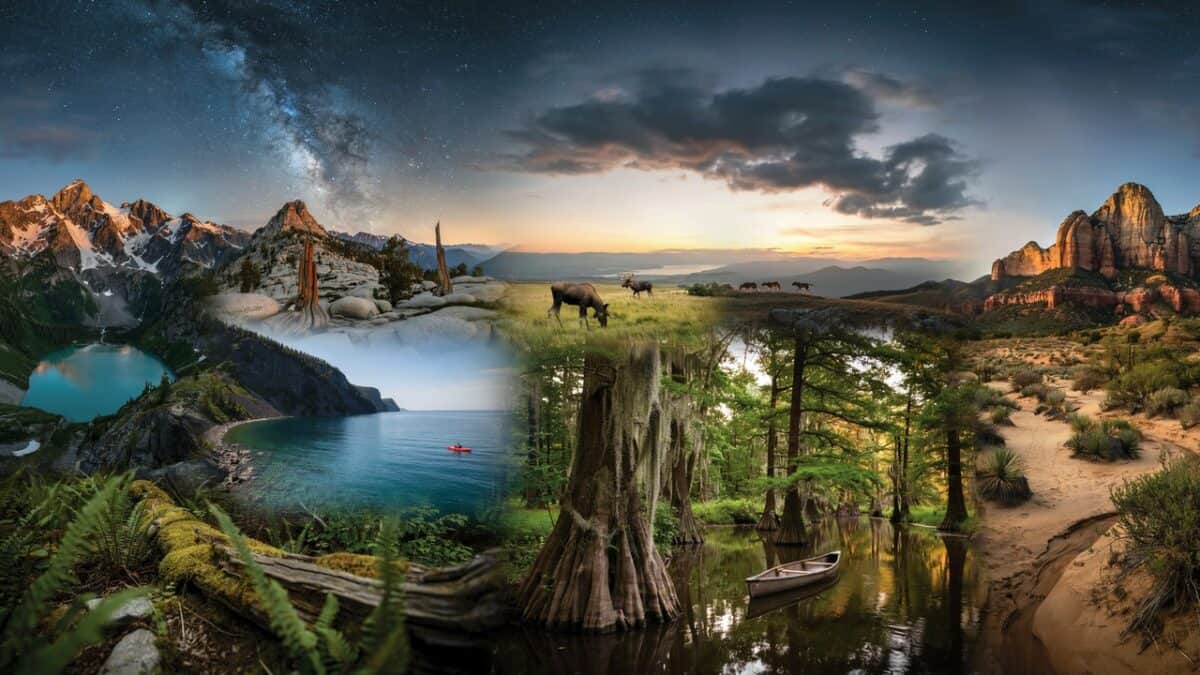
Image generated with Ai
The United States is home to some of the world’s most famous national parks. Every year, millions of people visit Yellowstone, Yosemite, Grand Canyon and Zion. These iconic destinations appear on almost every travel bucket list. Their waterfalls, deep canyons and wildlife attract visitors from every corner of the globe.
However, beyond these famous names lies another side of America. It is quieter. It is wilder. It is filled with breathtaking landscapes that many travellers have never heard about. These places receive only a small fraction of the visitors seen at America’s best-known parks. Yet they offer experiences that are just as remarkable.
From glacier-covered mountains in Washington to ancient forests in South Carolina, remote islands surrounded by Lake Superior and dramatic desert peaks in Texas, these forgotten national parks showcase the incredible diversity of America’s natural heritage. They offer peaceful hiking trails, crystal-clear lakes, rare wildlife, dark skies filled with stars and landscapes that remain almost untouched.
For travellers who dream of escaping busy tourist hotspots, these hidden gems provide something increasingly rare—space, silence and a true connection with nature.
Advertisement
Advertisement
Here are five of America’s most overlooked national parks that deserve far more attention than they receive.
Hidden in northern Washington near the Canadian border, North Cascades National Park is often called the “American Alps.” Yet despite its incredible beauty, it remains one of the least-visited national parks in the contiguous United States.
The park is frequently overshadowed by its famous neighbours, Olympic National Park and Mount Rainier National Park. Many visitors to Washington simply drive past it without realising what they are missing.
That is surprising because North Cascades protects one of the largest concentrations of glaciers in the United States outside Alaska. More than 300 glaciers shape the landscape. Snow-covered peaks rise high above deep valleys. Bright blue lakes sparkle beneath towering mountains. Dense forests blanket the lower slopes, creating an unforgettable wilderness.
Diablo Lake is one of the park’s greatest attractions. Its striking turquoise water gets its colour from glacial rock particles suspended in the lake. On sunny days, the water almost glows against the surrounding evergreen forests and rugged mountain scenery.
Ross Lake offers another spectacular experience. Visitors can kayak, canoe or simply enjoy the peaceful shoreline surrounded by untouched wilderness.
Hikers travel from around the world to walk the Cascade Pass Trail. This route passes through colourful alpine meadows, rocky ridges and breathtaking viewpoints. During summer, wildflowers bloom across the mountainsides while mountain goats climb steep cliffs with incredible ease.
Wildlife is another reason to visit. Black bears roam the forests. Marmots whistle from rocky slopes. Bald eagles soar above rivers. Deer and mountain goats are regularly spotted by patient visitors.
Unlike many of America’s busiest parks, North Cascades offers a sense of true solitude. Even during the peak summer season, hikers often enjoy long stretches of trail without seeing large crowds.
The park’s rugged terrain also helps preserve its wild character. There are few developed areas compared with larger tourist destinations, allowing visitors to experience nature in its purest form.
For photographers, adventure travellers and outdoor lovers, North Cascades delivers spectacular scenery that rivals any famous mountain destination in North America.
When people think about Nevada, Las Vegas usually comes to mind first. Bright lights, casinos and entertainment dominate the state’s image.
Far away from that busy world sits one of America’s most surprising national parks.
Great Basin National Park protects an extraordinary landscape where towering mountains, ancient forests, mysterious caves and crystal-clear skies come together in remarkable harmony.
Its remote location has kept visitor numbers low for decades. Many travellers simply do not realise such a spectacular national park exists in eastern Nevada.
The park’s centrepiece is Wheeler Peak, which rises more than 13,000 feet above sea level. Visitors can drive part of the way before continuing on scenic hiking trails that climb into cool alpine environments rarely associated with Nevada.
Near Wheeler Peak grows one of Earth’s oldest living organisms—the ancient bristlecone pine.
Some of these remarkable trees are believed to be thousands of years old. They survived changing climates, powerful storms and centuries of history. Their twisted trunks and weathered branches tell a story of extraordinary resilience.
Walking among these ancient trees feels like stepping back through time.
Another major attraction lies beneath the surface.
Lehman Caves stretch deep underground, revealing beautiful limestone formations created over millions of years. Guided tours allow visitors to explore delicate stalactites, stalagmites and rare shield formations that decorate the cave walls.
Above ground, the park offers another unforgettable experience after sunset.
Great Basin is recognised internationally for its exceptionally dark skies. With very little light pollution, thousands of stars become visible on clear nights. Visitors can often see the Milky Way stretching across the sky with remarkable clarity.
For astronomy enthusiasts, few places in America offer such outstanding stargazing opportunities.
The park also features alpine lakes, peaceful forests and diverse wildlife including mule deer, marmots and numerous bird species.
Each season brings something different.
Spring fills valleys with wildflowers.
Summer opens mountain hiking trails.
Autumn colours the forests.
Winter transforms the higher elevations into a peaceful snowy landscape.
Because relatively few tourists visit Great Basin, travellers often enjoy these incredible natural wonders in complete peace.
It remains one of America’s greatest hidden treasures.
Far out in the cold waters of Lake Superior lies one of the most isolated national parks in the United States.
Isle Royale National Park is unlike almost any other destination managed by the National Park Service.
There are no roads connecting visitors to the island.
Instead, travellers must arrive by ferry or seaplane.
This limited access naturally keeps visitor numbers low, making Isle Royale one of America’s quietest national parks.
For many travellers, reaching the island becomes part of the adventure itself.
Once visitors arrive, they discover a landscape almost completely untouched by modern development.
Dense forests cover much of the island.
Rocky shorelines meet the vast waters of Lake Superior.
Small inland lakes reflect peaceful skies.
Narrow hiking trails wind through forests filled with birdsong.
One of Isle Royale’s greatest attractions is its famous wildlife.
The island is internationally recognised for its long-running scientific research into wolves and moose. For decades, scientists have studied how these two species interact within one of North America’s most fascinating natural ecosystems.
Visitors often hope to spot a moose quietly feeding near a lake or walking through forest clearings.
Although wolves are rarely seen, knowing they live within this wilderness adds to the park’s unique atmosphere.
Water activities are equally impressive.
Kayakers explore quiet bays.
Canoeists paddle across inland lakes.
Divers discover historic shipwrecks resting beneath the clear waters of Lake Superior.
The surrounding lake has preserved many of these wrecks for generations because of its cold temperatures.
Backpacking is another popular activity.
Many visitors spend several days walking the island’s trail network while camping beneath star-filled skies.
Unlike more crowded national parks, Isle Royale allows travellers to disconnect almost completely from busy modern life.
Mobile phone signals are limited.
Traffic noise does not exist.
Instead, visitors hear gentle waves, birds calling through the forest and wind moving across the trees.
This peaceful environment has become increasingly valuable in today’s fast-moving world.
For travellers seeking genuine wilderness rather than busy tourist attractions, Isle Royale delivers an experience few places can match.
Many travellers planning a trip to Texas immediately think of Big Bend National Park. It is one of the state’s best-known outdoor destinations. Yet another spectacular national park stands quietly nearby, waiting to be discovered.
Guadalupe Mountains National Park protects one of the most remarkable landscapes in the American Southwest. Despite its outstanding scenery, it remains one of the country’s most overlooked national parks.
The park preserves an ancient Permian fossil reef that formed more than 250 million years ago when this region lay beneath a warm tropical sea. Today, those ancient marine deposits have become towering mountains that attract hikers, geologists and nature lovers from around the world.
The park’s greatest challenge is Guadalupe Peak.
Standing at 8,749 feet, it is the highest point in Texas.
Reaching the summit is a rewarding experience. The trail climbs steadily through changing landscapes before opening onto breathtaking views across the Chihuahuan Desert. On clear days, visitors can see for miles in every direction.
Another highlight is McKittrick Canyon.
This beautiful canyon surprises many first-time visitors. While much of West Texas is known for dry desert scenery, McKittrick Canyon offers colourful woodlands, flowing streams and rich autumn foliage that transforms the landscape into shades of gold, orange and red.
Every autumn, photographers travel here to capture one of Texas’ finest displays of seasonal colour.
El Capitan is another famous landmark.
Its massive limestone cliffs rise dramatically from the desert floor, creating one of the most recognisable mountain profiles in the American Southwest.
Wildlife also thrives throughout the park.
Golden eagles soar above the cliffs.
Mule deer move through the valleys.
Black bears occasionally return to parts of the park after decades of absence.
Desert plants such as agave, yucca and prickly pear cactus add colour and character to the landscape.
Because Guadalupe Mountains receives far fewer visitors than many other national parks, hiking trails remain peaceful even during popular travel seasons.
Visitors can stop to admire panoramic views without competing for space at busy viewpoints.
The park demonstrates that some of America’s greatest natural treasures are often those that receive the least attention.
South Carolina is famous for its beaches, historic cities and coastal resorts. Yet hidden inland is one of the most extraordinary forests in North America.
Congaree National Park may be smaller than many other national parks, but its ecological importance is enormous.
The park protects the largest remaining old-growth bottomland hardwood forest in the southeastern United States.
Many of its towering trees have stood for centuries.
Some of the hardwoods rank among the tallest in eastern North America.
Walking through Congaree feels very different from visiting mountain or desert parks.
Instead of steep peaks, visitors enter a peaceful world of giant trees, slow-moving waterways and rich wildlife.
The park’s elevated boardwalk trail makes exploration easy for visitors of all ages.
The wooden pathway winds through ancient forest without disturbing the delicate ecosystem below.
Massive cypress trees rise from shallow wetlands.
Their enormous trunks create a dramatic landscape that changes with the seasons.
Spring brings fresh green leaves and colourful wildflowers.
Summer fills the forest with birdsong.
Autumn adds golden colours to the canopy.
Winter offers quiet beauty as sunlight filters through bare branches.
Water plays an important role in Congaree.
The Congaree River regularly floods parts of the forest, bringing nutrient-rich soil that supports extraordinary plant growth.
These natural flood cycles have helped preserve the ecosystem for hundreds of years.
Canoeing and kayaking allow visitors to experience the park from a different perspective.
Paddling slowly through calm waterways offers close views of towering trees and abundant wildlife.
Birdwatchers find Congaree especially rewarding.
More than 200 bird species have been recorded within the park.
River otters, bobcats, deer, turtles and many amphibians also call the forest home.
One of the park’s most magical events happens after dark.
During late spring, synchronised fireflies gather within parts of the forest.
Thousands of tiny lights flash together in remarkable patterns, creating one of North America’s most beautiful natural displays.
Although Congaree remains less famous than many national parks, its ancient forest protects an ecosystem that has almost disappeared elsewhere in the United States.
Each of these five parks offers something completely different.
North Cascades showcases glaciers, alpine lakes and rugged mountain scenery.
Great Basin combines ancient forests, towering peaks, caves and exceptional stargazing.
Isle Royale provides one of America’s last true island wilderness experiences.
Guadalupe Mountains preserves dramatic desert landscapes and Texas’ highest summit.
Congaree protects one of the nation’s oldest remaining hardwood forests.
Together, they highlight the incredible diversity of the United States.
Many travellers mistakenly believe they must visit only the country’s most famous parks to experience America’s greatest landscapes.
In reality, these quieter destinations often provide richer and more personal experiences.
Visitors spend less time waiting in traffic.
Popular viewpoints remain uncrowded.
Hiking trails feel peaceful.
Wildlife encounters become more natural.
Photography opportunities improve because there are fewer people in each scene.
Many travellers now actively search for destinations that offer authentic outdoor experiences rather than crowded tourist attractions.
These forgotten parks answer that demand perfectly.
Travel preferences continue to change.
More people now choose meaningful experiences over busy sightseeing schedules.
National parks like these support that trend.
Visitors stay longer.
They explore local communities.
They spend more time hiking, paddling and learning about nature.
This slower style of travel also benefits conservation.
Lower visitor numbers reduce pressure on fragile ecosystems while allowing park authorities to protect wildlife and natural habitats more effectively.
Responsible tourism encourages travellers to leave no trace, respect wildlife and support nearby businesses that depend on sustainable visitor spending.
These lesser-known parks demonstrate that tourism does not always need record-breaking crowds to succeed.
Instead, careful management and thoughtful travel create better experiences for both visitors and nature.
Travellers planning to visit these parks should prepare carefully.
North Cascades is best explored during summer when mountain roads and high-altitude trails are fully open.
Great Basin offers excellent conditions from late spring through early autumn, while its night skies remain spectacular throughout the year.
Isle Royale operates seasonally because winter weather makes access difficult. Ferry and seaplane reservations should be made well in advance.
Guadalupe Mountains is most comfortable during spring and autumn when desert temperatures remain pleasant for hiking.
Congaree welcomes visitors throughout the year, although spring and autumn provide the most comfortable weather for walking and paddling.
Visitors should always check weather conditions, trail updates and park information before travelling.
Carrying sufficient water, wearing suitable footwear and respecting wildlife are essential in every national park.
The United States has no shortage of famous national parks.
Yellowstone, Yosemite, Grand Canyon and Zion deserve their global reputations.
However, America’s lesser-known national parks reveal another side of the country’s natural beauty.
North Cascades, Great Basin, Isle Royale, Guadalupe Mountains and Congaree each tell a different story about the landscapes that have shaped the nation.
They protect glaciers, ancient trees, mountain peaks, remote islands, desert canyons and rare ecosystems that continue to inspire scientists, photographers and adventurous travellers.
Their greatest advantage is not simply their beauty.
It is the opportunity to experience nature without overwhelming crowds.
As travellers increasingly seek authentic, peaceful and sustainable journeys, these forgotten national parks are becoming some of America’s most valuable travel destinations.
For those willing to venture beyond the country’s most famous attractions, these hidden wilderness treasures prove that the greatest adventures are often found where the fewest people choose to look.
Advertisement
Tags: Michigan, Nevada, South Carolina, Texas, Washington
Advertisement
Advertisement













Saturday, September 5, 2026

Friday, September 4, 2026

Saturday, September 5, 2026

Thursday, September 3, 2026

Wednesday, September 2, 2026

Saturday, September 5, 2026

Saturday, September 5, 2026