
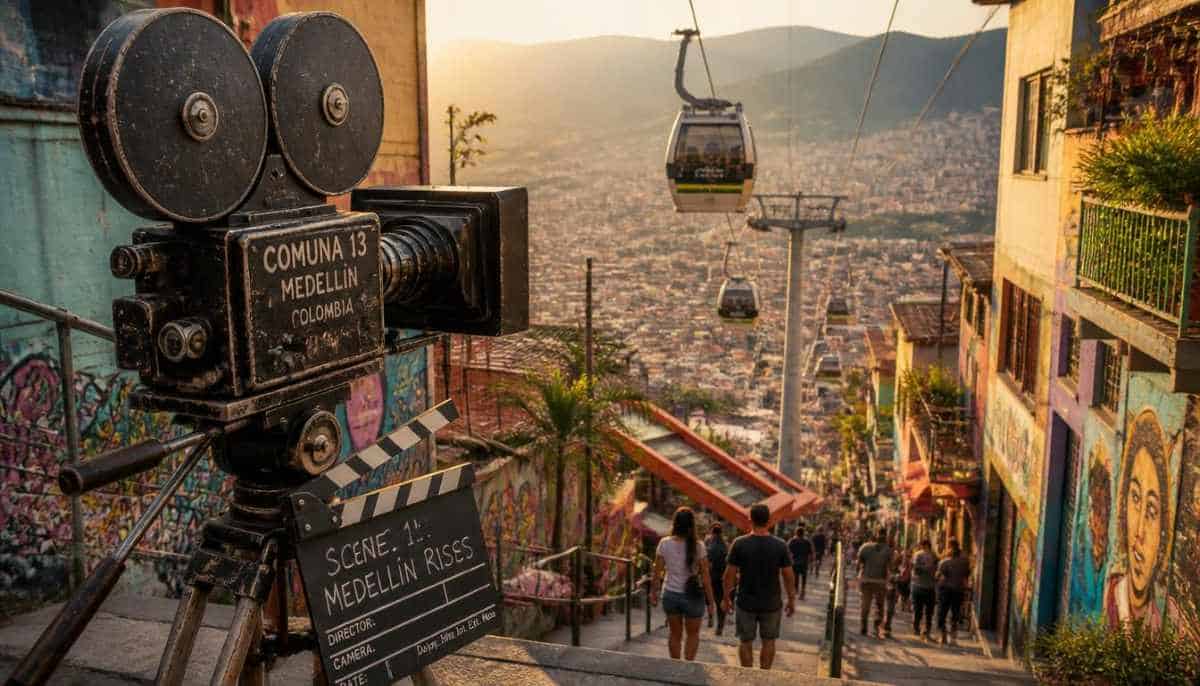
Image generated with Ai
It has made villainy a major driver of international tourism in South America, with the screen as a major driver of itineraries around the world. The streaming platforms are cramming high-production-value crime dramas into millions of living rooms, and something curious happens: the viewers become obsessed with the lush, dramatic landscapes that provide the setting for historical narco trafficking. Data collected by the country’s official tourism promotion agency, ProColombia, indicates that the number of international visitors has increased each year in recent years. The main reasons given are exposure to media and cultural curiosity. Travellers are no longer happy with sanitised resort experiences, and an increasing demographic is seeking out the authentic, complex geographies popularised by serialised television. To appreciate this phenomenon, it’s important to understand how fictionalised portrayals of historical cartels inadvertently spun off travel economies in Colombia, Panama, Nicaragua and beyond.
The global obsession with crime-thriller biographies launched South America’s Andean and Caribbean hubs into the international spotlight. The series focused on the rise and fall of infamous figures like Pablo Escobar and Griselda Blanco and exposed audiences to the vibrant topography of Medellín, Bogotá, and Cartagena. Rather than deterring visitors, these gritty narratives acted as an unvarnished introduction to a country previously obscured by fearful travel advisories.
Tourists arrive seeking the physical manifestations of television plots, only to discover modern, innovative urban centres. Medellín, once characterized globally by cartel violence, has reinvented itself through efficient cable-car transit systems, public escalators in Comuna 13, and botanical parks. Research from tourism intelligence groups indicates that a significant percentage of international visitors trace their initial awareness of the region back to streaming media. The transition from televised infamy to real-world exploration demonstrates the potency of media-induced travel. Visitors walking through Comuna 13 today encounter sprawling outdoor street art, local hip-hop performances, and steep hillside alleyways that tell a profound story of community resilience and architectural triumph over historical adversity. Similarly, the historic walled city of Cartagena draws millions with its colonial plazas, pastel-coloured balconies, and Caribbean warmth, serving as a dramatic coastal counterpoint to the high-altitude Andean valleys.
While Colombia dominates the primary narrative of cartel dramas, neighbouring Central American corridors featured in geopolitical thrillers experience parallel tourism growth. Panama, long celebrated for its engineering marvel—the Panama Canal—frequently emerges in cinematic storytelling as a clandestine transit hub for illicit capital and cargo. This exposure highlights the country’s dense rainforests, the Bocas del Toro archipelago, and the historic Casco Viejo, encouraging adventurous travelers to explore beyond the canal locks. In Casco Viejo, visitors find restored Spanish colonial architecture, bustling artisanal coffee shops, and vibrant plazas that contrast sharply with the shadowy portrayals of smugglers in modern espionage shows.
Advertisement
Similarly, the geopolitical intrigue associated with Central American trade routes directs traveller attention toward Nicaragua. Cinematic and literary depictions of historical political conflicts showcase the striking landscapes of Ometepe Island, the colonial architecture of Granada, and active volcanic vistas like Masaya. Travelers drawn in by historical dramas discover rich biodiversity, surf-haven coastlines, and deeply resilient local cultures. On Ometepe Island, twin volcanoes rise dramatically out of Lake Nicaragua, offering eco-lodges, hiking trails, and ancient petroglyphs. In Granada, preserved neoclassical and colonial facades provide an aesthetic richness that captivates culture enthusiasts, proving that the region’s drawing power extends far past the confines of television screens into authentic, sustainable exploration.
Local municipalities have their own set of operational challenges where dark history and leisure travel intersect. The mayor’s office is trying to figure out how to be economically successful and respectful of the past in a city whose history is defined by violence. Specialised walking tours and historical exhibitions walk the line between sensationalism and education.
Government programmes actively direct visitor spending towards community-run museums, coffee co-operatives and ecological reserves. Local stakeholders reframe the story from criminal syndicates to cultural resilience, so tourism dollars go to regional infrastructure and education programmes. Visitors to these sites are part of a much larger trend of conscious tourism, where knowledge of a country’s darkest times helps one appreciate its current democratic and cultural reawakening.
Advertisement
Tags: Colombia tourism, Medellín travel guide, media-induced tourism, Nicaragua vacation spots, Panama eco-tourism
Advertisement
Advertisement













Saturday, September 5, 2026

Saturday, September 5, 2026

Saturday, September 5, 2026

Saturday, September 5, 2026

Saturday, September 5, 2026

Thursday, September 3, 2026

Saturday, September 5, 2026

Saturday, September 5, 2026



