
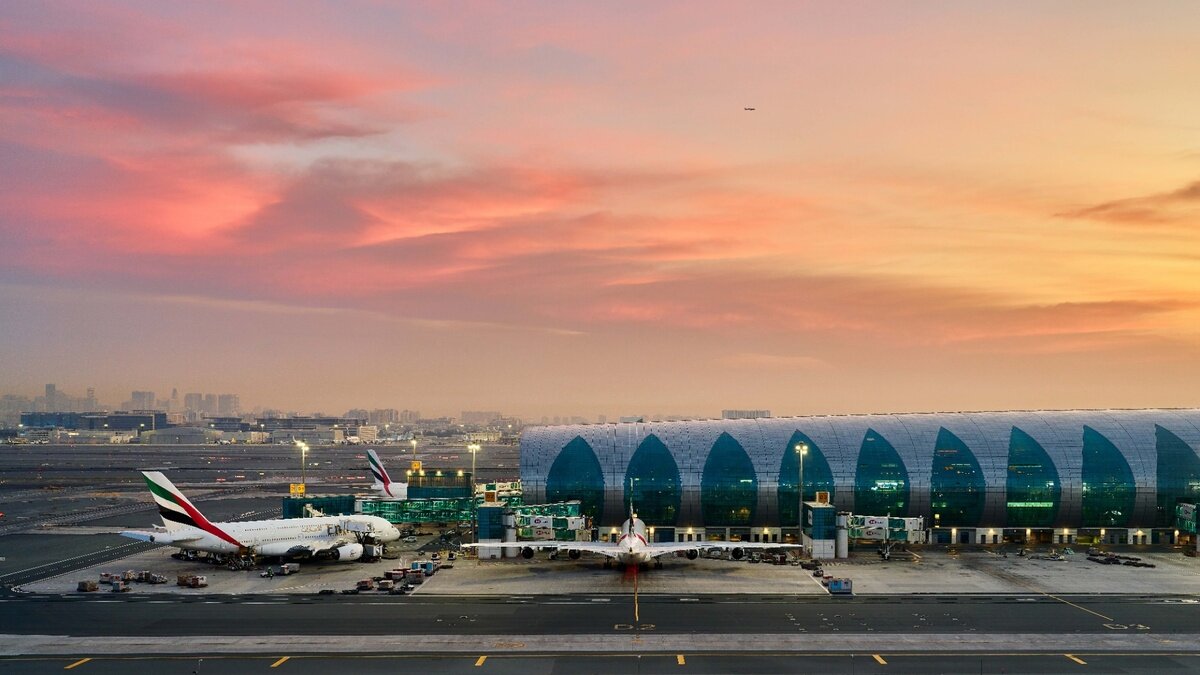
Dubai International Airport has added Tranzeet Deli at Terminal 3 near Gate A13 as DXB rebuilds international connectivity following severe regional airspace disruption. The significance extends beyond another airport restaurant. Official Dubai Airports information talks about traveler needs, different nationalities and how long people stay at the airport as very important to the idea. It puts the New York-style store into a plan from 2026 that includes things like how passengers move around where they wait, using biometrics letting people serve themselves and making the airport more flexible. DXB had 31.5 million passengers in the half of 2026. That is down 31.3, per cent compared to the time last year. However the number of passengers went up during the quarter.
The latest opening at Dubai International provides an unusually clear view of how airport food and beverage strategy is being adapted to a recovering international hub.
According to Dubai Airports, Tranzeet Deli is now operating in Terminal 3 near Gate A13 in the A Gates departures area. Its concept is based on the traditional New York deli, while the interior takes inspiration from a New York subway environment.
However, Dubai Airports has also identified a more operational purpose. Its latest institutional update says the concept was selected for its ability to accommodate different nationalities, travel requirements and dwell times, ranging from passengers making a quick purchase before boarding to travellers with enough time for a seated meal.
Advertisement
Advertisement
That distinction is important for the airport sector.
At a major connecting hub, passenger volumes alone do not determine how terminal concessions perform. The composition of the traffic matters. Connecting travellers can arrive with very different transfer windows, gate changes and boarding deadlines. An airport dining product capable of serving both compressed and extended dwell periods can therefore support terminal functionality in ways that a conventional destination restaurant may not.
The new outlet consequently fits into a broader DXB passenger-experience strategy rather than standing apart from it.
According to the Government of Dubai Media Office, Dubai International handled 31.5 million passengers during the first six months of 2026, representing a 31.3 per cent decline compared with the same period of 2025. Second-quarter traffic totalled 13 million.
The comparison is unusually significant because the first half of 2025 had been DXB’s busiest first half on record, with 46 million passengers.
The resulting gap was 14.5 million passengers between the two first-half periods.
Regional airspace constraints were a central factor. Dubai Airports recorded 18.6 million passengers during the first quarter of 2026, with March falling to 2.5 million as disruption intensified. Between the start of the disruption on 28 February and 30 April, Dubai’s airports still supported six million passenger journeys and more than 32,000 aircraft movements.
The direction changed during the second quarter.
Passenger volumes rose from 3.5 million in April to 4.5 million in May and five million in June. Based on those official monthly figures, June traffic was approximately 42.9 per cent higher than April traffic, providing a clearer measure of the recovery trajectory than the six-month headline alone.DXB operating indicator H1 2025 H1 2026 What the change means for travel trade Passenger traffic 46 million 31.5 million Hub traffic remained substantially below the previous record period H1 passenger change Record first half Down 31.3% YoY Recovery rather than unconstrained growth defines the 2026 operating environment Q2 passengers 22.5 million 13 million Transfer and originating traffic had considerable ground to recover Aircraft movements 222,000 150,600 Airline capacity remained materially lower Bags processed 41.8 million 30.3 million Lower throughput reflected reduced passenger volumes Mishandled bags 2 per 1,000 guests 2.7 per 1,000 passengers Performance weakened from 2025 but remained below the latest stated global benchmark Destinations More than 269 217 International network breadth had not fully returned Countries More than 107 99 Geographic connectivity remained below the previous H1 footprint International carriers More than 92 Almost 50 Returning foreign airline capacity remains important to the next recovery phase
Sources: Dubai Airports and Government of Dubai Media Office
The most underreported aspect of the Tranzeet Deli opening is its relationship with time.
Airport concessions operate inside a highly variable passenger environment. A traveller originating in Dubai may arrive with a different amount of discretionary terminal time from a transfer passenger connecting between long-haul services. Disruption, schedule recovery and network rebuilding can make those patterns even less uniform.
Dubai Airports’ decision to emphasise multiple dwell-time requirements therefore reveals an important commercial and operational principle.
The outlet is designed to function across more than one passenger behaviour pattern. Fast-turn passengers can make shorter stops, while customers with longer intervals can remain seated. That increases the relevance of the concession when the traffic mix shifts between originating passengers, international connections and irregular operations.
There is no official revenue figure for Tranzeet Deli, and it would be inappropriate to infer one. The stronger conclusion is operational: DXB is adding a flexible foodservice format while simultaneously trying to make the wider terminal environment more adaptable.
That timing makes the opening more strategically relevant than its menu alone.
The Government of Dubai Media Office says Dubai Airports is continuing a broad DXB enhancement programme while airline schedules rebuild.
Projects include improved guest facilities, a consolidated remote departures experience, wider self-service deployment, continuing biometric development, smarter operational capabilities, passenger-flow improvements and targeted capacity measures. Waiting areas are also being redesigned and refined to improve movement and passenger comfort.
Those investments and the Tranzeet Deli launch address different parts of the same passenger journey.
Digital and biometric systems can reduce friction at processing points. Better passenger-flow management can make movement through the terminal more predictable. More functional waiting spaces can improve the experience after processing. Flexible food and beverage formats can then serve travellers according to the time that remains before boarding.
The airport’s H1 operational figures demonstrate why this matters.
According to the Government of Dubai Media Office, 98.98 per cent of passengers completed departure passport control in under ten minutes during the first half of 2026. Another 98.95 per cent cleared arrivals passport control within 15 minutes, while 99.34 per cent passed through security in less than five minutes.
Efficient processing can effectively redistribute more of the passenger journey towards gate areas, lounges, retail and dining.
New York City has a direct connection with Tranzeet Deli, although that relationship must be described accurately.
Dubai Airports officially identifies the outlet as a reinterpretation of the New York deli experience, while its interior is inspired by New York subway design. The connection is therefore cultural, culinary and architectural. It is not evidence of a new Dubai–New York route or a change in aviation capacity between the two cities.
Lagardère Travel Retail’s first-party launch material also describes urban-rail design cues, including carriage-style seating, overhead handrails, grab handles, riveted finishes and transit-oriented wayfinding. Digital displays are used to introduce Dubai landscapes, historic districts, traditional souks and the modern skyline.
The result creates a deliberate two-city narrative.
New York supplies a globally recognisable deli and subway reference. Dubai supplies the location, local destination imagery and international passenger base.
For transfer passengers who may never leave the airport, that matters. Airport architecture and foodservice increasingly function as destination touchpoints rather than purely functional facilities.
Tranzeet Deli should not be interpreted as Lagardère Travel Retail entering this part of Dubai airport dining from a standing start.
In February 2022, Lagardère Travel Retail announced an agreement with Dubai-based HWH that integrated their food and beverage operations at Dubai airport. The portfolio covered 13 existing restaurants and included the Tranzeet name alongside other concepts. Lagardère already operated bespoke airport foodservice products at Terminal 3 at that time.
That historical detail changes the interpretation of the 2026 opening.
The new Tranzeet Deli represents an evolution of a concept lineage already embedded within Lagardère’s Dubai airport portfolio. The current version has been reformulated around contemporary airport passenger requirements, a New York deli identity and a stronger transport-design narrative.
For B2B travel retail, this demonstrates how airport operators and concessionaires can redeploy known intellectual property rather than rely exclusively on entirely new brands.Strategic element Earlier position 2026 development B2B significance Tranzeet brand Included in HWH portfolio integrated with Lagardère in 2022 Tranzeet Deli operates as a distinct Terminal 3 concept Existing portfolio equity has been adapted Passenger proposition Broad airport F&B coverage Explicit focus on varied travel needs and dwell times Greater operational versatility Design identity Existing Tranzeet presence at DXB New York deli and subway-inspired environment Stronger experiential differentiation Destination storytelling Airport foodservice Dubai imagery incorporated into the experience Concession becomes part of destination presentation Airport environment Pre-2026 record growth Network recovery following airspace disruption Opening coincides with a materially different demand cycle
DXB finished 2025 with 95.2 million passengers, its highest annual total and the highest annual international passenger traffic recorded by an airport at that point. It was connected to 291 destinations across 110 countries through 108 international airlines.
By the end of the first half of 2026, the network stood at 217 destinations across 99 countries, served by almost 50 international airlines.
The two periods are not directly identical because one represents a full-year endpoint and the other a mid-year position. Nevertheless, the difference shows the scale of network rebuilding still underway.
For Tranzeet Deli and other Terminal 3 concessions, the key variable is therefore not simply whether total passengers increase. It is whether international airlines, frequencies and transfer flows continue returning.
Dubai Airports expects stronger second-half momentum to be supported by recovering airline networks, additional frequencies, rising international transfer traffic, easing travel advisories in major source markets, the winter schedule and Dubai’s business, leisure and sporting calendar.
That creates a potentially stronger environment for airport food and retail activity than the H1 headline suggests.
The immediate traveller-facing change is straightforward: Tranzeet Deli is open in Terminal 3, A Gates departures, near Gate A13. Travellers should not assume that it is available across every terminal or concourse.
For travel advisers, the broader operating environment still requires careful handling. The Dubai Department of Economy and Tourism’s official travel advisory states that Dubai’s airports are operating and advises passengers to verify flight information with their airline before travelling to the airport. It also directs industry partners towards verified government and airline channels when handling disruption-related enquiries.
Tranzeet Deli is a relatively small physical addition when measured against the scale of Dubai International, but it reveals a much larger shift in airport thinking.
DXB is rebuilding from an exceptional disruption cycle while maintaining investment in processing technology, passenger movement, waiting environments and commercial choice. In that setting, a concession designed explicitly around multiple dwell times becomes part of the airport’s resilience architecture rather than an isolated hospitality launch.
The deeper industry lesson is that international hubs recovering from network shocks may need commercial spaces capable of serving more volatile passenger patterns. Flexibility, rapid service, seated dwell, strong destination identity and recognisable global references can coexist within a single product.
For the United Arab Emirates, the strategic story remains centred on Dubai’s role as an international transfer hub. New York City contributes the design language, but DXB supplies the aviation significance.
As international carriers continue restoring capacity, the performance of flexible passenger-facing concepts such as Tranzeet Deli will offer a useful indication of how the next generation of airport retail can be designed around traveller behaviour rather than passenger volume alone.
Image Source: Dubai Airports
Advertisement
Advertisement
Advertisement













Saturday, September 5, 2026

Friday, September 4, 2026
Saturday, September 5, 2026

Saturday, September 5, 2026
Saturday, September 5, 2026

Thursday, September 3, 2026

Saturday, September 5, 2026

Saturday, September 5, 2026


