
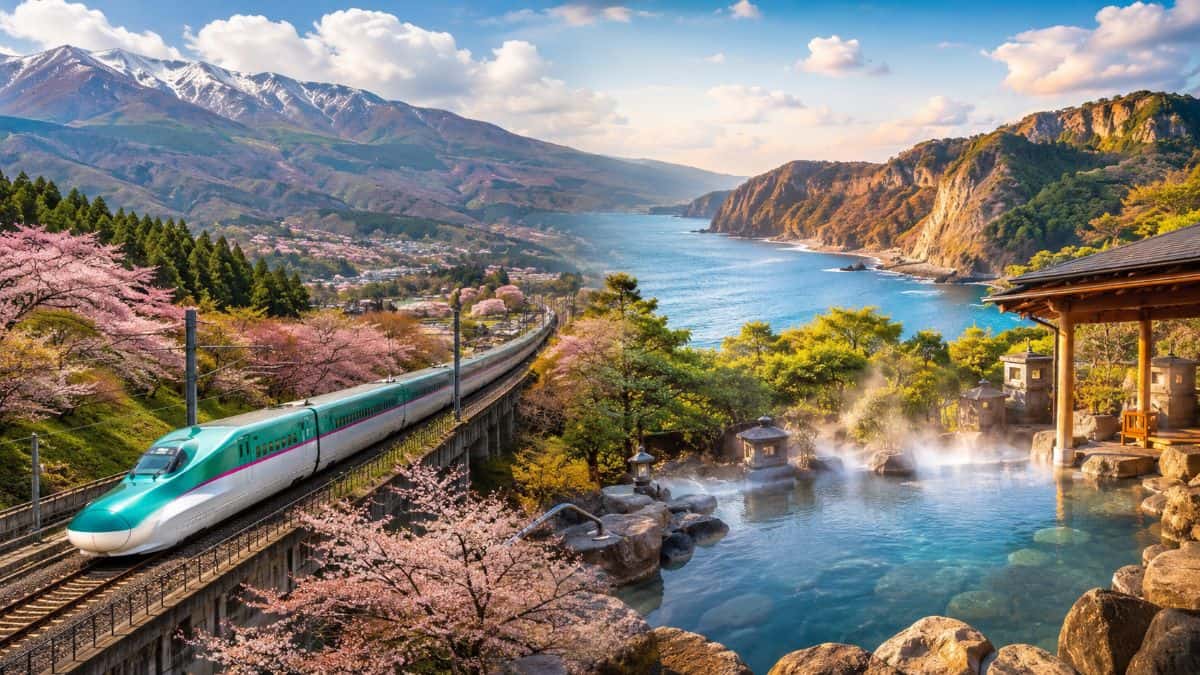
Image generated with Ai
The diversity beyond Tokyo, Kyoto, and Osaka encourages travelers to visit Japan again and again. Travelers discover history and nature in the Tohoku region in the North and Kyushu region in the South. Both areas rely on rail networks. While many travelers choose to visit the city regions (and beyond) of Japan, Tohoku and Kyushu offer options for travelers to choose from both.
Tohoku hasFields of interest to travelers include historical townships, scenery, seasonal festivals, an array of handcrafts, and beautiful landscapes. Kyushu encompasses Japan’s third largest island featuring historical city townships, beautiful scenic landscapes, and terrific culinary scenes. These two regions give a fantastic opportunity to showcase everything both the North and South of Japan have to offer. While in the North of Japan you can find beautiful scenic bays and the last remnants of the Samurai, the South of Japan has the historical pottery towns, calderas and of course the steaming onsens. Beautiful scenery joins the cultural and historical sites and allows travelers to take in the views of Japan fully.
Advertisement
Tohoku comprises six prefectures and offers a combination of heritage, natural scenery and living traditions. Fukushima provides an important starting point for understanding the region’s modern history while also showcasing its cultural attractions and traditional industries.
Aizuwakamatsu is particularly significant for travellers interested in Japan’s samurai heritage. Tsuruga Castle recalls the area’s feudal past, while local sake breweries provide an opportunity to discover Fukushima’s established brewing culture.
Advertisement
Advertisement
The journey can continue towards Sendai and Matsushima Bay, one of Japan’s celebrated scenic destinations. A sightseeing cruise around the bay reveals a striking landscape of pine-covered islands, creating an experience that combines maritime scenery with cultural heritage.
Iwate offers another perspective on Tohoku. Morioka provides access to historic remains and regional attractions, while nearby Hiraizumi is recognised for its temples, gardens and cultural significance. The destination provides a quieter alternative to Japan’s most heavily visited heritage centres.
Akita adds another layer of cultural discovery. The Akita Inu is closely associated with the prefecture, while seasonal festivals demonstrate the strength of local traditions. The Akita Kanto Festival is particularly distinctive, with performers balancing tall bamboo poles carrying illuminated lanterns.
Winter brings a different atmosphere through the Yokote Kamakura Festival, when snow huts create an atmospheric evening landscape.
Advertisement
Advertisement
Yamagata is well suited to travellers looking for a quieter regional experience. Yamadera, a mountainside temple complex reached by a long climb of stone steps, offers expansive views across the surrounding landscape.
The prefecture also changes dramatically according to the season. Fruit orchards become an attraction during harvest periods, while local cherries are among the region’s best-known agricultural products. Ginzan Onsen provides another compelling experience, particularly for visitors interested in traditional Japanese accommodation and hot-spring culture.
Aomori can complete a Tohoku itinerary with its celebrated apple-growing heritage, historic attractions and distinctive festivals. Visitors can explore the cultural story of the Nebuta Festival, see Hirosaki Castle and travel towards the Shimokita Peninsula.Tohoku destination Travel experience Fukushima Samurai heritage, sake and regional history Sendai and Matsushima Scenic bay cruises and island landscapes Hiraizumi Temples, gardens and heritage Akita Festivals and Akita Inu culture Yamagata Yamadera, orchards and onsen Aomori Apples, Nebuta traditions and historic sites
Kyushu offers a markedly different travel experience, particularly for visitors attracted to volcanic landscapes, hot springs and coastal scenery. Fukuoka is a convenient starting point, combining urban energy with shopping, dining and easy rail connections to other parts of the island.
Saga provides a more specialised cultural experience through its renowned ceramics. Travellers can explore the pottery traditions of Arita and Imari or visit Karatsu Castle for views over the surrounding coastline.
Nagasaki introduces a more complex historical dimension. The city was one of the two Japanese cities devastated by an atomic bomb during the Second World War. The Peace Park and Atomic Bomb Museum provide opportunities to understand the consequences of the bombing and its lasting impact on the local population.
Beyond its wartime history, Nagasaki offers distinctive architecture and landscapes. The former foreign settlement, including the Dutch Slope, reflects the city’s international connections, while Mount Inasa provides panoramic views across the urban landscape and harbour.
Kumamoto provides access to Mount Aso and its enormous volcanic caldera, giving travellers the opportunity to experience one of Kyushu’s most dramatic natural environments. Hiking opportunities around the area make it particularly attractive for visitors who want to combine sightseeing with outdoor exploration.
Oita offers a different form of volcanic activity through Beppu, one of Japan’s most famous hot-spring destinations. The city is characterised by numerous hot-spring sources and a long-established bathing culture. Staying at a traditional ryokan can add another dimension to the experience, allowing visitors to encounter Japanese hospitality alongside regional onsen traditions.
Miyazaki shifts the focus towards the coastline. Aoshima is known for its Devil’s Washboard, a striking geological formation created as waves and erosion shaped layers of sandstone and mudstone along the shore.
Kagoshima provides a dramatic finale with Sakurajima, one of Japan’s most active volcanoes. Ferries across Kagoshima Bay allow visitors to approach the volcanic landscape while experiencing the distinctive scenery surrounding the city.
Rail travel is central to exploring Tohoku and Kyushu efficiently. The Tohoku Shinkansen provides fast connections between Tokyo and major destinations in the north, while the extensive JR Kyushu network links important cities and attractions across the southern island.
For international visitors, regional rail journeys also provide an opportunity to see landscapes that can be missed when travelling exclusively between major airports and city centres. Local trains and buses can then extend journeys into rural areas, mountain communities and smaller towns.
For repeat visitors to Japan, this combination of efficient transport and regional diversity makes Tohoku and Kyushu compelling alternatives to more familiar itineraries. Tohoku offers samurai history, seasonal festivals, temples and scenic landscapes, while Kyushu delivers volcanic scenery, onsen culture, ceramics, coastal environments and complex historical narratives.
These regions appeal to those who wish to see another side of Japan. Tohoku has a strong combination of regional history, agriculture, festivals, and scenery. Kyushu has different food, craft, bathing, and coastal cultures owing to its different geology.
Both regions appeal to well-traveled Japan tourists. They provide more place with convenience. Rapid rail networks allow vacationers to visit numerous stops as they please. Vacationers leave main urban areas to experience Japan’s culture in these regions.
1. Why should repeat visitors consider Tohoku in Japan?
Tohoku offers samurai history, temples, festivals, mountain scenery, traditional crafts and seasonal experiences away from Japan’s busiest tourist centres.
2. What is Tohoku known for?
Tohoku is known for historic towns, scenic landscapes, regional food, sake, festivals, temples and distinctive seasonal attractions.
3. Is Tohoku accessible by train?
Yes. The Tohoku Shinkansen connects Tokyo with major destinations in the region, while local and regional trains provide access to smaller communities.
4. What makes Kyushu different from Tohoku?
Kyushu is particularly associated with volcanoes, hot springs, coastal scenery, ceramics and historic port cities, giving it a distinct geographical and cultural identity.
5. What is Kyushu famous for?
Kyushu is known for volcanic landscapes, onsen resorts, Fukuoka, Nagasaki, Mount Aso, Sakurajima and traditional ceramic-producing areas.
6. What can travellers see in Nagasaki?
Visitors can explore the Peace Park, Atomic Bomb Museum, historic foreign settlement areas and viewpoints around Mount Inasa.
7. Why is Beppu popular with tourists?
Beppu is renowned for its extensive hot-spring activity and provides opportunities to experience Japan’s traditional onsen culture.
8. What is special about Mount Aso?
Mount Aso is famous for its vast volcanic caldera and surrounding landscapes, which provide opportunities for sightseeing and outdoor activities.
9. What can travellers experience in Yamagata?
Yamagata offers Yamadera, fruit orchards, regional cherries and the atmospheric hot-spring town of Ginzan Onsen.
10. Are Tohoku and Kyushu suitable for first-time visitors to Japan?
They can be, although they are especially rewarding for travellers who want to move beyond the country’s best-known cities and discover regional Japan.
Advertisement
Advertisement
Advertisement













Saturday, September 5, 2026

Friday, September 4, 2026
Saturday, September 5, 2026

Saturday, September 5, 2026

Thursday, September 3, 2026

Wednesday, September 2, 2026

Saturday, September 5, 2026

Saturday, September 5, 2026


