
Dubai Surges Past Doha, Abu Dhabi, Riyadh and Several Others as Biometric Airport Screening in the Middle East Unlocks Frictionless Travel

Published
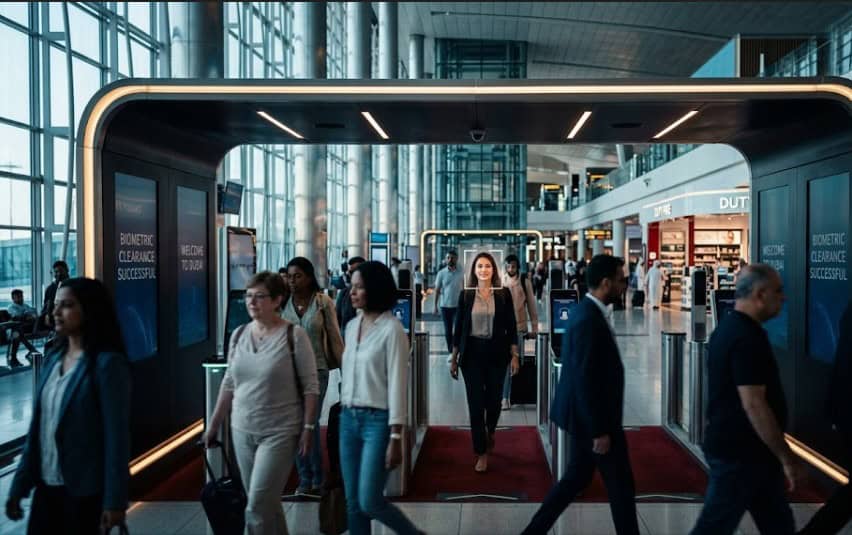
The landscape of global aviation is undergoing a profound transformation, and biometric airport screening in the Middle East is leading this technological revolution. As passenger volumes surge, Dubai has officially surpassed regional heavyweights like Doha, Abu Dhabi, and Riyadh in implementing frictionless travel solutions. Driven by record-breaking passenger numbers—hitting 31.5 million in the first half of 2026—Dubai International Airport’s innovative AI-powered ‘Red Carpet’ system and ‘Click and Travel’ services are redefining border security. This shift not only accelerates passenger processing to under 15 seconds but fundamentally reshapes the economic and tourism dynamics of the entire Gulf aviation hub.
The Evolution of Travel: Biometric Airport Screening in the Middle East
The aviation sector has always been at the forefront of technological adoption, but the recent acceleration of biometric airport screening in the Middle East represents a paradigm shift in how international borders operate. For decades, the Gulf region has positioned itself as the crossroads of the world, connecting East and West. However, managing the sheer volume of transit and destination traffic required a solution beyond traditional physical expansion. Enter biometric verification.
The integration of facial recognition, iris scanning, and artificial intelligence into border control has transformed the passenger journey. What was once a tedious, multi-step process involving physical passports, boarding passes, and manual checks is rapidly becoming a continuous, frictionless walkthrough. Governments across the region have recognised that the true competitive advantage in modern aviation is not just the size of the airport, but the speed and ease with which a passenger can navigate it.
Background: The Race for Aviation Dominance
Historically, airports in the Gulf Cooperation Council (GCC)—namely Dubai International (DXB), Doha’s Hamad International (DOH), Abu Dhabi’s Zayed International (AUH), and Riyadh’s King Khalid International (RUH)—have fiercely competed for the title of the premier global hub. While Doha and Abu Dhabi have heavily invested in luxury amenities and state-of-the-art terminal designs, Dubai has strategically pivoted towards operational hyper-efficiency.
Advertisement
Advertisement
The mandate was clear: accommodate explosive growth without compromising security or passenger experience. Biometrics offered the perfect solution. By digitising the passenger identity, airports could automate border control, reduce staffing bottlenecks, and enhance threat detection simultaneously. This strategic focus laid the groundwork for Dubai’s current dominance in the implementation of biometric airport screening in the Middle East.
Dubai’s Unprecedented Surge in 2026
As of late 2026, official reports from Dubai’s General Directorate of Residency and Foreigners Affairs (GDRFA) and Dubai Airports confirm that the emirate has definitively outpaced its regional rivals in biometric processing capacity.
Advertisement
Advertisement
The AI-Powered “Red Carpet” System
At the heart of this triumph is the groundbreaking “Red Carpet” system. Powered by advanced facial recognition and artificial intelligence, this designated corridor verifies passenger identities in real-time without the need for traditional immigration checkpoints.
- Processing Efficiency: The system has successfully reduced the average border processing time from 12.5 seconds down to a staggering 3.4 seconds—a 60% reduction.
- Simultaneous Clearance: Unlike standard smart gates that process one individual at a time, the Red Carpet can process up to 10 travellers simultaneously.
- Throughput: In the first eight months of 2026 alone, the Red Carpet system processed 745,188 travellers, showcasing its immense scalability.
The “Click and Travel” Innovation
Complementing the Red Carpet is the newly announced “Click and Travel” service. Introduced in September 2026, this mobile border processing service allows airport staff to complete entry and departure procedures using mobile devices in approximately 12 to 15 seconds per transaction. By eliminating the need for passengers to stop at traditional fixed immigration counters, Dubai has effectively decentralised border control, adding virtually limitless capacity to its processing infrastructure.
Advertisement
Advertisement
Official Statistics and Passenger Growth
The push for enhanced biometric airport screening in the Middle East is heavily driven by data and passenger volume. According to official figures released by Dubai Airports, DXB welcomed a massive 31.5 million passengers during the first half of 2026.
Furthermore, the existing Smart Gate infrastructure remains the backbone of the operation. Between January and August 2026, a remarkable 9,382,814 passengers utilised Dubai’s smart gates. This widespread adoption underscores growing public confidence in automated border services and validates the government’s heavy investment in the technology. In contrast, while Abu Dhabi has implemented facial-recognition solutions at five stages of the passenger journey and Etihad Airways continues AI testing, Dubai’s sheer processing volume and simultaneous multi-passenger clearance capabilities place it firmly in the lead.
Government Announcements and Strategic Initiatives
The UAE government has been highly vocal about its ambitions. The Airport Passport Sector in Dubai has not only focused on speed but also on inclusivity. In a world-first, Dubai launched a dedicated passport platform for children, processing over 2.06 million young travellers since its inception, including 212,746 in the first eight months of 2026.
Moreover, accessibility for People of Determination has been drastically expanded, with 263 specialised officers trained and dedicated biometric lanes established to ensure equitable service. These government-led initiatives demonstrate a holistic approach to airport management, ensuring that the benefits of biometric airport screening in the Middle East are accessible to all demographics.
Advertisement
Advertisement
How Doha, Abu Dhabi, and Riyadh Are Responding
While Dubai currently holds the crown, its regional competitors are rapidly accelerating their own biometric programmes.
Doha’s Hamad International Airport (DOH)
Qatar has consistently integrated smart technologies, focusing on a single-token biometric system that links a passenger’s face to their passport and boarding pass. However, Doha’s approach has traditionally leaned towards a highly curated, premium passenger experience rather than the mass-throughput models pioneered by Dubai.
Abu Dhabi’s Zayed International Airport (AUH)
Abu Dhabi remains a formidable challenger. Zayed International Airport has integrated facial recognition at multiple touchpoints, and the UAE’s national carrier, Etihad Airways, is aggressively testing AI-powered facial identity verification for boarding and lounge access.
Riyadh and the Saudi Vision 2030
Saudi Arabia represents the largest untapped potential in the region. Under Vision 2030, the Kingdom is investing heavily in King Salman International Airport in Riyadh, which aims to accommodate 120 million travellers by 2030. Saudi aviation authorities are observing Dubai’s model closely, viewing advanced biometrics not as an optional upgrade, but as a foundational requirement for their mega-airport projects.
Economic Implications and Industry Impact
The economic ripple effects of mastering biometric airport screening in the Middle East are profound. According to the International Air Transport Association (IATA), replacing manual checks with biometric identity verification can reduce processing times by up to 40%. For airports, this translates to massive operational cost savings and increased retail revenue.
When passengers spend less time queuing at immigration, they have more “dwell time” in the terminal. This directly boosts duty-free sales, food and beverage consumption, and luxury retail revenues. Furthermore, the global biometric technology market is projected to reach US$150.58 billion by 2030, with the airport biometrics services sector specifically forecast to grow to US$276.56 billion by 2032. Dubai’s position as an early adopter and innovator places it perfectly to export its expertise; indeed, in 2026, Dubai hosted 51 international delegations seeking to study its immigration systems.
Advertisement
Advertisement
Policy Implications and Security Standards
One of the most critical aspects of biometric integration is security. By linking facial biometrics and iris scans to official databases securely, border agencies achieve a higher degree of accuracy than human officers inspecting physical documents. The digital processing significantly reduces the risk of human error and identity fraud.
However, this transition necessitates robust data privacy policies. Middle Eastern governments, particularly the UAE, have had to implement stringent cybersecurity frameworks to protect passenger data. The success of the system relies entirely on public trust; any data breach could severely damage the reputation of the hub. Therefore, the policy landscape is shifting towards zero-trust architectures and encrypted, decentralised data storage for biometric templates.
Tourism and Public Impact
For the everyday traveller, the impact of seamless biometric screening is transformative. The stress traditionally associated with international travel—long queues, lost documents, and language barriers with immigration officers—is effectively eliminated.
Dubai’s ability to process a passenger from terminal entrance to boarding gate in mere minutes has become a major unique selling proposition (USP) for the city’s tourism board. It reinforces Dubai’s brand as a futuristic, hyper-efficient metropolis. As global travel continues its post-pandemic recovery, tourists and business travellers alike will increasingly route their journeys through hubs that offer the least friction.
Expert Statements and Global Recognition
The international community has taken note of Dubai’s achievements. The Red Carpet project recently received a Tier 3 (InUse) Innovation Endorsement from the Global Innovation Institute and was highlighted as a leading example of AI implementation at the IDC Voices of AI Innovation Forum.
Travel technology company SITA reports that by 2027, approximately 75% of airports worldwide are expected to utilise biometrics across key touchpoints. May Ismail, Event Manager at RX Middle East (organisers of the Airport Show in Dubai), noted that airports across the Middle East increasingly view biometrics as a “strategic opportunity to deliver a faster, more secure and fully touchless travel experience”.
Advertisement
Advertisement
Future Outlook: The Next Decade of Frictionless Travel
Looking ahead, the evolution of biometric airport screening in the Middle East is far from over. The next frontier involves predictive AI and fully integrated mobility ecosystems.
As Dubai prepares for the massive expansion of Al Maktoum International Airport—scheduled to begin its first major operational phases by 2032—the focus is shifting towards a completely “queue-free” environment. This next-generation facility will feature a highly integrated, AI-driven ecosystem focused on personalised services and smarter passenger-flow management.
We can anticipate a future where a passenger’s biometric profile serves as their ticket, passport, payment method, and lounge pass, all authenticated invisibly as they walk at a normal pace through the terminal. As Dubai continues to surge past Doha, Abu Dhabi, and Riyadh, it sets an incredibly high bar for the rest of the world, proving that the future of travel is not just about flying faster, but moving smarter.
In summary, the rapid expansion of biometric airport screening in the Middle East firmly establishes the region as the global pioneer of seamless aviation. Dubai’s strategic investments in AI-driven smart gates and the revolutionary Red Carpet system have decisively propelled it past Doha, Abu Dhabi, and Riyadh. By dramatically reducing processing times and enhancing border security, these initiatives seamlessly accommodate surging passenger demands. As we look towards the next decade, this frictionless travel ecosystem will undoubtedly continue to drive tourism growth, stimulate economic investment, and set the ultimate international benchmark for next-generation airport infrastructure and passenger experience worldwide.
Advertisement
