
Frankfurt And More Airports Embrace Digital Biometrics to Ease Schengen Entry Delays

Published
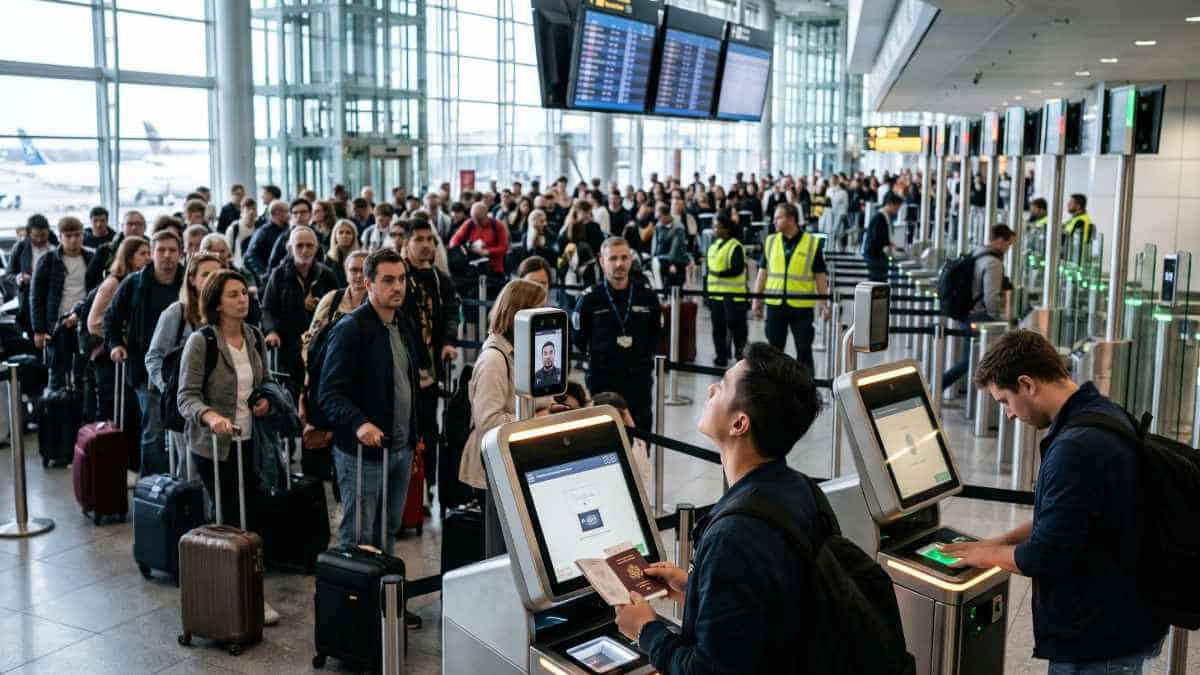
Operational tension at leading aviation ports in Europe has escalated due to the compulsory application of the Schengen Entry Exit System (EES). Physical congestion has been experienced in international airports due to the mandatory biometric scanning and fingerprinting of arrivals who are not from Europe. In order to alleviate port paralysis, there is a technology-driven initiative that is taking place at airport authorities, border authorities, and airline companies. High speed walk-through biometric passages, high speed rail passages, and smartphone credentials through European Digital Identity have been harmonized. Passengers’ movement at continental level is secured while strict border control is balanced with privacy protection rights.
The Schengen Entry/Exit System: Legislative Mandates and Terminal Bottlenecks
The operational architecture of European aviation is undergoing its most comprehensive structural transformation since internal continental borders were dismantled under the Schengen Agreement. Established by the European Parliament and the Council through Regulation (EU) 2017/2226, an automated, centralised IT system was engineered as the Schengen Entry/Exit System to monitor external frontier crossings. The digital registration of every third-country national entering the Schengen Area for a short stay—defined as a period not exceeding ninety days within any one-hundred-and-eighty-day window—has been mandated by the regulation.
Advertisement
Advertisement
Operating in tandem, the historic practice of physically stamping passports by hand was eliminated when the Schengen Borders Code (Regulation (EU) 2016/399) was amended by Regulation (EU) 2017/2225. Instead, entry and exit timestamps, the exact border crossing point, personal identity details, and any formal refusal of entry are required to be recorded digitally by border authorities into a centralised database administered by the European Union Agency for the Operational Management of Large-Scale IT Systems in the Area of Freedom, Security and Justice (eu-LISA). Furthermore, pre-entry security screenings were integrated into the border workflow by the introduction of Amending Regulation (EU) 2024/1356, whereby border systems are required to be interfaced continuously with Europol databases, the Visa Information System, and the Schengen Information System.
While visa overstayers were intended to be detected, transnational criminal networks combated, and document fraud eradicated through the codification of these legal instruments, a severe geometric mismatch within European airports was exposed by their implementation. Terminal buildings constructed over the past four decades were configured for rapid manual inspections. Approximately ten to fifteen seconds were required by a border control officer to examine an identity page and affix an ink stamp under the legacy manual stamping regime. Under the mandatory biometric regime of the Entry/Exit System, an extensive set of personal identifiers must be submitted by every non-EU traveler arriving for the first time: four flat fingerprints and a high-resolution facial image, paired with real-time biometric and biographic database queries.
Advertisement
Advertisement
The Structural Anatomy of Border Processing Latency
Although it was suggested by initial operational simulations from the European Commission that first-time passenger registration times would be restricted to roughly seventy seconds by self-service pre-enrolment kiosks, a far more disruptive reality was demonstrated during field deployments across European air hubs. First-time biometric registration is frequently extended between two and six minutes per passenger during actual peak operating conditions. This variance is accounted for by multiple physical and human factors, including presentation attack detection checks, finger placement errors on optical prisms, dynamic lighting corrections for facial capture, and passenger disorientation while multi-language digital interfaces are being navigated.
Processing delays are compounded non-linearly in high-density hub airports operating clustered flight banks. When roughly one thousand non-EU passengers are delivered simultaneously to an immigration hall equipped with standard bank infrastructure by three wide-body intercontinental aircraft, processing lines are backed up into arrival corridors, sterile gate ambulatories, and transit concourses.
Advertisement
Advertisement
The scale of this vulnerability led urgent warnings to be issued by ACI EUROPE and Airlines for Europe, wherein it was highlighted that passenger wait times routinely surpass two hours and escalate to five hours during severe peak periods. Misconnected journeys, terminal overcrowding, and long-haul flights departing with empty seats while ticketed travelers remain detained in border queues have been caused by these operational bottlenecks. The high-stakes nature of the digital filter is underscored by official monitoring: it was revealed by eu-LISA that nineteen thousand nine hundred and eighty-five entry refusals across external Schengen borders were identified and executed across early operational phases, demonstrating both the technical potency and logistical friction of the digital border wall.
Decentralised Privacy Architecture and the GDPR Mandate
It was recognized by aviation stakeholders—spearheaded by the International Air Transport Association, ACI EUROPE, and technology providers such as SITA and Amadeus—that physical terminal infrastructure cannot be expanded quickly enough to house traditional kiosk banks. A strategic shift was undertaken toward eliminating border queues entirely by moving credential enrollment onto passenger smartphones before arrival at the airport.
However, this technical ambition is governed by the European Union’s demanding data privacy regime: the General Data Protection Regulation (Regulation (EU) 2016/679). Explicit legal authorization, strict necessity, and robust storage limitations are required when biometric templates—classified as special category personal data under Article 9 of the GDPR—are processed.
The EDPB Opinion 11/2024 Framework and the Italian Precedent
The regulatory parameters governing passenger biometric authentication were formalized when Opinion 11/2024 was adopted by the European Data Protection Board (EDPB) on 23 May 2024, assessing the compatibility of airport facial recognition systems with GDPR Articles 5(1)(e), 5(1)(f), 25, and 32. Potential technical architectures were categorised by the EDPB into distinct operating scenarios:
- Scenario 1: The biometric template is stored exclusively on the personal mobile device under the passenger’s sole custody and control, enabling local one-to-one facial matching at gate turnstiles.
- Scenario 2: Biometric templates reside in a centralized repository but are encrypted using an encryption key held exclusively within the traveler’s personal smartphone, requiring a dual-party cryptographic handshake to unlock.
- Scenario 3.1: Biometric templates are stored in a central airport or contractor database for the duration of a flight cycle (up to forty-eight hours), encrypted using keys controlled by the airport operator.
- Scenario 3.2: Biometric templates are archived persistently across airline cloud networks for long-term frequent traveler programs.
It was determined by the EDPB that European data protection principles are fully respected by Scenario 1 because physical and cryptographic ownership of identifiers is maintained by passengers. Conditional compliance can be achieved by Scenario 2 provided that centralized decryption is prevented by technical controls.
Conversely, it was concluded by the Board that Articles 5(1)(f), 25, and 32 of the GDPR are violated by Scenarios 3.1 and 3.2. Unacceptable systemic risks of mass surveillance, mission creep, unauthorized access, and database compromise are introduced by the centralized storage of biometric templates. It was affirmed by the Board that the security liabilities inherent in central biometric databases are not justified by commercial travel facilitation.
Advertisement
Advertisement
The practical enforcement of this regulatory stance was demonstrated in March 2026 when Order n. 164 was issued against airport operator SEA Milan by Italy’s data protection regulator, the Garante per la protezione dei dati personali. The “FaceBoarding” platform had been deployed by SEA across Milan-Linate and Catania airports, allowing travelers to pass through security and boarding doors once their biometric passport was registered at an entrance kiosk.
The platform was ruled unlawful by the Garante under Articles 5(1)(a), 6, and 13 of the GDPR. It was revealed during the investigation that the prohibited Scenario 3.1 model was utilized by FaceBoarding through the routing of biometric templates to centralized servers. More critically, facial biometric vectors were captured by physical sensors at hybrid security lanes from non-enrolled passengers navigating adjacent lanes without their knowledge or lawful consent. The immediate suspension of centralized processing was ordered by the Garante, sending a clear signal across the Schengen Area that decisive regulatory shutdowns will be faced by any aviation biometric system relying on central template storage.
Sovereign Mobile Identity: EUDI Wallets and ICAO Digital Travel Credentials
Faced with this regulatory reality, European aviation is converging around the EU Digital Identity Wallet (EUDI Wallet) framework, codified under Regulation (EU) 2024/1183. It is established by the regulation that an interoperable digital identity wallet must be issued to citizens by all EU Member States by December 2026, while a binding legal duty is created for regulated private sectors—including transport, aviation, and financial services—to accept wallet credentials by December 2027.
Within this mobile ecosystem, technical standards for Digital Travel Credentials (DTC) established by the International Civil Aviation Organization (ICAO) are being embedded by airport operators and international carriers. Utilizing ICAO DTC Type 1 (a secure digital clone derived directly from the physical e-passport chip) and DTC Type 2 (a mobile credential bound to a physical document), passport data, facial portraits, and personal public keys are extracted and cryptographically bound into the hardware-isolated Secure Element of passenger smartphones.
When an airport e-gate is approached, authentication is executed via edge cryptography utilizing Zero-Knowledge Proofs or ephemeral mutual authentication handshakes. The validity of the government signature is proven and one-to-one facial biometric matching is performed locally by the traveler’s device. A mathematically verifiable authentication token is received by the airport turnstile, the physical gate barrier is released, and transient image vectors are permanently purged from memory. Total GDPR compliance is achieved by keeping personal biometrics strictly on personal devices while rapid and secure transit flows are ensured.
Field Deployments: European Hubs Testing Walk-Through Biometrics and High-Density Gates
Across major European gateways, operational blueprints have been adjusted by airport infrastructure authorities through the deployment of automated hardware, optical sensors, and passenger-facing software to keep terminals functional.
Advertisement
Advertisement
Milan-Linate and Catania: The Edge-First FaceBoarding Transformation
Prior to the regulatory intervention by Italy’s data protection authority, a voluntary paperless transit model was provided by SEA Milan’s FaceBoarding platform at Milan-Linate and Catania. Across participating domestic and Schengen routes, a single enrolment was completed by passengers with biometric passports at airport kiosks or via mobile applications, linking facial data to boarding passes. Checkpoint clearing speeds under ten seconds were achieved as travelers moved from security through lounge access to departure gates without physical boarding cards being displayed.
Following Garante Order n. 164, the FaceBoarding architecture was overhauled by SEA Milan. Central template matching was decommissioned, and the platform was re-established as a decentralized edge-identity ecosystem aligned with EDPB Scenario 1 and ICAO DTC principles. Biometric templates are generated and stored exclusively within the passenger’s mobile application.
At gate checkpoints, a direct, ephemeral session is established with the phone via high-frequency Near Field Communication or encrypted optical scanning. The match is validated in real time by the gate, and all operational tokens are purged upon clearance. The liability of harvesting data from non-participating travelers in hybrid lanes was eliminated by this structural reconfiguration, restoring operational throughput while the strictest standards of European privacy jurisprudence are satisfied.
Frankfurt and Munich: Full-Terminal SITA TS6 Multimodal Gates
At Germany’s primary hub facilities in Frankfurt and Munich, Fraport AG and Deutsche Lufthansa were confronted by the challenge of managing multi-hub connections where intra-European corridors are fed directly by non-Schengen international flights. To maintain connection reliability, Europe’s largest integrated biometric deployment was executed by Fraport through the installation of eighty-seven biometric-enabled SITA TS6 kiosks and multimodal e-gates across Terminals 1 and 2.
Travelers are supported across bag-drop, security access, and aircraft boarding through the integration of the TS6 kiosk network with SITA Flex and NEC Corporation’s biometric matching engines. Transit corridors were equipped by Fraport with optical arrays featuring near-infrared sensors, structured light three-dimensional depth cameras, and Presentation Attack Detection algorithms conforming to ISO/IEC 30107 specifications. Spoofing attempts—including paper cutouts, curved masks, and high-resolution digital screens—are neutralized by these sensors while high accuracy is maintained across diverse terminal lighting conditions.
Passenger identification intervals have been reduced to under ten seconds at gate thresholds through high-speed walk-through biometrics in Frankfurt. Boarding queue durations have been shortened by thirty to forty percent compared to traditional manual verification because credential checks were decoupled from physical counter staff, enabling ground staff to be redirected toward operational exceptions.
Advertisement
Advertisement
Paris-Charles de Gaulle and Paris-Orly: High-Density PARAFE Surge Management
Western Europe’s highest volumes of non-EU transatlantic, Middle Eastern, and African international traffic are processed by Groupe ADP at Paris-Charles de Gaulle and Paris-Orly. The primary line of defense at French borders is provided by the PARAFE system, executed in collaboration with the French border police. Checkpoints were upgraded by Groupe ADP with advanced self-service kiosks and dual-biometric e-gates to mitigate bottlenecks under the Schengen Entry/Exit System.
The challenges of the EES mandate are illustrated by the operational mechanics at Paris-CDG Terminal 2E. Although automated gates can be accessed for border exit by non-EU nationals from visa-exempt countries—such as the United Kingdom, the United States, Japan, and Canada—automated gates cannot be used for initial entry into the Schengen Area. Full biometric registration must be completed at an EES kiosk or staffed booth by non-EU travelers on their first arrival, recording four fingerprints and a facial portrait.
It is revealed by documented operational metrics that roughly six minutes per traveler are required for first-time EES registration at Paris-CDG, whereas automated PARAFE facial gates are cleared within ten to fifteen seconds by registered repeat travelers. Immigration queues reached sixty to ninety minutes during morning arrival surges between 06:00 and 09:00—when long-haul wide-body flights touch down in rapid succession—with severe disruption periods historically peaking at two hundred and forty minutes.
To keep passengers moving, the “Short Connection Pass” was introduced by Groupe ADP as a smartphone priority credential issued to transiting travelers whose inbound flights are delayed, routing them through expedited fast-track lanes so connecting flight schedules can be preserved.
Hub Infrastructure and Processing Capabilities
| Hub Location | Infrastructure Platform | Primary Checkpoint Hardware | Biometric Modalities | Transit Processing Speed | Operational Focus |
| Frankfurt (FRA) | SITA Smart Path / NEC / SITA Flex | 87 SITA TS6 kiosks + multimodal e-gates | Structured light 3D facial recognition & NIR liveness detection | Under 10 seconds per boarding gate transit | High-velocity transit hub connections between long-haul and Schengen routes. |
| Paris-CDG (CDG) | PARAFE / Groupe ADP / French Border Police | Touchscreen EES kiosks + PARAFE e-gates | Facial recognition (e-gates) + 4-fingerprint capture (kiosks) | First-time registration: ~6 minutes; repeat transit: 10–15 seconds | High-volume external Schengen arrivals and transatlantic connection banks. |
| Milan-Linate (LIN) | FaceBoarding / SEA Milan / Edge architecture | Contactless turnstiles + user mobile app enrollment | Edge-verified 1:1 facial matching via Secure Element | Sub-10 second walk-through clearance | High-yield corporate business travel; compliance with Italian DPA rulings. |
| London St Pancras | Eurostar / HS1 / French Border Police | Pre-clearance EES kiosks + automated smart e-gates | Facial recognition and optical fingerprint scanning | Kiosk throughput: 90–120 seconds; gate clearance: under 10 seconds | Juxtaposed cross-border rail-air credential pre-clearance on third-country soil. |
Cross-Border Rail-Air Intermodal Corridors: Extending the Schengen Frontier
Airport terminal boundaries are not the only front lines in Europe’s border transformation. Under European Green Deal mobility directives and national initiatives, short-haul domestic flights are being replaced by high-speed rail connections. However, cross-border rail services linking non-Schengen territories to continental Europe—most visibly the Channel Tunnel corridor—are subjected to identical Schengen Entry/Exit System requirements under Regulation (EU) 2017/2226.
The epicenter of this intermodal challenge is London St. Pancras International, the primary UK terminal for Eurostar services to Paris-Charles de Gaulle, Brussels, and Amsterdam. Juxtaposed border controls are established at St. Pancras under the historic Sangatte Protocol, whereby sovereign Schengen entry checks are conducted on British soil by French border police prior to train departure.
Advertisement
Advertisement
Because a Grade I-listed Victorian architectural structure is occupied by St. Pancras, border halls could not be physically expanded to house massive kiosk banks. It was indicated by operational modeling that multi-hour queues spilling outside the station would be produced by unchecked biometric registration, crippling high-speed rail operations.
In response, an infrastructure investment exceeding ten million euros was executed by Eurostar, in coordination with High Speed 1 and the French government, to re-engineer check-in infrastructure and install dedicated biometric systems. The earlier “SmartCheck” trial was replaced with an extensive installation of certified EES self-service kiosks and automated e-gates.
Passport scanning, fingerprint capture, and facial image enrollment are completed by passengers in the station’s reconfigured check-in zone before French border control booths are passed. Because full biometric pre-clearance is completed in London, passengers arriving at Paris Gare du Nord are disembarked directly into the terminal, transferring to local transport or connecting flights at Paris-CDG without secondary border verifications being undergone.
This intermodal framework is being extended by transport alliances through the integration of high-speed rail passenger manifests with airline Passenger Name Record and Advance Passenger Information ecosystems. International flight bookings can be linked directly to rail journeys through coordinated partnerships between carriers such as Deutsche Bahn, SNCF, Air France-KLM, and the Star Alliance.
When identity credentials are authenticated through the EU Digital Identity Wallet prior to boarding, clearance tokens are transmitted securely across intermodal data corridors. The passenger is verified by a single digital credential at rail platform barriers, airport perimeter security checkpoints, transfer transit doors, and boarding gates, eliminating redundant verification loops while terminal clearance is decoupled from physical paper documentation.
Operational Safety Valves: Emergency Safeguards and Flexibility Clauses
Specific statutory relief mechanisms were codified into Schengen border governance by European lawmakers and border agencies to prevent airport infrastructure from gridlocking under peak arrival surges. The primary legislative foundation for operational relief during initial deployment was established under Regulation (EU) 2025/1534, which introduced targeted temporary derogations from Regulation (EU) 2017/2226 and Regulation (EU) 2016/399.
Advertisement
Advertisement
A one-hundred-and-eighty-day progressive start of operations was established by Regulation (EU) 2025/1534, commencing from the formal operational date established by Commission Implementing Decision (EU) 2025/1544 on 12 October 2025. Essential operational safeguards were provided by this statutory progressive launch:
- Temporary Biometric Derogations: The collection of biometric data at border crossing points was made optional during the initial sixty calendar days of the rollout, enabling border police to capture biographic details only if terminal operations were threatened by queues.
- Suspension of Automated Calculators: System-generated overstayer lists and the automated length-of-stay calculation engine were temporarily deactivated so that false overstay alerts resulting from incomplete registration data during phased onboarding could be prevented.
- Dual Document Stamping: Travel passports continued to be physically stamped by border control officers in parallel with digital logging; in any instance of discrepancy between digital records and a physical stamp, legal precedence was maintained by the ink stamp.
- Phased Crossing Point Quotas: Flexibility was granted to member states to deploy EES features gradually across border crossing points and terminal lanes, scaling progressively from minimum traffic thresholds up to full operating capacity.
Beyond the initial progressive deployment window, permanent statutory recourse to emergency relief is provided through Article 9 of the Schengen Borders Code, which governs the relaxation of border checks.
When passenger queues reach critical volumes that threaten airport life safety codes, create fire exit blockages, or cause structural flight cancellations, statutory authority is held by the senior border control commander on duty to activate “flex mode”. Biometric fingerprint and facial capture are temporarily halted at external entry lanes under flex mode, and rapid manual visual passport verification paired with physical stamping is immediately restored. A physical stamp issued under flex mode is legally recognized as a valid entry record, shielding the traveler from downstream immigration penalties.
It was stressed in a joint statement of 12 October 2026 by ACI EUROPE and Airlines for Europe that long-term continental aviation connectivity cannot be protected by ad-hoc, localized flex mode activations alone. A six-point reform manifesto was submitted to the European Commission by the industry coalitions, calling for urgent structural adjustments:
- Elimination of Double Verification: Redundant secondary manual document checks at police booths are urged to be abolished after automated biometric enrollment has been completed at self-service kiosks.
- Optimization of Biometric Algorithms: False rejections caused by minor lighting or postural differences are recommended to be minimized by harmonising facial matching tolerance thresholds across all member states.
- Prevention of Duplicate Profiles: Duplicate identity files created upon passport renewals are sought to be eliminated through upgrades to central database resolution software.
- Upgrading Mobile Pre-Registration: Travelers should be enabled to pre-enrol passport data, biographic declarations, and facial portraits remotely prior to arrival through a re-engineering of the European Commission’s official mobile application.
- Standardization of Non-EU E-Gate Access: Automated border control gate software should be harmonized so that automated e-gates across all Schengen airports can be accessed by eligible, low-risk non-EU nationals.
- Codification of Permanent Surge Flexibility: Border control commands should be authorized by a permanent, legally binding operational flexibility mechanism to automatically suspend biometric capture whenever physical wait times exceed thirty minutes.
Economic Ripple Effects, Tourism Exposure, and Continental Mobility
The economic fallout of border friction extends far beyond airport terminals. Continental gross domestic product, business productivity, and international tourism revenue are heavily driven by European air transport. Severe direct and indirect financial costs are imposed upon airlines, infrastructure operators, and travelers by persistent bottlenecks at external Schengen borders.
Heavy financial exposure to passenger care, re-routing, and statutory compensation is faced by airlines under EU Regulation 261/2004 when flight networks break down. Although sovereign border delays and government IT failures are classified as extraordinary circumstances exempting carriers from direct compensation payments, full liability for passenger duty-of-care expenses—including hotel accommodations, meals, and rebooking costs on sold-out peak services—is retained by airlines. Furthermore, severe secondary network losses resulting from missed airport departure slots, delayed aircraft turnarounds, and displaced flight crews continue to be absorbed by carriers.
Advertisement
Advertisement
The integrity of connecting flight waves is essential for Europe’s major hub carriers. Network profitability depends on high-yield international passengers being swiftly transferred onto intra-European feeder services. When standard minimum connection times—traditionally calibrated at forty-five to sixty minutes—are shattered by two-to-three-hour immigration queues, the competitiveness of European mega-hubs is deteriorated. Business executives have been instructed by corporate travel managers to book itineraries via non-Schengen transit hubs or to schedule minimum layovers of three to four hours, reducing the productivity of corporate travel.
Concurrently, mounting exposure is faced by European inbound leisure tourism. Europe’s highest-spending visitor segments are represented by non-EU source markets subject to mandatory biometric enrollment, most notably the United Kingdom post-Brexit, alongside travelers from North America, Australasia, and Asia. Destination reputations risk being tarnished during peak holiday travel seasons by multi-hour queues at Mediterranean and Western European gateways.
The resolution of the European border crisis depends on the alignment of three foundational technologies:
- Sovereign Smartphone Credentials: The legal and technical basis for passenger-held credentials is provided by the rollout of the EU Digital Identity Wallet under Regulation (EU) 2024/1183. Sovereign control of verifiable identity attributes will be maintained by travelers as certified wallets are issued by member states. Rapid zero-knowledge cryptographic authentication can be conducted at gate checkpoints by airports, eliminating the security and privacy risks of central databases.
- Pre-Screening via ETIAS: The burden of security cross-checks will be shifted away from airport terminals by the implementation of the European Travel Information and Authorisation System. Because pre-travel online screening prior to departure will be required of visa-exempt third-country nationals, security and migration risks can be identified before flights are boarded, allowing physical terminal e-gates to be focused solely on high-speed biometric verification.
- Intermodal Decentralisation: The border frontier is decentralised through the expansion of rail-air intermodal partnerships. International travelers are permitted to clear Schengen border formalities at city-centre rail stations such as London St. Pancras and Paris Gare du Nord by connecting high-speed rail manifests with airline passenger data through open standards.
Europe’s transport industry is creating a robust and sustainable framework for international journeys through the delegation of border clearances to intermodal networks and empowering passengers with privacy-friendly mobile credentials.
This legacy airport infrastructure would not be able to cope with Entry/Exit System registrations without getting into total chaos. The use of decentralised credentials on smartphones, edge zero-knowledge proofs, statutory flexibility, and rail-air integration ensures that the airport terminal processing is protected. The fundamental right to privacy is respected in combination with external border security.
Advertisement
