
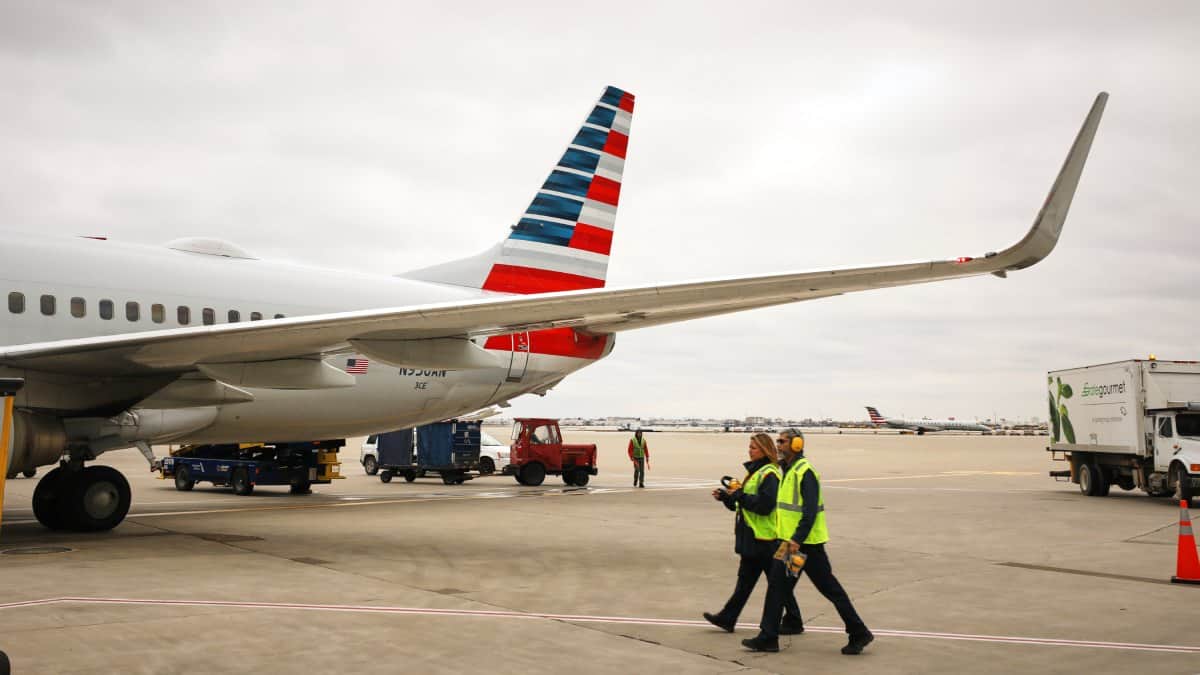
Image generated with Ai
American Eagle Flight AA3927 was diverted to Evansville, Indiana, after severe thunderstorms prevented three landing attempts in Kentucky and left the Embraer E175 with a reported 30 minutes of fuel remaining.
An American Eagle flight from Dallas/Fort Worth to Lexington was forced to declare a fuel emergency and divert to Indiana after powerful thunderstorms repeatedly disrupted its arrival plans.
Advertisement
Flight AA3927, operated by Envoy Air for American Airlines, was flying an Embraer E175LR registered as N285NN. The aircraft was initially heading towards Blue Grass Airport in Lexington, Kentucky, but deteriorating weather forced the crew to abandon its first approach.
The pilots subsequently diverted to Louisville, where two further landing attempts were also unsuccessful. With fuel reserves becoming increasingly limited, the crew declared an emergency and was directed to Evansville Regional Airport, where the aircraft landed safely.
Advertisement
Advertisement
AA3927 departed Dallas/Fort Worth International Airport (DFW) for Lexington Blue Grass Airport (LEX) on a scheduled domestic service.
The flight’s cruise phase was reportedly uneventful, with the aircraft operating at around 35,000 feet. The situation changed during the descent towards Lexington as the crew encountered intense thunderstorms and heavy precipitation in the destination area.
The first approach towards Runway 22 at Lexington could not be completed safely. The pilots therefore initiated a go-around, abandoning the landing and reassessing their options.
With the weather around Lexington becoming increasingly difficult, the crew decided to proceed towards Louisville Muhammad Ali International Airport (SDF), which had been designated as the flight’s alternate airport.
Advertisement
Advertisement
Diverting to Louisville did not immediately solve the problem because the storm system was also affecting the airport and surrounding airspace.
The crew attempted to land on Runway 35R after reaching Louisville. However, adverse weather conditions prevented the aircraft from completing the approach safely, resulting in another missed approach.
The pilots then attempted a second approach to Runway 35L. Once again, heavy precipitation and poor visibility made conditions unsuitable for landing.
That meant the flight had now experienced three unsuccessful approaches — one at Lexington and two at Louisville.
Each missed approach required additional fuel for manoeuvring, climbing, holding and repositioning. As the weather continued to restrict the available landing options, fuel management became an increasingly urgent consideration.
After the third missed approach, the crew alerted air traffic control that the aircraft was experiencing a fuel emergency.
The aircraft reportedly had approximately 30 minutes of fuel remaining. The crew also selected 7700 on the aircraft’s transponder, signalling an emergency situation to air traffic control.
The 7700 code is a standard international emergency squawk. It tells controllers that an aircraft requires immediate attention and allows them to prioritise the flight where necessary.
Given the combination of deteriorating weather, multiple missed approaches and limited remaining fuel, finding a suitable airport quickly became the priority.
Air traffic control directed AA3927 towards Evansville Regional Airport (EVV) in Indiana.
Evansville offered the flight a safer alternative away from the more challenging weather affecting Lexington and Louisville. The diversion also reduced the need for the crew to continue attempting approaches in an area affected by severe thunderstorms.
The flight was given priority as it proceeded towards Evansville. The pilots were able to complete the approach and land on Runway 22.
The aircraft arrived at Evansville roughly three hours after departing Dallas/Fort Worth, bringing the emergency situation to a safe conclusion.
The Embraer E175 landed safely, and emergency ground personnel were present after touchdown as a precaution.
There were no reported injuries among the passengers or crew.
The presence of emergency vehicles following a fuel emergency is a standard precaution designed to ensure that appropriate assistance is immediately available if required. In this case, the aircraft completed the landing without a reported incident.
The incident demonstrates how quickly severe weather can transform an otherwise routine regional flight into a complex operational situation.
Thunderstorms can affect visibility, precipitation levels, wind conditions and approach stability, forcing pilots to abandon an approach even when an aircraft is otherwise operating normally.
Airline crews must also balance several factors simultaneously, including available fuel, weather forecasts, airport conditions, alternate airports and the time required to complete another approach.
For AA3927, the combination of three missed approaches and worsening weather eventually made continued attempts at the original airports impractical.
The successful diversion to Evansville also highlights the importance of coordination between flight crews and air traffic controllers during emergencies. By directing the aircraft towards an airport with more favourable conditions, controllers helped the crew secure a safe landing before fuel reserves became critically restrictive.
AA3927 ultimately reached the ground safely in Indiana. The episode serves as a clear reminder that severe thunderstorms can have consequences well beyond a simple flight delay, particularly when multiple airports in the same region are simultaneously affected.
Advertisement
Advertisement
Advertisement













Saturday, September 5, 2026

Friday, September 4, 2026

Saturday, September 5, 2026

Thursday, September 3, 2026

Wednesday, September 2, 2026

Saturday, September 5, 2026

Saturday, September 5, 2026