
Haiti’s Travel Lifelines Strain Under a Triple Squeeze as US Commercial Flights Stay Off Port-au-Prince Routes, Embassy Mobility Is Curtailed and Emergency Assistance Becomes Critically Limited

Updated
Published
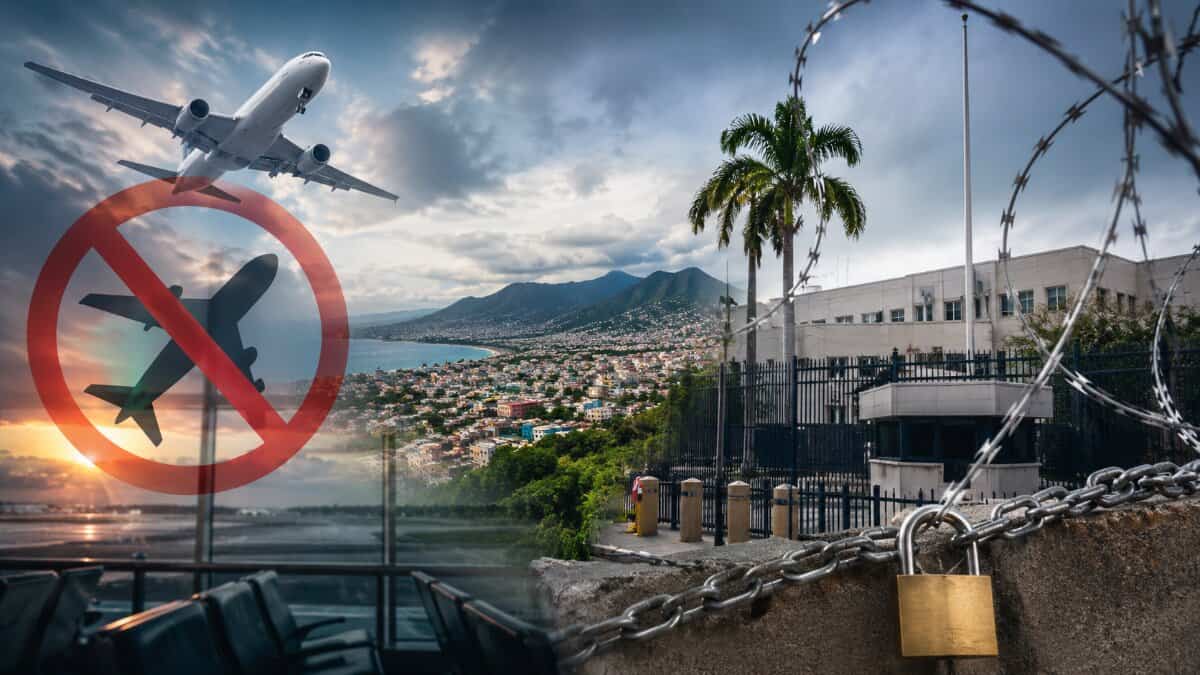
Image generated with Ai
Haiti has entered a more severe phase of travel isolation as air access, diplomatic mobility and emergency assistance face simultaneous restrictions. The United States retained its Level 4 Do Not Travel classification on 10 July but updated the advisory to reflect altered embassy operations. US government employees cannot leave the embassy for non-essential purposes, their family members cannot accompany them to Haiti, and assistance for US citizens remains extremely limited. Meanwhile, US commercial flights continue to be absent from Port-au-Prince under an FAA security prohibition.
Haiti Travel Advisory Update Signals More Than a Conventional Security Warning
The 10 July action did not increase Haiti’s advisory level or add new risk indicators. Haiti remains at Level 4 because of crime, kidnapping, terrorism, unrest and limited healthcare. The significant change lies within the operating conditions imposed on the US diplomatic mission.
Advertisement
Advertisement
US government employees working in Haiti are prohibited from travelling away from the embassy for non-essential reasons. Family members cannot join employees assigned to the country. Security-related mobility restrictions have also left the US government with an extremely limited capacity to provide emergency services to its citizens.
These measures turn the advisory into an operational warning rather than a simple recommendation against leisure travel. They show that even government personnel supported by diplomatic security systems cannot move freely through the capital for routine purposes.
Advertisement
Advertisement
The advisory also confirms that Haiti’s national state of emergency, introduced in March 2024, remains in force. This creates a prolonged risk environment in which air transport, local movement, medical evacuation and consular intervention cannot be treated as independently reliable systems.
Three Layers of Haiti’s Access-and-Assistance Crisis
| Restriction layer | Official position as of 12 July 2026 | Practical travel consequence |
|---|---|---|
| International aviation | US commercial flights are not operating to or from Port-au-Prince | Direct access from the United States to Haiti’s capital remains unavailable |
| Embassy mobility | US government employees cannot leave the embassy for non-essential purposes | Routine off-site consular response and physical intervention are severely constrained |
| Diplomatic staffing | Family members cannot accompany US government employees | The operating environment is considered unsuitable for normal accompanied diplomatic assignments |
| Emergency services | US emergency assistance capacity is extremely limited | Travellers cannot assume rapid government evacuation, recovery or field support |
| Ground transport | Roadblocks, armed activity and unpredictable local controls remain significant | Airport transfers and intercity movements can fail even when an air itinerary appears operational |
| Medical support | Healthcare facilities have limited staffing, supplies and emergency capacity | Travellers face a high need for private medical and evacuation arrangements |
The central issue is therefore not only the probability of encountering crime. It is the absence of dependable fallback options when an itinerary, transfer, medical emergency or security plan breaks down.
Advertisement
Advertisement
FAA Restriction Keeps US Airlines Away From Port-au-Prince
The current FAA Notice to Airmen, KICZ A0024/26, prohibits covered US aviation operators from flying between the surface and 9,999 feet above mean sea level within specified parts of Haitian territory and airspace.
The restricted zone includes the Port-au-Prince operating environment and other defined areas linked to continuing instability. The measure applies to US air carriers and commercial operators, most pilots exercising FAA-issued certificates, and most operators of US-registered civil aircraft.
Advertisement
Advertisement
The notice became effective on 2 March 2026 and is scheduled to remain in force until 3 September 2026 at 05:00 UTC, unless it is changed, replaced or extended. The FAA can approve limited operations through exemptions, deviations or other authorisations. Pilots may also depart from the restriction when immediate emergency action is required for flight safety.
Technical Scope of the Current FAA Haiti NOTAM
| FAA provision | Operational detail |
|---|---|
| NOTAM reference | KICZ A0024/26 |
| Effective period | 2 March 2026 at 20:10 UTC to 3 September 2026 at 05:00 UTC |
| Vertical restriction | Surface to 9,999 feet above mean sea level |
| Main affected market | Port-au-Prince and specified surrounding areas |
| Covered operators | US air carriers, US commercial operators and specified FAA-linked aviation activity |
| Main reason | Safety-of-flight risks associated with continuing instability |
| Exceptional access | Possible through FAA or authorised US government approval |
| Areas outside the zone | Operations outside the defined restricted areas do not require FAA authorisation |
The restriction is important but geographically specific. It does not constitute a complete prohibition on all aviation throughout Haiti. Operations outside the defined area do not require FAA authorisation under this particular notice.
Cap-Haïtien and Les Cayes Remain Outside the Same FAA Risk Assessment
The FAA’s supporting background notice separates Port-au-Prince and surrounding high-risk areas from other parts of Haiti.
According to the notice, security forces have remained unable to prevent attacks on aircraft around Port-au-Prince. Since September 2025, armed organisations classified by the United States as foreign terrorist organisations have used small-arms fire against at least three aircraft within the prohibited aviation area.
Advertisement
Advertisement
Violent activity has also expanded into parts of the Artibonite and Centre departments, increasing the exposure of aircraft operating at lower altitudes.
However, the FAA identifies a more limited armed-group presence around Cap-Haïtien International Airport and Antoine Simon International Airport in Les Cayes. It also records no history of aviation or airport targeting in those regions.
This distinction does not make northern or southern Haiti simple replacement gateways for Port-au-Prince. An alternative airport may sit outside the FAA prohibition while still presenting difficult ground transfers, limited onward transport, uncertain insurance coverage and reduced access to diplomatic assistance.
For travel planners, airport availability and destination accessibility are now separate questions.
Haiti’s Aviation Isolation Has Developed Through Repeated Aircraft Security Incidents
The current restriction forms part of a longer series of FAA interventions rather than a single temporary interruption.
On 11 November 2024, Spirit Airlines Flight 951 was damaged by reported gunfire while attempting to land at Toussaint Louverture International Airport. The aircraft diverted safely to Santiago de los Caballeros in the Dominican Republic. Two other Port-au-Prince-bound flights were diverted, and the airport closed.
Advertisement
Advertisement
The following day, the FAA prohibited US civil aviation below 10,000 feet throughout Haiti for 30 days. On 20 November 2024, the regulator modified that nationwide restriction and replaced it with a geographically targeted prohibition covering specified areas.
The FAA renewed the targeted restriction in March 2025. The present notice, introduced in March 2026, continues the same risk-based approach while accounting for changing patterns of armed activity.
Evolution of US Aviation Restrictions Affecting Haiti
| Date | Official development | Strategic significance |
|---|---|---|
| 11 November 2024 | US commercial aircraft damaged by reported gunfire near Port-au-Prince | Demonstrated direct exposure of passenger aviation to ground-based attacks |
| 12 November 2024 | FAA prohibited covered US civil flights below 10,000 feet throughout Haiti | Immediate nationwide emergency response |
| 20 November 2024 | FAA narrowed the restriction to specified areas | Shift from blanket prohibition to targeted airspace management |
| 11 March 2025 | Specified-area restriction renewed | Risk considered persistent rather than temporary |
| From September 2025 | At least three aircraft attacked within the prohibited zone | Confirmed continuation of direct aviation threats |
| 2 March 2026 | Current NOTAM became effective | Port-au-Prince-area restrictions extended through the 2026 travel period |
| 10 July 2026 | State Department updated embassy operating conditions | Aviation restriction became part of a wider mobility and assistance crisis |
This timeline shows that the interruption to US-linked Port-au-Prince connectivity is no longer a short-term schedule issue. It has developed into a sustained market-access constraint.
Consular Capacity Is Narrowing Alongside Aviation Access
The embassy remains present in Port-au-Prince, and official telephone and electronic contact channels continue to exist. However, physical presence does not equal unrestricted response capability.
The 10 July advisory makes clear that security conditions prevent employees from conducting non-essential movement away from the embassy. This restricts the practical reach of the mission during incidents involving travellers outside secure diplomatic facilities.
US citizens are advised to maintain an independent departure plan that does not rely on government help. They are also encouraged to secure medical evacuation cover because emergency transport can be extremely expensive and government assistance may not be available.
Advertisement
Advertisement
The advisory recommends keeping travel documents accessible, establishing family communication plans and enrolling in the Smart Traveler Enrollment Program. These recommendations reflect an operating environment in which personal contingency systems may become the first line of response.
Consular separation also extends beyond emergency assistance. Current State Department post guidance designates the US Embassy in Nassau, The Bahamas, to conduct immigrant visa services for residents of Haiti. That arrangement adds another international travel requirement for eligible applicants who would otherwise expect to complete key processes in Port-au-Prince.
Why the New Haiti Angle Matters to the Travel Industry
The most important development is the convergence of three forms of isolation.
The first is network isolation. US airlines cannot currently restore ordinary passenger services to Port-au-Prince while the FAA prohibition remains active.
The second is surface isolation. Even when travellers enter through another airport or on a non-US operation, road access may be interrupted by armed activity, barricades, neighbourhood controls or transport insecurity.
The third is assistance isolation. Travellers facing medical, legal or security emergencies may find that diplomatic personnel cannot move to them and that local emergency infrastructure is unable to provide a reliable substitute.
Advertisement
Advertisement
This creates a closed-loop risk structure. A traveller may reach Haiti but remain unable to complete the transfer. An alternative airport may operate but sit far from the intended destination. A medical event may require evacuation, while the aviation and security environment complicates arranging that evacuation.
For tour operators, humanitarian organisations, corporate travel managers and insurers, the critical product is no longer simply an air ticket. It is an end-to-end access plan with multiple independently tested exit routes.
Economic Weakness Increases the Cost of Haiti’s Connectivity Breakdown
Haiti’s access crisis is unfolding during an already severe economic contraction.
The World Bank records a seventh consecutive year of economic decline in 2025, with real gross domestic product falling by 2.7 per cent. Average inflation reached 28.3 per cent, while government revenue declined to 4.8 per cent of GDP. Approximately 49 per cent of the population was estimated to live below the international poverty threshold of US$3 per day.
Around 1.4 million people had been displaced by violence as of March 2026. The World Bank also reports that 5.4 million Haitians face daily difficulty obtaining sufficient food.
| Official economic indicator | Latest institutional position | Travel-market implication |
|---|---|---|
| Real GDP growth in 2025 | Down 2.7 per cent | Weak domestic demand and reduced ability to finance transport recovery |
| Average inflation | 28.3 per cent | Higher fuel, accommodation, security and local service costs |
| Government revenue | 4.8 per cent of GDP | Limited fiscal capacity for infrastructure protection and restoration |
| Internally displaced population | 1.4 million by March 2026 | Greater pressure on urban services, roads and accommodation |
| People facing food insecurity | 5.4 million | Higher humanitarian transport demand amid weak commercial connectivity |
Restricted aviation access adds cost to aid delivery, business travel, medical movement, diaspora journeys and project implementation. It can also discourage airlines from returning even after legal restrictions are removed because operators must consider airport security, crew protection, aircraft insurance and the reliability of ground handling.
Advertisement
Advertisement
Critical Takeaways for Travel Agents and Tour Operators
- Treat the State Department’s 10 July update as an operational-access warning, not merely a crime advisory.
- Do not sell or describe Port-au-Prince access as available through a US commercial carrier while the FAA prohibition remains active.
- Verify whether every flight is operated by the ticketed airline, a codeshare partner, a charter operator or a non-US carrier.
- Do not present Cap-Haïtien or Les Cayes as automatic substitutes for Port-au-Prince without confirming ground-transfer security and duration.
- Obtain written confirmation that insurance covers Haiti, medical evacuation, armed unrest, itinerary disruption and airport closure.
- Build departure plans that do not depend on the US government, local public transport or a single airport.
- Confirm the current location and operating capability of the relevant embassy before every movement.
- Require travellers to maintain accessible passports, emergency funds, communications equipment and offline contact records.
- Avoid non-refundable land arrangements where aviation access, road access and emergency assistance cannot all be verified.
- Reassess itineraries whenever the FAA notice approaches its 3 September 2026 expiry, since the measure may be withdrawn, modified or extended.
Haiti’s Long-Term Travel Recovery Now Depends on Restoring the Entire Access Chain
Haiti’s international travel recovery will require more than reopening an airport or allowing a small number of flights to return. A durable recovery depends on aircraft security around Port-au-Prince, protected airport approaches, reliable ground corridors, functioning medical evacuation systems and sufficient consular mobility.
The current position demonstrates how quickly a destination can become commercially inaccessible even when parts of its aviation system remain technically open. Airlines need confidence that aircraft and crews can operate safely. Tour operators need dependable transfers. Insurers need measurable risks. Travellers need realistic emergency support.
Until those conditions improve together, Haiti will remain divided between limited points of possible entry and broad areas of uncertain practical accessibility. The 10 July embassy update therefore marks a deeper stage of isolation: not a new travel warning, but official confirmation that air connectivity, ground movement and emergency assistance are all constrained at the same time.
Advertisement
