
UK Adjoins France and Other Countries in Modernising Air Traffic Control With Real-Time AI Decision Tools

Published
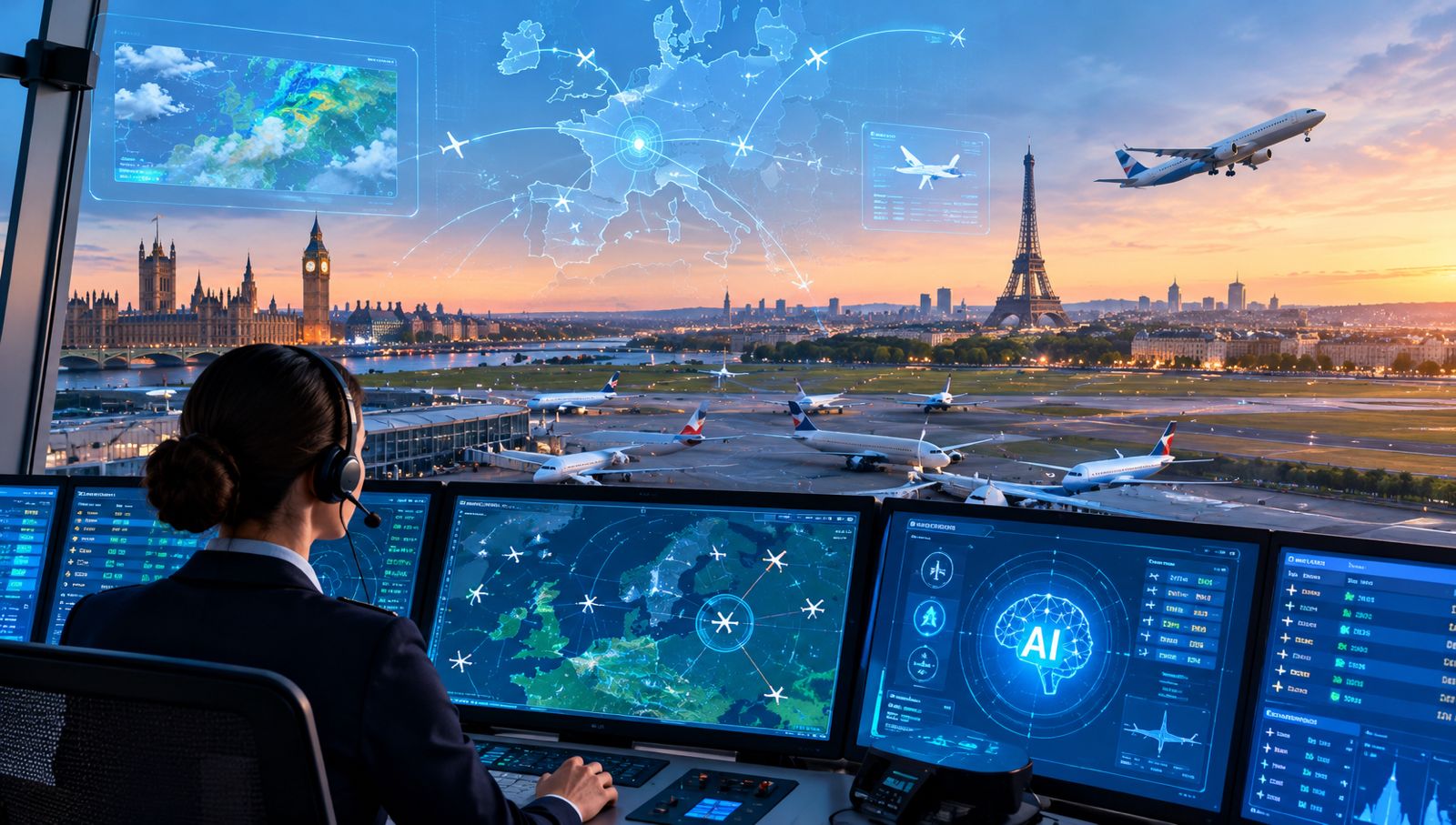
Image generated with Ai
As the world’s aviation industry enters a new era of unprecedented growth, UK adjoins France and other countries are at the forefront of rethinking the future of flight safety. Will traditional human controllers eventually be replaced by mysterious machines, or is an even more powerful digital revolution about to occur behind the scenes? UK adjoins France and other countries are using sophisticated artificial intelligence to address the challenge of unprecedented airspace congestion. Moreover, UK adjoins France and other countries are successfully adopting real-time AI decision tools to handle crowded skies. Finally, UK adjoins France and other countries are demonstrating that computer-co-pilots improve safety while transforming modernizing air traffic control.
Air traffic management is undergoing a quiet yet profound revolution as intelligent decision-support tools are integrated into control centres worldwide to assist human operators rather than replace them. This balanced transformation uses real-time computational co-pilots to simulate weather routing, predict sector congestion, and manage post-pandemic traffic surges safely.
Advertisement
Advertisement
Why Is Media Sensationalism Overshadowing Real Aviation Progress?
Popular culture and mainstream media frequently sensationalize the future of aviation with dramatic headlines regarding fully autonomous aircraft and pilotless commercial jets. However, this fictional narrative completely obscures the genuine, ground-breaking technological shift currently unfolding behind the scenes within global Air Traffic Management infrastructures. Control centres across major aviation hubs are quietly adopting sophisticated intelligent decision-support tools that function as real-time computational co-pilots for human controllers. Rather than attempting to eliminate human oversight, these advanced algorithms seamlessly model weather routing adjustments, accurately predict impending sector congestion, and intelligently re-sequence landing queues. By deploying these supportive systems, aviation authorities successfully handle record-breaking post-pandemic airspace volume while maintaining uncompromising safety standards.
“This report brilliantly cuts through the sensationalist media hype surrounding fully automated flight decks to spotlight the real, ground-breaking revolution happening inside air traffic control centres. By detailing how the UK, France, the US, and the UAE are successfully integrating real-time AI decision-support tools, it demonstrates a pragmatic approach to modern aviation challenges. Instead of replacing human expertise, these computational co-pilots empower controllers to handle record-breaking post-pandemic airspace volumes safely and efficiently. It is a vital read for anyone wanting to understand the true intersection of technology and aviation safety today.”
Advertisement
Advertisement
— Anup Kumar Keshan, Founder and Editor-in-Chief, Travel And Tour World
How Are UK and French Airspaces Transforming Through Digital Modernization?
National airspace resilience is experiencing a massive overhaul as European leaders prioritize digital integration and harmonized cross-border management to eliminate legacy bottlenecks. Following comprehensive independent reviews into historic system outages, the United Kingdom has accelerated the deployment of automated flow-management tools designed to phase out outdated manual route modeling. Simultaneously, France is spearheading ambitious Single European Sky digital modernization initiatives through DSNA to harmonize transit corridors and mitigate frustrating en-route delays. These collaborative frameworks deploy automated conflict-detection alerts and sophisticated trajectory-prediction tools, which significantly reduce controller workload while optimizing cross-border capacity. Consequently, regional aviation networks achieve unprecedented operational efficiency without compromising the critical safety buffers required for dense international flight paths.
Advertisement
Advertisement
To support the operational changes mentioned, official updates and background documents are detailed on the UK Government Airspace Modernisation Guidance portal.
What Role Do US and UAE Digital Grids Play in Modern Aviation?
Domestic radar and satellite tracking grids across the United States are currently undergoing extensive upgrades to integrate advanced algorithmic conflict-detection software safely into daily operations. Through foundational modernization programs, the Federal Aviation Administration blends modern tracking feeds with predictive algorithms to supply controllers with vital early-warning conflict projections. Meanwhile, the United Arab Emirates aviation sector is actively deploying high-capacity digital traffic management tools specifically engineered to handle hyper-dense multi-wave connecting hubs like Dubai. These specialized systems dynamically model complex arrival queues and manage intricate airspace transitions, allowing regional control centres to process ultra-high aircraft movements securely. Ultimately, these diverse technological implementations demonstrate a universal commitment to augmenting human decision-making rather than pursuing risky, unproven full automation.
Advertisement
Advertisement
| Country / Region | Key Focus Area | Technological Solution | Strategic Impact |
| United Kingdom | Airspace resilience & flow management | Automated flow-management and digital route modeling | Overhauls legacy systems and supports net-zero carbon goals. |
| France | Cross-border digital harmonization | SESAR trajectory-prediction and conflict alerts | Minimizes en-route delays and harmonizes European skies. |
| United States | Domestic radar and satellite tracking grids | TBFM, TFDM, and algorithmic conflict-detection | Provides early-warning conflict projections for heavy traffic. |
| United Arab Emirates | Hyper-dense multi-wave connecting hubs | High-capacity digital arrival queue management | Safely processes ultra-high aircraft movements at mega-hubs. |
The idea of using computational co-pilots in the international airspace is rapidly gaining momentum. Not only is it making previously unthinkable scenarios of everyday life a reality, but it is also happening right now. By helping human controllers instead of replacing them, countries can be certain to have safety in their skies despite the post-pandemic boom in air travelers, and it can help streamline flights and cut back on traffic jams in the skies, ultimately leading the world toward a more intelligent and efficient aviation industry.
What factors led to such a rampant influx of cutting-edge tech in the international airspace? The surge in post-pandemic air passengers and the resulting traffic jams in the skies led many authorities to the decision to implement more advanced technology. As such, aviation control agencies began using modern algorithms to keep their safety rates up and prevent air traffic controller fatigue. Such a decision bears fruits because programs can analyze greater amounts of data in drastically shorter times than humans can while also always being controlled by humans.
Advertisement
