
New England Matches the West and Upper Midwest, Alongside Many Autumn Destinations as Fall Foliage 2026 Captivates US Travellers

Published
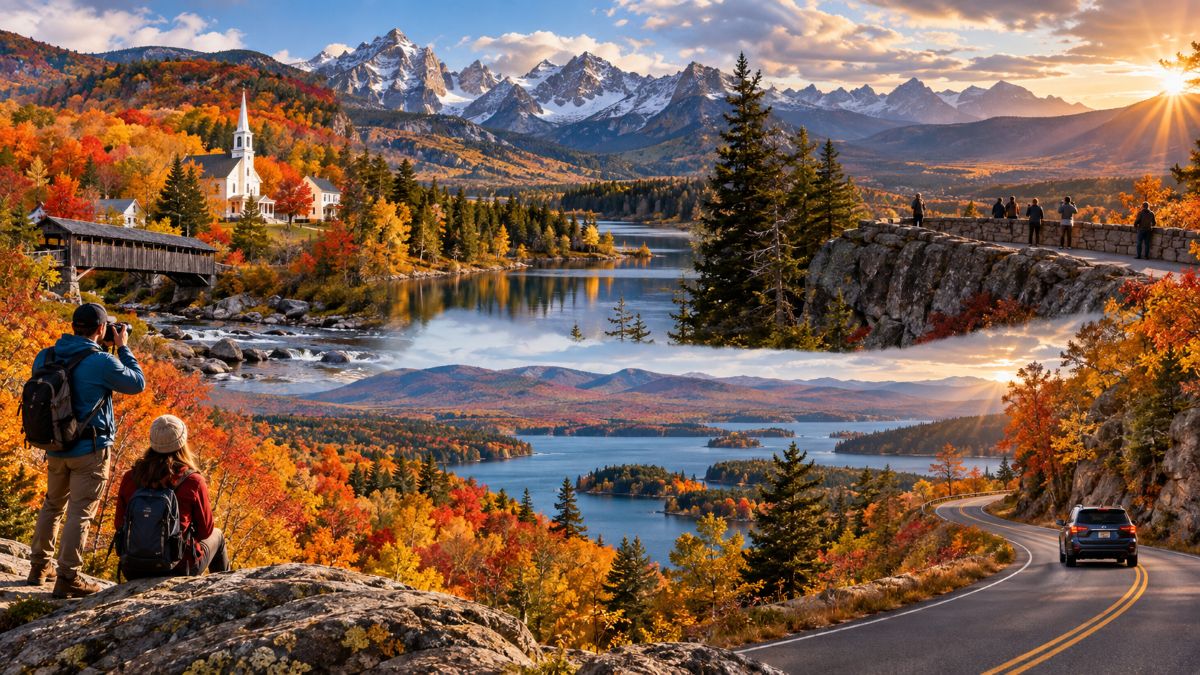
Image generated with Ai
The US autumn travel season is beginning with sharply different foliage prospects across the country. The Northeast is entering the season with healthier forests after difficult conditions in 2024 and 2025. However, drought continues to threaten colour quality in parts of Maine, New Hampshire and the Upper Midwest. Meanwhile, early colour is already emerging across Colorado, Wyoming, Montana, Idaho and Utah, where heat and dryness can accelerate the seasonal transition. For travellers, the message is clear: timing matters, but geography matters just as much. Peak colour will move gradually across regions rather than arrive nationwide at once. Weather during the next several weeks will ultimately determine the intensity and duration of the display.
Northeast Enters Autumn With Healthier Forests
The Northeast remains the central draw for travellers chasing America’s classic autumn landscape. After two difficult foliage seasons, regional forests have recovered across much of the area, creating stronger prospects for a vivid display.
Evan Fisher, founder of Explore Fall, told on September 22 that the Northeast is shaping up for a particularly strong season. He linked the outlook to the region’s recovery from recent drought conditions.
Jim Salge, a fall foliage reporter for Yankee Magazine, also described the forests as healthy after improved moisture conditions. However, the recovery is not uniform. Parts of Maine and New Hampshire remain vulnerable to drought, particularly along affected coastal areas.
Advertisement
Advertisement
The latest U.S. Drought Monitor assessment reinforces that caution. As of September 15, drought conditions had deteriorated across much of Maine, with extreme drought introduced along parts of the Maine coastline. Low streamflows and well levels were among the reported impacts.
Advertisement
Advertisement
For visitors, this creates a more nuanced autumn map. Northern New England can begin changing earlier, while southern and coastal locations may peak later.
| Region | Typical Peak Window | 2026 Travel Outlook | Main Risk |
|---|---|---|---|
| Northern Maine | Mid-September to early October | Early colour already developing | Coastal drought |
| White Mountains, New Hampshire | Late September to early October | Promising in many areas | Localised dryness |
| Vermont | Late September to mid-October | Strong prospects | Weather timing |
| Upstate New York | Late September to mid-October | Generally favourable | Short-term weather shifts |
| Southern New England | Mid to late October | Potentially gradual transition | Warmer temperatures |
| Coastal New England | Late October | Later seasonal display | Wind and coastal storms |
The traditional sequence remains useful for planning. New England’s northern mountains generally turn first, while coastal Connecticut and Rhode Island can retain colour into late October and early November.
Western States Are Already Turning Golden
The western United States presents a different autumn timetable. Parts of Colorado, Wyoming, Montana, Idaho and Utah are already reporting changing foliage.
Advertisement
Advertisement
Higher elevations usually lead the seasonal transition because temperatures fall faster with altitude. That makes mountain destinations particularly attractive for travellers seeking early autumn scenery.
However, this year’s timing also reflects persistent heat and dryness. The result could be an earlier peak across several western landscapes. That creates opportunities for early-season trips, but it also reduces flexibility for travellers who wait until October.
Advertisement
Advertisement
A current 2026 foliage outlook places Colorado’s Rockies around mid-to-late September, with the Tetons, parts of Montana and central Idaho generally reaching peak conditions from late September into early October. Northern Utah and southern Utah follow progressively later.
For international visitors, this matters because the western foliage window can overlap with the start of the Northeast season. A carefully planned multi-region itinerary could therefore capture very different autumn landscapes during one US journey.
Upper Midwest Faces A More Uneven Display
The Upper Midwest could become one of the more complicated foliage markets this autumn. Wisconsin, Michigan and Minnesota have experienced significant dryness in parts of the region.
The U.S. Drought Monitor has repeatedly recorded deterioration across northern Wisconsin and surrounding areas. Earlier assessments identified severe drought across sections of northern Wisconsin, while later reports continued to show dryness across the Upper Midwest.
That matters because drought can alter both the quality and duration of leaf colour. Trees under moisture stress can change earlier, produce less intense foliage or shed leaves before reaching their strongest colours.
Advertisement
Advertisement
The National Weather Service similarly notes that severe drought can reduce foliage brightness and cause leaves to die earlier. Strong winds can then accelerate leaf loss, shortening the viewing window further.
For travellers, the implication is practical. A trip to northern Wisconsin or Michigan’s Upper Peninsula should not depend on a historical peak date alone. Local foliage reports and short-range weather forecasts become increasingly important as October approaches.
Weather Will Decide The Final Show
Foliage forecasting remains an exercise in probabilities rather than certainty. Day length initiates the seasonal process, but temperature, moisture, sunlight and storm activity influence the final appearance.
Trees gradually stop producing chlorophyll as daylight decreases and autumn conditions develop. Once the green pigment fades, yellow and orange pigments become more visible. Red and purple shades can develop through anthocyanins under suitable conditions.
The ideal recipe often involves sunny days and cool nights without hard freezes. Warm, cloudy and persistently wet conditions can produce less vivid colour, while severe cold or strong storms can accelerate leaf drop.
Advertisement
Advertisement
That is why a location can appear spectacular one day and noticeably different several days later. The viewing experience also depends on sunlight. Bright skies can illuminate the canopy dramatically, while overcast conditions can make identical trees appear less vibrant.
| Weather Factor | Potential Effect On Foliage | Travel Implication |
|---|---|---|
| Cool autumn nights | Can support stronger red tones | Favour crisp-weather trips |
| Warm temperatures | May delay or alter colour development | Avoid relying solely on historical dates |
| Drought | Can shorten or weaken displays | Check local moisture conditions |
| Heavy rain | Can reduce visibility and accelerate leaf loss | Build flexibility into itineraries |
| Strong winds | Can strip leaves rapidly | Recheck forecasts before scenic drives |
| Sunny autumn days | Can enhance colour perception | Useful for photography |
| Hard frost | Can damage leaves prematurely | Peak window may shorten |
October Outlook Brings More Uncertainty
The broader climate pattern also deserves attention. NOAA’s September assessment favoured above-average temperatures across large parts of the continental United States. It also identified areas of expected precipitation differences and continued drought concerns in parts of the Upper Midwest and western United States.
The National Weather Service Climate Prediction Center’s September 17 outlook also points towards a warmer-than-normal October pattern across much of the eastern United States and north-central states. That does not determine individual foliage dates, but it adds another layer of uncertainty for travellers planning weeks ahead.
A strengthening El Niño is another factor in the wider seasonal climate picture. NOAA’s September outlook gave greater than a 90% chance of a very strong El Niño during the Northern Hemisphere autumn and winter.
Travellers should therefore treat long-range foliage maps as planning tools rather than guarantees. Conditions can change considerably between a forecast issued weeks ahead and the day of a visit.
Advertisement
Advertisement
Foliage Tourism Is A Major Autumn Driver
The significance extends beyond scenery. Leaf-peeping is an established tourism economy, particularly across New England, where autumn travel supports accommodation, restaurants, scenic attractions, outdoor recreation and local transport.
The National Park Service describes leaf-peeping as a billion-dollar industry in New England. It also notes that September and October have recorded some of the largest increases in visitation at Acadia National Park over the past two decades.
That concentration creates both economic opportunity and operational pressure. Popular scenic roads, national parks, small towns and mountain communities can experience substantial visitor surges during peak weekends.
Great Smoky Mountains National Park issued an autumn visitor advisory on September 10, warning that foliage, wildlife and seasonal events bring high visitor volumes. The park expects congestion and limited parking at several popular locations.
The same pattern occurs elsewhere. The National Park Service advises visitors to avoid unsafe roadside stops, remain alert around wildlife and pull over only at suitable locations when viewing foliage.
Advertisement
Advertisement
Smart Timing Can Improve The Experience
Travellers do not necessarily need to chase the exact historical peak. In fact, doing so can create unnecessary pressure around accommodation and transport.
A gradual foliage progression can offer a better strategy. Visitors can begin in northern or higher-elevation areas, then move south or towards lower elevations as the season advances.
This approach also spreads demand across destinations. Instead of concentrating travellers into one weekend, regional road trips can follow the movement of colour.
For travellers visiting New England, northern Maine and the White Mountains can provide earlier opportunities. Vermont and the Adirondacks generally follow. Southern New England then offers later-season options.
National parks can also provide reliable alternatives to famous roadside viewpoints. The National Park Service recommends September to mid-October for seasonal colour at Katahdin Woods and Waters National Monument, while emphasising the importance of checking current conditions and weather.
Advertisement
Advertisement
How Travellers Should Plan Autumn Trips
The most effective strategy for fall foliage 2026 is to combine historical patterns with live conditions. Historical averages establish a useful framework, but current weather determines whether a specific destination delivers the expected display.
Travellers should monitor state foliage reports before departure. They should also check national park advisories, road conditions and weather forecasts shortly before travelling.
Photography-focused visitors should consider morning and late-afternoon light. Drivers should avoid stopping on narrow roads or unsafe shoulders simply to capture a colourful vista.
For popular parks, weekdays can also reduce congestion. The National Park Service specifically notes that autumn parking areas can fill around midday on warm, sunny weekends at busy foliage destinations.
| Traveller Type | Recommended Strategy | Key Consideration |
|---|---|---|
| International visitors | Build a multi-region itinerary | Allow several days for weather flexibility |
| Road-trip travellers | Follow colour from north to south | Monitor local foliage reports |
| Photographers | Target sunny mornings and afternoons | Light can dramatically alter colour |
| Hikers | Check trail and park conditions | Rain and wind can change safety conditions |
| Families | Choose accessible scenic routes | Avoid congested peak-period stops |
| Luxury travellers | Book flexible accommodation | Peak weekends can tighten availability |
| Budget travellers | Consider weekdays and shoulder dates | Demand is lower outside peak weekends |
Autumn Travel Will Follow The Trees
The coming weeks will reveal whether the promising Northeast forecast translates into the vibrant display travellers expect. Forest health provides a stronger starting point than recent years, but weather will remain the decisive variable.
Advertisement
Advertisement
Across the West, earlier colour creates immediate opportunities, while drought makes timing more important. In the Upper Midwest, uneven moisture conditions could produce a more fragmented display. Meanwhile, northern New England is already entering the transition that will eventually sweep southwards.
For travellers, flexibility is now more valuable than a fixed peak date. The strongest autumn journeys will follow local conditions rather than depend entirely on historical calendars. With national parks, scenic highways and mountain communities preparing for seasonal demand, the US is entering another major foliage tourism period. The landscape will change daily, making timely planning essential.
Advertisement
