
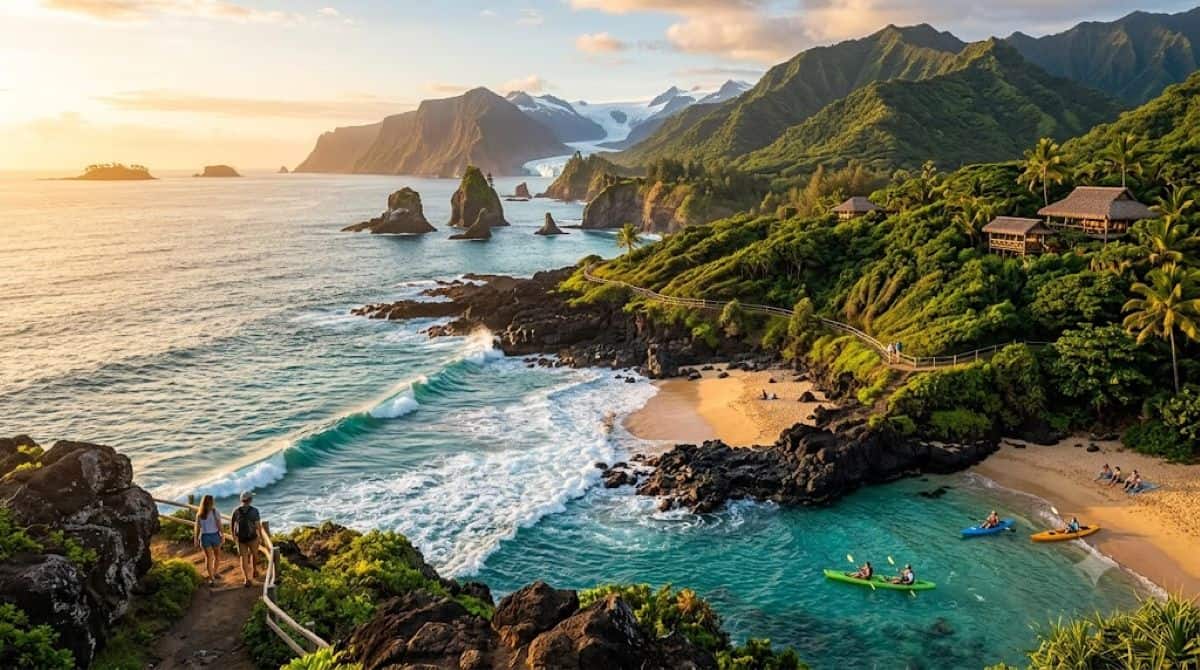
Image generated with Ai
Coastal tourism is becoming a powerful economic force across the United States, but the way people explore the coast is also changing. Hawaii, Alaska, Oregon, California, Florida, North Carolina and Maine are showing how longer stays, local experiences and responsible travel can bring visitor money deeper into communities.
The numbers are huge. According to the National Oceanic and Atmospheric Administration (NOAA), coastal tourism and recreation directly support more than 2.5 million jobs in the United States. The sector generates about $90.6 billion in wages and contributes roughly $207 billion to US GDP.
Advertisement
But destinations are looking beyond visitor numbers.
Many now want travellers to stay longer, explore more places and spend money with local businesses. This fits closely with the idea of slow travel. Instead of rushing from one famous attraction to another, travellers can spend more time understanding a destination.
Advertisement
Advertisement
Hawaii is one of the strongest examples of this changing approach.
Tourism remains a huge part of Hawaii’s economy.
In 2025, visitors spent about $9.42 billion on O‘ahu. Maui received around $5.97 billion in visitor spending. Hawai‘i Island recorded approximately $3.23 billion, while Kaua‘i received about $2.93 billion.
The story is not only about money.
The Hawaii Tourism Authority has increasingly focused on destination management and regenerative tourism. The aim is to protect local culture and natural places while creating benefits for communities.
That approach can work well with slower travel.
Visitors who spend more time on an island can explore local restaurants, cultural experiences and smaller communities. They can also learn how to respect fragile natural areas.
Maui offers a clear example of this shift. About 2.5 million visitors spent more than $5.9 billion on Maui in 2025, up from around $5.3 billion in 2024.
At the same time, tourism officials have worked to improve visitor behaviour. The Mālama Maui Hikina programme placed stewards at busy locations along the Hāna Highway. They helped guide visitors towards alternative places and reached more than 16,000 people.
The message is becoming clear. Hawaii does not simply need tourism. It needs tourism that works better for the islands.
The Oregon Coast shows how coastal tourism can reach far beyond beaches.
The region generated around $2.5 billion in direct travel spending, according to Travel Oregon’s economic impact figures. Tourism also supported about 26,250 jobs, produced $949 million in employee earnings and generated approximately $124 million in state and local tax revenue.
The coast recorded around 17.9 million overnight stays.
Those overnight stays matter because travellers need accommodation, meals and services. They may also spend money on outdoor activities, seafood, farms and locally made products.
Oregon has developed tourism around outdoor recreation, culinary experiences, rural communities and agritourism.
This creates an important opportunity. A coastal holiday does not have to stop at the shoreline. Tourism spending can move into small towns and rural businesses.
California provides another striking example.
Monterey County reached a record $3.3 billion in travel spending in 2025. That represented growth of 4.1% from the previous year.
Tourism supported nearly 28,000 jobs. State and local tourism-generated tax revenues also climbed to a record $346 million.
Monterey County is naturally suited to slower journeys.
Travellers can explore Monterey, Carmel-by-the-Sea, Pacific Grove and Big Sur. They can watch marine wildlife, walk coastal trails, visit restaurants and explore nearby wine areas.
A traveller who turns a short stop into a longer coastal journey has more opportunities to spend across the destination.
The Florida Keys provide an important lesson about visitor spending.
Tourism generates approximately $3.5 billion annually in visitor expenditure and supports more than 24,000 jobs. It also produces almost $400 million in tax revenue, according to Monroe County tourism reporting.
Some tourism money supports beaches, attractions, cultural events, coral restoration and marine protection.
However, recent visitor data reveal an important change.
Average spending per visitor per trip dropped from $1,376 in 2024 to $1,112 in 2025. Average length of stay also fell from 5.6 nights to 4.2 nights.
This does not prove that shorter trips alone caused lower spending. But it highlights why the length and quality of a visit can matter to coastal economies.
The Outer Banks of North Carolina shows the enormous local importance of tourism.
Visitors spent more than $2.1 billion in Dare County in 2024.
Tourism also generated over $147 million in state and local tax revenue and supported around 12,260 jobs.
That means tourism touches hotels, restaurants, shops, attractions and many other businesses.
The region is also pursuing long-term destination management. This is important because popular coastal destinations must balance visitor growth with the needs of residents and the environment.
Alaska offers perhaps the clearest official argument for slow travel.
Travel Alaska encourages visitors to stay longer and explore communities more deeply. It says slower travel can create greater economic benefits because visitors have more opportunities to spend with independent bookstores, family-run cafés, Alaska Native-owned galleries and other local businesses.
This turns tourism into something bigger than sightseeing.
Money spent locally can circulate through communities and support jobs, entrepreneurs, artists and local traditions.
Alaska also promotes sustainable tourism and encourages visitors to purchase locally produced goods and authentic Alaska Native art.
Maine completes the picture on America’s Atlantic coast.
Statewide tourism expenditure exceeded $9.37 billion in 2025. Tourism supported about 108,800 jobs and nearly $5.2 billion in wages.
That figure covers all tourism in Maine and should not be treated as coastal tourism spending alone.
However, Maine’s coastal towns, islands, seafood, outdoor activities and famous maritime landscapes make the state highly suited to slower, experience-led journeys.
The bigger change is not simply about tourists taking longer holidays.
It is about destinations asking how visitor spending can create greater local value.
Hawaii is pushing regenerative tourism. Alaska is encouraging travellers to slow down and spend locally. Oregon is connecting visitors with rural and culinary experiences. Monterey County is producing record tourism revenue. The Florida Keys demonstrate why visitor behaviour and length of stay deserve attention.
Together, these destinations reveal an important direction for US coastal tourism.
The future may not be about getting travellers to see as many places as possible.
It may be about convincing them to stay, explore, spend locally and leave coastal communities stronger than they found them.
Advertisement
Tags: alaska, California, florida, hawaii, Oregon
Advertisement
Advertisement













Saturday, September 5, 2026

Friday, September 4, 2026

Saturday, September 5, 2026

Thursday, September 3, 2026

Wednesday, September 2, 2026

Saturday, September 5, 2026

Saturday, September 5, 2026