
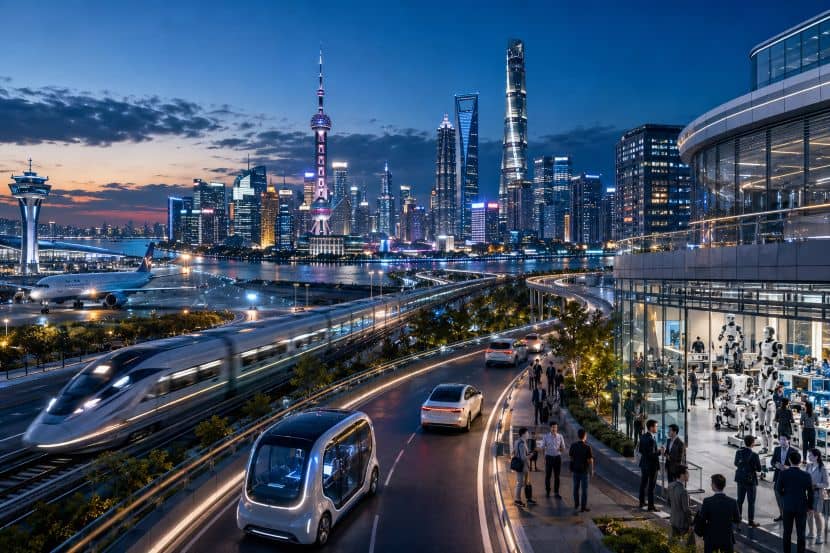
Image generated with Ai
India has rapidly emerged as one of the strongest source markets for China Tech Tourism, reflecting a wider transformation in global business travel. Instead of visiting destinations primarily for leisure or traditional corporate meetings, an increasing number of Indian entrepreneurs, startup founders, investors, engineers and technology professionals are travelling to Chinese innovation hubs to witness cutting-edge developments in electric vehicles, artificial intelligence, robotics and advanced manufacturing. Cities including Shanghai, Shenzhen and Hangzhou are positioning themselves as living laboratories where international visitors can observe future technologies in operation, interact with innovation ecosystems and gain valuable commercial insights. This growing travel trend is reshaping Asia’s business tourism landscape while creating new opportunities for cross-border knowledge exchange.
The movement also arrives as China continues expanding international tourism through easier visa policies, stronger aviation connectivity and wider promotion of its technology sector. Business-focused travel experiences are becoming an important addition to conventional tourism products, encouraging visitors to combine factory visits, technology exhibitions, startup ecosystems and urban sightseeing into one journey. For India’s expanding innovation economy, these visits offer direct exposure to emerging industries while strengthening commercial relationships between two of Asia’s largest economies. As technology increasingly influences global investment decisions, China is transforming itself from a manufacturing destination into a premium knowledge-travel destination attracting professionals from around the world.
Advertisement
For decades, technology professionals looked almost exclusively towards Silicon Valley when seeking inspiration for innovation, investment opportunities and entrepreneurial growth. Today, however, travel patterns are evolving. A growing number of international visitors are instead booking flights to China’s innovation corridors, where advanced manufacturing, artificial intelligence and electric mobility have become major attractions.
Unlike conventional corporate travel, China Tech Tourism combines education, networking and destination experiences within a single itinerary. Visitors spend several days exploring manufacturing facilities, innovation parks, research campuses, startup accelerators and technology demonstration centres while also experiencing local culture, cuisine and urban attractions.
Advertisement
Advertisement
This emerging travel segment reflects broader shifts occurring across the global tourism industry. According to the UN Tourism (formerly UNWTO), business travel continues recovering steadily following the pandemic, while experiential travel is becoming increasingly valuable for corporate visitors seeking specialised knowledge rather than standard conference attendance.
China has successfully positioned several cities as global technology destinations. Shanghai has strengthened its reputation in artificial intelligence and financial technology. Shenzhen continues leading electronics manufacturing and hardware innovation. Hangzhou has become internationally recognised for digital commerce, cloud computing and smart city development.
These destinations increasingly appeal not only to investors but also to university groups, innovation agencies, corporate executives, startup founders and government delegations.
India’s startup ecosystem has expanded significantly over the past decade. According to official figures from the Department for Promotion of Industry and Internal Trade (DPIIT), India has recognised more than 1.8 lakh startups, making it one of the world’s largest startup ecosystems. This rapid entrepreneurial growth has naturally increased demand for international learning experiences.
Advertisement
Advertisement
Rather than relying solely on market reports or online research, many Indian business leaders now prefer observing manufacturing ecosystems first-hand before making investment or expansion decisions.
Several factors are supporting this trend.
First, India and China remain two of Asia’s largest manufacturing and consumer markets despite ongoing geopolitical complexities.
Second, both countries are investing heavily in electric mobility, artificial intelligence, renewable energy and advanced production technologies.
Third, business travellers increasingly value experiential learning, where factory visits provide insights impossible to gain through virtual presentations.
For travel companies specializing in corporate experiences, this represents an entirely new product category combining education with destination marketing.Technology Travel Trend Growing Business Value AI innovation centres Investment research EV manufacturing facilities Supply chain understanding Robotics companies Technology benchmarking Startup incubators Partnership opportunities Smart city projects Urban innovation learning Research parks Academic collaboration
The appeal extends far beyond factories.
Visitors increasingly travel to observe autonomous vehicle demonstrations, robotics laboratories, drone applications, smart retail technologies and next-generation mobility solutions operating in real-world environments.
Shanghai has developed into one of China’s leading centres for artificial intelligence research, international finance and advanced manufacturing.
Meanwhile, Shenzhen continues attracting international attention through its concentration of electronics manufacturers, semiconductor companies, robotics firms and electric vehicle innovators.
Hangzhou has built a global reputation for digital commerce, cloud computing and financial technology, making it another essential stop for business travellers interested in future technologies.
This evolution reflects a broader trend within global tourism where destinations increasingly market innovation alongside traditional attractions.
Instead of museums alone, visitors now seek technology campuses.
Instead of sightseeing only, travellers want immersive industry experiences.
Instead of conference halls, professionals increasingly prefer direct exposure to operational manufacturing environments.
For destination marketing organisations, this diversification creates higher-value tourism capable of generating longer stays and greater visitor spending.
China’s technology sector continues expanding rapidly across multiple industries.
Government data show the country’s electric vehicle industry has become one of the world’s largest, while advanced manufacturing, robotics, renewable energy and digital infrastructure continue receiving substantial investment.
According to the National Bureau of Statistics of China, high-tech manufacturing has remained one of the country’s fastest-growing industrial segments, supported by sustained investment in research and development.
The rapid commercialisation of technologies including autonomous driving, industrial robotics and artificial intelligence has created numerous demonstration sites suitable for organised professional visits.
Unlike traditional industrial tours of previous decades, today’s visitors experience operational innovation ecosystems where research, manufacturing and commercial deployment occur simultaneously.Major Chinese Innovation Hub Key Industry Strength Tourism Appeal Shanghai Artificial Intelligence, Finance Innovation centres, technology exhibitions Shenzhen Electronics, Robotics Manufacturing ecosystem, smart mobility Hangzhou Digital Commerce, Cloud Technology Startup ecosystem, digital economy Beijing Research, AI Development Universities, innovation institutes
The emergence of China Tech Tourism also reflects changing economics within international travel.
Traditional leisure tourism generally focuses on accommodation, attractions and entertainment.
Technology-focused travel, however, generates additional value through curated business experiences, private industry visits, expert presentations and specialised networking opportunities.
This premium positioning allows travel companies to design higher-value itineraries targeting executives, investors, universities and corporate groups rather than mass-market leisure travellers.
Business travellers also tend to spend more than leisure visitors on accommodation, transport, dining and professional services.
For airlines, convention centres, hotels and destination management companies, technology tourism therefore represents a fast-growing niche with considerable long-term commercial potential.
Increasing international air connectivity between India and major Chinese cities could further strengthen this segment over the coming years, particularly if business visa procedures continue improving and corporate exchanges expand.
The evolution of China Tech Tourism extends well beyond guided manufacturing tours. Increasingly, travel itineraries combine technology experiences with business networking, academic exchanges and cultural exploration, creating a more comprehensive visitor experience. Delegates often spend mornings inside innovation parks or research centres before exploring heritage districts, waterfront developments, museums and local culinary destinations later in the day. This blended approach makes professional travel more attractive while encouraging longer stays and higher visitor spending.
Technology-focused itineraries also support China’s wider objective of strengthening inbound tourism. Recent improvements in visa facilitation, expanded international flight capacity and stronger destination marketing have made major Chinese cities more accessible to overseas visitors. While leisure tourism remains an important pillar, business-oriented travel is emerging as an additional growth driver capable of attracting high-value international visitors throughout the year.
International convention centres, innovation districts and technology expos are becoming important tourism assets. Visitors attending industrial exhibitions frequently extend their trips to explore nearby attractions, creating additional revenue for airlines, hotels, restaurants and local transport providers.
Corporate travel preferences have changed significantly over the past decade. Instead of attending only boardroom meetings or conferences, professionals increasingly seek immersive experiences that deliver practical knowledge and strategic insights.
This shift has encouraged travel organisers to design programmes centred on real-world innovation. Participants can observe advanced production systems, smart logistics, automated warehouses, electric mobility solutions and digital retail technologies operating in commercial environments rather than laboratory settings.
Such experiences appeal to a wide range of sectors, including manufacturing, logistics, renewable energy, higher education, healthcare technology and venture capital. Universities are also beginning to view innovation-focused travel as an extension of international education, allowing students and researchers to gain exposure to rapidly evolving industries.Business Travel Evolution Traditional Corporate Travel Modern Innovation Travel Primary Purpose Meetings Knowledge acquisition Duration 1–2 days 3–5 days Activities Conferences Factory visits, innovation parks, networking Visitor Profile Executives Entrepreneurs, investors, students, researchers Tourism Impact Limited sightseeing Extended city exploration
Despite periodic geopolitical challenges, economic engagement between India and China continues across several commercial sectors. Both countries are among Asia’s largest manufacturing economies and are investing heavily in digital transformation, clean energy, electric mobility and artificial intelligence.
India’s technology sector has experienced remarkable growth in recent years. Government initiatives promoting digital infrastructure, electronics manufacturing and startup development have encouraged greater international collaboration. At the same time, Chinese cities have continued investing in industrial automation, robotics and smart manufacturing.
For Indian entrepreneurs, visiting these ecosystems provides practical exposure to production efficiency, supply chain management and industrial automation. Such visits can influence investment decisions, technology partnerships and business expansion strategies, particularly for companies operating in manufacturing, logistics, software and advanced engineering.
This exchange of knowledge also benefits the broader travel industry. Business delegations often include professionals from multiple sectors, generating demand for premium accommodation, conference facilities, domestic transportation and destination management services.
The growth of China Tech Tourism has important implications for airlines and hospitality providers across Asia. As demand for specialised business travel increases, airlines can benefit from stronger passenger volumes on routes connecting major innovation hubs.
Shanghai, Shenzhen, Beijing and Hangzhou already serve as important international aviation gateways, supported by extensive domestic air networks and high-speed rail connectivity. Business travellers often combine multiple cities within a single itinerary, increasing domestic tourism expenditure in addition to international arrivals.
Hotels are also adapting to changing visitor expectations. Premium business hotels increasingly provide meeting facilities, co-working spaces, digital connectivity and concierge services tailored to corporate travellers. Luxury and upper-upscale properties benefit particularly from executive groups seeking convenience near financial districts or technology parks.Travel Sector Potential Benefit from China Tech Tourism Airlines Higher international business passenger demand Airports Increased premium traffic and transit passengers Hotels Longer average stays and higher daily spending Destination Management Companies Growth in curated corporate itineraries Convention Centres Additional conferences and networking events Local Tourism Greater spending on dining, attractions and transport
China has invested extensively in developing innovation clusters that integrate research institutions, universities, manufacturing companies and startup ecosystems. These districts not only stimulate domestic economic development but also create internationally marketable tourism products.
Several municipal governments actively promote innovation districts through investment forums, technology exhibitions and international cooperation programmes. As these initiatives expand, travel centred on industrial learning is expected to become an increasingly important component of business tourism across Asia.
Industry analysts also note that younger entrepreneurs place greater value on experiential learning than previous generations. Visiting innovation centres, observing manufacturing processes and understanding commercial ecosystems provide insights that cannot easily be replicated through online research alone.
As global competition intensifies across artificial intelligence, electric vehicles and advanced manufacturing, destinations capable of demonstrating technological leadership are likely to attract increasing numbers of professional visitors.
The rapid emergence of China Tech Tourism illustrates how business travel is evolving beyond meetings and conferences into immersive learning experiences. By combining advanced manufacturing, artificial intelligence, robotics, electric mobility and innovation ecosystems with world-class urban infrastructure, China is creating a distinctive tourism segment that appeals to entrepreneurs, investors, researchers and technology professionals.
For India’s expanding startup ecosystem, these journeys offer opportunities to understand industrial trends, evaluate emerging technologies and strengthen international business networks. For the wider travel industry, they represent a high-value market capable of supporting airlines, airports, hotels, convention centres and destination management companies through increased premium travel demand.
As international connectivity continues improving and global interest in next-generation technologies accelerates, China Tech Tourism is well positioned to become one of Asia’s fastest-growing business travel segments, reinforcing the region’s importance within the global innovation economy.
Advertisement
Tags: AI Industry China, China business travel, China tech tourism, electric vehicle tourism, innovation tourism
Advertisement
Advertisement













Friday, September 4, 2026

Friday, September 4, 2026

Friday, September 4, 2026

Friday, September 4, 2026

Thursday, September 3, 2026

Wednesday, September 2, 2026

Friday, September 4, 2026



