
Egypt’s QR Visa Eases Cairo Travel Yet Gilf Kebir Expeditions Still Require Advance Permits and Security Checks

Updated
Published
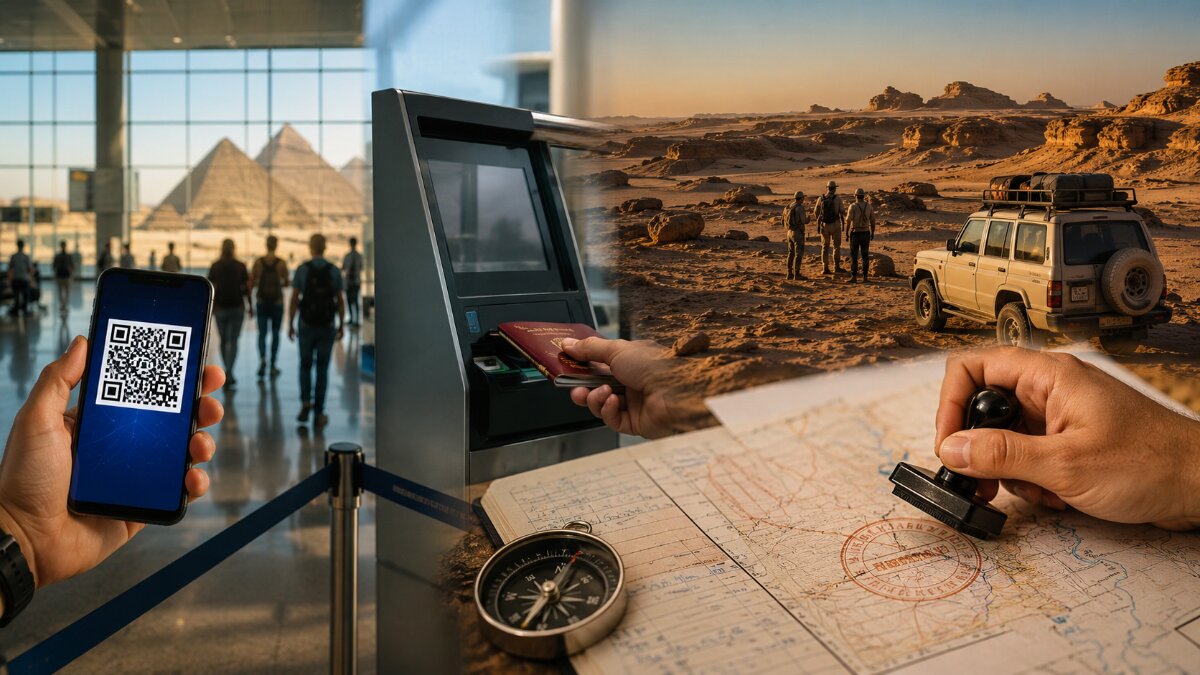
Image generated with Ai
Egypt’s new automated visa-on-arrival system is making international entry through Cairo faster and more digital, but travellers planning a Gilf Kebir expedition face a second and entirely separate clearance process. The Egyptian government allows the new QR-based arrival visa to be arranged electronically, including before arrival within 48 hours. However, official environmental rules require tourism companies arranging protected-area visits to submit itinerary, route, passport, driver and security documentation at least three working days before the reserve visit. For the travel trade, Egypt’s newest visa convenience therefore does not remove the advance-planning burden attached to its remotest desert.
Egypt’s New Visa Story Is Really About Two Different Permission Clocks
The most important development for travel companies is not simply that Egypt has introduced another digital entry tool. It is that the country’s immigration journey and its remote-expedition approval journey now move at different speeds.
According to the Egyptian Cabinet’s published details of the automated visa-on-arrival system, travellers can enter their information through self-service machines, an official web platform or a mobile application. Payment is electronic. The visa is generated as a QR code for verification by passport-control officials. The system also permits travellers to obtain the visa before arrival within 48 hours or through tourism companies.
The Ministry of Tourism and Antiquities confirmed on 27 August that trial operation had started at Cairo International Airport as the first phase from the beginning of August. The electronic QR visa replaces the conventional paper visa sticker under the new process.
Advertisement
Advertisement
That faster border process is significant. Yet it should not be interpreted as an end-to-end authorisation for highly controlled expeditions.
Gilf Kebir illustrates why.
Advertisement
Advertisement
Cairo’s QR Visa Removes One Friction Point, Not Every Travel Permission
Egypt’s May 2026 operating framework shows how far the arrival process has moved towards digital distribution.
The government designed the system around electronic data capture, electronic payment and QR verification. It also established more than one acquisition channel, which is particularly important for organised travel because tourism companies can participate in the visa process. The initial deployment is at Cairo International Airport, with the government previously identifying gradual expansion to other Egyptian airports as the broader objective.
Advertisement
Advertisement
The Ministry’s August campaign is targeting travellers in the United Kingdom, United States, France, Germany, Spain, Italy, Poland, the Czech Republic and Japan. That provides a clear indication that Egypt sees the new process as part of international visitor facilitation rather than merely an airport technology project.
There is also an important distinction between the existing Egyptian e-Visa and the new automated visa on arrival. Egypt’s official e-Visa portal continues to offer a separate pre-travel visa process for eligible nationalities. It lists a tourism visa at US$30 for single entry and US$65 for multiple entry and requires, among other items, a passport valid for at least six months, itinerary information and accommodation or destination details.
Travel companies should therefore avoid treating e-Visa, automated visa on arrival and specialist destination permissions as interchangeable products.
| Traveller authorisation layer | Official position as of 2 September 2026 | Practical implication |
|---|---|---|
| Egyptian e-Visa | Existing online visa for eligible nationalities; official portal lists US$30 single-entry and US$65 multiple-entry tourism visas | Pre-travel national immigration permission, subject to border control |
| Automated visa on arrival | Cairo trial operating from August; electronic application/payment and QR verification | Faster arrival processing at the border |
| Pre-arrival QR option | Cabinet documentation provides for obtaining the new arrival visa before entry within 48 hours | Gives travellers and tour operators another preparation channel |
| Protected-area visit process | Separate environmental rules apply to tourism companies visiting nature reserves | National immigration permission does not replace destination approval |
| Border-area security approval | Relevant security approvals are required for protected areas on Egyptian coasts and borders | Particularly important for remote south-western itineraries |
Gilf Kebir Introduces a Completely Different Administrative Threshold
Gilf Kebir is not simply another desert excursion from Cairo.
Advertisement
Advertisement
Egypt’s State Information Service identifies the Gilf El-Kebir Reserve as a natural and cultural national park in the south-western part of New Valley Governorate. It was declared a protected area under Prime Ministerial Decree No. 10 of 2007 and covers approximately 48,523 square kilometres.
Its geography immediately changes the compliance calculation.
The official reserve description places significant parts of its tourism landscape deep in Egypt’s south-west, including areas associated with Mount Uweinat, the Great Sand Sea, prehistoric rock-art sites and locations close to the Libyan frontier.
Egypt’s own safari guidance goes further. It describes the region as barren and says reaching it requires a group consisting of five equipped four-wheel-drive vehicles, sufficient provisions for the duration of the stay and satellite-linked GPS equipment.
That is why the visa change should not be reported as if it makes Gilf Kebir a frictionless extension of a conventional Egypt holiday.
The Three-Working-Day Rule Is the Hidden Planning Detail Travellers Need
The most consequential official document for travel agents is the Egyptian Environmental Affairs Agency’s requirements for obtaining tourism permits to visit protected areas.
Advertisement
Advertisement
For applications made by tourism companies, the agency requires a request showing the full travel programme, a map containing the route and coordinates, copies of foreign travellers’ passports, copies of drivers’ licences and relevant security approvals for reserves situated on Egyptian coasts and borders.
Crucially, the official document requires the request to be submitted three working days before the planned visit so that the necessary procedures can be completed.
The same rules require compliance with agreed travel routes and other permissions from competent authorities. They also require appropriate communications and first-aid equipment for applicable tourism activity.
This creates the core information gain in the story.
A traveller could potentially arrange the new digital arrival visa on a much shorter timetable than the planning period required for a specialist reserve itinerary. The faster immigration layer therefore does not make last-minute Gilf Kebir bookings operationally equivalent to last-minute Cairo city breaks.
Mut Marks the Point Where Easy Arrival and Extreme Expedition Travel Diverge
Mut, the capital of Dakhla Oasis, provides an important geographical reference for understanding that difference.
Advertisement
Advertisement
Egypt’s State Information Service identifies Mut as the capital of Dakhla, while official Egyptian tourism information places Dakhla and Kharga to the north and east of the broader Gilf Kebir landscape.
Current UK government travel advice also makes a striking distinction. The Foreign, Commonwealth & Development Office exempts the oasis towns of Dakhla (Mut) and Kharga, together with specified roads, from its broader advice against all but essential travel across much of Egypt’s Western Desert.
Gilf Kebir itself is not included among those stated Western Desert exceptions. The same official guidance says a Ministry of Interior permit is required when travelling into Egypt’s south-western corner near the Sudanese or Libyan borders.
For itinerary designers, this means arrival in Mut or passage through Dakhla cannot be treated as evidence that onward travel deep into the south-west carries the same regulatory or risk status.
Egypt Is Digitising Protected Areas Too, but Operators Must Not Assume Universal Coverage
There is another layer to the story.
Egypt is also developing digital administration for its protected areas. In March 2026, the Ministry responsible for the environment reviewed implementation of electronic ticket booking and activity permits for nature reserves, including electronic payment and visitor information. The government was still working on modifications to the broader booking system ahead of further implementation.
Advertisement
Advertisement
Electronic reserve permits and ticketing had already been introduced in phases through earlier environmental programmes. However, the Environmental Affairs Agency’s current permit page specifically states that the attached first-phase environmental permit forms concern protected areas in South Sinai and the Red Sea. The same page separately publishes procedures and conditions applying to tourism companies visiting reserves.
Nothing in the official material reviewed through 2 September establishes that the new Cairo QR visa automatically connects to, replaces or constitutes a Gilf Kebir expedition authorisation.
That distinction should appear prominently in consumer advice and tour-operator documentation.
Why This Matters for the International Travel Trade
The commercial consequence is a change in where booking friction sits.
Egypt is removing friction at the national border, but the most complex products still carry friction at the destination-access level. For mainstream tourists, faster visa processing may shorten the period between booking and departure. For expedition operators, that same behaviour could create a new expectation problem.
A traveller may see a digital visa obtainable close to departure and assume the whole trip can be confirmed on comparable notice. Gilf Kebir proves otherwise. The operator may still need passenger passport records, driver information, precise route coordinates, protected-area documentation and security approvals before the desert component can proceed.
Advertisement
Advertisement
This effectively separates Egypt products into two operational classes.
Conventional Cairo, Nile Valley or resort itineraries can increasingly benefit from digital entry infrastructure. Extreme Western Desert products remain dependent on advance compliance, specialist transport, security coordination, environmental protection requirements and contingency planning.
The strategic opportunity for tour operators is therefore not merely selling easier entry. It is packaging visa readiness and expedition readiness as separate milestones. Companies that communicate those milestones clearly can reduce last-minute cancellations, mis-selling risk and disputes over what possession of an Egyptian visa actually authorises.
Tourism Growth Makes the Distinction More Important
The visa upgrade is arriving while Egypt continues to pursue inbound tourism growth.
According to the Ministry of Tourism and Antiquities, international tourist arrivals grew by 4 per cent during the first half of 2026, while arrivals from the United States increased by 2 per cent.
The Egyptian Tourism Promotion Board also approved the basic framework of a 2026–27 tourism incentive programme in July, designed to support inbound growth and destination competitiveness. The framework was due to proceed through the Tourism and Antiquities Support Fund approval process.
Advertisement
Advertisement
Digital visas can support that expansion by reducing one of the visible barriers at arrival. Yet growth in adventure and specialist tourism increases the need for equally clear communication about what happens after immigration.
| Planning question | Cairo-focused traveller | Mut and Gilf Kebir expedition traveller |
|---|---|---|
| Is an Egypt entry visa required according to nationality? | Yes, where applicable | Yes, where applicable |
| Can the new QR arrival process assist? | Potentially, subject to eligibility and system rules | Potentially for entering Egypt, but not as expedition permission |
| Is a protected-area process relevant? | Normally not for an ordinary Cairo itinerary | Yes for protected-area expedition activity |
| Does the operator need a route map and coordinates? | Not for ordinary city travel under the cited reserve rules | Required in the official tourism-company reserve permit documentation |
| Are passport copies part of the reserve application? | Not applicable to ordinary Cairo tourism under this process | Yes |
| Can additional security approvals apply? | Not ordinarily for standard Cairo sightseeing | Yes for relevant border-area reserve travel |
| Is specialist desert equipment required? | No | Official guidance describes five equipped 4WD vehicles, supplies and satellite-linked GPS |
Operational Takeaways for Travel Agents and Tour Operators
- Separate immigration clearance from destination clearance. Never market possession of an Egyptian visa as confirmation that a client may enter Gilf Kebir.
- Build the expedition permit deadline ahead of the visa deadline. The EEAA documentation requires tourism-company reserve applications at least three working days before the visit.
- Collect operational data early. Full itinerary, route map, coordinates, passport copies and driver-licence information can form part of the reserve approval process.
- Verify border-security requirements before confirmation. Gilf Kebir’s south-western geography makes security clearance materially different from ordinary urban tourism.
- Distinguish Mut from onward desert access. Dakhla (Mut) has a different official travel-advice status from the deeper Western Desert.
- Do not promise universal digital processing. Egypt is expanding electronic reserve administration, but official material reviewed does not establish that Cairo’s QR visa creates an integrated digital clearance pathway for Gilf Kebir.
- Protect booking terms. Expedition products should make permits, security clearances, route approval and prevailing government travel advice explicit conditions of operation.
- Recheck regulations immediately before travel. Visa deployment, protected-area systems and security restrictions can change independently.
Egypt’s Visa Modernisation Could Make the Remaining Friction More Visible
Egypt’s automated visa-on-arrival programme is a meaningful improvement in travel infrastructure. It digitises payment, replaces the paper arrival sticker with QR verification and gives travellers and tourism companies additional ways to prepare for entry.
Its significance for Gilf Kebir, however, lies partly in what it does not change.
The international border can become faster while the desert remains tightly controlled. Cairo can operate on a QR code while expedition planners must still think in terms of working-day deadlines, mapped coordinates, protected-area rules, border clearances, multiple vehicles and satellite navigation.
For global adventure-tourism operators, that is the real 2026 visa story: Egypt is shortening the administrative journey into the country without necessarily shortening the regulatory journey into its most remote places.
That distinction is likely to become increasingly important as governments worldwide digitise immigration faster than they digitise permits governing national parks, border regions, archaeological zones and environmentally sensitive destinations.
Advertisement
