
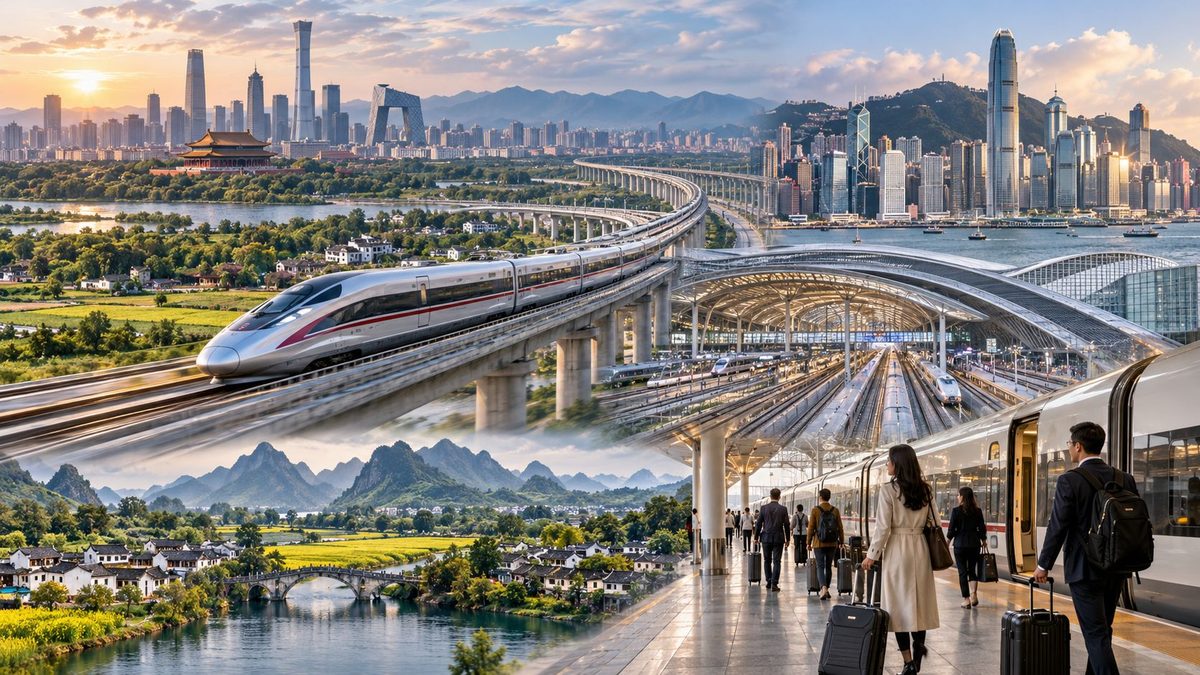
Image generated with Ai
China is almost finished building the last part of its 2,370 km rail line, linking its capital region with Hong Kong. According to the most recent data, the section of the line between Beijing and Xiongan will begin operations this month. It is expected that by 2027 the network will be fully integrated and there will be a large number of direct and express services. With the rail services connecting Hong Kong to the mainland, it will become easier for travelers to access the mainland China from the south, thus making Hong Kong a gateway to all other mainland trips. Currently, additional rail services connecting Hong Kong to Hebei, Shandong, Anhui and Jiangxi will have a positive impact and transform those regions from being provincial to international tourism regions. In addition, travel demand will help develop mainland China’s railway services to accommodate all forms of travel including leisure and business.
The new section connects Beijing with Xiongan New Area in Hebei province. From there, the wider corridor continues towards central China before linking with the existing route towards Hong Kong.
The development completes an important piece of a railway architecture built progressively over several years. Rather than representing an entirely new railway, it brings previously separate sections closer to functioning as one north-south travel corridor.
The significance extends well beyond journey times. A more coherent route gives travellers and travel companies greater scope to combine destinations that have traditionally required separate transport planning.
Advertisement
Advertisement
China Railway expects the wider network to become fully interconnected in 2027. At that stage, the number of direct and express services between Hong Kong, Beijing and central mainland destinations could increase considerably.
That prospect matters because Hong Kong already has an established high-speed rail gateway. The Hong Kong Section of the Guangzhou-Shenzhen-Hong Kong Express Rail Link entered service on 23 September 2018 and connected the city directly with the national railway system.
West Kowloon Station has evolved considerably since the 2018 opening. The station initially provided direct services to 44 mainland destinations, but that network has since expanded to 110 destinations.
Hong Kong’s Transport and Logistics Bureau said in May 2026 that the number of directly accessible mainland destinations had nearly doubled from 58 before the pandemic. The increase includes both short-haul and long-haul destinations across an increasingly broad geographical area.
Advertisement
Advertisement
The network now includes major destinations such as Beijing, Shanghai, Chengdu, Xi’an and Zhangjiajie. Recent additions have also strengthened access to cities and tourism regions away from the traditional Guangdong travel market.
That expansion has changed the proposition for travellers. Hong Kong’s high-speed rail system is no longer simply a convenient option for trips into Shenzhen or Guangzhou.
Instead, it increasingly functions as a national mainland travel gateway. The latest corridor development could deepen that role by improving the north-south structure behind the network.
The infrastructure expansion comes as China’s railway system continues to carry enormous passenger volumes. Official Chinese statistics show that the country’s railways handled 46.0 billion passenger trips in 2025, representing a 6.7 per cent annual increase.
Rail passenger turnover reached 16,395.6 billion passenger-kilometres during the same year. By comparison, civil aviation handled 7.7 billion passenger trips, although aviation recorded stronger growth in passenger turnover.
The figures demonstrate the scale of China’s rail travel market. They also show why new high-speed connections can have consequences for tourism, hospitality and destination development.Indicator Latest official figure Travel significance China railway passenger trips, 2025 46.0 billion Shows enormous domestic rail demand Annual railway passenger growth 6.7% Indicates continued expansion Railway passenger turnover, 2025 16,395.6 billion passenger-km Reflects extensive long-distance travel Hong Kong direct mainland destinations 110 Wider choice for cross-border travellers Daily XRL services At least 212 Greater timetable flexibility Average daily XRL patronage More than 90,000 Indicates strong demand XRL patronage in 2025 More than 30 million trips Demonstrates sustained usage XRL cumulative patronage More than 100 million trips Shows long-term network adoption
Hong Kong’s own figures reinforce that picture. The Transport and Logistics Bureau reported average daily high-speed rail patronage above 90,000 passenger trips in 2026.
The Hong Kong section also recorded more than 30 million passenger trips during 2025, while cumulative patronage surpassed 100 million trips. These figures provide a strong demand base for further expansion.
Beijing already ranks among China’s most important tourism and business destinations. The capital combines international air connectivity with an extensive domestic transport network, making it a natural northern anchor for the new corridor.
The railway adds another dimension to that role. Travellers arriving in Hong Kong could potentially use rail to reach Beijing without taking a separate domestic flight.
For tourism operators, that creates opportunities for Hong Kong-Beijing multi-city itineraries. Such programmes could appeal to international visitors who want to combine China’s southern commercial centre with its political and cultural capital.
The route also creates opportunities in the opposite direction. Travellers beginning in Beijing could reach Hong Kong by rail while adding destinations across central and southern China.
That two-way flow matters commercially. Hotels, attractions, restaurants and tour operators can benefit when travellers stay longer and visit several destinations during one journey.
Xiongan New Area adds a distinctive element to the corridor. The planned urban development in Hebei has been positioned as a major centre for innovation, modern services and advanced industries.
Its transport connectivity forms part of that broader development strategy. Better rail access can make an emerging urban destination more practical for business travellers, investors and visitors.
The tourism impact may take longer to materialise. Infrastructure can open access quickly, but destination awareness, accommodation supply and visitor experiences generally develop more gradually.
Nevertheless, the railway creates an important foundation. Xiongan could become an increasingly viable stop for travellers exploring northern China.
For business-event organisers, the connection could also support new itineraries. Meetings in Beijing could potentially be combined with visits to Xiongan without relying entirely on road transport.
The most interesting tourism opportunity may lie beyond Beijing and Xiongan. The wider corridor is expected to improve access towards provinces including Hebei, Shandong, Anhui and Jiangxi.
These provinces offer a different tourism proposition from China’s largest metropolitan centres. Their attractions include historic cities, cultural heritage, scenic landscapes and regional food traditions.
Better rail connectivity can therefore support destination diversification. Visitors who might previously have concentrated their trips around Beijing, Shanghai, Guangzhou or Shenzhen could consider broader itineraries.Region Travel proposition Potential impact Beijing Culture, heritage and business Stronger northern gateway Xiongan Emerging urban and business destination New stopover opportunities Hebei Heritage and regional attractions Easier access from Beijing Shandong Heritage, cities and coastal tourism Greater multi-city potential Anhui Mountains, heritage and cultural tourism Improved inland accessibility Jiangxi Nature, history and cultural attractions Wider international reach Greater Bay Area Business, leisure and events Strong southern tourism hub Hong Kong International gateway and city tourism Stronger mainland rail role
The commercial benefit could be particularly valuable for secondary destinations. Improved accessibility can reduce the transport penalty that often prevents lesser-known locations from competing for international visitors.
However, railway access alone will not guarantee tourism growth. Destinations still need quality hotels, attractions, multilingual services, digital booking infrastructure and efficient last-mile transport.
The new corridor should not be viewed simply as a threat to aviation. Instead, it creates another transport option within China’s increasingly integrated travel market.
Rail has a clear advantage when stations are centrally located and journey times remain competitive with the complete airport experience. Travellers also avoid airport transfers and can remain in a single ground-based journey.
Aviation, however, retains significant advantages on longer routes. International visitors may also prefer flights when connecting directly with China’s extensive global air network.
That means the strongest tourism model could involve both modes. A traveller could fly into Hong Kong, explore the Greater Bay Area by rail, continue towards Beijing and eventually fly home.
Travel companies can build products around that flexibility. Rail therefore becomes a tool for itinerary expansion rather than simply an alternative to flying.
West Kowloon Station’s importance is rising alongside its expanding network. The station now connects Hong Kong directly with 110 mainland destinations and supports at least 212 daily train trips.
Hong Kong officials have said the government will continue working with mainland authorities to add destinations and improve direct services. The stated objective includes providing travellers with better access to tourism destinations and major economic hubs.
The development is already visible in the route map. Direct long-haul services have expanded towards Chengdu, Zhangjiajie and Xi’an, while the network has also added access to destinations around Shanghai and Hefei.
This matters for international tourism because route breadth affects destination choice. The more cities travellers can reach directly, the easier it becomes to sell Hong Kong as part of a wider mainland holiday.
The station is consequently becoming more than a transport interchange. It is evolving into an important distribution point for regional tourism demand.
Greater rail connectivity can influence how travellers structure holidays. When transport between cities becomes simpler, visitors are more likely to consider adding another destination.
That can increase average trip length and distribute spending across several locations. Hotels, restaurants, attractions and local transport providers can all benefit from this broader movement.
For Hong Kong, the opportunity is particularly significant. Visitors who previously spent several days in the city could add a mainland rail journey before or after their Hong Kong stay.
For mainland destinations, Hong Kong provides an international tourism gateway. Visitors already travelling through the city could therefore become potential customers for inland tourism products.
The effect can work both ways. Mainland visitors arriving in Hong Kong can similarly extend their journeys into international-facing leisure and shopping markets.
The evolution since 2018 provides useful context. The Hong Kong section began with direct access to 44 mainland destinations, while the current network has expanded to 110.
The national high-speed railway system has also grown dramatically. Hong Kong government information now describes the mainland network as exceeding 50,000km, placing it among the world’s largest high-speed rail systems.Development 2018 2026 Direct mainland destinations from West Kowloon 44 110 Hong Kong XRL status Newly opened Established network National high-speed network Expanding rapidly More than 50,000km Annual Hong Kong XRL patronage Early operation More than 30m in 2025 Cumulative XRL patronage New service More than 100m Average daily patronage Early-stage demand More than 90,000
The comparison illustrates a broader transformation. Hong Kong’s rail relationship with mainland China has moved from a regional connection towards a much wider national network.
The next stage is therefore less about introducing high-speed rail to Hong Kong. It is about deepening the city’s integration with an enormous existing system.
Travellers should distinguish between the opening of individual infrastructure sections and the eventual service pattern. The wider Beijing-Hong Kong corridor is expected to become fully interconnected in 2027, but train schedules can change as operations develop.
Passengers should therefore check current timetables before building tightly connected itineraries. They should also allow sufficient time for immigration and other cross-boundary procedures at West Kowloon Station.
The Hong Kong railway system operates under specific cross-boundary arrangements. A rail ticket does not itself determine whether a traveller meets mainland entry requirements.
International visitors should therefore verify passport, visa or other applicable entry conditions before departure. They should also check whether their planned route requires changes rather than assuming that every section will operate as one direct service.
Weather and operational disruption can also affect high-speed rail. Hong Kong’s Transport Department has previously issued notices concerning mainland railway cancellations during adverse weather, demonstrating why travellers should check live service information before departure.
The infrastructure creates a planning opportunity for travel companies. Operators do not need to wait until 2027 to study the commercial implications of the expanding network.
Hotels can examine demand from rail-connected markets. Destination-management companies can map potential multi-city products, while corporate travel agencies can assess rail options for meetings and business travel.
Airlines can also view the development strategically. Combined air-and-rail itineraries could allow carriers to use Hong Kong or Beijing as gateways while rail distributes visitors across mainland destinations.
This is particularly relevant to business tourism. Hong Kong, Beijing and the Greater Bay Area each possess substantial commercial ecosystems, and improved connectivity can make multi-city business programmes easier to organise.
The broader opportunity lies in selling connectivity as an experience, rather than treating transport as a standalone product.
The new section of railway connecting Beijing and Xiongan closes a major gap in an extensive corridor that connects mainland China, the capital, and the Hong Kong Special Administrative Region. For travelers, increased railway options mean more convenience. For tourism businesses, the opportunity becomes designing travel itineraries that combine known travel gateways with lesser-known destinations.
Hong Kong’s fast growing direct railway network serves as evidence of the demand for increased travel connecting mainland China and Hong Kong. The expected large volumes of travelers using China’s new high speed rail network are evidence of growing demand for increased travel opportunities.
The expected completion of the rail network in 2027 will connect the various railways. Once this happens, the rail network will allow increased travel to and from China’s central provinces and easier accessibility to mainland China. In addition, increased rail travel will make Hong Kong a more important travel gateway to China’s growing tourism travel.
Advertisement
Advertisement
Advertisement













Saturday, September 5, 2026

Friday, September 4, 2026

Saturday, September 5, 2026

Saturday, September 5, 2026

Saturday, September 5, 2026

Thursday, September 3, 2026

Saturday, September 5, 2026

Saturday, September 5, 2026


