
Saudi Arabia and Oman Join Darkest Countries in 2026 as Remote Skies Beckon Global Stargazers

Published
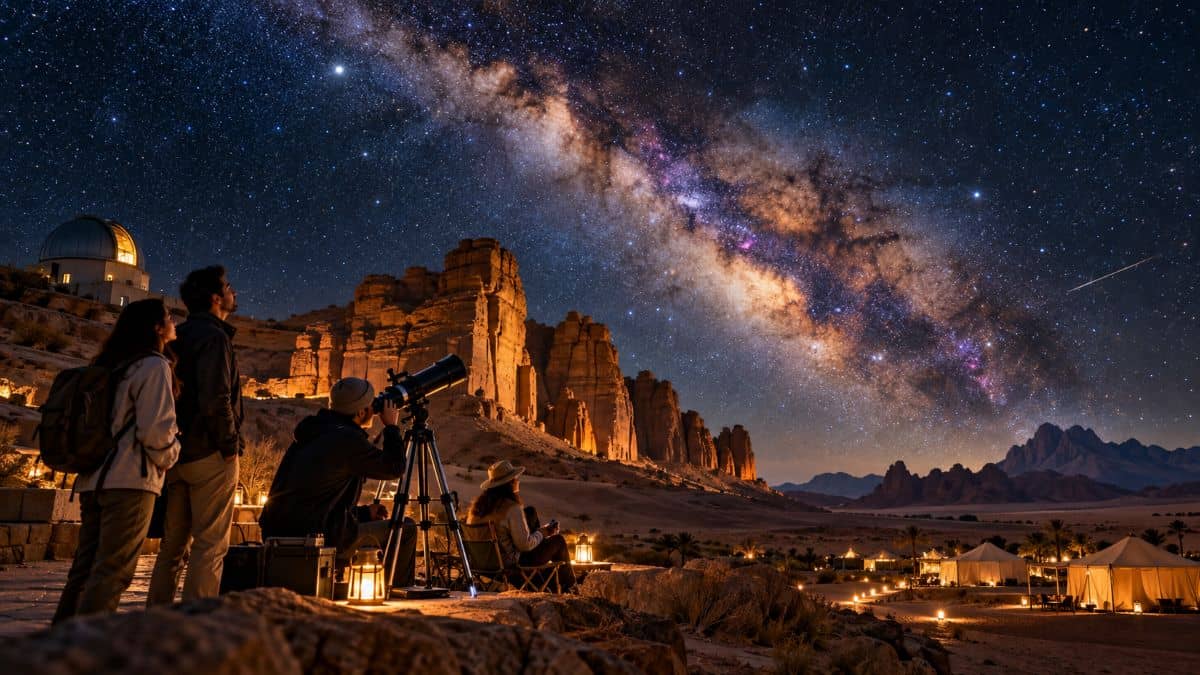
A widely circulated 2026 darkest countries list has triggered fresh interest in Milky Way travel, but its underlying data require careful interpretation. World Population Review lists Vatican City, Qatar, Saudi Arabia, Libya and Oman using radiance per 1,000 people, yet higher radiance means more artificial light, not darker skies. Its underlying table shows Chad at 0.006 average radiance, compared with Vatican City at 68.480, creating a striking reversal between the headline ranking and the actual light-pollution measure.
For travellers, the distinction matters. A countrywide light-pollution statistic does not automatically identify a good stargazing destination. Remote deserts, protected reserves, controlled lighting and public access matter far more when planning a night-sky experience. Recent developments in Saudi Arabia, Australia and other destinations show how dark skies are becoming a defined tourism asset.
The Ranking Needs A Closer Reading
The 2026 World Population Review page describes its measure as radiance, using data derived with the NASA VIIRS satellite instrument. Radiance measures ambient nighttime light, so lower values generally indicate darker conditions.
That creates an important distinction in the current list. Vatican City records an average 2023 radiance of 68.480, while Qatar records 19.894. Saudi Arabia follows at 1.024, Libya at 0.152 and Oman at 0.184. These figures do not indicate that Vatican City has darker skies than Oman.
Advertisement
Advertisement
The apparent contradiction comes from the radiance-per-1,000-population column. Vatican City reaches 527.9 on that measure, while Qatar records 429.4 and Saudi Arabia 267.1. The page nevertheless also states that lower radiance indicates darker skies.
For travel publishers and consumers, this distinction is crucial. A statistic designed around population normalisation should not be interpreted as a direct ranking of where the Milky Way will appear most clearly.
Advertisement
Advertisement
| Country | Average Radiance 2023 | Radiance Per 1,000 Population | Travel Interpretation |
|---|---|---|---|
| Vatican City | 68.480 | 527.9 | Highly illuminated urban environment |
| Qatar | 19.894 | 429.4 | Bright overall, but desert areas offer darker horizons |
| Saudi Arabia | 1.024 | 267.1 | Remote desert regions can support strong stargazing |
| Libya | 0.152 | 229.8 | Large dark landscapes, but travel conditions require careful assessment |
| Oman | 0.184 | 226.6 | Remote desert and mountain areas offer practical stargazing opportunities |
| Chad | 0.006 | 2.2 | Extremely low measured radiance, but tourism access and safety are separate considerations |
| Namibia | 0.019 | 29.8 | Exceptionally low radiance and established astronomy tourism potential |
| Australia | 0.046 | 64.2 | Vast remote areas plus certified dark-sky destinations |
The figures above show why average radiance deserves attention alongside the per-capita measure. Chad, for example, records 0.006 average radiance, while Namibia records 0.019. Australia records 0.046.
Why Dark Skies Matter For Tourism
The appeal of the night sky is moving beyond specialist astronomy. Travellers increasingly seek experiences that combine nature, photography, science, wellness and solitude.
Advertisement
Advertisement
DarkSky International describes astrotourism as travel centred on celestial experiences. Its wider dark-sky tourism concept includes destinations where visitors can experience naturally dark nights.
The tourism opportunity is also linked to conservation. DarkSky International says certified places can support nature connections while creating economic activity around protected nighttime environments. Its programme now covers hundreds of recognised locations worldwide.
That makes dark skies particularly valuable for rural and remote destinations. They can extend visitor activity beyond daylight hours without requiring major urban attractions.
For tourism boards, this creates another product layer. A desert destination can sell sunset excursions, astronomy sessions, overnight camping, photography and cultural storytelling within one itinerary.
Advertisement
Advertisement
Saudi Arabia Builds A New Night Economy
Saudi Arabia offers one of the clearest examples of how dark skies can become a tourism development tool.
AlUla has expanded its internationally recognised dark-sky territory considerably. In December 2025, Sharaan National Park and Wadi Nakhlah Nature Reserve received Dark Sky Park designation. The additions expanded AlUla’s protected night-sky territory to 6,146 square kilometres.
The development builds on the earlier designation of AlUla Manara and Gharameel Nature Reserve. Together, the four areas create a substantial protected landscape designed around conservation, science and tourism.
AlUla is therefore a more useful case study than simply placing Saudi Arabia on a numerical country list. The destination has invested in a framework where the night sky itself becomes part of the visitor proposition.
The official destination organisation describes Gharameel as a location where visitors can experience the Milky Way alongside distinctive desert rock formations. Guided experiences also combine astronomy with storytelling and outdoor dining.
AlUla is also developing AlUla Manara, a future astronomy and space-science facility intended to combine research, education and visitor experiences.
Advertisement
Advertisement
Oman Turns Desert Nights Into Experiences
Oman presents a different model. Its appeal comes from the combination of desert, mountains and coastline rather than one large dedicated dark-sky complex.
Official tourism information highlights remote locations such as Ras Al Hadd for stargazing away from city lights. The destination can also combine astronomy with marine experiences, wildlife and coastal accommodation.
The country’s desert tourism offering increasingly incorporates organised stargazing. Official Visit Oman listings include astronomy experiences around the sands of Al Sharqiyah.
This matters commercially because travellers rarely build an international trip around darkness alone. They usually want a broader itinerary that justifies the journey.
Oman’s model therefore connects night-sky tourism with road trips, desert camping, wildlife and coastal travel. That approach can distribute visitor spending across accommodation, guides, transport and outdoor activities.
Australia Expands Its Astrotourism Proposition
Australia demonstrates how dark-sky tourism can develop through protected areas and regional infrastructure.
Advertisement
Advertisement
Warrumbungle National Park in New South Wales celebrated its tenth anniversary as Australia’s first International Dark Sky Park in 2026. The government describes the area as one of Australia’s premier astrotourism destinations, with views of the Milky Way, planets and constellations.
The region also operates ranger-led Explore the Dark Sky experiences. The 2026 programme includes guided sessions using telescopes and binoculars, alongside explanations of constellations and night-sky mapping.
Australia’s development goes beyond one park. Winton became Queensland’s first International Dark-Sky Community in March 2026. The initiative includes responsible lighting guidelines, lighting audits and community education.
Karlu Karlu in Australia’s Northern Territory also gained Dark Sky Sanctuary status in 2026. The 1,800-hectare reserve combines night-sky tourism with significant Indigenous cultural heritage.
| Destination | Dark-Sky Development | Traveller Proposition |
|---|---|---|
| AlUla, Saudi Arabia | 6,146 sq km protected night-sky territory | Desert astronomy, culture and photography |
| Warrumbungle, Australia | International Dark Sky Park | Guided astronomy and Milky Way viewing |
| Winton, Australia | International Dark-Sky Community | Outback tourism and responsible lighting |
| Karlu Karlu, Australia | Dark Sky Sanctuary | Stargazing and Indigenous cultural landscape |
| Oman | Remote desert stargazing experiences | Desert, coast and astronomy |
| Niue | Entire country recognised as a Dark Sky Place | Island tourism and exceptional night skies |
Travellers Need More Than A Country Ranking
A country can have extremely low average radiance while offering limited practical access for international visitors. Conversely, a country with substantial urban illumination can contain outstanding dark-sky reserves.
That distinction makes destination-level certification particularly valuable. DarkSky International says certified International Dark Sky Places maintain public nighttime access and meet standards designed around preserving quality night skies.
Advertisement
Advertisement
Travellers should therefore assess several factors before booking a stargazing trip. These include cloud cover, moon phase, seasonal visibility, local lighting, altitude, accessibility and the operating schedule of guided experiences.
Moonlight can also change the experience significantly. NSW National Parks specifically advises visitors seeking dark skies to check the lunar phase and moonrise when planning Warrumbungle visits.
For astrophotographers, equipment adds another layer. A tripod, wide-angle lens and manual camera controls can substantially improve results. However, travellers should also respect protected landscapes and local photography restrictions.
Dark Tourism Needs Responsible Lighting
The commercialisation of darkness creates an obvious paradox. Tourism development can threaten the very darkness that attracts visitors.
Australia’s Western Australian government has already recognised this issue through its Dark Sky and Astrotourism Position Statement. The policy encourages planning decisions that consider artificial lighting, its direction, timing and impact on the night sky.
The principle has broader relevance. Hotels, camps, visitor centres and roads can all introduce unnecessary light pollution. Poorly designed outdoor lighting can weaken the visitor experience while affecting wildlife and ecosystems.
Advertisement
Advertisement
DarkSky International therefore promotes responsible astrotourism principles and lighting practices. The organisation also operates a DarkSky Approved Lodging programme for properties demonstrating responsible nighttime stewardship.
For tourism businesses, this creates a strategic opportunity. Darkness can become a protected tourism resource rather than an empty space between daytime activities.
What The 2026 Data Really Tell Travellers
The latest figures are valuable, but they require context. The World Population Review dataset shows enormous differences in measured nighttime radiance between countries. Yet the figures should not be mistaken for a straightforward list of the world’s best stargazing destinations.
The data show Chad at 0.006 average radiance, Eritrea at 0.005 and the Central African Republic at 0.001. Niue is separately identified as having exceptionally low radiance and became the first entire country recognised as an International Dark Sky Place in 2020.
However, low light pollution does not equal easy tourism access. Travellers must consider safety, infrastructure, accommodation, transport and official travel advice before choosing remote destinations.
For accessible astrotourism, certified sites can offer a stronger practical proposition. AlUla, Oman and Australia’s established dark-sky destinations demonstrate how night-sky experiences can integrate with broader tourism itineraries.
Advertisement
Advertisement
The Night Sky Is Becoming A Product
The renewed attention around the 2026 list reflects a wider shift in travel. Tourists are increasingly searching for experiences that cannot be replicated inside major cities.
The Milky Way is one such experience. It requires geography, atmospheric conditions and darkness rather than expensive infrastructure. That scarcity gives remote destinations a powerful tourism asset.
The strongest destinations are now moving beyond simple stargazing. They are combining astronomy with conservation, Indigenous culture, desert hospitality, scientific education and photography. Australia’s regional programmes and Saudi Arabia’s AlUla expansion demonstrate how governments can turn darkness into a structured visitor economy.
For travellers, the message is equally important. The darkest countries in 2026 should not be selected from a ranking alone. Instead, visitors should look for genuinely dark locations, recognised conservation frameworks, favourable weather and safe nighttime access.
The future of astrotourism may therefore depend less on finding the darkest country. It may depend on finding destinations that can protect darkness while making it accessible.
Advertisement
