
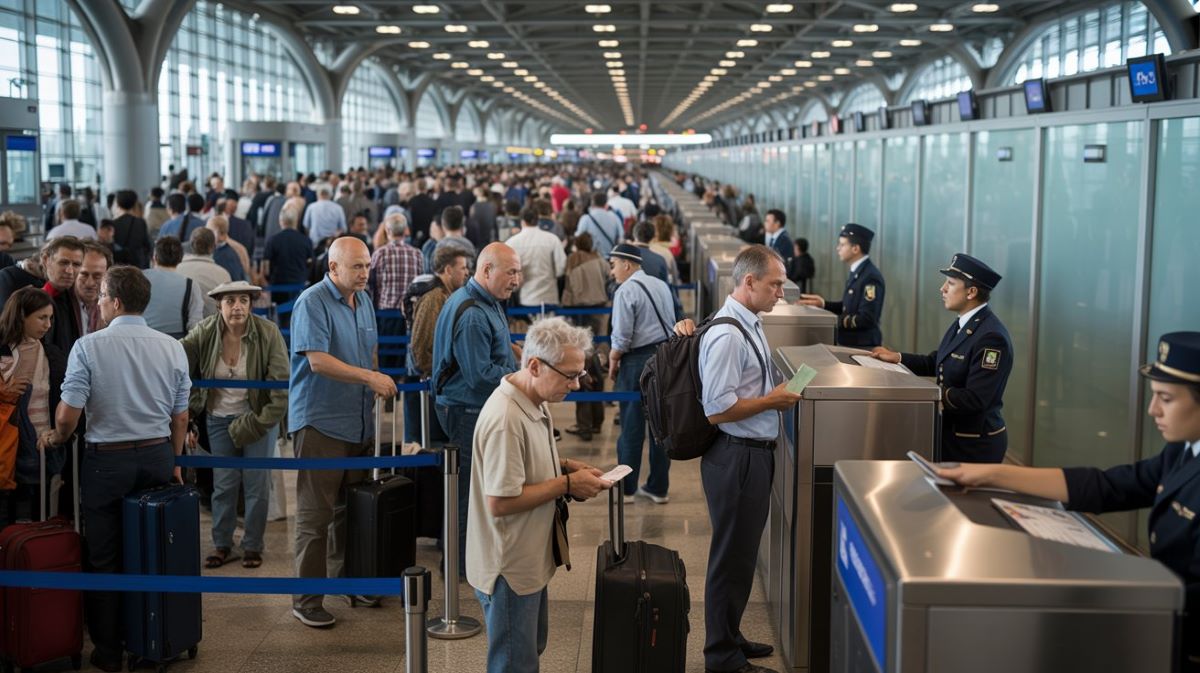
Image generated with Ai
These Popular European Destinations could see slower Tourist Arrivals as New Border Rules Take Effect, creating fresh considerations for international travellers planning Europe holidays. As the EU Entry/Exit System changes border processing, popular European Destinations may experience longer queues during busy travel periods. These New Border Rules introduce biometric registration for eligible non-EU visitors entering the Schengen Area. Therefore, Tourist Arrivals could face slower processing at some busy gateways, particularly when passenger volumes surge. For British travellers and other global tourists, understanding these Border Rules is increasingly important. Travel And Tour World urges readers to read the entire story for essential guidance before planning European journeys.
British tourists heading to Europe should prepare for a different border experience under the European Union’s Entry/Exit System (EES). The system applies to most non-EU nationals making short visits to the Schengen Area. It replaces traditional passport stamping with digital records and biometric checks. The EES became fully operational at participating external borders on 10 April 2026. Therefore, travellers should not treat 7 September as a new launch date. Instead, September holidaymakers should already expect the system when entering or leaving participating European destinations.
Advertisement
British visitors generally do not need to complete an application before travelling for EES. Registration takes place at the external Schengen border. Travellers may have their passport scanned, photograph recorded and fingerprints collected. The system records entry and exit information digitally.
The European system covers 29 Schengen countries for eligible short-stay visitors. Ireland and Cyprus are outside the Schengen Area. Iceland, Norway, Switzerland and Liechtenstein are among the non-EU Schengen countries participating in the wider border framework.
Advertisement
The main travel concern is additional processing time. UK government guidance says individual EES checks could take around one to two minutes, although queues can become longer when many passengers arrive simultaneously.
This matters particularly for travellers using Dover, Folkestone or London St Pancras. French border controls operate at these UK locations before passengers enter the Schengen Area. Consequently, EES procedures can happen before departure rather than after arrival in continental Europe.
Children are also included in the digital registration process. Children aged 11 or younger are not required to provide fingerprints, although their photograph can still be recorded. Babies can also receive digital records and may need photographs.
Travellers should therefore avoid tight connections immediately after border control. Families and large groups may particularly benefit from allowing additional time.
Advertisement
Advertisement
EES does not introduce a new 90-day allowance. British visitors can generally travel visa-free within the Schengen Area for up to 90 days during any 180-day period, subject to the applicable conditions.
The digital system helps authorities monitor those movements electronically instead of relying on passport stamps. Travellers visiting several Schengen countries should count their combined stay rather than treating every country separately.
Not every UK national is subject to EES registration. Certain British citizens holding qualifying residence documentation under the Withdrawal Agreement are exempt. UK-EU dual nationals travelling with their EU passport are also outside the EES process. Long-term residents with relevant documentation can likewise be exempt. Travellers should carry proof of their status when appropriate.
The safest approach is straightforward. Check passport validity, confirm the destination’s entry requirements and review the latest official travel advice before leaving. Travellers should also allow additional time at airports, ports and international railway stations.
For September holidays, the key message is preparation rather than panic. EES is already operational, and British tourists should expect digital registration and biometric checks when applicable. Understanding the process before reaching the border can make European journeys smoother and reduce avoidable delays.
The European Union’s Entry/Exit System (EES) is now fully operational at the external borders of participating countries. It electronically records eligible non-EU short-stay visitors, including passport details, entry and exit information, facial images and fingerprints. The system covers the Schengen Area’s 29 countries.
For British holidaymakers, the issue is not a new September launch. Instead, the operational system can add another stage to busy border processing. That matters most in destinations with very large international visitor volumes.
Important data limitation: official tourism agencies publish different measures, including border arrivals, tourist trips, accommodation guests and overnight stays. They are not interchangeable. A defensible article should therefore not invent monthly British-visitor figures where the national statistics agency does not publish them in the accessible release. The figures below use official measures and clearly identify what they represent.
| Destination | Latest official tourism indicator | Why EES processing matters | Main British-traveller relevance |
|---|---|---|---|
| Spain | 96.8m international tourists in 2025 | Huge international arrival volumes create busy border periods | UK is one of Spain’s largest source markets |
| France | 102m international arrivals in 2024 | High visitor concentration at airports, rail and ports | Major UK-France travel corridor |
| Greece | 37.98m inbound travellers in 2025 | Strong summer concentration can amplify queues | Large British leisure market |
| Portugal | 19.7m foreign accommodation guests in 2025 | Major international tourism footprint | UK is a key source market |
| Italy | 458.4m accommodation nights in 2024 | Large accommodation and international tourism demand | Major British holiday destination |
Spain is the clearest example of a destination where additional border processing could become noticeable during peak travel periods. The Spanish National Statistics Institute, INE, recorded 96.8 million international tourists in 2025, a new historical record and 3.2% above 2024.
The scale has continued into 2026. Spain received 11.5 million international tourists in July 2026, 4.9% more than July 2025. International arrivals during January-July 2026 were 4.6% higher than the corresponding 2025 period.
British demand is particularly important. In August 2025, UK residents generated 19.2% of Spain’s international tourist expenditure, ahead of France at 13.4% and Germany at 11.1%. International visitors spent €16.39 billion in Spain that month.Spain indicator Official figure International tourists, 2025 96.8m Growth versus 2024 3.2% International tourists, July 2026 11.5m July 2026 annual growth 4.9% UK share of international expenditure, Aug. 2025 19.2% International expenditure, Aug. 2025 €16.39bn
For British tourists, popular gateways such as Barcelona, Madrid, Málaga, Alicante and the Balearic Islands can therefore be particularly sensitive to peak-period processing. This does not mean EES will reduce visitor numbers. Rather, the combination of high demand and biometric registration could make border queues more noticeable at busy times.
France has an even larger overall international tourism base. Atout France estimates that the country welcomed 102 million international arrivals in 2024, while international tourism spending reached €77.5 billion.
French tourism remained exceptionally strong after the pandemic. Government-linked reporting on 2024 described more than 100 million international visitors and approximately €71 billion in international tourism revenue, although the different figures reflect different measurement methodologies.
France is particularly significant for British travellers because the journey can involve airports, ferries, Eurostar and the Channel Tunnel.France indicator Official figure International arrivals, 2024 102m International tourism spending, 2024 €77.5bn 2024 international tourism revenue reported by French government €71bn Q4 2024 hotel overnight stays 47.8m Q4 non-resident overnight-stay growth 5.4%
French accommodation data also show continuing international demand. In the fourth quarter of 2024, non-resident hotel overnight stays increased by 5.4%, contributing 830,000 additional nights.
The UK-France corridor deserves particular attention because French border checks are carried out at several UK departure points. British passengers can consequently encounter European border formalities before physically reaching France.
Greece has experienced another record-breaking tourism period. Bank of Greece data show that inbound traveller flows increased 5.6% in 2025, reaching approximately 37.98 million travellers, compared with 35.95 million in 2024. Travel receipts rose 9.4% to €23.626 billion.
The Greek market is highly seasonal. Summer produces substantial concentrations of international visitors, particularly around islands and major gateways.Greece indicator 2024 2025 Inbound travellers 35.95m 37.98m Annual change — +5.6% Travel receipts — €23.626bn Travel balance surplus €18.787bn €20.255bn
Because EES registration occurs at external Schengen borders, high-volume airports and ports could experience heavier processing during concentrated arrival windows. This is a potential operational pressure, not evidence that tourism demand itself will fall.
Portugal also enters this discussion because of its substantial foreign tourism base. In 2025, tourism accommodation recorded 32.5 million guests, including 19.7 million foreign guests. Foreign guests increased 1.9% from 2024, while overall guests rose 3.0%. Tourism revenue increased 5.0%.Portugal indicator, 2025 Figure Total accommodation guests 32.5m Foreign guests 19.7m Foreign-guest annual growth 1.9% Total guest growth 3.0% Tourism revenue growth 5.0% Overnight-stay growth 2.2%
Monthly demand remained substantial. Portugal recorded 2.9 million accommodation guests and 7.1 million overnight stays in April 2025, while October recorded 3.1 million guests and 7.7 million overnight stays.
This illustrates why border processing can become more visible during periods when international demand rises sharply.
Italy is another major European destination where high tourism volumes make efficient border processing important. Italian official statistics recorded 458.4 million nights spent in tourist accommodation establishments during 2024, 2.5% above the previous record set in 2023. Accommodation arrivals also increased during the year.Italy indicator 2024 result Tourist accommodation nights 458.4m Annual increase in nights 2.5% Q4 arrival growth 1.2% Q4 overnight-stay growth 11.1%
Italy’s major international gateways and heavily visited cities therefore have a large visitor base passing through external borders. Rome, Milan, Venice and major airport gateways are especially important for international tourism.
A crucial point for publication is that EES itself does not provide a destination-by-destination monthly visitor forecast. It records eligible travellers crossing external borders. National tourism statistics instead measure tourism activity using different methodologies.
The following table therefore provides a five-year evidence framework rather than manufacturing unsupported monthly numbers.Year Spain international-tourism position France tourism position Greece inbound travel Portugal foreign accommodation guests Italy accommodation nights 2021 Recovery year Recovery year Recovery year Recovery year Recovery year 2022 Strong rebound Strong rebound Strong rebound Strong rebound Strong rebound 2023 Continued growth Record-level demand Strong recovery Strong growth Record accommodation demand 2024 New high 102m international arrivals 35.95m inbound travellers 29m non-resident arrivals estimate 458.4m accommodation nights 2025 96.8m international tourists 102m+ international arrivals reported 37.98m inbound travellers 19.7m foreign accommodation guests Strong tourism demand
The available official sources demonstrate a consistent pattern: European tourism volumes have recovered strongly since 2021, with several destinations reaching or exceeding pre-pandemic records.
The practical message is preparation rather than avoiding Europe.
British tourists should allow additional time for border formalities, particularly when travelling during school holidays, weekends and major summer peaks.
Passengers travelling through Dover, Folkestone and London St Pancras should pay close attention to operator instructions because French border controls can take place before departure from Britain.
The EES is designed to digitally record non-EU short-stay travellers and strengthen external-border management. It does not itself introduce a new 90-day allowance. British visitors should continue to observe the 90-days-in-180-days Schengen rule where applicable.
Most importantly, travellers should distinguish between potentially slower border processing and falling tourism demand. Current government tourism statistics show strong visitor numbers across Europe’s leading destinations. There is not sufficient official evidence to claim that EES alone will cause tourism declines.
For global travellers, the bigger change is therefore operational: European holidays can still be highly attractive, but international visitors should build border-processing time into their itineraries.
The new European border rules are changing how international tourists enter the Schengen Area. While the system is designed to improve border management, busy travel periods could mean longer processing times at major gateways. Therefore, travellers should plan their journeys carefully and allow extra time for border checks. British tourists should also remember the 90-day-in-180-day Schengen rule and carry any relevant travel documents. Popular European destinations remain highly attractive despite these changes. However, understanding the new process can make holidays smoother and less stressful. Travel And Tour World urges travellers to check official government guidance before departure and prepare for changing border procedures.
Advertisement
Advertisement
Advertisement













Friday, September 4, 2026

Friday, September 4, 2026

Friday, September 4, 2026

Friday, September 4, 2026

Thursday, September 3, 2026

Wednesday, September 2, 2026

Friday, September 4, 2026