
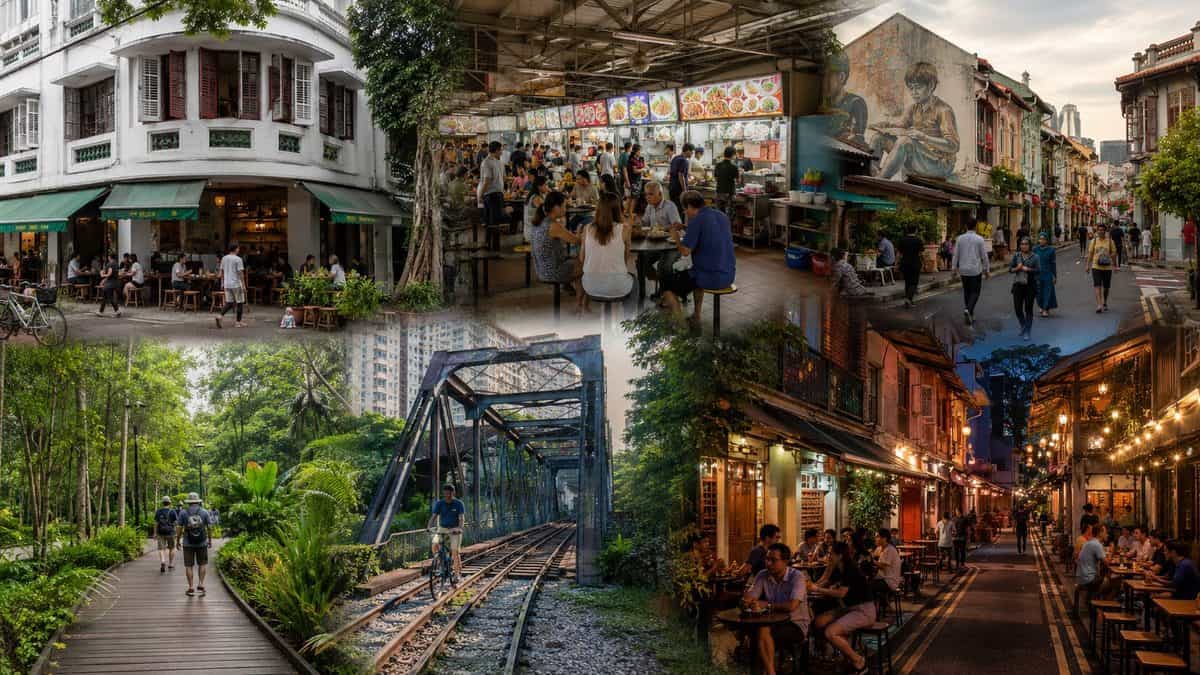
Image generated with Ai
Three zones in Singapore are not enough to fill an entire day. There are other ways to experience 24 hours in Singapore. There are markets, conserved shophouses, hawker centers, forest trails, and heritage precincts that provide Singapore’s alternative tourism route. This alternative tourism route also reflects Singapore’s tourism direction in the Singapore Tourism Board’s (STB) Tourism 2040 strategy and is indicative of differentiated tourism experiences. In 2025, Singapore had 16.9 million international tourists compared to 2024’s 16.7 million international tourists, and record breaking tourism receipts of S$32.8 billion. This remarkable growth of tourism makes an original alternative tourism itinerary worthwhile for an international tourist.
Singapore’s global tourism image is unusually concentrated. Marina Bay supplies the skyline, Sentosa delivers leisure attractions and Orchard Road dominates the city’s traditional shopping narrative. Yet those districts represent only one layer of a much larger urban experience, where historic communities, food traditions, ecological corridors and residential neighbourhoods coexist within a compact city-state.
That distinction matters because Singapore is exceptionally suited to neighbourhood-led travel. Its rail network now covers around 240 kilometres across more than 170 MRT stations, with more than three million daily rail journeys. The wider rail system has been planned to reach about 360 kilometres over the next decade, making it practical for visitors to build itineraries around places outside the conventional tourist core.
STB’s Tourism 2040 roadmap reinforces that direction. The agency wants Singapore to develop more distinctive experiences while pursuing sustainable, higher-value tourism. It projects tourism receipts of S$47 billion to S$50 billion by 2040, with visitor spending expected to grow faster than arrivals.
Advertisement
For travellers, the implication is straightforward. The alternative Singapore is not a second-rate version of the famous Singapore. It is the part of the destination where food, history, nature and everyday urban life become the attraction.
Start the day in Tiong Bahru, Joo Chiat, Katong or Geylang Serai, rather than immediately heading towards the central business district. The objective is not to tick off a landmark, but to watch Singapore begin its working day.
A traditional kopitiam breakfast provides the right introduction. Kaya toast, soft-boiled eggs and kopi offer a compact lesson in Singaporean food culture, while a wet market reveals a more practical side of neighbourhood life. Travellers should allow time to observe rather than simply eat and leave.
Tiong Bahru works particularly well for visitors interested in architecture and café culture. Joo Chiat and Katong offer a stronger Peranakan visual identity, with colourful conserved shophouses and a food culture shaped by Singapore’s Straits Chinese heritage. Geylang Serai provides another perspective, particularly around Malay food, markets and community life.
The editorial advantage of this opening is significant. The first hour establishes Singapore as a lived-in city, rather than an attractions catalogue.
After breakfast, move towards a heritage precinct where Singapore’s multicultural history becomes visible at street level. Chinatown is an obvious choice, but the objective should be to explore its layers rather than simply photograph its best-known streets.
STB itself highlights Chinatown’s unusual concentration of religious and cultural landmarks. Thian Hock Keng Temple, Masjid Jamae and Sri Mariamman Temple sit within the same broader precinct, illustrating how different communities have shaped the historic city.
This is where travellers should look beyond the obvious. Study the façades, five-foot ways, clan associations, traditional businesses and narrow lanes. The most interesting details often sit above shopfront level, where decorative motifs and conserved architecture reveal the commercial history of the district.
The same principle applies in Kampong Gelam, Little India and Joo Chiat. Singapore’s heritage is strongest when experienced as a neighbourhood ecosystem, not as isolated monuments.
By late morning, the itinerary should move towards food. Singapore’s hawker centres are not merely inexpensive places to eat; they represent an important part of the country’s social fabric.
UNESCO inscribed Hawker Culture in Singapore on its Representative List of the Intangible Cultural Heritage of Humanity in 2020. UNESCO describes hawker centres as community dining spaces where people from different backgrounds gather over food.
That distinction makes a hawker centre one of the most useful stops in a 24-hour itinerary. Visitors can experience Chinese, Malay, Indian and other culinary influences within the same dining environment. They can also see how specialist stalls preserve recipes, techniques and food traditions across generations.
Rather than treating lunch as a quick refuelling stop, travellers should allow 60 to 90 minutes. Look at what locals order, compare several dishes and observe the rhythms of communal dining. That turns an ordinary meal into an unusually concentrated cultural experience.What To Observe Why It Matters Kopitiam breakfast Shows Singapore’s everyday food traditions Hawker centre Demonstrates multicultural community dining Specialist food stalls Preserves recipes and culinary skills Shared seating Reflects the communal character of hawker culture Neighbourhood markets Connects food with everyday urban life
The afternoon should reveal a Singapore that surprises first-time visitors. The city-state’s built environment is extensive, yet its parks, reservoirs and ecological corridors create a parallel landscape.
For a manageable one-day itinerary, the Singapore Botanic Gardens offers one of the most efficient choices. The Gardens open from 5am until midnight, while the National Orchid Garden operates from 8.30am to 7pm, with final ticket sales and entry at 6pm. Botanic Gardens and Napier MRT stations provide direct rail access.
The site also carries unusual heritage significance. Singapore Botanic Gardens is the country’s UNESCO World Heritage Site and combines scientific collections, rainforest landscapes, gardens and historic spaces.
Travellers should resist the temptation to cover everything. A focused two-hour walk through the Rain Forest, Learning Forest and selected garden areas creates a better experience than rushing between every attraction.
Weather also matters. Singapore’s tropical climate can make exposed walking uncomfortable during the afternoon. Carry water, use shaded routes and check weather conditions before committing to longer outdoor sections.
For travellers who want something more distinctive, the Rail Corridor offers a stronger alternative to conventional sightseeing.
The former railway route has been transformed into a green spine connecting communities, heritage sites and natural landscapes. NParks describes the route as a 24-kilometre ecological corridor linking Woodlands with Tanjong Pagar. The northern section provides more than 21 kilometres of continuous connectivity and over 30 access paths.
This is not simply another walking trail. Its appeal comes from the collision of history and ecology. Old railway infrastructure, forest, grassland and residential neighbourhoods appear along the same journey.
However, visitors should plan carefully in 2026. A section of the Rail Corridor South between the Henderson Road and Spooner Road accesses has been closed since 9 March 2026 for Phase 2 improvement works. The corridor is not lit at night, and NParks recommends leaving before darkness falls.
For a one-day itinerary, the Bukit Timah Railway Station section is especially useful. King Albert Park MRT provides access, while the former station and surrounding landscape add historical context without requiring a full-length hike.
Singapore’s evening light does not belong exclusively to Marina Bay. The alternative itinerary should deliberately seek a viewpoint where the city appears as a lived urban landscape.
Depending on the route, travellers can finish the green segment near Bukit Timah, move towards a heritage neighbourhood or choose another elevated public space. The important point is to avoid creating another artificial “iconic view” moment.
Instead, watch the transition from daylight to evening. Residential towers begin to illuminate, traffic intensifies and neighbourhood food businesses become busier. This is Singapore without the postcard filter, and it provides a more textured visual ending to the afternoon.
Dinner should return the traveller to food, but with a broader geographical and cultural lens. Singapore’s evening dining scene extends well beyond the restaurant districts most familiar to international visitors.
A neighbourhood hawker centre can provide a more grounded experience. Alternatively, travellers can explore Malay, Indian, Chinese or Peranakan food traditions in the districts associated with them.
The important distinction is not whether a meal is cheap or expensive. It is whether the meal tells the traveller something about the city.
Singapore’s tourism economy also makes this broader food ecosystem commercially significant. In 2024, tourism receipts reached a record S$29.8 billion, while the 2025 figure rose further to S$32.8 billion. STB has increasingly emphasised distinctive experiences as part of its strategy for maintaining destination appeal.
That makes neighbourhood dining more than a niche travel preference. It fits the destination’s wider effort to create deeper, differentiated visitor experiences.
The final hours should become deliberately slower. Rather than returning to a major attraction, settle into a neighbourhood café, dessert shop, quiet bar or late-night food venue.
A short walk through illuminated shophouses can work better than another attraction. So can a final kopi while watching residents return from work. The purpose is to end the itinerary with atmosphere rather than another checklist item.
This approach also makes the itinerary adaptable. Visitors with early flights can finish earlier, while those staying another night can continue exploring the local district.
The real luxury after 24 hours is not seeing more. It is understanding more.
The biggest advantage of this itinerary is Singapore’s transport infrastructure. Visitors do not need a private vehicle to stitch together neighbourhoods, food districts and green spaces.
The LTA says more than 170 stations now span six MRT lines. The network also records more than three million daily ridership, demonstrating how deeply rail travel is embedded in everyday movement across the city.
For travellers, that makes the itinerary relatively resilient. If rain disrupts a nature walk, a heritage precinct can replace it. If a morning market feels too busy, the traveller can move towards a museum, café district or covered food centre.Time Experience Suggested Area Ideal Duration 7am Kopitiam breakfast and market Tiong Bahru / Katong 2 hours 9am Heritage walk Chinatown / Kampong Gelam 2 hours 11am Food and cultural exploration Hawker centre 1.5 hours 1pm Botanical escape Botanic Gardens 2 hours 3pm Railway heritage and nature Rail Corridor 2 hours 5.30pm Golden-hour neighbourhood walk Nearby district 1.5 hours 7pm Multicultural dinner Local food district 2 hours 9.30pm Dessert, café or evening walk Heritage neighbourhood 1.5 hours
The alternative itinerary mirrors a wider shift in Singapore’s tourism strategy. STB’s Tourism 2040 framework places emphasis on destination attractiveness, future demand and tourism-sector development, rather than relying solely on established attractions.
That approach matters because Singapore is competing in an increasingly crowded Asian travel market. The destination needs repeat visitors to find fresh reasons to return, while first-time travellers need more meaningful experiences within limited stopover periods.
The numbers show why this matters. Singapore recorded 16.9 million international arrivals in 2025, with Mainland China, Indonesia, Malaysia, Australia and India among its largest source markets. Tourism receipts reached S$32.8 billion, up 10% year on year.
For the industry, that creates an opportunity to spread visitor spending beyond the most recognisable tourism nodes. For travellers, it creates a more interesting proposition: one compact city can support several different versions of a holiday.
The strongest case for this itinerary is not that travellers should permanently avoid Marina Bay, Sentosa or Orchard Road. Those destinations remain important parts of Singapore’s tourism offer, and STB continues to invest in them.
The more useful lesson is that they do not need to define an entire visit. Singapore’s neighbourhoods offer architecture, food, community, ecology and history within a highly connected urban system. The city’s 24-hour story becomes richer when those elements are allowed to lead.
For first-time visitors, this route provides a different introduction. For repeat visitors, it can reveal a new layer of the destination. Either way, 24 hours in Singapore can become less about collecting landmarks and more about reading the city itself.
| Traveller Need | Best Approach |
|---|---|
| First-time visitor | Combine heritage, food and one major green space |
| Repeat visitor | Prioritise Rail Corridor, neighbourhood markets and local food |
| Food-focused traveller | Build the day around kopitiams and hawker centres |
| Architecture enthusiast | Choose Tiong Bahru, Katong and historic precincts |
| Nature traveller | Prioritise Botanic Gardens or Rail Corridor |
| Short stopover | Stay within one connected cluster |
| Wet-weather day | Increase indoor heritage, food and cultural stops |
| Evening arrival | Reverse the itinerary and begin with neighbourhood dining |
Stuffing extra attractions into your 24-hour Singapore itinerary won’t make your trip more valuable. An itinerary is valuable when each hour adds something new to your understanding of the city.
Start your day with kopi and market activities. Spend your afternoon at the rainforest and the heritage railway. Finish your night with hawker centers and preserved streets. This build up will add to your itinerary, not just length.
It also shows how Singapore is changing the way they look at tourism. As tourists continue to increase and so do tourist dollars spent in Singapore, tourism experiences that stand out from the crowd become more important. For travelers that break from the usual path, they offer a massive amount of things to do in a day.
Yes. Singapore has a dense network of heritage neighbourhoods, hawker centres, parks and walking trails that can easily fill a day. Tiong Bahru, Joo Chiat, Katong, Chinatown, Kampong Gelam, the Singapore Botanic Gardens and the Rail Corridor offer a distinctly different perspective.
A strong route can begin with breakfast in Tiong Bahru or Katong, followed by a heritage walk, hawker-centre lunch, an afternoon in the Botanic Gardens or Rail Corridor, and neighbourhood dining after sunset. The route can be adjusted according to weather and transport connections.
A neighbourhood kopitiam is ideal for experiencing traditional breakfast culture. Kaya toast, soft-boiled eggs and kopi are among the classic choices, while a nearby wet market can add an authentic glimpse of morning neighbourhood life.
Tiong Bahru, Joo Chiat, Katong, Chinatown, Kampong Gelam and Little India are particularly rewarding. Each offers a different combination of architecture, food, religious heritage, traditional businesses and contemporary culture.
Absolutely. Singapore’s hawker culture was inscribed on UNESCO’s Representative List of the Intangible Cultural Heritage of Humanity in 2020. Hawker centres are also valuable for travellers because they bring different culinary traditions and communities together in accessible public spaces.
The Singapore Botanic Gardens and Rail Corridor are among the strongest choices for a short itinerary. MacRitchie Reservoir and other nature areas can also work, although travellers should consider travel time when planning a tightly packed day.
Yes. The Singapore Botanic Gardens generally remains open until midnight, although individual attractions within the Gardens have different operating hours. Travellers should check the latest official timings before visiting.
Yes, particularly if travellers choose a manageable section rather than attempting the entire route. The former railway landscape combines industrial heritage, greenery and urban history, making it substantially different from Singapore’s conventional sightseeing circuit.
Singapore’s MRT and public-transport network makes independent exploration relatively straightforward. Visitors can combine MRT journeys with short walks and occasional buses or taxis, reducing the need for a private vehicle.
Advertisement
Tags: 24 hours in Singapore, alternative Singapore, Singapore itinerary, Singapore neighbourhoods, Singapore Travel
Advertisement
Advertisement













Saturday, September 5, 2026

Friday, September 4, 2026

Saturday, September 5, 2026
Friday, September 4, 2026

Thursday, September 3, 2026

Wednesday, September 2, 2026

Saturday, September 5, 2026



