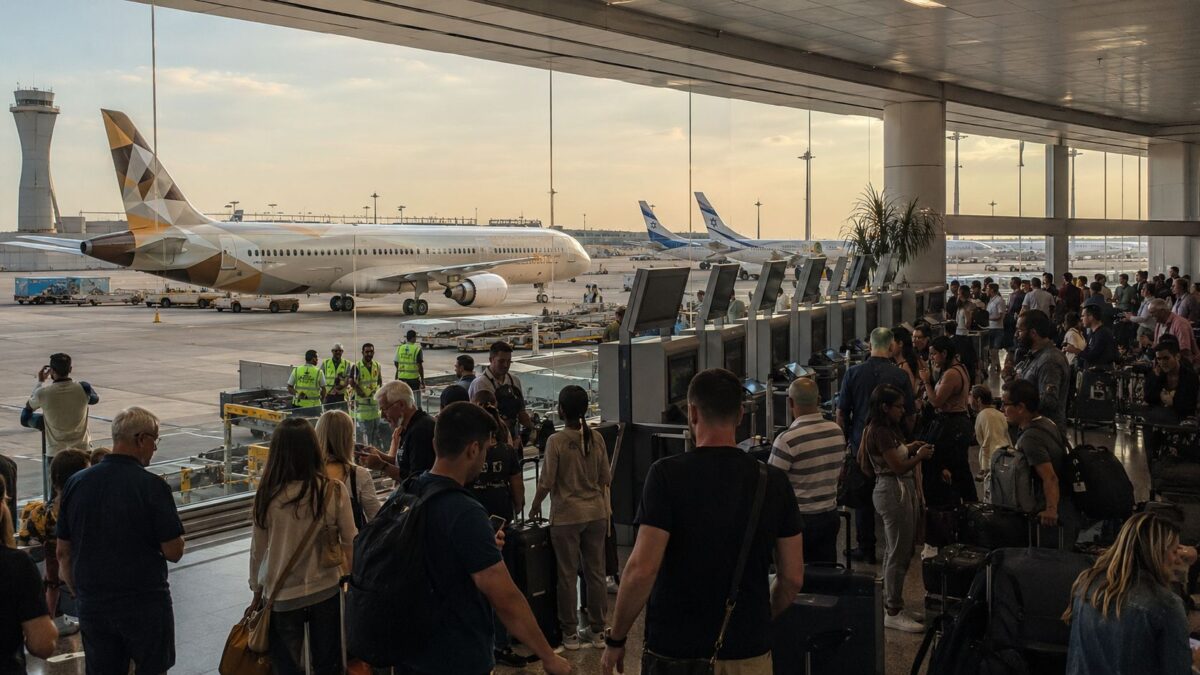
Image generated with Ai
Etihad Airways cancelled EY608 and limited EY594 due to unprecedented strikes that impacted Ben Gurion International Airport on August 20. The strikes closed check-in counters and affected passenger processing at one of the busiest days during the summer peak. Approximately 100,000 passengers and 600 flights were planned through the airport and the disruption that took about an hour significantly impacted the airport’s operations. Etihad posted delays on EY597 and EY598 for the Abu Dhabi-Tel Aviv route. At about 3 p.m. the airport started recovering operations and continuing to process passengers. The disruptions caused delays to passengers and their baggage. The Finance Ministry of Israel estimated the first level of economic disruption to be NIS 25 million to NIS 30 million, which is about $8.3 million to $10 million.
The Etihad flight disruptions developed after ground-service workers stopped passenger-handling activities at Ben Gurion Airport. The industrial action affected several airlines, rather than Etihad alone, and temporarily paralysed critical airport functions.
Advertisement
Etihad cancelled EY608 from Tel Aviv to Abu Dhabi. The airline also operated EY594 with a restricted number of passengers because airport services remained constrained. Meanwhile, EY597 from Abu Dhabi to Tel Aviv and EY598 from Tel Aviv to Abu Dhabi faced delays.
Etihad described the cause as “unplanned industrial action affecting a number of airlines at Ben Gurion International Airport.” The wording is significant because the disruption originated within airport ground operations rather than from an Etihad aircraft or crew issue.
Advertisement
Advertisement
The incident demonstrates how quickly a ground-handling interruption can affect international connectivity. Even when aircraft remain available, passengers cannot complete the departure process without functioning check-in, baggage and security interfaces.
For travellers, this distinction matters. A flight shown as scheduled can still become delayed or cancelled after airport-side restrictions emerge.Etihad Service Route Disruption Reported Immediate Effect EY608 Tel Aviv–Abu Dhabi Cancelled Passenger journey disrupted EY594 Tel Aviv–Abu Dhabi Restricted operation Limited number of guests EY597 Abu Dhabi–Tel Aviv Delayed Arrival affected EY598 Tel Aviv–Abu Dhabi Delayed Departure affected
Flight-tracking data also recorded delays on the affected services, underlining how the airport disruption translated into operational delays. EY594, for example, departed substantially later than its scheduled time on August 20.
The timing made the disruption particularly consequential. Ben Gurion Airport was already operating near its summer capacity during the incident.
The Israel Airports Authority projected approximately 2.6 million passengers at Ben Gurion during August 2026. It expected weekday traffic to reach between 90,000 and 95,000 passengers, excluding weekends. Several peak dates were forecast to reach around 100,000 passengers. August 20 was one of those dates.
The airport also expected 47 airlines to operate during the month. The United Arab Emirates, Greece, Cyprus, Italy, the United States and Germany were among the most popular destination markets.
That traffic profile explains why even a short operational stoppage produced disproportionate disruption.
A major international airport works as an interconnected system. Check-in feeds baggage processing, security and gate operations. Aircraft turnaround schedules then depend on those processes running in sequence.
Once one component stops, the resulting delays can spread well beyond the original disruption window.Ben Gurion August Indicator Expected Level Monthly passengers About 2.6 million Typical weekday traffic 90,000–95,000 passengers Peak daily traffic About 100,000 passengers Airlines operating 47 August 20 forecast About 100,000 passengers Daily flight volume during peak period About 600 flights
The Israel Airports Authority advises passengers to arrive three hours before departure, complete online check-in where possible and verify their terminal and updated departure time before travelling.
The Ben Gurion disruption was not simply a conventional airline cancellation event. It exposed the dependence of international aviation on ground infrastructure and airport labour.
Workers at four ground-service companies reportedly stopped passenger-handling operations. All check-in counters were closed during the disruption, while airport operations were temporarily suspended around 2pm. Operations gradually resumed from approximately 3pm.
The workers reportedly raised concerns over operational difficulties, aircraft loading and unloading challenges and a shortage of aircraft parking stands.
The disruption also occurred amid heavy aircraft movements and constrained airport infrastructure. Reports indicated that more than 20 American refuelling aircraft occupied parking stands near Terminals 3 and 1.
That situation increased the complexity of moving passengers and baggage between aircraft and terminals.
Several inbound flights were reportedly forced to turn around after airport operations were reduced. The effect therefore extended beyond passengers already inside the terminal.
For airlines, such disruptions create a difficult operational calculation. An aircraft can arrive but remain unable to complete its turnaround efficiently. A delayed departure then affects the aircraft’s next sector, crew scheduling and airport slot utilisation.
The result is a classic network disruption effect, where a local operational problem becomes a wider schedule problem.
The financial consequences also underline the scale of the incident.
Israel’s Finance Ministry estimated the preliminary economic damage from the work stoppage at between NIS 25 million and NIS 30 million. That equates to approximately $8.3 million to $10 million, based on reported estimates.
The assessment reportedly included passenger time losses, airline operating costs and reduced airport-related revenue. It also covered disruption to cargo, logistics, tourism and hospitality.
The economic calculation is important for the travel sector because airport disruption rarely stops at the terminal building.
Delayed passengers may require accommodation, meals and ground transportation. Airlines can incur additional crew, fuel and aircraft-handling costs. Airports can lose commercial and operational revenue.
Cargo disruption can create another layer of economic exposure. Time-sensitive goods depend on predictable aviation schedules, particularly when supply chains rely on international air freight.Economic Area Potential Effect Airlines Additional operational and scheduling costs Passengers Lost time and potential additional travel expenses Airport operators Reduced operational and commercial revenue Cargo Handling and supply-chain disruption Tourism Delayed arrivals and disrupted itineraries Hospitality Changes to hotel and visitor spending Ground transport Additional waiting and transfer requirements
The reported Finance Ministry assessment also highlighted broader infrastructure constraints. Israeli media reports said the ministry linked the severity of the economic impact to limited aviation infrastructure capacity and operational rigidity.
For passengers travelling through Ben Gurion, the incident offers a practical lesson. Checking a flight once is no longer enough during major operational disruption.
Travellers should check their flight status before leaving for the airport. They should then check again shortly before departure, particularly during peak travel periods.
Etihad allows passengers to use Manage My Booking to view bookings, update contact information and check available flight options. The airline also advises passengers to maintain current contact details so operational notifications can reach them.
Passengers who booked through travel agents should also maintain contact with the agency. Etihad states that passengers using agents may need to contact those agents directly for certain booking changes.
The Israel Airports Authority has separately advised passengers to verify their departure terminal. This is particularly relevant because Terminal 1 resumed international operations during 2026, while Terminal 3 continues handling international arrivals.
Travellers should therefore avoid assuming that a previous airport visit or an old booking confirmation reflects the latest operational arrangement.Traveller Action Why It Matters Check Etihad before leaving Identifies cancellations and delays Update contact details Enables direct operational notifications Verify Ben Gurion terminal Terminal assignments can differ Arrive three hours early Allows additional time during peak periods Complete online check-in Reduces dependence on airport counters Check baggage arrangements Ground handling can become constrained Recheck flight status Disruptions can evolve rapidly
Passengers should also retain essential medication, documents and valuables in hand baggage. A checked-baggage delay can otherwise turn an airport disruption into a longer travel problem.
The Tel Aviv-Abu Dhabi corridor has particular importance for connecting travellers. Abu Dhabi functions as a major transfer point for passengers continuing towards Asia, Australia, Africa and other international markets.
Consequently, a delayed Tel Aviv departure can affect more than the first flight sector.
A passenger travelling from Tel Aviv through Abu Dhabi may have a separate onward connection. A delay therefore creates a risk of missed connections, baggage misconnection and itinerary changes.
The operational impact depends on the length of the delay and the connection window. However, travellers with tight connections should pay particular attention to revised timings.
Etihad’s booking-management system allows passengers to review flight information and available options. The airline also states that passengers can receive notifications through email and its app when flights are rescheduled or cancelled.
This makes accurate contact information particularly important during periods of airport instability.
For passengers travelling beyond Abu Dhabi, the safest approach is to avoid making separate non-refundable arrangements around a tight connection. Flexible accommodation and transport bookings can reduce exposure when flight schedules remain uncertain.
The Ben Gurion incident arrives during an exceptionally busy aviation period. The airport’s own August projections show how little spare capacity exists during peak travel days.
Around 100,000 passengers in a single day means that even a one-hour interruption can affect thousands of journeys.
The airport had forecast 100,000 passengers on August 20. It also expects another similar peak on August 27.
That creates a clear operational consideration for airlines and airport authorities. Labour availability, baggage infrastructure, aircraft stands and passenger-processing capacity all become increasingly important during peak periods.
For travel companies, the lesson extends beyond Ben Gurion. Tour operators and corporate travel managers should build flexibility into itineraries involving airports operating close to capacity.
That can include longer connection windows, refundable accommodation and contingency transport arrangements.
For airlines, the incident illustrates the importance of resilience beyond aircraft availability. A modern carrier can have a serviceable aircraft and crew but still face cancellation when the airport ecosystem cannot support departure.
The disruption also highlights a broader industry issue: airport resilience is becoming as important as airline reliability.
Travellers often judge disruption through the airline shown on their ticket. Yet airports control many essential processes that airlines cannot independently restore.
Check-in systems, baggage handling, stands, passenger buses and ground services all influence whether an aircraft can operate.
The incident therefore provides a useful distinction between an airline-controlled disruption and an airport-controlled disruption.Disruption Type Typical Trigger Possible Airline Response Airline operational issue Aircraft, crew or scheduling problem Rebook or substitute aircraft Airport labour action Ground-service interruption Adjust schedule and notify passengers Security restriction Airport or government instruction Hold, divert or cancel service Baggage disruption Ground-handling capacity Restrict baggage or delay departure Infrastructure constraint Stands, terminals or systems Reschedule or reroute operations
The distinction does not reduce the inconvenience for passengers. However, it helps explain why airlines may have limited control over the original cause.
It also demonstrates why travellers should monitor both airline communications and airport notices during major disruption.
Etihad flight disruptions at Ben Gurion Airport were centered around a brief but important operational stoppage. Flight EY608 was canceled, while flight EY594 was subject to restrictions. Flights EY597 and EY598 were subject to delays.
The disruption occurred on a day when Ben Gurion was expecting around 100,000 passengers. This created a massive travel disruption, as a labor dispute would normally have a much more local impact.
The estimated economic impact of up to NIS 30 million also provides insight. It shows how airport disruptions can affect many entities including airlines, travelers, cargo shippers, and the tourism economy.
For travelers, as a general rule, the best thing to do is prepare. This means checking flight statuses, checking which terminal to go to, and being sure to provide updated contact information.
This particular incident also shows that airlines and travelers should prepare for disruptions in peak travel season. The ground operations, the airlines and the travelers all play an important role and there should be constant flexibility. Travelers should constantly check if they need to make any changes to their travel plans.
1. Why were Etihad flights disrupted at Ben Gurion Airport?
Etihad flight disruptions followed industrial action by airport ground-service workers at Ben Gurion Airport in Israel. The stoppage affected check-in and passenger-handling operations.
2. Which Etihad flights were cancelled or delayed?
EY608 from Tel Aviv to Abu Dhabi was cancelled, while EY594 operated with a restricted number of passengers. EY597 and EY598 also experienced delays.
3. How many travellers were affected by the Ben Gurion disruption?
Ben Gurion was handling around 100,000 passengers and 600 flights during the affected peak travel day, significantly increasing the disruption’s potential impact.
4. Did the Ben Gurion Airport strike affect other airlines?
Yes. The industrial action affected several airlines operating at Ben Gurion Airport, as check-in counters and passenger-handling services were temporarily suspended.
5. What should Etihad passengers travelling from Tel Aviv do?
Passengers should check their flight status before travelling to the airport, keep their contact details updated and monitor Etihad’s operational notifications for schedule changes.
6. What was the estimated economic impact of the airport disruption?
Israel’s Finance Ministry estimated the preliminary damage at NIS 25 million to NIS 30 million, equivalent to approximately $8.3 million to $10 million, including airline, passenger, airport, cargo and tourism-related losses.
Advertisement
Tags: Abu Dhabi flights, ben gurion airport, Etihad Airways, Etihad flight disruption, Tel Aviv Flights
Advertisement
Advertisement













Friday, September 4, 2026

Friday, September 4, 2026

Friday, September 4, 2026

Friday, September 4, 2026

Thursday, September 3, 2026

Wednesday, September 2, 2026

Friday, September 4, 2026