

Virtual Reality in Mount Wutai: How XR Technology and Digital Mapping Are Revolutionizing Cultural Heritage Tourism in Shanxi, China

Published
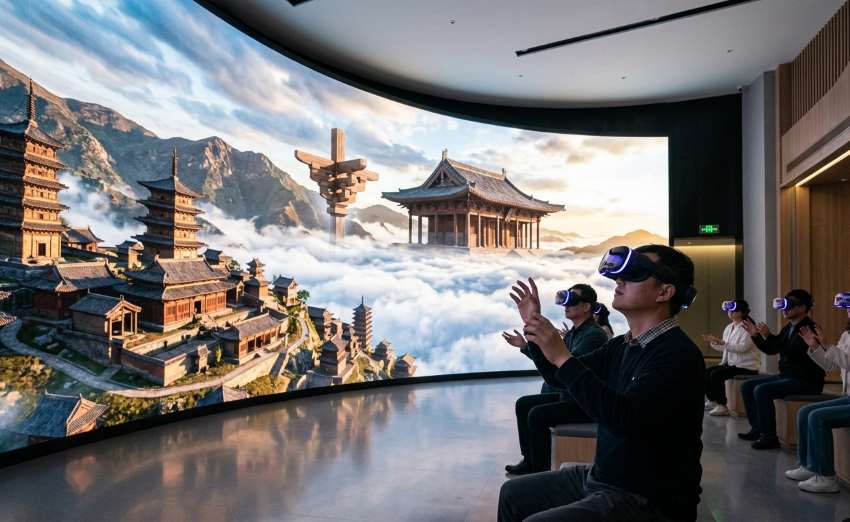 Image generated with Ai
At the foot of Mount Wutai, one of the most famous UNESCO World Cultural Heritage sites and a Chinese Buddhist sanctuary for more than 1,800 years, there is a fusion of ancient tradition and virtual realities. Visitors to a newly opened immersive experience centre don extended reality (XR) headsets to experience in 20 minutes what would normally take days of strenuous activity to explore. With the help of high-precision three-dimensional modelling, users can have virtual experiences of seasonal seas of clouds, closely observe the complex timber joints of century-old temples, and climb the five different peaks of the sacred mountain in a virtual space.
The centre, which was officially opened in April, was conceived by Xing Wei, a 40-year-old local who was born in the village of Yingfang at the foot of the mountain range. Last year, Xing and fellow villagers Liu Yong and Guo Lijun pooled their capital to establish a technology startup to focus on the digitisation of regional tourism. The engineering team spent seven months trekking across the mountainous terrain, so that spatial data could be collected and the primary architectural treasures could be filmed, in partnership with a Shanghai-based virtual reality corporation.
The static façade is no longer simply observed, travellers experience an interactive engagement with the surrounding landscape. This timely venture has generated lucrative returns, attracting a record 7.27 million tourists in 2025, a 5.22 per cent year-on-year increase in Mount Wutai. So far, at least 10,000 visitors have paid fees to participate in the XR simulation.
Enhancing the Physical Pilgrimage
For a vast number of travellers, an interactive educational primer is provided by the digital simulation before the physical ascents of the mountain are confronted. The layout of the sanctuaries was studied via the XR hall by Wang Yanlin, a fifty-four-year-old traveler from Tianjin, prior to the commencement of his upward trek. An immediate and intuitive comprehension of how these ancient structures were engineered was gained by Wang through the initial digital viewing of the architecture. A realization has been shared that when a visitor subsequently stands before the actual monuments, a much more profound appreciation is felt regarding the immense scale of what was constructed by ancient craftsmen within such a rigorous alpine environment.
Advertisement
Advertisement
A total of 121 immovable cultural relics are boasted by the mountain, among which four top-tier national protection units are counted, encompassing ancient timber designs, painted sculptures, and extensive historic murals. Since the construction of its inaugural temple in 68 AD during the Eastern Han Dynasty (25–220), a living testament has been maintained by Mount Wutai regarding the localized evolution of Buddhism within China and its subsequent transmission across East Asia.
Non-Contact Preservation and Engineering
Beyond the realms of consumer entertainment, digital innovation is being utilized as an essential mechanism for structural conservation. A comprehensive data-acquisition programme is currently being accelerated by local authorities to protect historical assets that are continuously threatened by environmental weathering and physical deterioration.
Advertisement
Advertisement
At the historic Luohou Temple, advanced techniques including three-dimensional laser scanning, oblique photography, and close-range photogrammetry are being deployed by preservation experts to map every square centimetre of the complex. This undertaking is characterized as an entirely non-contact method of data collection by Wang Chao, deputy general manager of Shanxi Cultural Tourism Digital Communication Co.—the corporate entity by which the digital mapping project is being directed.
A permanent digital repository is being established by the engineering team to log exact structural proportions, precise spatial configurations, and detailed surface textures. It is emphasized by the team that preservation is prioritized above all else; if a catastrophic event or severe structural decay is suffered by the buildings, the immutable blueprints required for meticulous restoration will be provided by this digital archive. Full three-dimensional modelling has already been completed by Wang’s team for four of the most critical national heritage complexes on Mount Wutai, including the legendary Tayuan and Xiantong temples.
Future Perspectives on Intelligent Management
Regional heritage administrators highlight the need to keep the site relevant to a highly tech-literate public as a precondition of its long-term survival. True cultural revitalisation is a conscious effort to think about how cultural treasures could be better presented to the world, said Han Ruijie, director of the Mount Wutai Cultural Relics and Heritage Protection Centre. The scenic management team is working on plans to grow both static and dynamic digital exhibits, to ensure deeper cultural context is provided to domestic and international sightseers alike.
The administration intends to shift the overarching conservation philosophy from physical isolation to active digital interaction to ease the foot-traffic pressure on the delicate, ancient timber frameworks and simultaneously expand the global visibility of the sanctuary. “The best protection is not to lock up these ancient treasures from human eyes, but to pass down heritage through creative innovation,” Liu Yuan, director of the Mount Wutai Scenic Area Management Committee, told the Shanxi Daily in a recent briefing. According to the committee, deepening of digital protection frameworks and implementation of intelligent management systems will scientifically survive this millennium-old legacy for generations to come.
Advertisement
