
Thailand’s Free Fruit Check-In Lets Travellers Carry 10 kg Across 20 Airports With Seven Airlines

Published
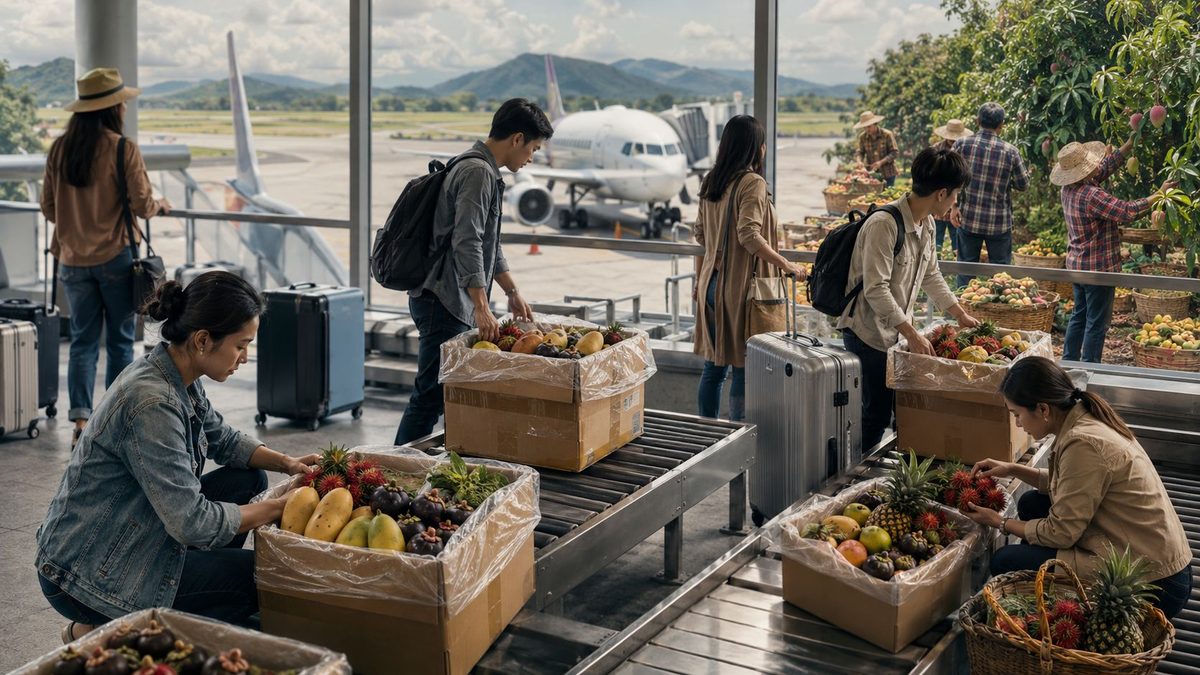
Image generated with Ai
Thailand is promoting domestic flights by carrying free “fruit boxes” from twenty airports. Passengers can bring ten kilograms of fruit for free using this initiative. Participating airlines will have the fruit boxes in cargo holds for the passenger. The campaign will begin on September 1, 2026, and will continue until August 31, 2027. Participating farmers may sell fruit directly to customers who travel through the participating airports. The government builds market spaces for the farmers. The campaign aims to distribute one thousand tons of fruit, by bringing one hundred thousand boxes of fruit. Participating airlines will have one cargo space reserved for one passenger. Farmers will follow strict packaging requirements. Durians and other fruit with pungent scents are excluded.
Seven Airlines Join Thailand’s Fruit Drive
Thailand is using its domestic aviation network to address an agricultural distribution challenge while adding value to the visitor experience. The Ministry of Commerce, through the Department of Internal Trade, has partnered with the Ministry of Transport’s Department of Airports and seven airlines for the initiative.
Advertisement
Advertisement
The participating carriers are Thai Airways International, Thai AirAsia, Bangkok Airways, Nok Air, Thai Lion Air, Thai Vietjet Air and EZY Airlines. Each airline has agreed to support the movement of eligible fruit in the aircraft hold without an additional transport charge, subject to the programme’s 10kg limit per passenger.
The agreement runs for one full year, from 1 September 2026 through 31 August 2027. During that period, the government will provide standard 10kg fruit boxes at participating airports, while the airlines will promote the initiative through their passenger communication channels.
Advertisement
Advertisement
The policy has a clear tourism dimension. It allows visitors to take part of their regional travel experience home, while giving farmers another route to reach consumers beyond conventional markets.
Advertisement
Advertisement
Twenty Regional Airports Lead Programme
The programme deliberately focuses on secondary destinations rather than Thailand’s biggest international gateways. That gives the initiative a stronger regional-tourism dimension, particularly for travellers using domestic flights after visiting provincial destinations.
The Department of Internal Trade identifies 20 participating locations covering northern, northeastern, central and southern Thailand. The list includes Nan, Lampang, Tak, Phitsanulok, Loei, Udon Thani, Khon Kaen, Sakon Nakhon, Nakhon Phanom, Roi Et, Ubon Ratchathani, Buri Ram, Prachuap Khiri Khan, Chumphon, Ranong, Surat Thani, Nakhon Si Thammarat, Krabi, Trang and Narathiwat.
For travellers, the geographical spread is significant because many of these locations serve as gateways to regional tourism circuits. Krabi, Surat Thani and Trang connect visitors with southern beaches and islands, while Nan, Loei and Nakhon Phanom offer stronger cultural, community and nature-led experiences.
Advertisement
Advertisement
The airport network also reaches agricultural regions where seasonal produce forms part of the local identity. That makes the initiative more than a baggage promotion, because the government is effectively connecting destination discovery with agricultural consumption.
| Programme Detail | Official Position |
|---|---|
| Programme period | 1 September 2026 to 31 August 2027 |
| Participating locations | 20 |
| Airline partners | 7 |
| Maximum fruit weight | 10kg |
| Free allowance | One standard box per passenger |
| Target boxes | 100,000 |
| Target fruit volume | Approximately 1,000 tonnes |
| Accepted produce | Fresh fruit |
| Required packaging | Official Department of Internal Trade box |
| Additional transport charge | None under the programme |
| Strongly scented fruit | Not permitted |
The Department of Airports is responsible for providing collection points and helping passengers use the service. It will also allocate temporary areas where farmers can sell seasonal fruit directly inside participating airports.
Advertisement
Advertisement
How Travellers Can Use The Scheme
The process is deliberately simple, but travellers must follow the programme’s packaging rules. Passengers who want to use the service should first locate the designated fruit-box service point at their participating airport.
The Department of Internal Trade will provide the official 10kg box, rather than allowing passengers to use any packaging they bring themselves. After obtaining the box, travellers can place eligible fruit inside, secure it correctly and present it for loading into the aircraft hold.
The allowance is limited to one box per passenger. The combined weight of the fruit must not exceed 10kg, so passengers should not expect the programme to cover multiple boxes or heavier consignments.
Travellers should also allow additional time at the airport. Buying fruit shortly before departure, obtaining the official packaging and completing the relevant baggage procedure could take longer than a conventional check-in.
The safest approach is to arrive early and ask airport staff where the designated service point operates. Travellers should also retain enough time for normal security and baggage procedures.
Advertisement
Advertisement
Packaging Rules Matter at Check-In
The free allowance does not mean passengers can simply place loose fruit inside an ordinary suitcase. The authorities have introduced specific packaging requirements to reduce leakage, insects, foreign objects and odours during transport.
Only fresh fruit qualifies under the programme. The fruit must remain dry and cannot contain excess moisture, while the official box must be securely sealed using adhesive tape or straps.
The packaging rules are particularly relevant to aviation operators. Fruit can release liquid as it moves through baggage systems, while poorly sealed produce can attract insects or create unpleasant odours.
Consequently, passengers should inspect the fruit before packing it. Bruised, leaking or excessively wet produce could create problems during handling.
The government has also made the official container mandatory. That gives airport and airline personnel a consistent package to handle and creates a clear visual distinction between the programme’s approved fruit shipments and ordinary baggage.
Advertisement
Advertisement
| Traveller Requirement | What It Means |
|---|---|
| Fruit type | Fresh fruit only |
| Maximum weight | 10kg |
| Boxes per passenger | One |
| Box source | Airport service point |
| Packaging | Official government-supplied box |
| Moisture | Fruit must be dry |
| Closure | Tape or straps |
| Leakage | Not permitted |
| Insects | Packaging must prevent entry |
| Strong odour | Not permitted |
These conditions make the programme relatively straightforward for travellers, provided they prepare properly. The key message is that the free service covers a controlled fruit shipment, rather than unrestricted agricultural baggage.
Durian Is The Major Exception
Thailand’s most famous fruit creates the programme’s clearest restriction. Durian and other strongly scented fruit cannot be carried under the initiative, either in the cabin or in the aircraft hold.
The government says the restriction is intended to prevent smells from disturbing other passengers and to keep the journey comfortable. That warning is particularly important because durian remains one of Thailand’s strongest fruit-related tourism products.
The restriction also highlights the difference between agricultural tourism and aviation practicality. A fruit may be perfectly suitable for purchase at an orchard or market but unsuitable for air transport because of its odour.
Banjongjitt Angsusingh, adviser to Thailand’s commerce minister, urged passengers to check their packaging before travelling. She specifically warned travellers against bringing durian and strongly scented fruit into the cabin or aircraft hold.
Advertisement
Advertisement
For travellers, the safest rule is simple. If the fruit has a powerful persistent smell, passengers should confirm its eligibility before taking it to the airport.
Farmers Gain A Direct Sales Channel
The initiative also creates a commercial opportunity for farmers. Provincial commerce offices will coordinate with agricultural producers and bring seasonal fruit sellers into designated airport areas.
This arrangement can shorten the distance between producer and traveller. Visitors can purchase regional produce at or near the destination and then use the airport programme to take eligible fruit home.
The Department of Airports will provide temporary sales areas within airports under its supervision. That turns parts of the airport environment into short-term marketplaces for locally produced fruit.
The model could be particularly valuable during periods of seasonal oversupply. Instead of depending solely on wholesale distribution, farmers gain access to passengers who have already demonstrated an interest in visiting the region.
Advertisement
Advertisement
It also creates a direct tourism story. A traveller can visit an orchard, explore a provincial market, buy seasonal fruit and then take it home on the return flight.
Fruit Becomes Part Of Tourism
Thailand’s tourism authorities have increasingly connected local food with destination experiences. The Tourism Authority of Thailand recently promoted Southern MUST TASTE Thai Fruits, encouraging visitors to plan journeys around seasonal fruit across the South’s 14 provinces.
That campaign encourages travellers to combine fruit experiences with orchards, communities, nature, culture and nearby attractions. The airport initiative provides a practical extension of that concept by helping visitors transport eligible produce after their trip.
The connection is especially relevant for secondary destinations. Travellers may now have another reason to visit local markets and farms rather than treating regional airports merely as points of departure.
This approach also supports Thailand’s broader emphasis on distributing tourism value beyond established hotspots. Local produce can become part of a destination’s identity, while farmers and communities gain greater visibility among visitors.
Advertisement
Advertisement
The Numbers Show A Modest But Useful Scheme
The programme’s headline target is 100,000 boxes, equivalent to approximately 1,000 tonnes of fruit. That means the planned average volume works out at about 10kg per box, matching the maximum passenger allowance.
However, 1,000 tonnes remains a small proportion of Thailand’s national fruit economy. The Ministry of Agriculture and Cooperatives has forecast 2026 production of nine major fruit categories at approximately 6.91 million tonnes, according to government reporting.
The airport programme therefore should not be viewed as a solution to national agricultural distribution. Its value lies instead in creating another sales and transport channel while linking that channel directly with domestic tourism.
| Indicator | Figure |
|---|---|
| Programme duration | 12 months |
| Participating airports/locations | 20 |
| Partner airlines | 7 |
| Target boxes | 100,000 |
| Target fruit volume | Approximately 1,000 tonnes |
| Maximum per passenger | 10kg |
| Maximum boxes per passenger | 1 |
| Approximate national production of nine major fruit categories in 2026 | 6.91 million tonnes |
The programme’s target represents roughly 0.014% of the projected 6.91 million tonnes. That reinforces the point that the initiative functions primarily as a targeted market-access and tourism measure rather than a national logistics programme.
Its success should instead be judged through passenger uptake, farmer participation and the ability to stimulate spending in regional destinations.
Advertisement
Advertisement
What It Means For Domestic Tourism
For the tourism industry, the initiative arrives at an interesting intersection. Airlines gain another way to support regional economic activity, while airports gain a role beyond conventional passenger processing.
The seven participating airlines also represent a broad cross-section of Thailand’s domestic aviation market. Their involvement means the initiative is not restricted to a single carrier or airport network.
The programme could particularly benefit destinations where seasonal produce already forms part of the visitor proposition. Southern Thailand, for example, has a strong fruit calendar alongside its established beach and island tourism.
The opportunity is equally relevant in northern and northeastern provinces. Visitors to these areas often seek local food, markets, cultural attractions and community experiences, making agricultural products a natural addition to the tourism basket.
For regional airports, the initiative may also increase interaction between travellers and local businesses. That could support a broader airport-retail model centred on products with a clear regional identity.
Advertisement
Advertisement
Travellers Should Plan Before Departure
Passengers intending to use the scheme should avoid leaving the process until the final minutes. They should identify the airport’s designated service point, obtain the official box and confirm that their fruit meets the programme’s conditions.
The fruit must be fresh and dry, while the total weight must remain at or below 10kg. The box must be properly sealed, and travellers should not include durian or other strongly scented produce.
Travellers should also remember that the initiative concerns the designated fruit box. It should not be interpreted as a universal change to each airline’s standard baggage rules.
Passengers with connecting flights should exercise additional caution. They should verify their itinerary and baggage arrangements with the operating carrier, particularly if their journey involves airlines or airports outside the programme.
The Department of Airports and participating airline staff remain the best point of contact for operational questions at the airport.
Advertisement
Advertisement
A Practical Bridge Between Farms and Flights
Thailand’s free fruit check-in program uniquely incorporates aviation into its agricultural supply chain. Rather than view airports as passenger crossing points, Thailand’s government is treating airports as regional produce distribution centers.
This new program incorporates the Department of Internal Trade, the Department of Airports, farmers and seven airlines. It also gives travellers a benefit and helps the government achieve its goal of making Thai fruit part of the visitor offering.
Although the goal for the first year is to have 100,000 fruit box shipments and about 1,000 tons, the initiative may help gain insight into using airports as optimal agricultural channels for regional produce.
For travellers, the benefits are immediate. Travellers who check in the fruit with the provided box and meet packing requirements can take up to 10 kg of fruit, free of transport costs.
For farmers, the value is in having a closer consumer market. And for regional food tourism operators, it is an additional way of crossing food, regional markets and tourism.
Advertisement
Advertisement
Instead of treating a baggage allowance as a simple allowance for personal goods, Thailand’s airports and the fruit box check-in program offer a bridge for farms and airlines to travellers. Please do not forget, travellers, pack smart, and check the rules; especially, leave the durian at home.
Frequently Asked Questions
What Is Thailand’s Free Fruit Check-In Programme?
Thailand’s free fruit check-in programme allows eligible passengers to check up to 10kg of fresh fruit without an additional transport charge. The initiative runs from 1 September 2026 to 31 August 2027 across 20 participating airports.
How Much Fresh Fruit Can Travellers Check In For Free?
Each passenger can receive one standard fruit box weighing up to 10kg. The allowance is limited to one box per passenger under the programme.
Which Airlines Are Participating In The Programme?
Seven airlines are taking part: Thai Airways International, Thai AirAsia, Bangkok Airways, Nok Air, Thai Lion Air, Thai Vietjet Air and EZY Airlines. They will transport eligible fruit in the aircraft hold and promote the initiative through their passenger communication channels.
Which Thai Airports Offer Free Fruit Check-In?
The programme covers 20 airports: Nan, Lampang, Tak, Phitsanulok, Loei, Udon Thani, Khon Kaen, Sakon Nakhon, Nakhon Phanom, Roi Et, Ubon Ratchathani, Buri Ram, Prachuap Khiri Khan, Chumphon, Ranong, Surat Thani, Nakhon Si Thammarat, Krabi, Trang and Narathiwat.
Advertisement
Advertisement
Can Travellers Use Their Own Fruit Box?
No. Passengers must use the official fruit box supplied by the Department of Internal Trade at the designated airport service point. The box must be securely closed with adhesive tape or straps before being checked into the aircraft hold.
What Type Of Fruit Is Accepted?
The initiative accepts fresh fruit, provided it is dry and properly packed. Travellers should ensure the produce does not leak and that the packaging prevents insects, foreign objects, moisture and odours from escaping.
Can Travellers Check In Durian?
No. Durian is specifically excluded, along with other strongly scented fruit. The restriction applies because strong odours could disturb passengers and create problems during air transport.
Where Do Travellers Get The Official Fruit Box?
Passengers should visit the designated service point at the participating airport. The Department of Internal Trade supplies the boxes, while the Department of Airports provides collection points and assistance.
Advertisement
