Maldives joins Indonesia and more beach countries chasing hard-to-steal nuptials with five-star resorts and over-the-water bungalows as honeymoon competition reaches a new level.
Maldives joins Indonesia and more beach countries trying to reach hard-to-steal nuptials with five-star resorts and over-the-water bungalows. Today, couples are demanding more than beaches. Maldives joins Indonesia as destinations compete for romantic travellers, while more beach countries are trying to reach nuptials through memorable stays.
The hard-to-steal market rewards creativity, and five-star resorts remain powerful magnets. Over-the-water bungalows create visual appeal, but thoughtful service, privacy, dining, wellness and experiences increasingly influence decisions. For couples, the competition creates choice. For tourism businesses, it creates pressure to deliver distinctive romance, value and experiences that turn a honeymoon into a memorable journey.
For honeymooners, the appeal of a beach destination is rarely limited to a beautiful shoreline. Couples increasingly look for privacy, distinctive accommodation, memorable dining, marine activities, wellness, culture and experiences that make the journey feel personal.
Advertisement
From the secluded resort islands of the Maldives to the dramatic volcanic landscapes of Saint Lucia, destinations across the Indian Ocean, Caribbean, Southeast Asia and South Pacific are competing for the global honeymoon market with very different propositions.
Here are 10 destinations that stand out for couples seeking a beach-focused honeymoon, each offering a distinct combination of scenery, accommodation and experiences.
“The global honeymoon market is becoming more competitive, and this is a positive development for travellers. Maldives, Indonesia and other beach destinations are no longer relying only on beautiful coastlines; they are creating stronger, more personalised experiences around romance, privacy and luxury. Five-star resorts and over-water bungalows remain powerful attractions, but today’s couples also value service, wellness, gastronomy, adventure and memorable experiences. This competition can encourage destinations and hospitality brands to innovate, improve value and raise service standards. For the travel industry, it creates exciting opportunities to showcase diverse honeymoon products and connect couples with destinations that match their dreams.”— Anup Kumar Keshan, Founder and Editor-in-Chief, Travel And Tour World
The Maldives remains one of the world’s most recognisable luxury beach honeymoon destinations. Its appeal centres on private resort islands, clear lagoons, beaches and overwater accommodation.
Advertisement
Advertisement
For couples prioritising seclusion, the destination offers an experience that is difficult to replicate in a conventional coastal city. Many resorts are designed around privacy, with villas positioned over the lagoon or directly beside the beach.
The Maldives is also expanding beyond the traditional resort model. Visitors can consider local-island stays, diving, fishing, surfing, wellness retreats and liveaboard experiences.
The destination is particularly compelling for honeymooners who want the accommodation itself to become part of the holiday experience.
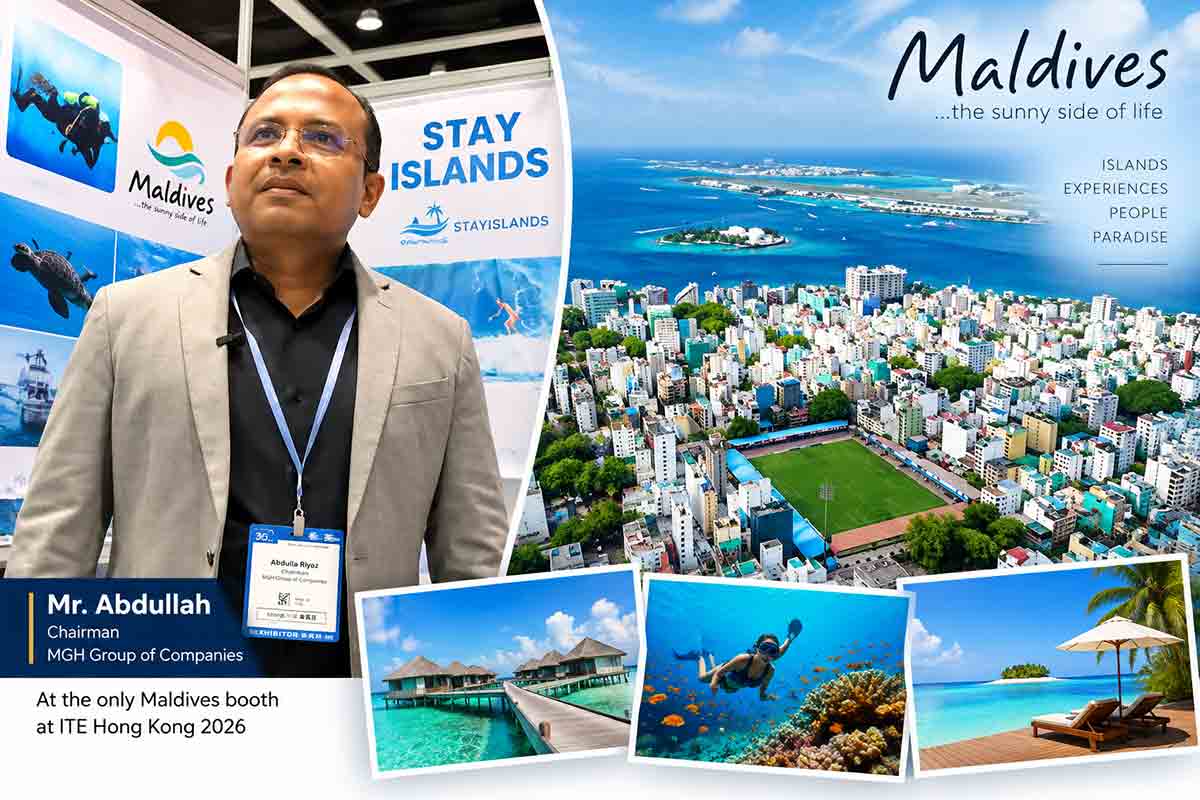
The Maldives is often associated with luxury resorts, turquoise waters and private-island escapes. But at the 40th ITE Hong Kong 2026, the destination was presented as a broader tourism proposition, with accommodation, local-island stays, wellness retreats, fishing, surfing, diving, liveaboards and yacht experiences all forming part of the offer.
Speaking exclusively to Travel Tour World at the event, Mr Abdullah, Chairman of MGH Group of Companies, discussed the company’s presence at ITE Hong Kong and its efforts to promote the Maldives across both business-to-business (B2B) and business-to-consumer (B2C) markets.
According to Abdullah, the company was participating at ITE Hong Kong for the first time and was promoting Maldives holidays through its own hotels and resorts as well as through its destination management activities.
“We are promoting the Maldives here,” Abdullah said, explaining that the group owns hotels and resorts in the Maldives and also operates as a DMC, supporting clients with a wider range of resort and tourism requirements.
Abdullah’s message at ITE Hong Kong was that the Maldives should not be viewed exclusively through the lens of high-end resort holidays.
While the country has an established reputation for luxury tourism, he highlighted the availability of different types of accommodation and experiences, ranging from five-star resorts and international brands to local guest houses.
He also pointed to experience-led tourism products, including yoga retreats, fishing retreats, surfing retreats and diving.
“The Maldives is a luxury hotel destination. We have resorts, five-star resorts, all the big brands are there,” Abdullah said.
At the same time, he stressed that visitors have alternatives beyond traditional luxury resorts.
“We have local guest houses and we have experiences like yoga retreats, fishing retreats and surfing retreats to dive in as well,” he added.
This positioning could give travel buyers more flexibility when developing Maldives itineraries, particularly for travellers who want to combine accommodation with specific activities or interests.
Abdullah also argued that the Maldives can cater to different traveller segments, rather than only the luxury market.
“Whoever has money, whether it is a budget traveller, for the medium-income owners or for the luxury, for whatever you choose, Maldives is there,” he said.
His comments reflect an effort to communicate the diversity of the destination’s tourism offering to the Hong Kong travel trade and consumers.
Despite the emphasis on diversification, the Maldives’ core attraction remains its marine environment and beaches.
During the interview, Abdullah explained that travellers can experience the country’s beaches and sea regardless of whether they choose a luxury resort, a local island or a liveaboard experience.
The discussion underlined an important point in the Maldives tourism proposition: different accommodation categories can provide access to the country’s marine and island experiences, although the precise experience will naturally depend on the property, itinerary and package selected.
For MGH Group, the strategy appears to be about packaging that wider experience for different types of customers rather than limiting the destination to one segment.
The company is also targeting the travel trade and corporate buyers.
When asked about corporate, incentive and wellness-related facilities, Abdullah said MGH Group was working with partners and discussing deals for the B2B market.
“We are making deals. We are discussing with the partners,” he said.
He also referred to existing relationships with local agents in Hong Kong and said the company was offering special packages for travel partners.
Among the products specifically mentioned were fishing, wellness and diving packages.
“We are giving them a special offer on fishing packages and wellness retreat packages as well as diving packages,” Abdullah said.
The comments suggest that the company’s ITE Hong Kong presence is not solely focused on direct consumers. Building relationships with travel agents and other trade partners is also a significant part of the group’s strategy.
That approach is particularly relevant for experience-driven Maldives travel, where international visitors may require support with accommodation, transfers, activities and resort arrangements.
MGH Group was also promoting special offers for consumers attending the exhibition.
Abdullah said that discounts were available during the event and that visitors who made a booking through the company could receive additional benefits.
“There are already special discounts there for this,” he said, referring to the festive period around the event.
He added that customers who came to the booth and made a booking could receive free nights as part of the promotion.
The exact terms, eligibility requirements and availability of the free-night promotion were not detailed in the interview. Therefore, travellers would need to confirm the conditions directly with the company before booking.
The offer nevertheless demonstrates how tourism businesses are using trade exhibitions such as ITE Hong Kong to convert consumer interest into bookings.
The interview also revealed that MGH Group’s Maldives portfolio extends beyond conventional hotel and resort accommodation.
Abdullah confirmed that the company offers liveaboard experiences and luxury yachts, with the latter particularly positioned towards honeymoon travellers.
“We have liveaboard, we have luxury yachts as well for honeymooners,” he said.
This adds another dimension to the Maldives holiday proposition. Instead of remaining at a single resort or island, travellers can experience the destination from the water and potentially incorporate multiple locations into their journey.
Liveaboard tourism is particularly relevant for travellers whose primary interests include marine activities and diving, while yacht experiences can provide a more private and flexible holiday format.
Perhaps the most notable product discussed during the interview was a new luxury honeymoon concept that Abdullah described as a floating hotel experience.
According to him, the product had been newly introduced by the company and was being positioned as a luxury honeymoon package.
He explained that the concept allows travellers to move between different locations rather than remaining in one place.
“This is our new luxury honeymoon package,” Abdullah said. “We are the first to introduce in the Maldives. It’s like a floating hotel.”
The concept is designed to combine accommodation and movement, allowing honeymooners to explore different places while travelling on the water.
“You don’t have to stay in one place, go around different places,” he explained.
The product therefore appears to target travellers seeking a more mobile and experiential luxury holiday rather than the conventional model of spending an entire honeymoon at one resort.
Abdullah described it as a “perfect experience” and emphasised its luxury positioning.
Because the interview did not provide detailed specifications about the vessel, route, duration, inclusions, pricing or operating schedule, those details should be confirmed with MGH Group before being used in consumer-facing booking information.
MGH Group’s participation at ITE Hong Kong 2026 reflects the importance of international travel exhibitions as platforms for destination promotion, trade relationships and direct consumer engagement.
For the company, the event provided an opportunity to present a broad Maldives portfolio to both travel professionals and consumers.
The message from Abdullah was clear: the Maldives can be sold through multiple tourism segments.
Luxury resorts remain central, but the offering also includes local guest houses, wellness retreats, fishing, surfing, diving, liveaboards and yacht experiences. The company is simultaneously pursuing B2B partnerships and consumer bookings.
The introduction of a new floating luxury honeymoon concept adds another layer to that strategy, potentially appealing to travellers who want to combine accommodation, sightseeing and movement into a single experience.
The interview ultimately presented a Maldives tourism proposition that extends beyond the conventional image of an overwater villa and a private beach.
MGH Group is positioning its products across several traveller categories, from budget-conscious visitors and local-island travellers to luxury holidaymakers and honeymooners. It is also developing packages around specific interests such as wellness, fishing, surfing and diving.
At ITE Hong Kong 2026, Abdullah used the company’s first participation at the exhibition to highlight those options and promote the Maldives to both the travel trade and consumers.
The company’s special exhibition offers, including discounts and the possibility of free nights for eligible bookings, add a commercial incentive for visitors considering a Maldives holiday.
Most significantly, the floating honeymoon concept signals an attempt to create a different luxury travel format within the destination. Rather than asking travellers to choose one place and remain there, the product is designed around movement between locations on the water.
As the Maldives continues to attract travellers seeking both luxury and experiences, the MGH Group strategy highlighted at ITE Hong Kong 2026 shows how accommodation, marine tourism, wellness and adventure products can be combined to create a wider destination proposition.
For travellers and travel advisers, the key takeaway is that the Maldives offering discussed at the event is not limited to traditional resort stays. Depending on budget, interests and travel style, visitors can consider a range of accommodation and experiences, with MGH Group presenting itself as a provider capable of supporting both individual consumers and travel-trade partners.
Seychelles offers a different interpretation of the Indian Ocean honeymoon.
The destination is known for beaches framed by distinctive granite formations, lush vegetation and sheltered coves. Its multi-island geography also gives couples opportunities to build an itinerary rather than remain in a single resort throughout their trip.
That makes Seychelles particularly suitable for travellers who want luxury and privacy but also want to explore.
Beach time can be combined with island-hopping, nature experiences and water-based activities, giving honeymooners more variety than a purely resort-centred itinerary.
Mauritius is another leading Indian Ocean option, but its strength lies in the breadth of experiences available beyond the coastline.
Couples can combine beach resorts with sightseeing, gastronomy, cultural experiences, outdoor activities and exploration of the island’s interior.
That diversity makes Mauritius attractive to honeymooners who do not want their entire holiday to revolve around a resort.
The destination can therefore work particularly well for longer honeymoons, where couples want several days of relaxation alongside excursions and cultural discovery.
Indonesia, particularly Bali, provides a more experiential version of the tropical honeymoon.
Beach resorts are only one element of the destination. Couples can combine coastal stays with temples, traditional culture, wellness, food, countryside landscapes and outdoor experiences.
Bali’s appeal is its ability to support different honeymoon styles within one trip. A couple can spend time at a beach resort, move inland for a wellness-focused stay and explore cultural attractions without leaving the island.
For travellers who want a honeymoon with substantial sightseeing and cultural content, Indonesia offers an alternative to the private-island model.
Thailand’s beach honeymoon market is built around variety.
Destinations including Phuket, Koh Samui, Krabi, Phi Phi and other southern islands provide different combinations of beaches, resorts, restaurants, watersports and nightlife.
This flexibility makes Thailand suitable for couples with different budgets and interests. A honeymoon can be built around luxury accommodation and private excursions, or designed as a more active itinerary involving several islands.
Thailand is particularly attractive for couples who want beach relaxation without giving up access to food, culture, entertainment and excursions.
Fiji provides a strong South Pacific alternative for couples seeking private beaches and island experiences.
Its honeymoon appeal comes from the combination of tropical scenery, resort accommodation, marine activities and opportunities for island exploration.
Couples can choose a relaxing resort stay or incorporate activities such as snorkelling, diving, boating and island-hopping.
Fiji’s geographical setting also gives it a distinctly remote character. For honeymooners seeking a sense of escape, that distance can be part of the attraction.
French Polynesia is home to one of the most recognisable names in luxury honeymoon travel: Bora Bora.
The destination is closely associated with overwater accommodation, spectacular lagoons and high-end romantic escapes.
Its strongest appeal is for couples who see their honeymoon as a once-in-a-lifetime luxury trip. The overwater-villa experience, combined with lagoon activities and dramatic tropical scenery, creates a holiday where accommodation and destination are closely connected.
French Polynesia is therefore particularly suited to honeymooners who place luxury, privacy and iconic scenery at the top of their priorities.
Saint Lucia offers something distinctly different from flat coral-island destinations.
The Caribbean island combines beaches with volcanic landscapes, rainforest and the iconic Pitons. This creates opportunities for couples to mix relaxation with hiking, sightseeing and nature-based experiences.
For honeymooners, that combination is significant. A couple can spend a morning on the beach and devote another day to exploring the island’s landscapes.
Saint Lucia therefore works particularly well for couples who want romance without sacrificing adventure.
Antigua and Barbuda has a straightforward honeymoon proposition: beaches, warm Caribbean waters, resorts and opportunities for privacy.
Antigua is particularly associated with its large number of beaches, while the country’s islands and coastal environment provide opportunities for sailing and marine experiences.
For couples who want a traditional Caribbean honeymoon centred around sunshine, beaches and resort relaxation, Antigua and Barbuda remains an important option.
Its appeal is less about packing every day with sightseeing and more about creating a relaxed tropical escape.
Jamaica offers perhaps one of the broadest experiences on this list.
Its beaches are complemented by music, food, local culture, nightlife and outdoor activities. Couples can choose a resort-based holiday while still having access to a destination with a strong cultural identity.
Negril, Montego Bay and other coastal areas provide different settings, while activities such as snorkelling, diving and water sports can add variety to a honeymoon.
Jamaica is therefore particularly suitable for couples who want their beach holiday to include substantial cultural and entertainment experiences.
The honeymoon battlefield is expanding well beyond the tropical escape. Maldives remains a powerful premium luxury proposition, particularly for couples drawn to private resorts, turquoise lagoons and over-water accommodation. Yet Indonesia and other beach countries are offering compelling alternatives by combining coastal beauty with culture, wellness, adventure, gastronomy and island exploration. That competition is changing how destinations sell romance.
A spectacular beach may attract attention, but personalised service, privacy, distinctive accommodation and memorable activities can determine the final booking. For travellers, this is an advantage because the market now offers more choices across different budgets, interests and holiday styles. For hotels, resorts, tourism boards and destination management companies, the challenge is greater: simply promising paradise is no longer enough. Successful honeymoon propositions will connect scenery with experiences and deliver consistent service. As competition intensifies, couples can expect destinations to become more creative, specialised and focused on creating holidays worth remembering.
The strongest beach honeymoon destinations do not all sell the same dream.
The Maldives and French Polynesia excel in ultra-luxury island experiences and overwater accommodation. Seychelles and Mauritius combine Indian Ocean beaches with exploration and nature. Bali and Thailand provide greater cultural and experiential variety, while Fiji offers South Pacific seclusion and marine adventure.
In the Caribbean, Saint Lucia adds mountains and rainforest to its beach proposition, Antigua and Barbuda focuses strongly on beaches and relaxation, and Jamaica combines coastal holidays with culture and entertainment.
For honeymooners, the most important decision is therefore not simply which country has the best beach. It is what kind of honeymoon they want to build around that beach.
A couple seeking complete seclusion may favour the Maldives. Those wanting island exploration could consider Seychelles or Fiji. Travellers interested in culture and wellness may find Bali more suitable, while couples looking for beaches alongside adventure have strong choices in Mauritius, Thailand and Saint Lucia.
That diversity is what keeps beach destinations central to the global honeymoon market: the beach may be the starting point, but the experience surrounding it increasingly determines where couples choose to spend one of their most important holidays.
Advertisement
Tags: beach honeymoon destinations, Indonesia honeymoon, luxury honeymoon resorts, Maldives honeymoon, Overwater Bungalows
Advertisement
Advertisement













Sunday, September 13, 2026
Sunday, September 13, 2026
Sunday, September 13, 2026

Sunday, September 13, 2026
Sunday, September 13, 2026
Sunday, September 13, 2026
Sunday, September 13, 2026

Sunday, September 13, 2026