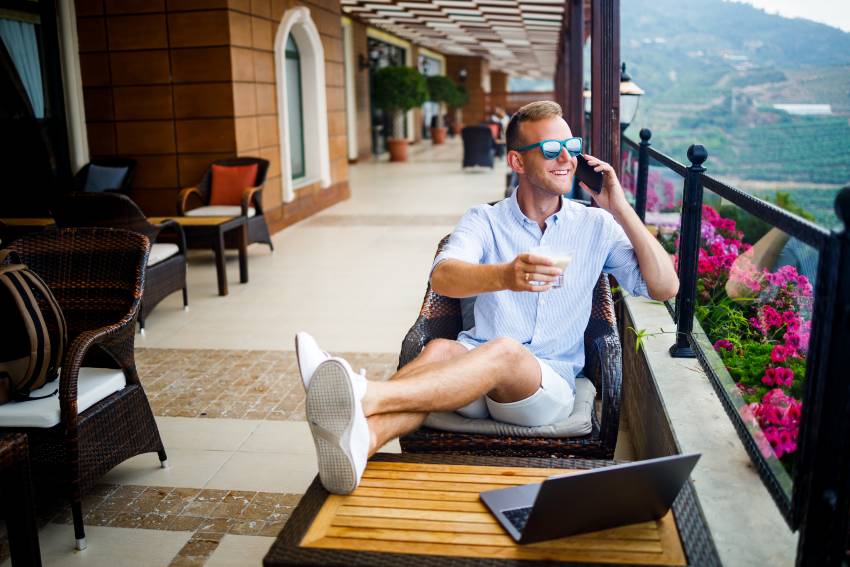
Image generated with Ai
Bleisure travel has gained significant popularity in recent years, from millennials to professionals of all ages. Mixing business with pleasure, bleisure travel gives employees the flexibility to tack vacation days to their business trips, conferring equilibrium to working responsibilities and relaxation. Once perceived as a trend catered to Gen Z, new data reveals that Canadians of all ages are hopping on the bandwagon of this emerging fad.
That’s according to recent research released by Corporate Traveller Canada and YouGov, and it is increasingly prevalent among the nation’s working population, including Gen X business travelers. The findings, however, show the changing attitudes of Canadians towards work travel, as an increasing number of young and mature working professionals see the value in mixing business with pleasure. And it isn’t only among young employees—it’s a burgeoning notion that’s rippling through the entire workforce.
Advertisement
The recent findings demonstrate a dramatic shift in how business travelers approach their trips, with bleisure travel emerging as a key aspect of their travel habits. Data from Corporate Traveller Canada reveals that 24 percent of Canadian business travelers aged 45 to 60 regularly mix work with leisure, bringing them just a few percentage points behind their younger counterparts, with 28 percent of Gen Z travelers also adopting the practice.
This trend highlights how bleisure is no longer confined to just the younger generations but has permeated a wider demographic, including those in their middle ages, further indicating the concept’s acceptance and mainstream appeal. According to a related survey by Flight Centre, nearly 63 percent of Canadian workers who plan to travel in 2025 are open to incorporating leisure into their work trips, with almost one-third (32 percent) having already done so.
Advertisement
Advertisement
The statistics show that bleisure travel is being recognized as an important way to enhance the work-life balance of employees, particularly as travelers seek ways to make their business trips more fulfilling.
The drive for better work-life balance is one of the primary reasons behind the surge in bleisure travel. With 96 percent of Canadians acknowledging the positive impact of travel on their mental health, it becomes evident that the country’s workforce is increasingly aware of the importance of balancing work and personal time. In fact, many employees now look for opportunities to combine their work commitments with leisure activities, aiming to improve their mental well-being while on business trips.
The data further underscores that work-life balance has improved for a significant portion of the workforce. Among small and medium-sized enterprise (SME) employees, 91 percent reported that their work-life balance on business trips has either stayed the same or improved since 2019. Younger Canadians have been especially vocal about the positive changes in their balance, with 50 percent of Gen Z workers and 43 percent of Millennials agreeing that their balance has gotten better.
Interestingly, Gen X workers, while acknowledging improvements, show a slightly more reserved response. Only 21 percent of them feel that their work-life balance has improved, but a majority (68 percent) feel that their balance has remained the same.
As bleisure travel becomes a fixture in the Canadian workforce, the percentage of SME employees who add leisure to their business trips has surged. The survey revealed that nearly 68 percent of SME employees incorporate leisure time into their business travel at least occasionally. Among different age groups, Millennials lead the pack, with 33 percent indicating that they often blend business with leisure. Gen Z follows closely with 28 percent, while Gen X, though less likely, still reports a notable 24 percent participation.
This shift reflects broader trends in how employees are rethinking their approach to work and travel. What once seemed like an indulgence or luxury is now becoming an integral part of the professional landscape. Companies are increasingly recognizing the appeal of allowing employees more flexibility, knowing that it can contribute positively to their overall job satisfaction and retention.
While the demand for bleisure has grown, it’s also clear that flexibility plays a significant role in its widespread adoption. Business leaders who want to retain talent and improve employee satisfaction are beginning to see the value in offering flexibility during business trips. However, the level of flexibility varies among age groups. Younger workers, particularly those between 18 and 24, report less flexibility, with 38 percent indicating that they have little to no room for personal extensions on business trips.
As employees grow older, their flexibility tends to increase. Among workers aged 25 to 34, 31 percent report minimal flexibility, while 28 percent of those aged 50 to 64 face similar restrictions. On the other hand, employees aged 65 and older enjoy the highest level of flexibility, with only 14 percent reporting little to no personal time during their business trips.
This increasing flexibility for older workers has been viewed as a strategic move by employers who recognize that work-life balance is crucial for engagement and long-term retention. As more employees seek the benefits of bleisure travel, businesses are becoming more accommodating, not only to meet the evolving demands of a younger workforce but also to ensure that seasoned professionals enjoy the same advantages.
The rise of bleisure travel is not only a cultural shift but also one that’s having economic implications. As more Canadians blend their work and leisure travel, businesses and local economies are benefiting from increased tourism revenue. Employees who extend their business trips to explore local destinations are contributing to the growth of leisure tourism in the country.
Small and medium-sized enterprises (SMEs) that support this shift see benefits too. With nearly three in ten employees reporting that their company’s travel demand is higher than pre-pandemic levels, it’s clear that business travel is rebounding strongly. Bleisure travel, as part of this recovery, is contributing to both the individual worker’s sense of well-being and the broader economic ecosystem.
For those looking to make the most of their bleisure trips, here are a few quick tips:
Bleisure, which is taking a business trip and spending a few extra days for pleasure, is deeply rooted in Canada’s work culture, and a wide range of age groups is now taking advantage of it. As professionals nationwide work toward a better work/life balance, bleisure travel remains an essential element to their success. Couple this with a demand for greater work-life balance and an emphasis on mental health, and bleisure is here to stay as a leading trend in Canadian business travel in the coming year.
And as more Canadian professionals look for ways to level up their travel, we can expect even more crossover between travel for work and travel for play—diversifying how we experience the world while providing a boost to our economy.
References: Corporate Traveller Canada, YouGov
Advertisement
Advertisement
Advertisement













Saturday, September 5, 2026

Friday, September 4, 2026

Saturday, September 5, 2026

Saturday, September 5, 2026

Thursday, September 3, 2026

Wednesday, September 2, 2026

Saturday, September 5, 2026