
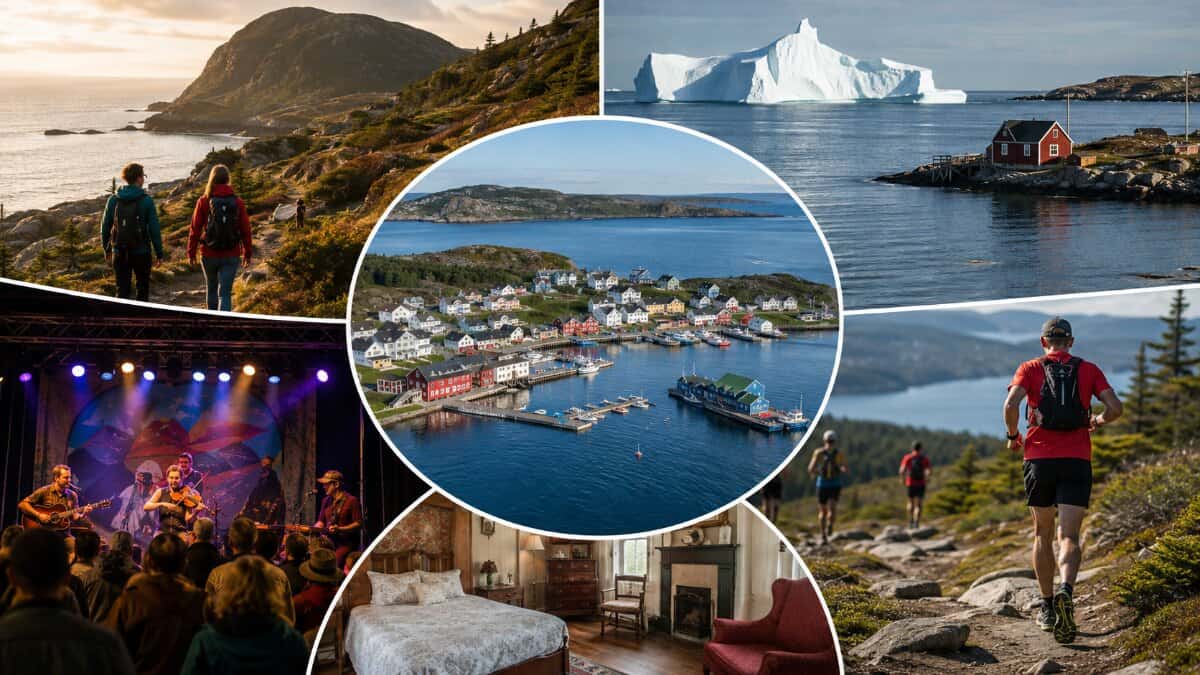
Image generated with Ai
Twillingate is entering September 2026 with a more diversified tourism proposition designed to stretch visitor activity beyond its iceberg-led summer period. The federal government has recorded a C$297,000 agreement for a Twillingate-cluster tourism season-extension initiative, while separate operators and organisations are offering autumn heritage accommodation, cultural programming and trail-running experiences. The initiatives must not be presented as one government-funded events programme. Together, however, they demonstrate how Twillingate is building additional reasons to visit after summer at a time when Newfoundland and Labrador’s fall tourism market is expanding.
Twillingate’s emerging tourism story is not that the Newfoundland community is abandoning the icebergs that established its visitor identity. It is that heritage, culture, hiking and endurance travel are increasingly providing additional products beyond the strongest summer period.
Advertisement
The distinction matters.
The Town of Twillingate continues to promote the community as the Iceberg Capital of the World and says icebergs are often visible between May and July. Twillingate therefore remains firmly associated with Iceberg Alley rather than undergoing a wholesale destination rebrand.
Advertisement
What is changing is the range of reasons travellers have to stay or arrive later in the year.
According to Visit Twillingate, the destination now explicitly promotes early fall as September and October, while acknowledging that operating conditions differ substantially from the peak season and that many local businesses close after Labour Day. That makes the expansion of bookable autumn experiences commercially significant: season extension depends not merely on attracting visitors, but on keeping enough tourism supply operating to serve them.
The strongest institutional evidence behind the broader shift comes from the federal government.
According to the Government of Canada Grants and Contributions database, the Atlantic Canada Opportunities Agency recorded an agreement valued at C$297,000 with Central Destination Marketing Organization Inc. beginning on 27 January 2026 and running until 28 February 2027.
Its recorded purpose is to implement a season-extension initiative for the tourism sector in the Twillingate cluster under ACOA’s Regional Innovation Ecosystem programme.
This is the principal government-backed development supporting the headline.
However, the federal disclosure does not state that the C$297,000 agreement finances the individual accommodation packages, Unscripted Arts Festival or Rockcut Race Weekend discussed below. Those activities are independently verified tourism products occurring during the same autumn period.
They should therefore be described as concurrent evidence of Twillingate’s expanding shoulder-season tourism offer, not components of the federal agreement unless further official documentation establishes a financial relationship.
That correction prevents several distinct tourism developments from being incorrectly collapsed into a single announcement.
Twillingate’s move comes as Newfoundland and Labrador is recording measurable growth outside July and August.
The province’s 2025 Tourism Key Performance Indicators, published in 2026, show 102,100 visitors during September and October 2025, an increase of 7,900 or eight per cent compared with 2024.
Fall visitation was also 11 per cent above 2019 and 15 per cent higher than in 2011, according to the Department of Tourism, Culture, Arts and Recreation.
The increase is even more striking when leisure travel is isolated.
The province recorded more than 50,400 fall vacation visitors in 2025, compared with 31,600 in 2011. That represents growth of 59 per cent. By comparison, July and August vacation visitation increased by 28 per cent over the same period to 102,200.Newfoundland and Labrador tourism indicator Official result Why it matters to Twillingate Fall visitors in 2025 102,100 Expanding September and October demand Growth versus 2024 8% Shoulder season continues gaining momentum Growth versus 2019 11% Fall travel now exceeds pre-pandemic levels Fall vacation visitors in 2025 50,400+ Significant leisure market beyond summer Fall vacation growth since 2011 59% Long-term structural expansion Summer vacation growth since 2011 28% Fall leisure travel has grown faster
These are province-wide figures, not Twillingate-specific results. They do not prove that the federal Twillingate project has already delivered additional visitors.
They do establish a considerably more favourable market environment for a destination attempting to lengthen its season.
The first visible autumn component begins on 1 September 2026.
Newfoundland and Labrador Tourism lists the Time Traveller’s Escape at Lupinfield Cottage from 1 September to 31 October 2026. The three-night product is explicitly positioned around quieter autumn travel after the summer rush and includes a reduction on the third night when booked under the offer.
The heritage dimension is supported separately by Visit Twillingate.
Lupinfield Cottage is described as a fully restored nineteenth-century home containing vintage and antique furnishings, period rooms, heritage colours and Victorian design characteristics. Its listed operating season stretches from April through November.
This matters because the product is not dependent on iceberg sightings.
It instead monetises built heritage, atmosphere and slow travel, providing a tourism experience whose core appeal remains available after the principal iceberg months.
Another provincial tourism listing reinforces this transition. The Iceberg Alley Bed and Breakfast Fall Getaway runs from 1 September to 6 October 2026, focusing on autumn colours, coastal walking and quieter conditions.
Cultural tourism becomes particularly important in the middle of September.
The Unscripted Arts Festival is scheduled to return to Twillingate from 18 to 20 September 2026, with programming centred on performances, exhibitions and Newfoundland creativity.
Unlike many tourism events where season extension is inferred by observers, the organiser explicitly identifies extending Twillingate’s tourism season and attracting visitors after the busiest summer period as part of the festival’s economic-development purpose.
That makes Unscripted particularly relevant to the wider strategy.
There is also historical precedent for viewing the festival through this lens. The Government of Newfoundland and Labrador previously included Twillingate’s Unscripted event among festivals supported under provincial season-extension programming. The current federal C$297,000 agreement should still be treated separately, but the earlier government record shows that cultural events in Twillingate have long been considered potential shoulder-season tourism tools.
The provincial policy environment remains supportive of the model.
Newfoundland and Labrador’s Tourism Product Development framework says multi-season tourism products are intended to extend the traditional visitor season and raise tourism revenue, while the province’s developing Festivals and Events Partnership Program is focused specifically on shoulder and winter events capable of increasing non-resident visitation.
Twillingate’s trail network provides the outdoor counterpart to heritage and arts travel.
Visit Twillingate lists 15 Rockcut trails, describes the network as suitable for hiking, cycling and trail running, and identifies it as open year-round.
That infrastructure becomes the centre of a defined sports-tourism event on 26 September 2026, when Outport REACH stages Rockcut Race Weekend.
The 2026 programme contains three events:Rockcut event Distance Date Rockcut Ultra 50 km 26 September 2026 Halfcut 23 km 26 September 2026 Shortcut 9 km 26 September 2026
The organiser confirms that all three races use Twillingate’s Rockcut trail system and coastal outport landscape. Registration for the 2026 event is currently closed, an important limitation for travel businesses considering last-minute race packages.
Race registration for participants takes place on 25 September, while the races and awards programme follow on 26 September, effectively creating a multi-day visitor period rather than a single morning activity.
The organiser states that Rockcut Race Weekend draws more than 300 people to Twillingate during the final week of September. That figure comes from the event organisation rather than government statistics and should therefore be regarded as an organiser-reported event estimate.
The accommodation sector is also being positioned around outdoor travel.
Anchor Inn Hotel’s Fall For Twillingate package runs from 15 September through 25 October 2026 and combines a two-night stay with a hiking map and a proposition focused on Twillingate’s coastline, history and walking trails.
A separate Rockcut Ultra accommodation package is available for 25 to 27 September, specifically for participating runners and requiring proof of race entry.
Again, there is no official evidence showing these hotel packages are funded by the federal C$297,000 agreement.
Their importance lies elsewhere: they demonstrate that commercial accommodation products are being sold around late-September and October experiences, which is essential if season extension is to translate into room nights rather than simply day visitation.
The province’s currently published Fall Vacation Visitor Profile, based on the 2023 Provincial Visitor Exit Survey, provides another reason the strategy is commercially plausible.
Fall leisure visitors stayed an average of 12.2 nights in Newfoundland and Labrador and spent C$3,534 per travel party. Some 71 per cent arrived by air, while 41 per cent were repeat visitors.
Their interests closely match what Twillingate can sell after summer.
The survey found 66 per cent participated in hiking, while coastal sightseeing, rural communities, historic sites and cultural experiences were among the prominent activities. Scenery, natural landscapes and coastlines motivated 49 per cent of fall vacationers, while people, culture and history motivated 34 per cent.
Nearly 47 per cent began planning their Newfoundland and Labrador trip less than three months before travelling, suggesting that late-summer promotion can still influence September and October bookings.
These figures are not 2026 forecasts. They describe the province’s published fall visitor profile based on the 2023 survey and should be used as behavioural context rather than current-year performance data.
The destination does not have to establish awareness from zero.
Newfoundland and Labrador’s Vacation Visitor Profile shows that the wider Gander and Twillingate economic zone attracted overnight stays from 33 per cent of surveyed vacation visitors in 2023.
Within Central Newfoundland, 66 per cent of surveyed regional vacation visitors visited Twillingate, making it the strongest listed Central Region destination in that research, ahead of Gander at 59 per cent.
This provides Twillingate with an important advantage.
A destination that already sits on established provincial touring itineraries may have a better opportunity to shift when people travel, rather than having to convince an entirely new audience to discover it.
For repeat visitors in particular, autumn heritage, arts and trail products can offer a materially different proposition from a first trip centred on icebergs and whales.
Product diversification alone will not determine whether the strategy succeeds.
Visit Twillingate identifies Gander International Airport as the closest airport, approximately 1.5 hours away by car. Travellers coming from St. John’s face an approximately 4.5 to five-hour drive, or can fly to Gander and continue by road.
There is no direct public transport service completing the journey from Gander to Twillingate, according to the destination’s visitor information.
This connectivity should be considered an access issue, not part of the federal season-extension announcement.
For the travel trade, however, it is highly relevant. Shoulder-season travellers need confidence that rental vehicles, accommodation, restaurants and attractions will remain available once peak summer schedules begin contracting.
Visit Twillingate itself cautions that many businesses close after Labour Day.
That is arguably the most important commercial test facing the initiative.
Twillingate’s autumn calendar demonstrates expanding product variety, but it does not yet prove that the tourism season has materially lengthened.
The C$297,000 agreement remains active into February 2027, while September and October 2026 have not yet occurred. Destination-level occupancy, room revenue, visitor spending and length-of-stay figures for this autumn therefore cannot yet be used to establish success.
The meaningful performance indicators will be:
Newfoundland and Labrador’s broader tourism policy makes these outcomes increasingly important. Budget 2026 identifies extending the tourism season towards a year-round destination model as a provincial priority and allocates C$14.5 million to tourism marketing and air access.
The most accurate interpretation of Twillingate’s 2026 autumn tourism push is therefore one of portfolio expansion.
Its iceberg identity remains intact. Heritage accommodation adds a slow-travel proposition. The Unscripted Arts Festival establishes a cultural reason to arrive in mid-September. Rockcut creates a late-month endurance travel market. Hiking infrastructure remains usable beyond the principal summer season. Accommodation operators are extending dedicated offers into October.
At the same time, Canada has an independently verified C$297,000 agreement specifically aimed at tourism season extension in the Twillingate cluster.
Those developments should not be incorrectly portrayed as a single government-funded campaign.
Taken together, however, they point in the same strategic direction at precisely the moment when Newfoundland and Labrador’s fall visitation is growing faster than its traditional summer market over the long term.
For Twillingate, the opportunity is no longer simply to attract travellers after iceberg season.
The more consequential challenge is to convert autumn interest into additional room nights, longer business operating periods and dependable tourism revenue. If that occurs, the destination will have extended far more than its calendar. It will have begun building a more resilient visitor economy beyond summer.
Advertisement
Advertisement
Advertisement













Saturday, September 5, 2026

Saturday, September 5, 2026

Saturday, September 5, 2026

Saturday, September 5, 2026
Saturday, September 5, 2026

Saturday, September 5, 2026

Saturday, September 5, 2026

Saturday, September 5, 2026



