
United States Joins Chile and Others as São Paulo Tourism Boom Drives 10% Rise in New Travel Businesses

Published
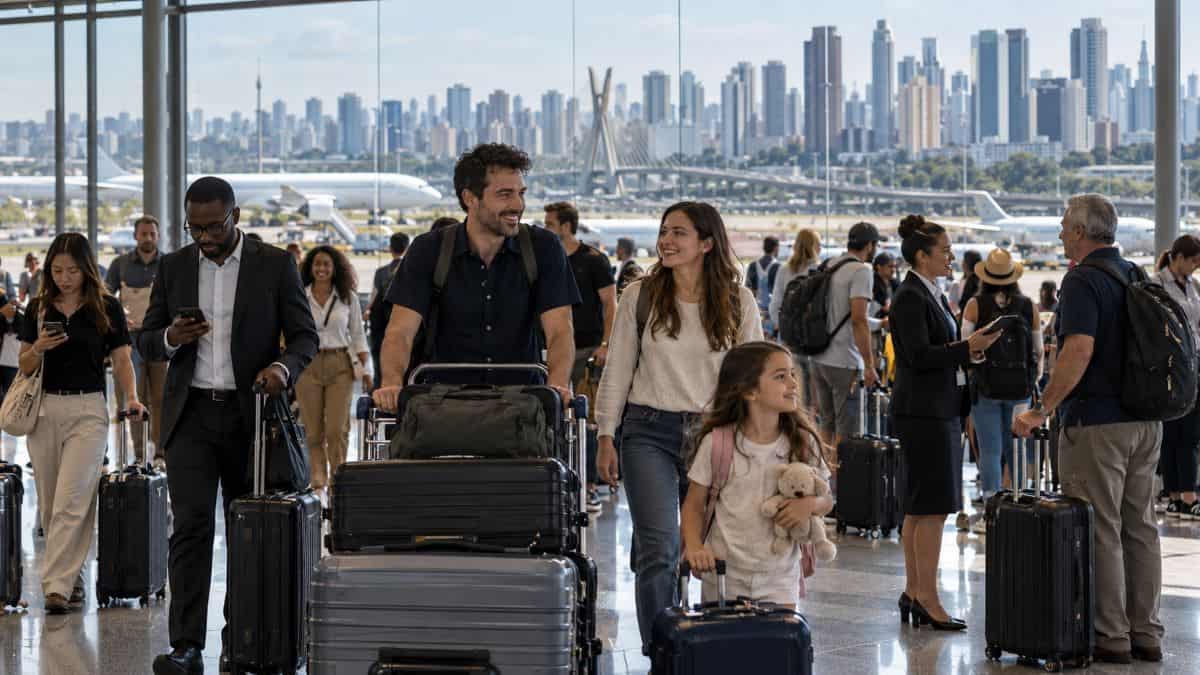
São Paulo is growing its tourism sector at a rate that is now transforming the scope and nature of its tourism economy. Between January and August 2026, 1,237 new travel-related businesses were registered across the state, 10% more than during the same period in 2025. It encompasses travel agencies, tour operators and reservation-service companies, and visitor demand is growing from the United States, Chile and Argentina and other international markets.
For travellers, the important story is not simply that more companies exist. São Paulo is building a larger network capable of selling trips, organising complex itineraries, connecting international arrivals with domestic destinations and serving a fast-growing Brazilian travel market.
Advertisement
Advertisement
São Paulo Tourism Boom at a Glance: The Numbers Travellers Need to Know
The strongest way to understand São Paulo’s tourism expansion is to look at demand and supply together.
| 2026 tourism indicator | Latest official figure | Why it matters to travellers |
|---|---|---|
| New selected tourism businesses, Jan-Aug | 1,237 | More agencies, operators and booking services |
| Growth in new tourism businesses | 10% | Tourism supply is expanding with demand |
| International arrivals to São Paulo state through August | About 1.9 million | Stronger global demand |
| São Paulo city visitors, H1 | 25.4 million | Large year-round customer base |
| Domestic visitors to São Paulo city, H1 | 24.1 million | Domestic travel anchors the market |
| International air arrivals to São Paulo state, Jan-Jul | 1.64 million | Confirms São Paulo’s gateway role |
| São Paulo city tourism turnover, June | R$2.21 billion | Visitor demand is translating into spending |
| Formal direct tourism jobs, Q1 | 984,778 | The tourism workforce is also expanding |
São Paulo city’s first-half visitor volume increased 13.3% year on year, while tourism turnover in June climbed 9.8%. Tourism-related municipal service-tax revenue reached R$81.9 million that month, up 14%.
Advertisement
Advertisement
The significance is clear: company formation is taking place inside a tourism economy that is already processing more travellers and more spending.
New Travel Agencies Dominate, but Tour Operators Are Growing Faster
Of the 1,237 companies created between January and August:
Advertisement
Advertisement
- 949 were travel agencies
- 127 were tour operators
- 161 were reservation and other tourism-service businesses
Travel agencies accounted for roughly 77% of the new companies.
However, the more revealing figure sits elsewhere. Tour operators increased from 112 new registrations in the comparable 2025 period to 127 in 2026, equivalent to growth of about 13.4%. That was faster than the expansion in travel agencies or reservation businesses.
Advertisement
Advertisement
Author analysis: this distinction matters because operators generally assemble products rather than simply sell individual components. Faster operator formation can expand the market for organised city experiences, regional circuits, transfers and multi-destination packages.
For travellers using São Paulo as an entry point into Brazil, that could gradually make complicated journeys easier to package and book.
United States, Chile and Argentina Are Reshaping São Paulo’s International Mix
São Paulo’s international market is not dependent on a single country.
During January-April 2026, the state registered a record 1,071,368 international tourist arrivals, 4.9% more than in the corresponding period of 2025.
Advertisement
Advertisement
The largest source markets were:
| International market | São Paulo arrivals, Jan-Apr 2026 |
|---|---|
| Argentina | 162,226 |
| United States | 153,874 |
| Chile | 65,346 |
| Portugal | 53,497 |
| Germany | 52,222 |
The unusually narrow gap between Argentina and the United States is particularly important.
Argentina dominates Brazil’s national inbound tourism market, but São Paulo attracts an exceptionally strong US flow. That creates a more internationally diversified customer base for businesses serving foreign visitors.
São Paulo city’s leading international markets in the first half of 2026 also included the United States, Argentina, China, Chile and Colombia.
For travellers, that diversity can support greater demand for multilingual services, tailored itineraries and products designed for different trip lengths and travel styles.
São Paulo’s Aviation Advantage Is Becoming Even More Valuable
One of the strongest insights in the latest government data comes from aviation.
Advertisement
Advertisement
More than four million international tourists arrived in Brazil by air between January and July 2026, up 12% from the same period in 2025. São Paulo alone received 1.64 million international tourists by air, the highest total among Brazilian states.
But there is a striking contrast.
Across all modes of transport, Brazil recorded 5.87 million international arrivals during January-July, 1.3% lower year on year. Air arrivals, meanwhile, increased 12%.
That divergence gives São Paulo an important structural advantage.
Its tourism economy is tied closely to international aviation and the Guarulhos hub. As international demand becomes increasingly aviation-led, São Paulo sits directly in the part of Brazil’s inbound market that is currently expanding fastest.
For international visitors, this reinforces São Paulo’s dual role:
Advertisement
Advertisement
- a major destination in its own right;
- a gateway for onward journeys across Brazil.
Domestic Tourism Is the Hidden Giant Behind the Business Boom
International growth explains only part of the opportunity.
São Paulo city received 25.4 million tourists in the first half of 2026, including 24.1 million domestic travellers. Brazilian visitor numbers rose 13.8%, while international tourism increased 4.4%.
That means approximately 95% of first-half visitor volume was domestic.
This is one of the most important facts for understanding the 10% increase in new businesses.
International travellers add valuable global demand, but Brazilian travellers provide the enormous volume needed to sustain agencies, operators and other services throughout the year.
Expert interpretation: São Paulo therefore has a two-engine tourism market. Domestic tourism provides scale. International tourism adds diversification, aviation demand and additional opportunities for specialised services.
Advertisement
Advertisement
That mix makes business growth less dependent on one country or one travel season.
Tourism Credit Is Reaching More São Paulo Entrepreneurs
Business creation also needs capital.
Banco do Povo Paulista issued R$482,300 in tourism microcredit from January through August 2026, up 90.2% from R$253,600 during the same period of 2025.
The number of tourism credit operations increased from 15 to 27, an 80% rise.
A closer calculation reveals another useful insight. Average lending rose only from about R$16,900 to R$17,900 per operation.
In other words, the surge came mainly because more tourism entrepreneurs received financing, rather than because a small number of businesses took dramatically larger loans.
Advertisement
Advertisement
That broadening of access could be particularly relevant for small agencies, operators and service providers that need equipment, working capital or capacity to expand.
More Tourism Businesses Mean More Choice — But Travellers Should Still Verify Providers
Rapid business creation should not automatically be interpreted as guaranteed lower prices or better service.
More competition can expand choice, but quality will still vary between providers.
Brazil gives travellers an official verification tool through Cadastur, the Ministry of Tourism’s national register of tourism-service providers.
Registration is mandatory for categories including travel agencies, accommodation providers, tourist transport companies, event organisers, theme parks and tourism guides. The government describes Cadastur as an official source that tourists can consult when checking providers.
Before paying for a tour, transfer or package, travellers can therefore:
Advertisement
Advertisement
- confirm that the provider is formally registered where registration is required;
- compare cancellation and refund conditions;
- check exactly what a package includes;
- confirm whether transport, guides and attraction tickets are included;
- retain booking documents and payment records.
This becomes more important as the number of tourism businesses grows.
United States joins Chile and others as São Paulo tourism boom drives 10% rise in new travel businesses, powered by stronger visitor demand.
Why São Paulo’s 10% Tourism Business Rise Matters Beyond the Numbers
The United States joins Chile, Argentina and other international markets in strengthening São Paulo’s visitor economy, but foreign arrivals alone do not explain the expansion.
The bigger picture combines several forces: strong domestic tourism, growing international aviation, rising visitor spending, almost one million formal tourism jobs and wider access to business finance.
Government data do not prove that international arrivals directly caused the 10% rise in new travel businesses. What they do show is a powerful alignment between growing demand and expanding tourism supply.
For travellers, this is where the São Paulo tourism boom becomes tangible.
Advertisement
Advertisement
A larger network of agencies, operators and reservation companies can create more ways to build a Brazil itinerary, move beyond the main gateway and buy specialised experiences. São Paulo is therefore evolving from simply being Brazil’s biggest international entry point into something more valuable: a deeper travel marketplace connecting millions of visitors with the rest of the country.
Advertisement
