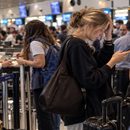
Image generated with Ai
Hundreds of passengers across Europe are facing another day of heavy disruptions today, with travelers through Barcelona dealing with the heaviest delays, while passengers flying to or from Catania face a surge in cancellations linked to renewed activity at Mount Etna.
Across major European hubs in London, Paris, Amsterdam, Frankfurt, Barcelona, Milan, Rome, Madrid, Zurich, and Munich, 2,379 flights are delayed and 176 are cancelled today.
Barcelona is the biggest delay hotspot with 427 delays, while travelers at Catania faced the heaviest cancellations. The airline picture is led by Vueling Airlines, followed by British Airways, easyJet, Lufthansa, Ryanair, and Air France. KLM is also facing substantial disruption at Amsterdam Schiphol.
The contrast is striking: Barcelona is absorbing a heavy wave of delayed flights, while Catania is experiencing a cancellation-heavy disruption as volcanic ash from Mount Etna continues to affect aviation in eastern Sicily. Fresh ash emissions have forced an extended suspension of flights at Catania, disrupting peak-season travel.
For passengers flying through Barcelona today, delays are the main concern. The airport has 427 delayed flights, accounting for approximately 18% of the 2,379 delays recorded today, while 24 flights have been cancelled. Travelers are therefore more likely to face longer waits, late departures or disrupted connections than a completely cancelled service.
Advertisement
The situation is very different for passengers using Catania Airport. The Sicilian airport has recorded 68 cancellations against just 15 delays following Mount Etna’s eruption. Fresh volcanic ash emissions have repeatedly disrupted flight operations, with the suspension of flights extended as ash affects airspace over eastern Sicily. Travelers flying to or from Catania face a greater risk of having their flight removed from the schedule altogether rather than simply departing late.
The airline patterns across Europe reinforce the difference. Vueling Airlines has 260 delays, but 211 are concentrated at Barcelona. British Airways has 212 delays, with 188 at Heathrow. Both airlines therefore have substantial delay exposure concentrated at individual hubs.
Advertisement
Advertisement
easyJet faces a different operational pattern. Its 211 delays are spread across Zurich, Paris, Madrid, Munich, Gatwick, Malpensa, Amsterdam, Fiumicino, Barcelona, Naples and Orly. That makes its disruption geographically broader than the concentration seen with Vueling and British Airways.
Lufthansa has 125 delays across Frankfurt, Munich and other European markets, while its 20 cancellations include significant disruption at Barcelona and Catania.
Barcelona has 427 delays and 24 cancellations, making it the clear delay hotspot in Europe today.
Vueling Airlines accounts for 211 delays, nearly half of the airport’s entire delay total. Lufthansa, Air France, British Airways, easyJet and Ryanair are also contributing to the disruption.
Advertisement
Advertisement
For passengers, delays are a far greater concern than cancellations at Barcelona today, with most scheduled services still operating but running behind schedule.
Catania has 15 delays and 68 cancellations, making it the most cancellation-heavy airport in today’s European picture.
The disruption is directly connected to Mount Etna’s ongoing eruption. Fresh ash emissions have forced Catania to suspend flight operations, with the resulting restrictions affecting arrivals and departures in eastern Sicily. Reuters reported that the suspension has been extended because of the continuing ash emissions.
Ryanair has 21 cancellations at Catania, while easyJet has 17 and Lufthansa has four. BA Euroflyer, Buzz, Finnair, Delta Air Lines, Transavia France, Israir, Aer Lingus, City Airlines, Edelweiss Air, Eurowings, HOP!, Iberia and Air Canada have also recorded cancellations.
Catania’s 68 cancellations account for approximately 39% of all 176 cancellations, an unusually large concentration at a single airport.
Heathrow has 252 delays and seven cancellations, with British Airways accounting for 188 delays.
That represents almost 89% of British Airways’ 212 delays across the European airports in this story. Iberia, United, Emirates, Etihad Airways, Qatar Airways and Vueling Airlines are also experiencing disruption.
Amsterdam Schiphol has 207 delays and 12 cancellations. KLM accounts for 92 delays and all 12 of its cancellations.
Transavia Airlines, Vueling Airlines, easyJet, Air Baltic, ITA Airways, Air France and Delta Air Lines are also affected, adding pressure to one of Europe’s major connecting hubs.
Zurich has 191 delays and four cancellations. Swiss, Edelweiss Air, Air Baltic, Helvetic and easyJet are among the affected airlines.
The balance is strongly weighted toward delays, making Zurich more similar to Barcelona and Heathrow than to cancellation-heavy Catania.
Paris Charles de Gaulle has 221 delays and five cancellations. Air France accounts for 93 delays, making the Paris hub the overwhelming center of the airline’s disruption.
HOP!, easyJet, Vueling Airlines and British Airways are also affected. Paris Orly adds another 116 delays and five cancellations to the wider Paris picture.
Frankfurt, Munich, Rome Fiumicino, Malpensa, Madrid and Naples are also experiencing disruption, creating a broad European network effect.
Vueling Airlines leads the delay ranking with 260 delays and seven cancellations.
Barcelona accounts for 211 of those delays, meaning more than 80% of Vueling’s delays are concentrated at one airport. Additional delays are spread across Charles de Gaulle, Gatwick, Heathrow, Malpensa, Amsterdam, Fiumicino and Orly.
That gives Vueling a wide European disruption footprint but an exceptionally strong concentration at Barcelona.
British Airways saw 212 delays and 14 cancellations.
Heathrow accounts for 188 delays, or almost 89% of its total delay count. Additional disruption has occurred at Charles de Gaulle, Frankfurt, Malpensa, Barcelona and Naples.
The airline’s disruption is therefore heavily centered on London rather than evenly distributed across its European network.
British Airways is preparing to shift its long-running Tampa service from Gatwick to Heathrow on October 25, 2026, creating a new London Heathrow–Tampa airport pairing. The airline has served Tampa since 1985, making the route part of its long-standing transatlantic network. Passengers are searching for “British Airways Tampa flight changes” as they seek clarity on the airline’s upcoming route changes.
easyJet faced 211 delays and 32 cancellations, giving it the highest cancellation total among the major airlines.
Its delays stretch across Zurich, Paris, Madrid, Munich, Gatwick, Malpensa, Amsterdam, Fiumicino, Barcelona, Naples and Orly. Catania is particularly significant for cancellations, with 17, while Gatwick has five and Malpensa another five.
Unlike Vueling and British Airways, easyJet’s disruption is spread across multiple national markets.
Lufthansa saw 125 delays and 20 cancellations.
Frankfurt and Munich account for the largest portions of its delays, while Barcelona and Catania add to its cancellation total. The airline is therefore dealing with disruption at several major European hubs rather than a single dominant point.
Ryanair faced 118 delays and 29 cancellations across Madrid, Malpensa, Fiumicino, Barcelona, Catania and Naples.
Catania is the standout location, accounting for 21 of the airline’s cancellations. Mount Etna’s disruption therefore has a particularly direct impact on Ryanair’s operations in Sicily.
Air France saw 106 delays and one cancellation.
Charles de Gaulle accounts for 93 delays, meaning Paris represents the overwhelming majority of its disruption. Smaller delay totals at Amsterdam, Barcelona and Naples extend the impact beyond its main hub.
Mount Etna is the primary cause of the exceptional cancellation pattern at Catania. Fresh volcanic ash emissions disrupted airspace over eastern Sicily and forced the suspension of flight operations at the airport.
Operational pressures such as high traffic volumes, airport congestion, aircraft rotations, connecting-flight knock-on effects, airline scheduling pressure and air traffic management can contribute to delays across interconnected networks. These are general aviation mechanisms, however, and should not be treated as confirmed explanations for the disruption at each individual airport.
The contrast with Catania is therefore important. Volcanic ash provides a documented cause for the cancellation spike there, while the reasons behind individual delays elsewhere require separate confirmation.
Passengers travelling through Barcelona should prepare for significant delays, particularly those flying Vueling Airlines, given the concentration of its disruption at the Spanish hub.
Passengers flying British Airways through Heathrow should closely monitor their flight status because 188 of the airline’s 212 delays are concentrated there.
Catania requires particular attention because the disruption is being driven by cancellations rather than ordinary delays. Mount Etna’s ongoing ash emissions are continuing to affect flight operations, so passengers should check directly with their airline before travelling to the airport.
Travelers connecting through Amsterdam should monitor KLM schedules, while passengers using easyJet across Italy, Spain, the UK and France should watch for schedule changes across different points of their journey.
Delays can also move through the network during the day. An aircraft arriving late at one airport can subsequently depart late on its next sector, while crews and connecting passengers can face the same knock-on effect.
Aviation across Europe is dealing with 2,379 delays and 176 cancellations today, stretching from Barcelona, London and Amsterdam to Paris, Frankfurt, Rome, Milan, Madrid, Zurich and Munich.
Barcelona remains the principal delay hotspot, while Catania has become the major cancellation center as Mount Etna’s eruption disrupts aviation in Sicily. Vueling Airlines, British Airways, easyJet, Lufthansa, Ryanair, Air France and KLM are among the airlines facing significant operational pressure.
The disruption is not uniform. Barcelona, Heathrow, Zurich and Paris are experiencing predominantly delay-heavy operations, while Catania is facing a dramatically different situation in which cancellations far exceed delays.
With aircraft, crews and passengers continuing to move between European hubs throughout the day, travelers should continue monitoring their individual flight schedules as operating conditions change.
The data has been extensively curated by our editorial team using real-time aviation figures recorded on 12 August 2026 at 1:13 pm ET USA (5:13 pm GMT)
Primary Source: FlightAware.
Verification Protocol: All statistics have been independently reviewed and cross-checked by our human editorial desk. Timestamped records, data logs and feed snapshots are securely archived internally to support historical accuracy and editorial transparency.
Note: Real-time flight-tracking figures reflect active airspace and operational data. Minor variations may occur when compared with information displayed at individual airport terminals or airline departure gates.
Travellers are advised to check directly with their respective airlines and airports for the latest flight status, schedule changes and operational updates.
Advertisement
Tags: Barcelona International Airport Cancellations Today, british airways tampa flight changes, Europe flight cancellations today, europe flight delays today, Vueling Airlines Flights Cancelled Today
Advertisement
Advertisement











Tuesday, September 1, 2026

Tuesday, September 1, 2026

Tuesday, September 1, 2026

Tuesday, September 1, 2026

Tuesday, September 1, 2026

Tuesday, September 1, 2026

Tuesday, September 1, 2026

Tuesday, September 1, 2026