
Japan Partners With Netherlands and Other Countries in Open-Flow Biometric Boarding and Digital Identity Revolution

Published
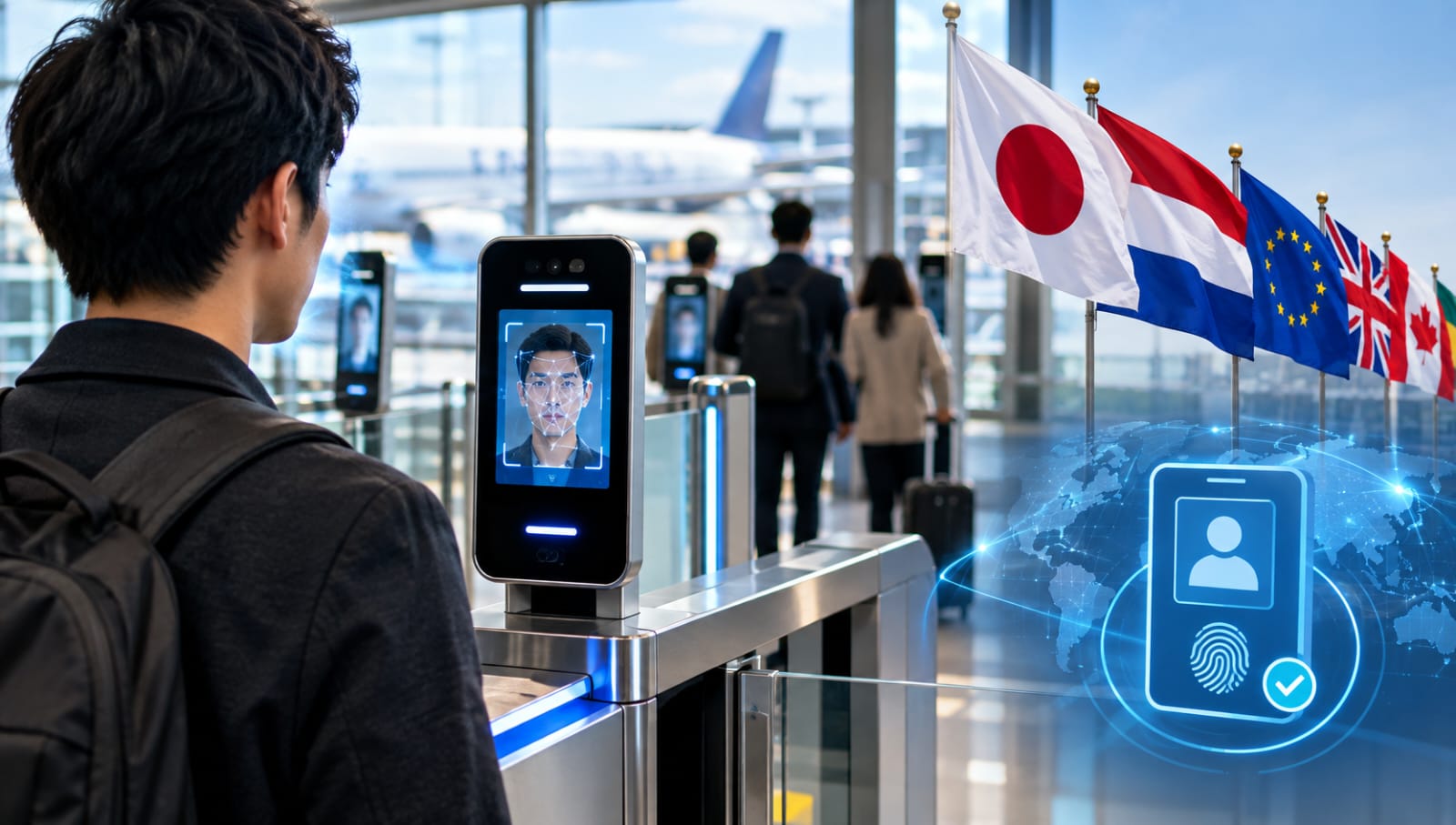
Japan partners with Netherlands and other countries to pioneer a mind-blowing open-flow biometric boarding concept that will radically change the face of travel. Smart-travelers no longer need to use apps or paper passes to get through the airport. The decentralized wallet concept allows travelers to keep encrypted facial vectors on their devices. High-speed optical cameras then scan the face to match it to an open manifest within milliseconds. This amazing innovation makes getting through the gate faster than ever before. Airports worldwide are adopting this futuristic approach to make getting through the airport easier than ever for travelers.
Open-loop biometrics boarding gates and decentralized sovereign identity wallets create an innovative paradigm that can revolutionize the world’s airport industry. This new concept completely revolutionized the boarding process by erasing the need for traditional phone apps or paper boarding passes by allowing passengers to store encrypted facial vectors in a decentralized wallet on their devices. As travelers arrive at the open-loop airport gates, high-speed open-loop optical cameras scan the face to identify it against the manifest within mere milliseconds. This totally transforms the process of getting through the gate to the point where there are no more slow stop-and-scan queues to deal with at all. Four nations are uniting to adopt this new system around the world at major transportation hubs through localized infrastructure adaptations.
How Are Open-Flow Biometric Corridors Revolutionizing Travel in the United Arab Emirates?
The United Arab Emirates is aggressively scaling open-flow biometric corridors across major aviation hubs to process high volumes of international transit travelers instantaneously. Major transport centers like Dubai International Airport utilize advanced smart zones to eliminate traditional checkpoint bottlenecks completely. Modern infrastructure leverages high-speed edge computing to authenticate passengers in milliseconds without slowing down pedestrian movement. These systems integrate local facial capture directly with government databases to ensure high accuracy. Modern algorithms handle massive daily crowds effortlessly while maintaining strict operational security standards across departure terminals.
Stringent security protocols manage passenger data safely during every high-volume transit movement. The aviation sector continues to prioritize speed alongside robust defensive encryption layers.
Advertisement
Advertisement
What Role Does Japan Play in Deploying Rapid-Transit Facial Recognition?
Japan is deploying advanced facial recognition infrastructure across domestic and international terminals to drive rapid-transit boarding efficiency. Major airlines and airport authorities utilize automated systems that link passenger booking records directly to unique facial templates upon initial registration. Travelers simply walk past specialized optical terminals without needing physical boarding passes or mobile device QR codes. This streamlined framework significantly cuts down aircraft turnaround times while reducing congestion in busy departure halls. Such efficient processing mechanisms allow terminal operators to handle surging tourism numbers effortlessly.
Automated gates process thousands of daily flyers with minimal human intervention required by ground staff. System developers maintain rigorous data deletion schedules to safeguard individual privacy rights throughout the journey.
Advertisement
Advertisement
You can check the official details and updates on the Ministry of Civil Aviation portal via civilaviation.gov.in.
How Is India Integrating National Digital ID Architecture With Airport Control Systems?
India is expanding national digital ID architecture integration with airport departure control systems for paperless, touchless terminal transit. Popular frameworks utilize decentralized community tokens where encrypted credentials sit securely on personal user smartphones. These mobile credentials verify locally against government identity profiles without centralizing raw biometric images on vulnerable external servers. Passengers navigate through entry checkpoints and boarding gates smoothly by simply glancing at integrated optical sensors. This national rollout demonstrates how decentralized sovereign identity models can scale efficiently across massive domestic aviation networks.
Government bodies collaborate closely with private technology vendors to ensure seamless interoperability across diverse regional hubs. Continuous system updates protect user credentials against emerging cyber threats while maintaining optimal gate throughput.
“This incredible breakthrough changes everything we thought we knew about airport security and passenger processing. By combining decentralized sovereign identity wallets with high-speed open-flow cameras, these forward-thinking nations have completely eliminated the frustrating stop-and-scan queues that have plagued terminals for decades. Passengers no longer need to juggle physical passports or mobile boarding passes while rushing to their gates. Instead, they enjoy a seamless, frictionless walk straight onto their aircraft. Furthermore, strict privacy protocols and immediate data deletion ensure that individual user security remains fully protected throughout the entire journey.”
— Anup Kumar Keshan, Founder and Editor-in-Chief, Travel And Tour World
Why Are Privacy-First Protocols Essential at Amsterdam Schiphol Airport?
The Netherlands is pioneering privacy-first, decentralized identity verification protocols at Amsterdam Schiphol that wipe biometric data immediately after flight departure. European regulatory standards demand robust compliance frameworks that strictly prohibit the long-term storage of transient facial vectors. Travelers benefit from automated eGates that confirm identity credentials locally before purging matching tokens instantly. This privacy-centric approach reassures passengers who worry about biometric surveillance while still delivering a frictionless walk-through experience. Strict governance models ensure that convenience never compromises individual data sovereignty or regulatory compliance.
Advertisement
Advertisement
Airport authorities continue to test innovative zero-knowledge cryptographic proofs to strengthen security layers further. These advanced protocols establish a new global benchmark for ethical biometric deployment in modern aviation.
| Country / Region | Primary Aviation Hub / Project | Core Technical Integration | Privacy & Data Retention Policy |
| United Arab Emirates | Dubai International Airport (DXB) | Open-flow biometric smart corridors leveraging high-speed edge computing. | Integrates local captures with GDRFA databases under strict security protocols. |
| Japan | Narita & Haneda Airports (Face Express) | Automated optical scanning linked directly to airline booking manifests. | Automated data purging schedules wipe temporary facial profiles within 24 hours. |
| India | National Airport Networks (DigiYatra) | Decentralized community tokens connecting mobile digital IDs to Departure Control Systems. | User credentials verify locally against ID profiles without centralizing raw biometrics. |
| Netherlands | Amsterdam Airport Schiphol | Privacy-first decentralized identity verification via automated eGates. | Immediate post-flight erasure of transient biometric matching tokens to satisfy GDPR. |
This modern revolution in aviation is an excellent example of how the gates allowing pedestrian walk-through are the future of secure international travel. The progressive countries manage to mitigate the annoying congestion in airports by using innovative edge-computing technologies and decentralized cryptographic solutions which effectively grant passengers freedom of movement.
The open-flow biometric systems are successful because decentralized digital wallets provide users with a sense of control of their personal data, and the automated data purging procedures ensure that the privacy of individuals is respected by eliminating the facial recognition vectors after the departure.
Advertisement
