
Germany Keeps Pace With Poland and Other EU Nations as Border Checks Put Coach Travel Connections in Focus

Updated
Published
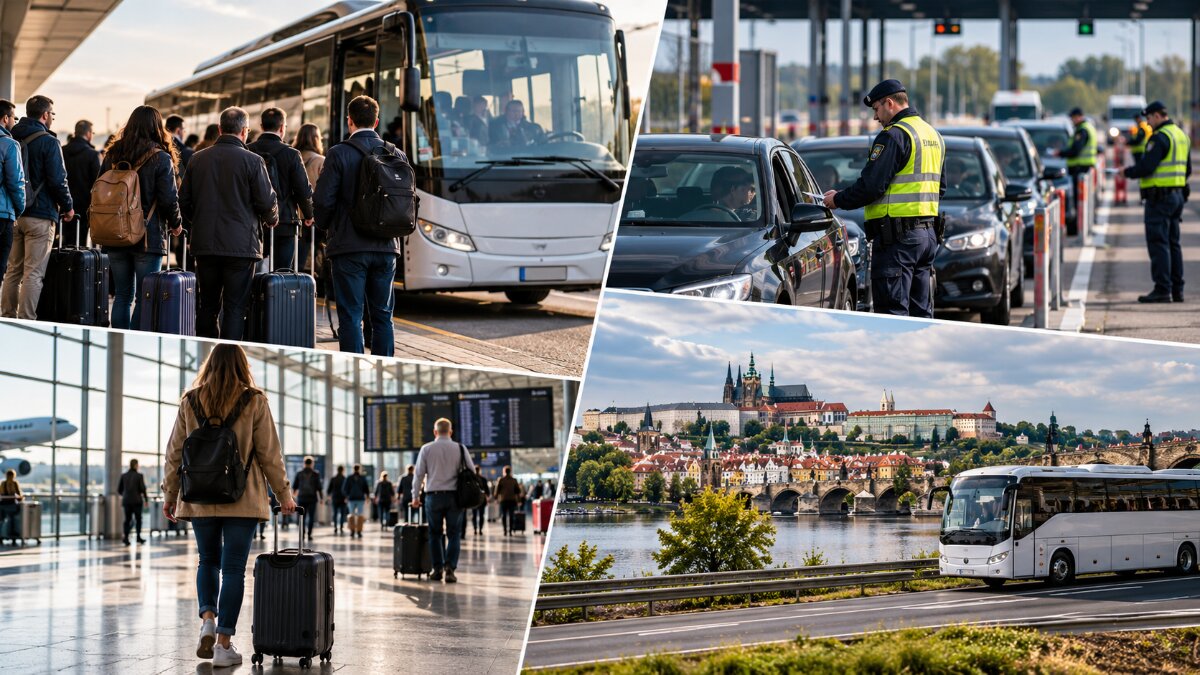
Germany, Poland and Austria are maintaining temporary Schengen border controls that could complicate road holidays, international coach journeys and airport transfers involving Lithuania and Czechia. According to the European Commission, German and Austrian measures remain notified until 15 March 2027, while Poland’s controls continue until 30 March 2027. Newly updated Austrian crossing-point guidance highlights another operational concern: not every border route permits the same vehicles or operating hours. Travellers can continue crossing these borders, but tightly scheduled connections require closer planning.
Europe’s Schengen Border Checks Create a New Challenge for Five-Country Travel
Europe’s international travel network faces an important operational test as overlapping internal border controls remain in place during October and November 2026.
The measures affect interconnected journeys involving Germany, Poland, Lithuania, Czechia and Austria. All five countries belong to the European Union and the Schengen Area, where travellers normally move between participating countries without routine internal border inspections.
However, the European Commission’s Migration and Home Affairs department confirms that temporary checks can be introduced when serious public-security concerns justify exceptional measures.
Advertisement
Advertisement
For the travel industry, the issue extends beyond identity checks. Coach timetables, airport pickup schedules, organised holidays and international group transfers may require greater flexibility.
Official Border-Control Measures Affecting Travel Through March 2027
| Country | Current border-control position | Official notified period | Travel industry implications |
|---|---|---|---|
| Germany | Controls at nine neighbouring land borders, including Poland, Czechia and Austria | 16 September 2026–15 March 2027 | Potential inspection-related journey variability |
| Poland | Controls at land borders with Germany and Lithuania | 2 October 2026–30 March 2027 | Additional planning considerations for Baltic–Central European road journeys |
| Lithuania | Affected by controls implemented by neighbouring Poland | Polish controls continue until 30 March 2027 | Possible additional processing when entering Poland |
| Czechia | Affected by German and Austrian controls | Relevant neighbouring measures run until 15 March 2027 | Route selection and coach connection planning become important |
| Austria | Controls at Czech, Hungarian, Slovenian and Slovak borders | 16 September 2026–15 March 2027 | Crossing eligibility, operating hours and transfer buffers require attention |
The current notifications do not establish that every traveller will be inspected or that all international services face delays.
Advertisement
Advertisement
Germany’s Extended Controls Place Important European Road Connections Under Attention
Germany occupies a central position in the five-country travel network. Its land connections support passenger journeys between the Baltic region, Central Europe and Western European destinations.
According to the European Commission, Germany’s temporary controls cover its borders with Poland, Czechia and Austria, alongside six other neighbouring countries.
The notified extension until March 2027 means that international coach operators cannot assume the controls will disappear after the autumn holiday season.
Germany’s measures are not entirely new. Checks involving Poland and Czechia began in October 2023, while controls involving Austria have a longer history.
The implications vary according to travel direction, location and inspection arrangements. A journey entering Germany from Poland may encounter different operational conditions from a coach leaving Germany for Czechia.
For travel planners, this distinction matters more than a generalised warning about border congestion.
Advertisement
Advertisement
Poland’s October Extension Adds Another Layer to Baltic Holiday Planning
Poland provides the essential road connection between Lithuania and Germany.
On 1 October 2026, the Polish Ministry of the Interior and Administration confirmed that temporary controls would continue from 2 October 2026 until 30 March 2027.
The government originally introduced these checks on 7 July 2025.
Its October announcement reported that authorities had inspected more than 4.5 million people and nearly 2.3 million vehicles since the measures began.
Poland also reported nearly 1,300 entry refusals at its Lithuanian border and nearly 1,200 at its German border.
These figures demonstrate the scale of enforcement. They do not, however, indicate average waiting times or prove systematic disruption to tourist coaches.
Advertisement
Advertisement
For journeys connecting Vilnius, Warsaw and Berlin, the important operational consideration is the possibility of inspections at successive national frontiers.
Lithuania’s Border Infrastructure Developments Strengthen the Wider Regional Picture
Lithuania occupies the northern end of the five-country itinerary and connects Baltic travellers with mainland European road networks through Poland.
Although Lithuania is not separately listed among the three countries implementing the relevant current controls, its travellers and transport services can be affected by Polish inspections.
A separate infrastructure development highlights continuing cross-border security cooperation.
On 6 October 2026, the Lithuanian State Border Guard Service announced the opening of a new border-guard complex at Kalvarija.
The Lithuanian–Polish cooperation project has a total value exceeding €5.822 million, including more than €4.658 million in programme funding.
Advertisement
Advertisement
The investment is designed to support border operations and joint policing. It should not be interpreted as evidence of faster tourist processing or increased coach capacity.
Nevertheless, it demonstrates the importance both countries place on managing their shared frontier.
Czechia’s Position Between Germany and Austria Creates a Critical Travel Connection
Czechia provides an important geographical link between German transport centres and Austrian destinations.
International journeys involving Prague, Berlin and Vienna can therefore encounter different national border-control arrangements within a relatively compact European travel region.
Germany operates temporary controls on its Czech border, while Austria maintains measures affecting its border with Czechia.
The Czech Ministry of Foreign Affairs has advised travellers to prepare valid identity documents and consider possible delays associated with German inspections.
Advertisement
Advertisement
More importantly, Czech diplomatic guidance updated on 19 October 2026 draws attention to Austria’s rules governing authorised border crossings.
For coach operators, this introduces a distinction between an available road and a crossing legally suitable for a particular vehicle.
That distinction becomes especially relevant for late-night transfers, international excursions and itineraries using smaller regional routes.
Austria’s October Crossing Rules Reveal a More Specific Risk for International Coaches
Austria’s controls remain notified until 15 March 2027.
The Austrian Federal Ministry of the Interior confirms that travellers crossing affected internal borders should carry valid travel documents.
A crossing-point schedule dated 1 October 2026, made available through the Czech Embassy in Vienna, identifies differences in operating hours and permitted vehicle categories.
Advertisement
Advertisement
Selected Austria–Czechia Crossings and Their Operational Conditions
| Border crossing | Listed operating hours | Coach-related conditions |
|---|---|---|
| Drasenhofen–Mikulov | 24 hours | Buses and coaches permitted |
| Fratres–Slavonice | 05:00–24:00 | Buses and coaches permitted |
| Mitterretzbach–Hnanice | 05:00–23:00 | Buses permitted up to 12 metres |
| Oberthürnau–Vratěnín | 05:00–23:00 | Buses and coaches permitted |
| Ottenthal–Mikulov | 24 hours | Coaches are not included among listed permitted vehicle categories |
These official distinctions are particularly important for charter coaches and private sightseeing groups. The opening hours should not be confused with estimated inspection waiting times.
Operators must verify current crossing permissions before departure rather than assuming that every road suitable for a private car is also available to a full-sized coach.
Multi-Border Itineraries Introduce Different Risks at Each Stage
A five-country journey connecting Vilnius, Warsaw, Berlin, Prague and Vienna illustrates how successive border arrangements can affect the same holiday.
| Illustrative journey stage | Relevant national control | Primary operational consideration |
|---|---|---|
| Lithuania to Poland | Poland | Inspection exposure on entry into Poland |
| Poland to Germany | Germany and Poland | Controls implemented by both neighbouring authorities, depending on direction and operational practice |
| Germany to Czechia | Germany | German controls affect the frontier, particularly travel entering Germany |
| Czechia to Austria | Austria | Inspection exposure and authorised crossing requirements |
This is an illustrative itinerary, not a newly announced commercial coach service.
The number of actual inspections depends on travel direction, enforcement practices and selected crossings.
A group may complete the entire journey without significant interruption. Another itinerary could require more flexibility because of checks, traffic conditions or an unsuitable crossing.
Advertisement
Advertisement
The distinction between possible disruption and documented disruption is essential when assessing travel guarantees.
The Overlooked Travel Risk Lies Between Border Permissions and Booking Contracts
The most important analytical finding from the official records is that border-control duration alone cannot measure the reliability of an international travel connection.
A workable itinerary depends on four separate factors: the direction of travel, the authorised crossing, the scheduled arrival time and the passenger’s contractual protection.
Austria’s October crossing schedule makes the problem especially clear. A route can be geographically practical yet unsuitable for a particular coach because of vehicle restrictions or operating hours.
An operator might therefore need to use a different crossing without any unusually long immigration inspection taking place.
For a multi-country holiday, that decision could influence the time available for airport check-in, accommodation arrival or an organised excursion.
Advertisement
Advertisement
The commercial consequences depend on how travel services were purchased. A protected coach connection, an independently booked flight and a package-holiday transfer may involve different responsibilities.
The central operational question is therefore whether booking systems identify these dependencies before confirming an itinerary.
This analysis does not establish that operators are failing to provide appropriate buffers. It identifies a specific planning issue that deserves testing against published schedules, booking conditions and documented journey performance.
European Passenger Rights Make the Type of Booking Crucial
According to the European Commission’s passenger-rights guidance, the principal EU protections for long-distance bus travel apply to regular scheduled services covering at least 250 kilometres.
When a qualifying service is cancelled or delayed by more than 120 minutes at departure, passengers generally become entitled to a choice between reimbursement and rerouting.
If the carrier fails to offer the required choice, additional compensation equivalent to 50 per cent of the ticket price may apply.
Advertisement
Advertisement
However, these provisions do not amount to an automatic guarantee covering independently purchased airline tickets, hotel reservations or unrelated onward transport.
The distinction is visible in FlixBus’s published conditions of carriage. Its rules provide continued carriage arrangements for qualifying connections booked together, while separately assembled journeys and transfers to other operators do not receive the same contractual protection.
For package holidays, the European Union’s package travel rules impose broader responsibilities on organisers for services included in the package.
They also require relevant pre-contract information about transport, itineraries and transfers.
These provisions make transparent booking conditions commercially important, but they do not prescribe a universal border-delay allowance.
Airport Transfers and MICE Travel Face Particular Scheduling Sensitivities
Airport transfers introduce an additional risk because road arrival times must be coordinated with airline check-in and boarding requirements.
Advertisement
Advertisement
A passenger who independently purchases a coach ticket and a flight should not assume that a missed departure caused by a road delay will automatically qualify for airline compensation.
The same concern extends to meetings, incentives, conferences and exhibitions.
Corporate groups travelling between Berlin, Prague, Warsaw and Vienna may have fixed registration times, event programmes or onward flights.
For destination management companies, itinerary reliability is therefore part of the overall service proposition.
Greater attention to transfer scheduling could help protect customer satisfaction while reducing avoidable rebooking expenditure.
Official European Tourism Figures Explain Why Reliable Connections Matter
The broader economic context strengthens the significance of this issue.
Advertisement
Advertisement
According to Eurostat’s figures published on 9 October 2026, EU residents made approximately 1.20 billion personal and professional trips during 2025.
Of these, 264 million were foreign trips within the European Union, representing 22 per cent of the total.
Another Eurostat release dated 16 October reported approximately 3.1 billion nights spent in EU tourist accommodation during 2025.
These are economy-wide tourism figures, not measurements of journeys delayed by border controls.
However, they demonstrate the scale of the travel market in which cross-border connectivity operates.
The European Commission also identifies Germany, Poland and Lithuania within the North Sea–Baltic transport corridor, while Poland, Czechia and Austria form part of the Baltic Sea–Adriatic corridor.
Advertisement
Advertisement
Those interconnected networks create commercial opportunities for multi-destination travel, making dependable scheduling an important consideration.
Critical Operational Priorities for Travel Agents and Tour Operators
Travel businesses managing October–November journeys and advance 2027 bookings should consider the following measures:
- Verify border-control periods: Monitor official EU notifications and national updates before confirming departures.
- Validate coach crossings: Check vehicle permissions, opening hours and authorised entry points.
- Review connection buffers: Assess road-transfer timings against airport requirements and onward departures.
- Identify booking protection: Distinguish integrated connections from independently purchased services.
- Improve pre-sale disclosure: Explain material scheduling uncertainties without portraying every journey as disrupted.
- Prepare alternatives: Maintain contingency arrangements for delayed arrivals, overnight stays and replacement transfers.
- Retain operational records: Document actual waiting times, route changes and missed connections to improve future scheduling.
Europe’s Border-Control Extensions Could Reshape Travel Planning Through 2027
The continuing measures demonstrate how temporary security procedures can become recurring considerations for international travel planning.
Germany, Poland and Austria remain the principal controlling states in this five-country story. Lithuania and Czechia are connected through their location within the same international transport network.
Their shared Schengen membership supports cross-border tourism, but does not eliminate temporary inspection requirements.
For travel companies, the longer-term implication is a stronger need for accurate route information, realistic connection planning and transparent passenger protection.
Advertisement
Advertisement
The available evidence does not justify predictions of widespread travel disruption or reduced tourism growth.
Instead, it identifies an opportunity for operators to improve resilience while maintaining the convenience that makes multi-country European holidays attractive.
FAQs
1. Which five European countries are connected to the October 2026 border-control developments?
Germany, Poland, Lithuania, Czechia and Austria are connected through Schengen membership and international road transport networks. Germany, Poland and Austria are implementing the relevant controls, while Lithuania and Czechia are affected by neighbouring measures.
2. How long will Germany, Poland and Austria maintain their current border checks?
Germany and Austria have notified controls until 15 March 2027. Poland has notified its controls until 30 March 2027. These dates reflect the official position on 22 October 2026 and may change through subsequent government decisions.
3. Can tourists continue travelling between these five Schengen countries?
Yes. Temporary internal border checks do not automatically close international road crossings. Travellers must carry appropriate identification and comply with applicable crossing requirements. Inspection arrangements may vary.
4. Are airport transfers and international coach connections guaranteed against border delays?
Not automatically. Protection depends on the travel contract, booking structure and applicable passenger-rights legislation. Separate coach and airline reservations may not provide the same safeguards as qualifying package holidays or integrated connections.
5. What should travellers check before booking multi-country European road journeys?
Travellers should verify authorised crossings, required documents, coach schedules, airline check-in deadlines and cancellation conditions. Booking arrangements should provide adequate flexibility for possible inspection-related delays.
Advertisement
